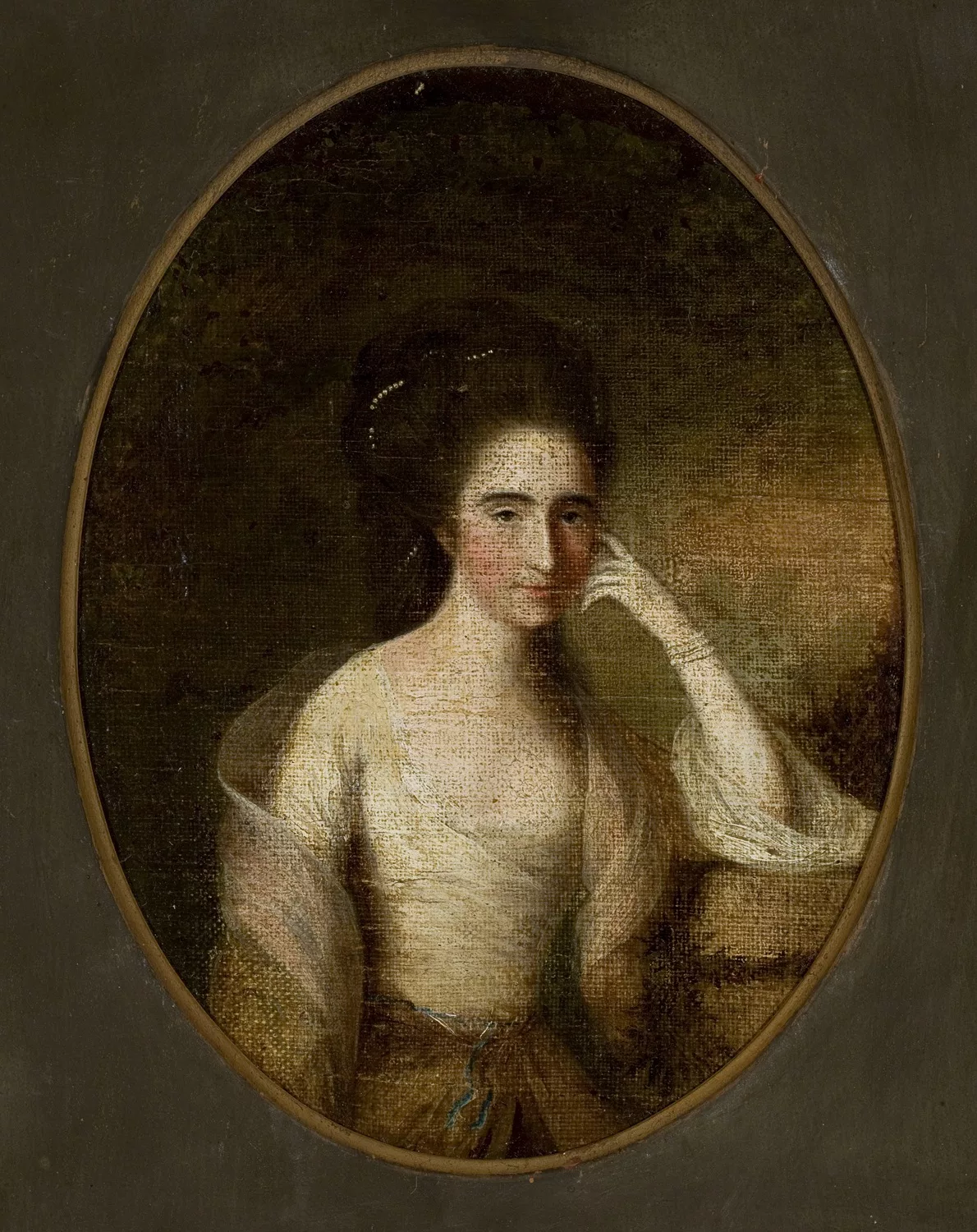
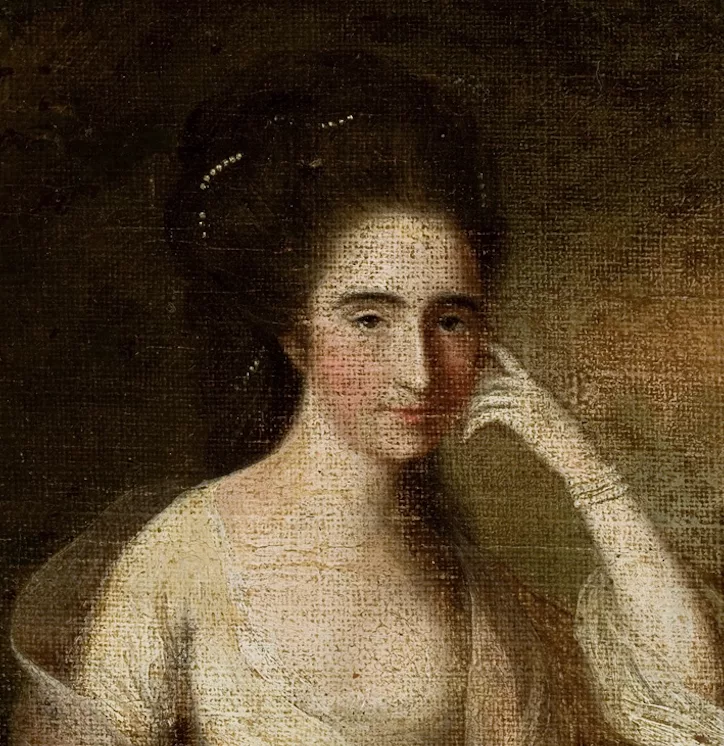
Alcipe, Self-portrait, 1787–1790, oil on canvas mounted on wood panel, 28 × 22 cm, São Paulo, São Paulo Museum of Art, Donated by Vasco Lima, 1949
História das mulheres, histórias feministas, curated by Julia Bryan-Wilson, Mariana Leme, Isabella Rjille and Lilia Moritz Schwarcz, São Paulo, MASP, 2019
Portuguese writer and painter.
The Marquise of Alorna, known as Alcipe, is considered one of the most notable Portuguese writers of the 18th century. Her work as a painter is of a much more modest output, and has received less critical and art historical attention. Yet because of limited access to education for women in Portugal and its colonies at the time, women artists of her era are few and far between.
Alcipe is a singular figure, in part because of her unusual personal trajectory. As the first daughter of Dom João de Almeida Portugal, the Marquis of Alorna, and Dona Leonor de Lorena e Távora, she was born into the House of Távora. Between 1758 and 1759, members of the Távora family were accused of attempted regicide and publicly executed. The Marquis of Alorna was arrested and his daughter, along with her sister and their mother, was confined to the convent of São Félix de Chelas. Leonor remained there from the age of eight to twenty-seven, and spent her time studying diverse subjects including philosophy, literature, poetry, music and painting. She was especially devoted to poetry and to the translation of classical works, and left behind her a collection of over one thousand poems. During this period, she began to sign her work ‘Alcipe’ (Alcippe), after one of the daughters of Ares, Greek god of war.
Her oeuvre as a painter is less sizable. We know of the self-portrait now at the São Paulo Museum of Art (MASP), along with documents indicating she created a series of studies for the decoration of the Ajuda Palace in Lisbon. Dating from 1801, when the artist was lady-in-waiting to the Queen Consort Dona Carlota Joaquina, these studies were lost following the latter’s exile in 1803. The self-portrait was painted between 1787 and 1790 when Alcipe was living between Avignon, with her husband Count Karl von Oyenhausen-Gravenburg, and Lisbon. Following her husband’s death, she would return to Lisbon alone, and enter the circle of Queen Maria I.
Alcipe chooses to portray her physical identity in the painting: there is no suggestion of her intellectual or artistic activities, no paintbrushes or palette, no books. Her complexion, the style and colour of her hair, her posture and clothes echo the “simplicity” extolled by Jean-Jacques Rousseau, one of the writers she had studied during her time at the convent. The work was donated to the MASP in 1949 by Vasco Machado de Azevedo Lima, a Portuguese caricaturist who had settled in Brazil at the beginning of the 20th century. It was one of the first paintings attributed to a woman to enter the collection of the museum, which opened in 1947 with the founding mission of creating the largest collection of Western art in the Southern Hemisphere. As such, the painting has become a pertinent historical document, drawing attention to the difficulties and opportunities encountered by women artists of the Portuguese-speaking world on both sides of the Atlantic.
A biography produced as part of the programme “Reilluminating the Age of Enlightenment: Women Artists of 18th Century”.