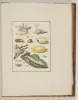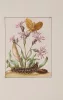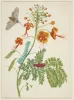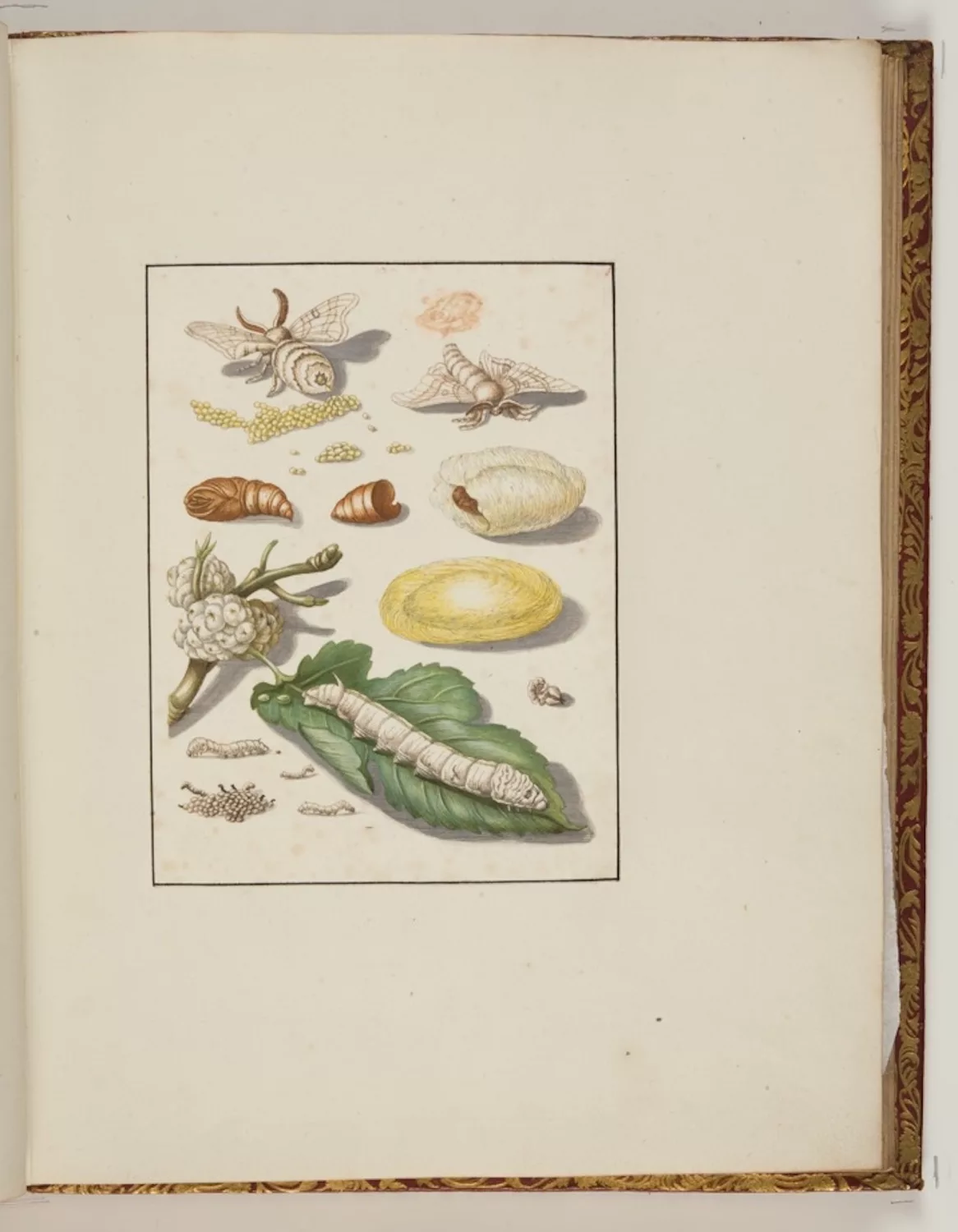
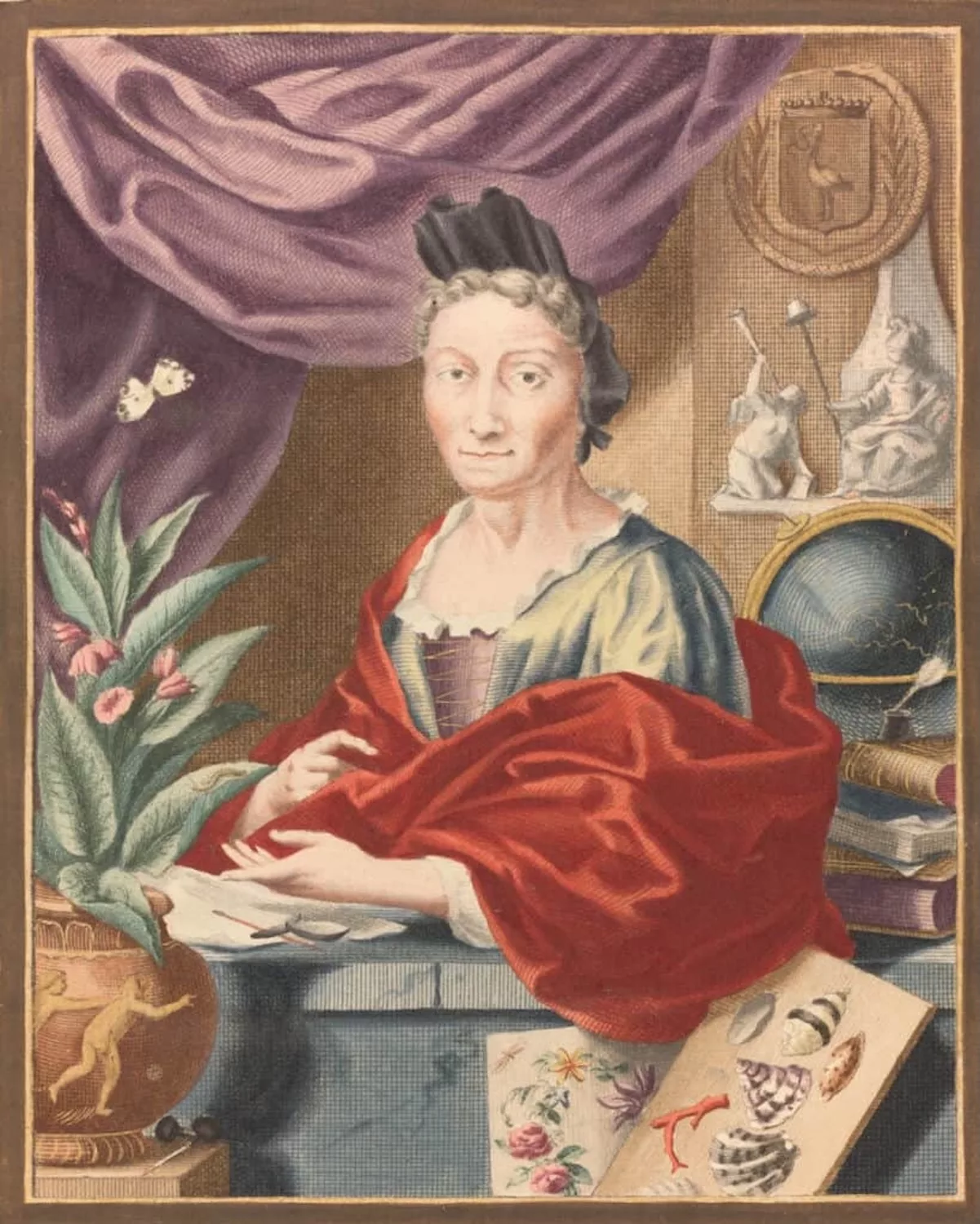
Jakob Houbraken after Georg Gsell, Portrait of Maria Sibylla Merian, hand-coloured counterproof, Dutch edition of the three Caterpillar Books 1717, quarto, 27.55 x 21.5 cm, Artis Library, University of Amsterdam
Reitsma, Ella, Maria Sibylla Merian & Daughters, Women of Art and Science, assisted by Sandrine Ulenberg entomologist, exh. cat., Museum Het Rembrandthuis, Amsterdam [February 23 – May 18, 2008]; J. Paul Getty Museum, Los Angeles [June 10 – August 31, 2008], Zwolle, Waanders Publishers and, J.Paul Getty Museum, Los Angeles, 2008
→Metamorphosis insectorum Surinamensium/Verandering der Surinaamse insecten, facsimile-edition with articles, Tielt België, Publisher Lannoo, 2016
→Etheridge, Kay, The Flowering of Ecology: Maria Sibylla Merian’s Caterpillar Book (with English translation of the 1679 edition), Leiden, Publisher Brill, 2021
Maria Sibylla Merian 1647-1717, Artist and Naturalist, Teylers Museum, Haarlem, March 14 – May 31, 1998, Bloemendaal, J.H.
→Maria Merian’s Butterflies, The Queen’s Gallery, Buckingham Palace, London, April 15 – October 9, 2016
German naturalist and painter.
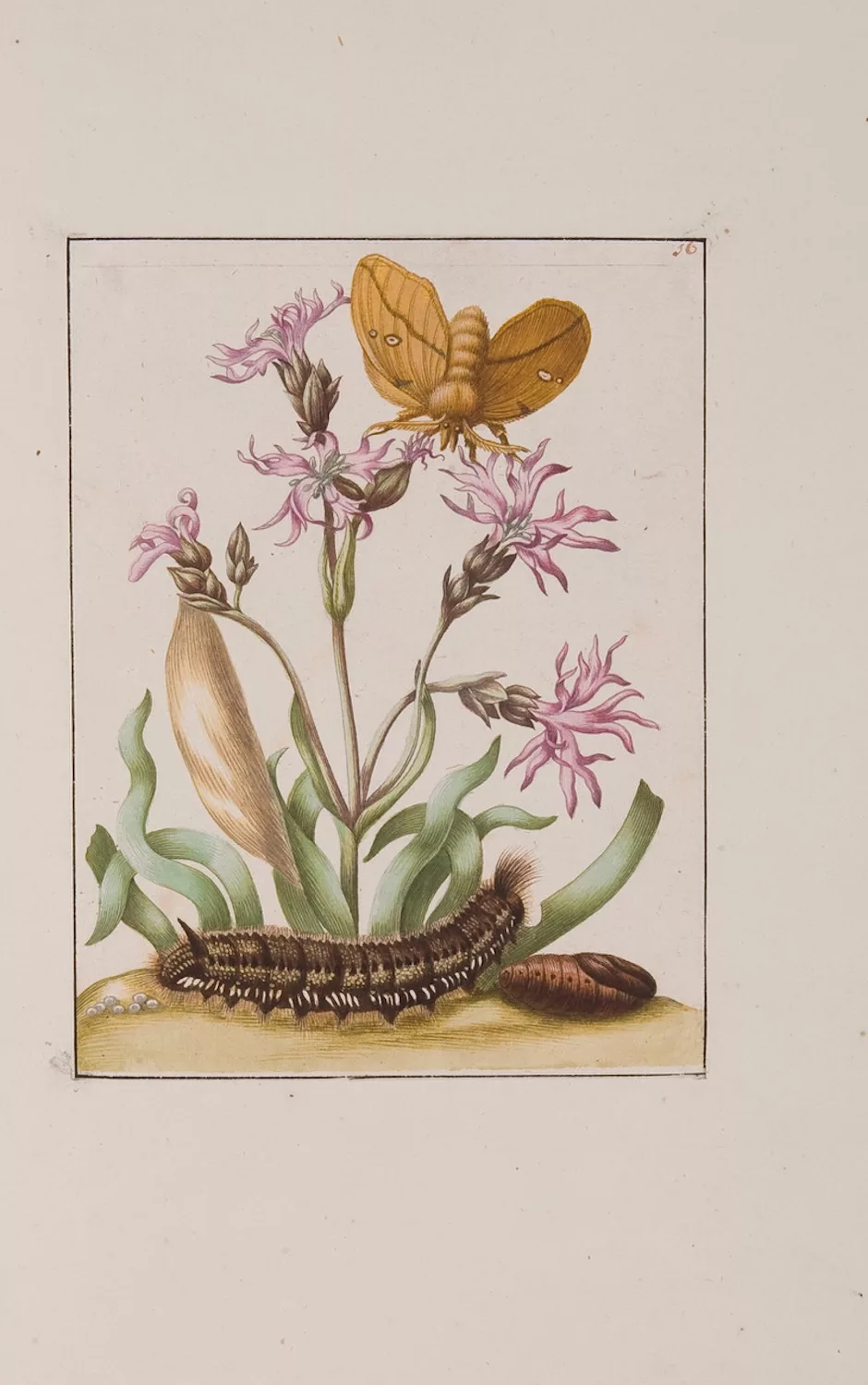
Maria Sibylla Merian grew up in a Calvinist artistic environment. Her father Matthäus Merian (1593-1650) was a renowned engraver and publisher. M. Merian lost her father at the age of three. His two eldest sons took over thebusiness. M. Merian’s mother remarried to flower painter and art dealer Jacob Marrel (1614-1681). Within this artistic and trader’s milieu, M. Merian developed a fascination with the life cycle of insects. She was the first to discover that butterfly caterpillars are always dependent on specific plants- now an ecological law.
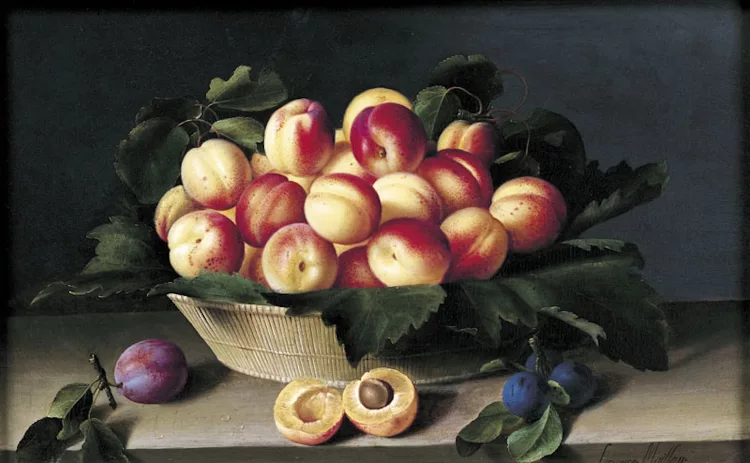
At eighteen, M. Merian wed Andreas Graff (1637-1701), a student of her stepfather. She earned money by water color painting flowers and fruits and by teaching drawing to wealthy ladies. In 1679, her first Caterpillar Book was self-published: Der Raupen wunderbare Verwandelung und sonderbare Blumennahrung [The Caterpillar’s Wondrous Metamorphosis and Extraordinary Nourishment from Flowers,1679]. In 1680, Neues Blumenbuch [ The New Book of Flowers, 1680] was published, followed by the second Caterpillar Book in 1684. Meanwhile, Johanna Helena (1668-1730), and ten years later Dorothea Maria (1678-1743) were born; daughters who would become herindispensable aides. The family returned to Frankfurt as M. Merian’s mother had become a widow and needed aid.
When her marriage started to crack, M. Merian fled with her mother and daughters to Wieuwerd in Friesland. A Protestant cult, the Labadists, lived there on the estate of Cornelis van Aerssen van Sommelsdijck, governor of the Dutch colony Suriname. The cult was reigned by his sisters and additionally managed its own plantation on the Suriname River. Presumably, M. Merian conceived the idea to visit that tropical land with its large colorful butterflieswhile in Wieuwerd. She was not permitted to create free work, but she was allowed to work on her third Caterpillar Book. The financial situation worsened and an infectious disease broke out. Thereupon, in 1691 M. Merian took the leap and moved together with her daughters to cosmopolitan Amsterdam. As a widow (her husband was not a Labadist, so the cult considered him dead), she was able to start her own business In de Roosentak, nearby the Hortus Botanicus. The director, physician/botanist Caspar Commelin, became a good acquaintance.
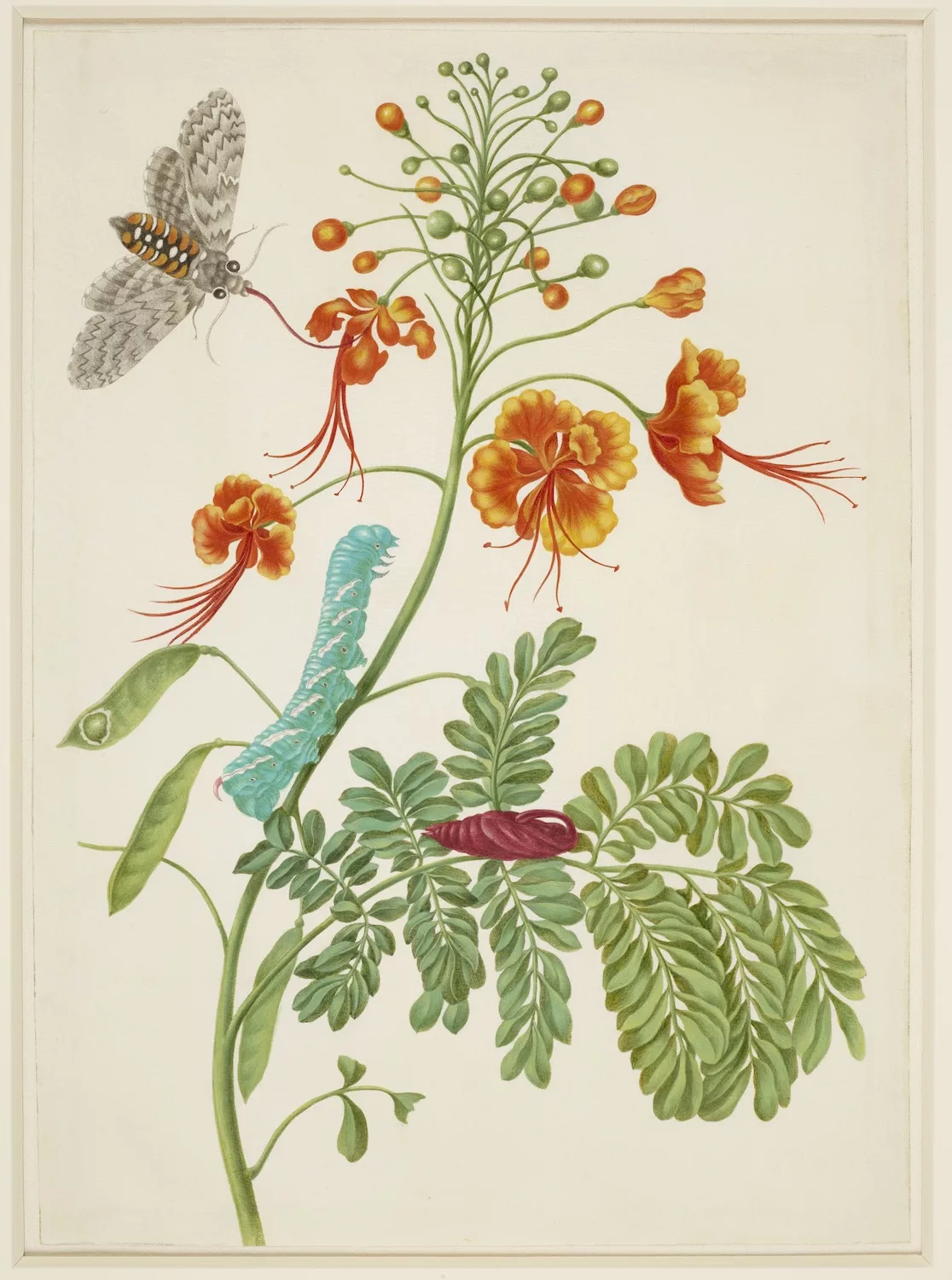
To finance her trip to Suriname, M. Merian sold hundreds of drawings, copper plates and prepared insects, in the four months before departure. Then, in June 1699, she set sail with her youngest daughter to Paramaribo. They rented a small house with a garden and visited plantations searching for caterpillars, butterflies and their host plants.
Stricken by a tropical disease, M. Merian was forced to return to Amsterdam in the spring of 1701. Her daughter and an ‘Indian woman’ accompanied her. M. Merian must have recovered quickly as Metamorphosis Insectorum Surinamensium [Transformations of the Insects of Suriname, 1705] appeared in folio format including 60 plates in the spring of 1705.
Caspar Commelin provided the Latin text, and M. Merian authored the Dutch content. It was successful and ran several reprints.
Her daughter Dorothea pursued publishing the third Caterpillar Book that appeared a few weeks after M. Merian’s death on January 13, 1717.
The largest M. Merian collections are in London and St. Petersburg. Hans Sloane, an avid natural history collector and British Museum founder, along with Tsar Peter the Great and his personal physician Areskin, were eager buyers.
A biography produced as part of the programme “Common Ground”
© Archives of Women Artists, Research and Exhibitions, 2026