Research
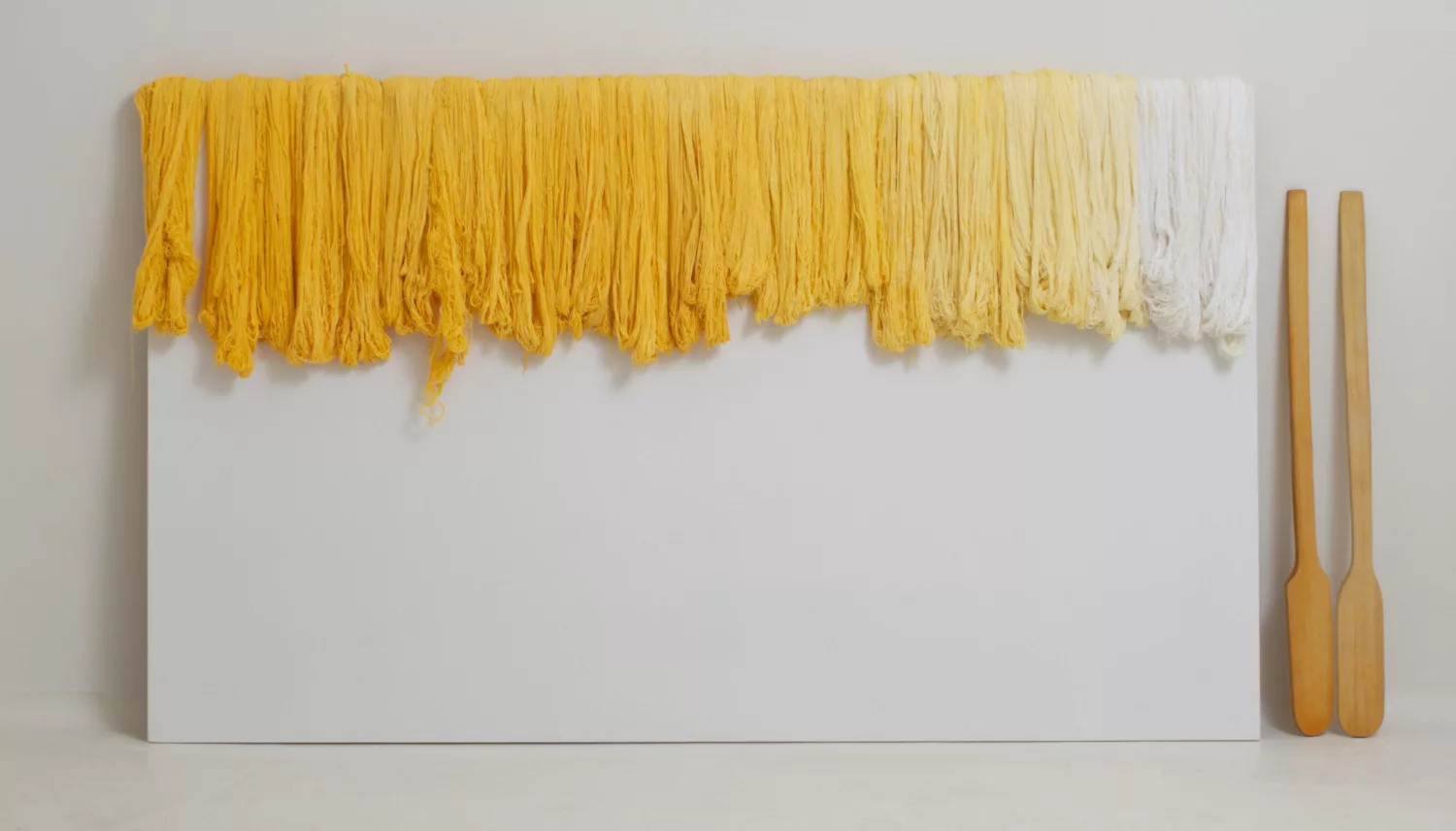
Sandra Monterroso, Expoliada [Despoiled], 2011, installation, dyed and washed out thread, yellow dye and wood, 120 x 60 x 60 cm © Courtesy Sandra Monterroso
Indigenous weaving practices have long embodied deep ancestral knowledge, yet academia has often reduced these processes to their resulting objects, admired primarily for their surface beauty. This approach typically relies on a stagnant, “disciplinary material language (…) based on separation from earth, community, ancestrality and cosmological time,”1 which fails to acknowledge the complexity of these practices. Scholars of contemporary Indigenous material culture challenge this narrow approach and instead emphasise how weaving practices serve to document and revitalise memory. This perspective encourages us to view woven objects as vessels that house an amalgamation of histories, memories, rituals and recipes, which have been passed down through generations. Art historians Denise Arnold and Silvia Espejo advocate for a shift in the approach to textiles, focusing on “reconstructing the shared path through life between textiles and human lives” to better understand “textiles as subjects and objects, as part of a person’s vital spirit and as part of material culture.”2 In doing so, textiles are treated less as static, finished objects in an exhibition space, and the focus is instead on how these works interact within and beyond social networks.
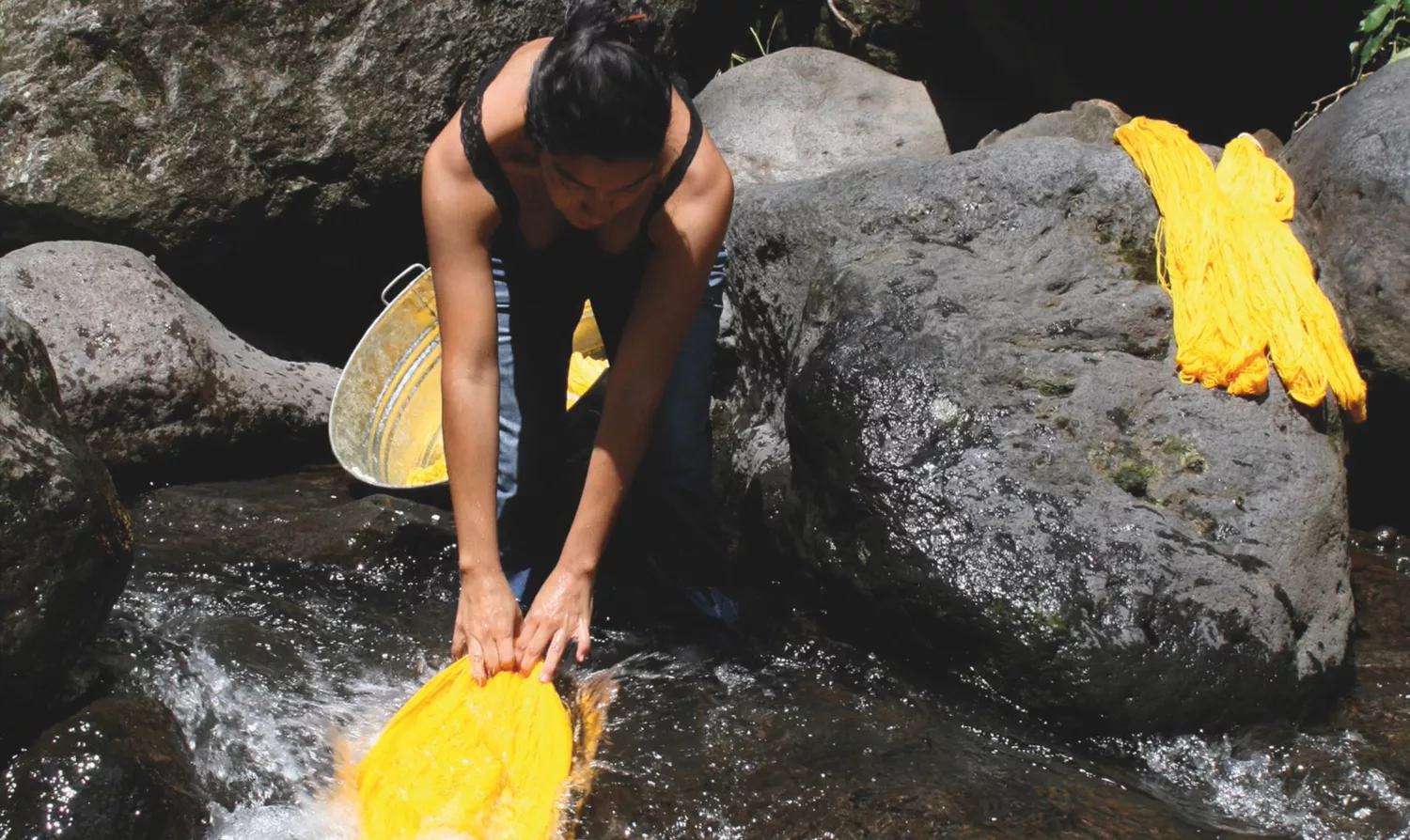
Sandra Monterroso, Colorando y decolorando las hebras [Colouring and bleaching the threads], 2011, video, 7min 28 sec © Courtesy Sandra Monterroso
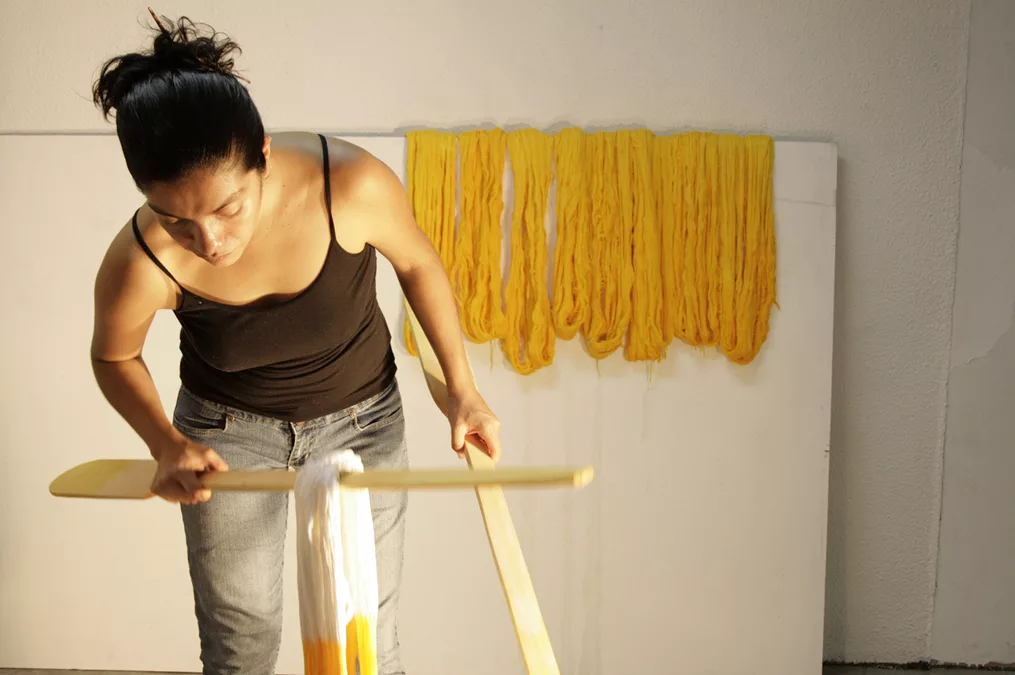
Sandra Monterroso, Colorando y decolorando las hebras [Colouring and bleaching the threads], 2011, video, 7min 28 sec © Courtesy Sandra Monterroso
Here I wish to consider the ways these objects are also organic vessels that both contain and communicate the memories of their makers. The artists who produce these vessels can be identified as “memory workers,”3 a term used in archaeology to describe individuals who manage and preserve cultural knowledge, ensuring its continuity amid cultural erasure. Guatemalan artist Sandra Monterroso (1974–) embraces this role in her own practice, incorporating Mayan histories into contemporary forms such as video, installation, weaving and performance, and simultaneously challenging the Western emphasis on aesthetic objectification. While S. Monterroso does not identify as Indigenous, she has an Indigenous ancestry, and her art is in conversation with this heritage. Through works like Colorando las hebras/Decolorando las hebras [Colour the Strands/Decolour the Strands, 2011], S. Monterroso centres ancient Mayan wisdom amidst ongoing colonial violence and environmental destruction, using her pieces as vessels that not only function as a form of revival, but confront the threat of its erasure.
S. Monterroso began to use performance and textiles as expressions of her role as a memory worker in the 1990s. She explains that, like many with Indigenous ancestry, she feels they “have been robbed of our indigenous knowledge for 500 years,”4 and is committed to recovering those lost processes. By engaging in Indigenous dye extraction, weaving techniques and traditional garments, S. Monterroso translates her personal quest to reclaim Mayan pasts into tangible artistic forms. She frequently employs indigo, turmeric and cochineal, materials deeply intertwined with both Mayan cosmology and colonial exploitation, embodying ritualistic healing and resistance to violence.
The autobiographical nature of S. Monterroso’s practice links to the history of survival within her family. She was born in 1974, amid the brutality of the Guatemalan Civil War (1960–1996), which resulted in the destruction of 626 villages and the murder of more than 200,000 people, about 83% of whom were members of the Maya Ixil population.5 The majority of these deaths occurred during “Operation Sofía” in 1982, led by ex-dictator Efrain Ríos Montt. This operation was amongst the most devastating periods of the war, targeting Indigenous communities to erase both their cultural heritage and existence. S. Monterroso’s work draws directly from this context of violence and cultural destruction.
S. Monterroso’s practice gains contemporary relevance within the ongoing ecological and social upheaval faced by Mayan communities. This theme is evident in her video diptych Colorando las hebras/Decolorando las hebras, where the artist engages in the laborious process of dyeing strands with natural pigment, and then her futile attempt to destroy the threads by washing the dye out in a river. The performance activates these threads as vessels of cultural memory, demonstrating the resilience of Indigenous despite ongoing attempts at their destruction. While S. Monterroso did not directly experience the war, living in its aftermath gave her a profound sense of urgency to protect the histories and identities of her ancestors. She works collaboratively with Indigenous makers, sourcing raw materials from her extended family in Verapaces and from weaving associations across Guatemala. In doing so, she honours and supports Indigenous knowledge and technologies.
Through these practices, S. Monterroso reflects on the relationship between language, textiles and identity. She often speaks of the “importance of retaking [her] roots,”6 a theme that underscores her personal connection to her Maya heritage. A pivotal moment in this journey occurred when S. Monterroso’s grandmother, a member of the Q’eqchi community, spoke to the artist in her mother tongue just before passing. Despite initially feeling disconnected from her Indigenous heritage, this moment deeply impacted S. Monterroso, inspiring her to embrace her identity and preserve her culture. She utilises didactic materials representative of both Indigenous and colonial histories – such as the healing and symbolic properties of turmeric.
Turmeric plays a key role in Colorando las hebras/Decolorando las hebras. Works like this evidence knowledge and recipes drawn from Aspectos de la medicina popular en el area rural de Guatemala [Aspects of Popular Medicine in Rural Guatemala], a study published by the Insituto Indigenista Nacional [National Indigenous Institute] in 1978. The book was treasured by her family as an archive of communal generational knowledge that was passed onto S. Monterroso by her maternal aunt.7 The use of chromatic ingredients in her work is a direct reference to this knowledge, emphasising the connection between art, memory and healing.
S. Monterroso challenges the misconception that Mayan histories and identities are relegated to the past, instead reminding her audience that indigeneity is a dynamic and living culture. Part of her diptych video performance, Colorando las hebras, demonstrates the labour-intensive processes of dyeing and weaving that are deeply rooted in ongoing Mayan cultural practices. In this performance, the artist is present in a room empty save for a propane-powered portable burner, a silver steel washing basin and a board for dyeing outsourced threads.8 She begins by mixing turmeric into hot water, watching as the solution shifts from yellow to bright crimson, crowned with a yellow froth. S. Monterroso describes pigments as “archaeological vestiges,”9 remnants of ancestral Mayan stories embedded in these materials. The use of turmeric, which hs a relatively recent history in Guatemala (introduced in the 1800s from the Caribbean and India),10 is dualistic. While turmeric is revered for its healing properties, the yellow it produces also connects to Mayan cosmology, representing the South and symbolising birth. S. Monterroso sees turmeric as an ‘active pigment’, using it to emphasise the vibrancy of her performance work, which she considers a conduit for cultural memory. She explains that learning these techniques allows her to connect with millennia-old artistic practices and speak from a place of enunciation that she shares with her ancestors.11
The performance is a visual manifestation of Mayan traditions, and contrasts sharply to its companion video, Decolorando las hebras. Here the viewer is transported to the Guatemalan riverside where S. Monterroso, dressed in the same attire as in Colorando las hebras, attempts to scrub the threads she has dyed with turmeric. The serene natural environment – marked by rushing water and lush greenery – echoes the violence and erasure that rivers in Guatemala have historically witnessed. Dating back to the Spanish invasion, rivers were used as sites to dispose of the murdered bodies, and today are threatened by pollution from capitalist exploitation.12 The viewer watches as S. Monterroso repeatedly scrubs the product of her labour with rocks and submerges them in the river. The materials begin to lose their initial vibrancy as she attempts – but ultimately fails – to rid the strands of their colour, the physical evidence of the ancestral knowledge used to create them. Despite her efforts, the dye remains embedded in the threads, serving as a potent metaphor for the resilience of Indigenous identity, memory and culture – enduring and unerasable, even in the violent attempts to wipe them away.
S. Monterroso intertwines personal narrative with historical trauma to underscore the enduring significance of indigenous knowledge, technologies and cultural practices. With her use of materials and practices that carry deep communal experiences, she presents herself as a memory worker, focused on creating spaces and objects that serve as resilient vessels of memory, lending voice and visibility to her ancestors amidst the ongoing challenges of violence, ecological degradation and cultural erasure. Navigating the complex terrain of heritage and identity, her works affirm the vitality of Mayan cultures in the face of adversity.
1
Rolando Vásquez, “Decolonial Aesthesis: Weaving Each Other, a Conversation”, L’internationale Online, 26 September 2023, https://internationaleonline.org/contributions/decolonial-aesthesis-weaving-each-other/.
2
Denise Arnold and Elvira Espejo, El textil tridimensional: la naturaleza del tejido como objeto y como sujeto, (ILCA, Instituto de Lengua y Cultura Aymara, 2013), 305. My translation.
3
Society of American Archivists, “Memory Worker”, Dictionary of Archives Terminology, https://dictionary.archivists.org/entry/memory-worker.html.
4
Kshitija Mruthyunjaya, “Indigenously Good”, DAMN Magazine, no. 83: (Winter 2022), https://www.damnmagazine.net/indigenously-good.
5
Comisión para el Esclarecimiento Histórico (CEH), Guatemala Memoria del Silencio: Conclusiones y Recomendaciones Memoria del Silencio (CEH, 1999), 100.
6
DC Foundation, “Full interview with Sandra Monterroso @DC Foundation” [Video], YouTube, 28 April 2023, https://www.youtube.com/watch?v=655Vf9x3KPw.
7
Alma Ruiz, “Sandra Monterroso: The Healing Paradox”, Sicardi, Accessed 23 November 2024, https://www.sicardi.com/exhibitions/sandra-monterroso2
8
It is not confirmed whether these threads were prepared by family members who still work in the textile industry or the community weavers from the aforementioned weaving associations.
9
DC Foundation. “Full interview with Sandra Monterroso @DC Foundation” [Video]: 9:44. YouTube, 28 April 2023. (translated) https://www.youtube.com/watch?v=655Vf9x3KPw.
10
Paula Contreras, “Sandra Monterroso: Colorando/Decolorando las hebras”, Denver Art Museum, 27 February 2024, https://www.denverartmuseum.org/en/blog/sandra-monterroso-colorando-decolorando-las-hebras.
11
Sandra Monterroso, “Artist Statement”, in Sandra Monterroso, Museo Madre Napoli, accessed 20 August 2025, https://www.madrenapoli.it/en/sandra-monterroso/#:~:text=For%20me%20it%20is%20important,itself%20that%20is%20an%20art.
12
The Matgaua River is one of the most polluted rivers in the whole of Central America, and has generated two per cent of the world contribution of plastic into the ocean: “Guatemala’s Motagua River: Intercepting 500 Cubic Meters of Plastic Waste Daily”, in RiverImpact, accessed 20 August 2025, https://riverimpact.nl/guatemala/.
Rolando Vásquez, “Decolonial Aesthesis: Weaving Each Other, a Conversation”, L’internationale Online, 26 September 2023, https://internationaleonline.org/contributions/decolonial-aesthesis-weaving-each-other/.
2
Denise Arnold and Elvira Espejo, El textil tridimensional: la naturaleza del tejido como objeto y como sujeto, (ILCA, Instituto de Lengua y Cultura Aymara, 2013), 305. My translation.
3
Society of American Archivists, “Memory Worker”, Dictionary of Archives Terminology, https://dictionary.archivists.org/entry/memory-worker.html.
4
Kshitija Mruthyunjaya, “Indigenously Good”, DAMN Magazine, no. 83: (Winter 2022), https://www.damnmagazine.net/indigenously-good.
5
Comisión para el Esclarecimiento Histórico (CEH), Guatemala Memoria del Silencio: Conclusiones y Recomendaciones Memoria del Silencio (CEH, 1999), 100.
6
DC Foundation, “Full interview with Sandra Monterroso @DC Foundation” [Video], YouTube, 28 April 2023, https://www.youtube.com/watch?v=655Vf9x3KPw.
7
Alma Ruiz, “Sandra Monterroso: The Healing Paradox”, Sicardi, Accessed 23 November 2024, https://www.sicardi.com/exhibitions/sandra-monterroso2
8
It is not confirmed whether these threads were prepared by family members who still work in the textile industry or the community weavers from the aforementioned weaving associations.
9
DC Foundation. “Full interview with Sandra Monterroso @DC Foundation” [Video]: 9:44. YouTube, 28 April 2023. (translated) https://www.youtube.com/watch?v=655Vf9x3KPw.
10
Paula Contreras, “Sandra Monterroso: Colorando/Decolorando las hebras”, Denver Art Museum, 27 February 2024, https://www.denverartmuseum.org/en/blog/sandra-monterroso-colorando-decolorando-las-hebras.
11
Sandra Monterroso, “Artist Statement”, in Sandra Monterroso, Museo Madre Napoli, accessed 20 August 2025, https://www.madrenapoli.it/en/sandra-monterroso/#:~:text=For%20me%20it%20is%20important,itself%20that%20is%20an%20art.
12
The Matgaua River is one of the most polluted rivers in the whole of Central America, and has generated two per cent of the world contribution of plastic into the ocean: “Guatemala’s Motagua River: Intercepting 500 Cubic Meters of Plastic Waste Daily”, in RiverImpact, accessed 20 August 2025, https://riverimpact.nl/guatemala/.
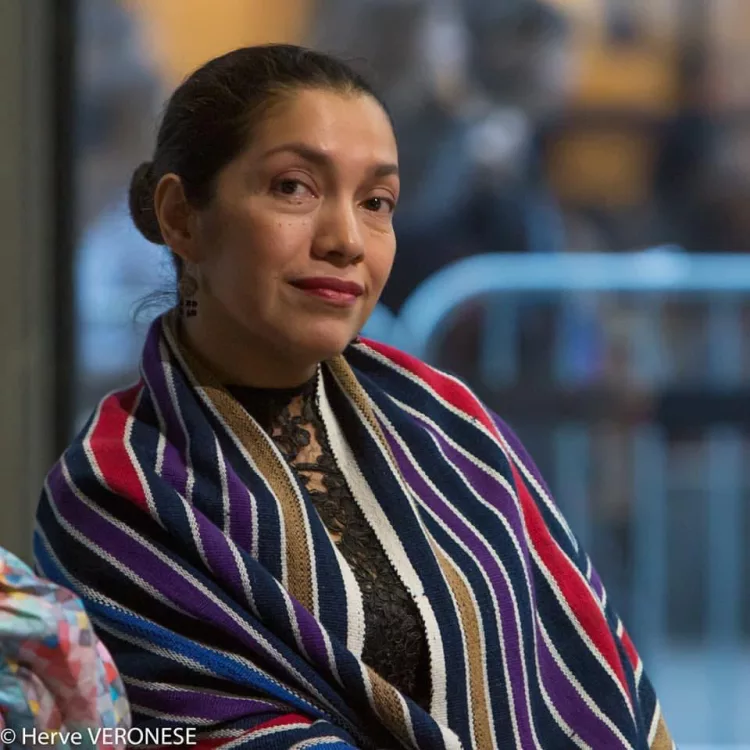
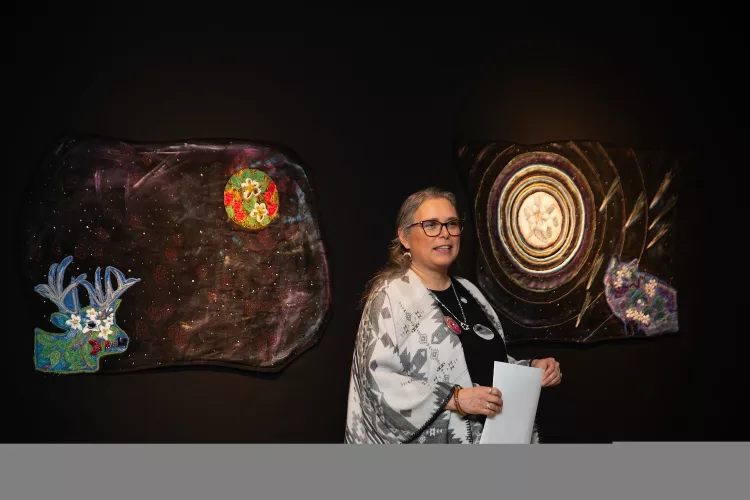
Taylor Moss is a master’s student in Art and Art History at the University of Colorado Boulder. Her undergraduate studies at the University of Rhode Island in the resilience of memory, the roles of material culture and the effects of climate change laid the foundation for her research – earning her numerous awards. Most recently, she has contributed to such projects as a Reacting to the Past publication: Guerrilla Girls in Our Midst: 1984-1987 and co-curated the exhibition Second Time Around for the Jamestown Arts Center, Rhode Island.
An article produced as part of the TEAM international academic network: Teaching, E-learning, Agency and Mentoring.


How to cite this article:
Taylor Moss, "Textiles as Vessels: Indigenous Weaving and Memory Work." In Archives of Women Artists, Research and Exhibitions magazine, . URL : https://awarewomenartists.com/en/magazine/les-textiles-comme-instruments-le-tissage-autochtone-et-le-travail-de-la-memoire/. Accessed 28 March 2026
Taylor Moss, "Textiles as Vessels: Indigenous Weaving and Memory Work." In Archives of Women Artists, Research and Exhibitions magazine, . URL : https://awarewomenartists.com/en/magazine/les-textiles-comme-instruments-le-tissage-autochtone-et-le-travail-de-la-memoire/. Accessed 28 March 2026