
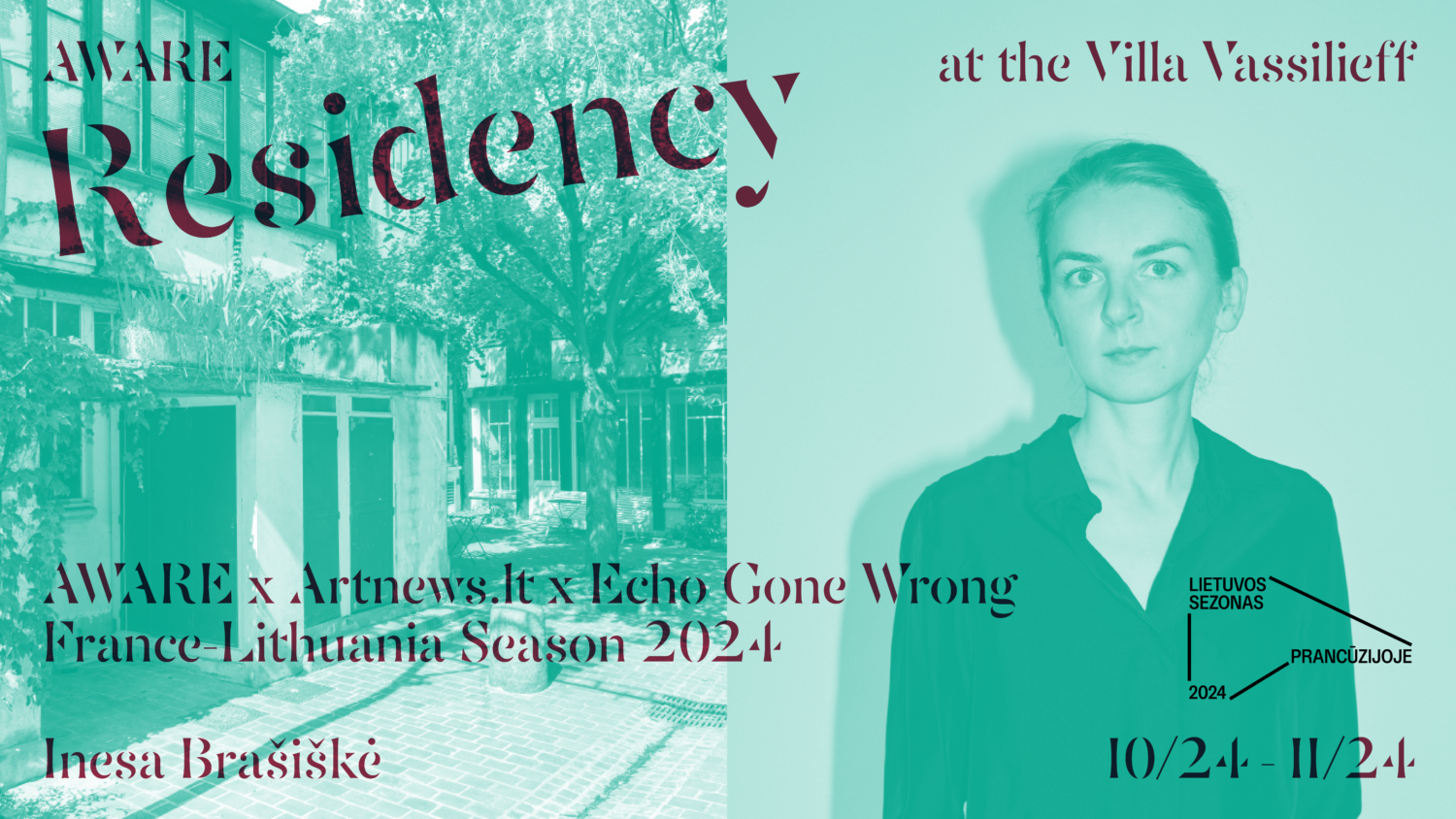
From left to right: Chemin du Montparnasse, © Margot Montigny/AWARE; Portrait of Inesa Brašiškė by Visvaldas Morkevicius; Design by Lisa Sturacci studio, © AWARE: Archives of Women Artists, Research & Exhibitions
Montparnasse – Bienvenüe metro station, Exit 2, Lines 4, 6, 12 and 13
Villa Vassilieff is accessible to visitors using wheeled devices or who have mobility difficulties thanks to special facilities (access ramp, adapted toilets, and a lift).
In addition, several reserved parking spaces are available close to the Villa Vassilieff:
• in front of 4 rue d’Alençon, 75015 Paris
• in front of 7 rue Antoine Bourdelle, 75015 Paris
• in front of 23 rue de l’Arrivée, 75015 Paris
Consult the map of adapted parking spaces in Paris here.
AWARE is pleased to announce Inesa Brašiškė as the researcher-in-residence at the Villa Vassilieff as part of the programme “Women’s Voices: Representation of 20th and 21st Century Lithuanian Women Artists,” in partnership with Artnews.lt and Echo Gone Wrong as part of the 2024 France-Lithuania cultural season.
During her two-month residency, I. Brašiškė will examine the intersection of art and archive in works by Lithuanian women artists. She takes as a starting point the idea of artist Aurelija Maknytė, who summarized her artistic practice by proclaiming her interest in “how much history there is in the subject and how many subjects in history.” I. Brašiškė’s research explores the stories and histories told by Lithuanian artists of different generations primarily working in video, performance, and text. She examines the ways these artists engage with language, the written and spoken word, in order to offer up new ways of being and connecting. She studies, among other things, the place of an archive (and the process of self-archiving) as a repository of experiences and emotions and inquires how these artists address silenced bodies, memory, and the blind spots in communication in their work. She proposes an investigation of the voice as a form of expression of kinship, a means of critical fabulation, and a tool to unlearn.
Inesa Brašiškė is an art historian and curator specializing in modern and contemporary art and artists’ films, with a particular focus on East Central Europe. Her work is informed by decolonial epistemologies, feminist theories and transnational and cross-temporal dialogues. Brašiškė’s writing has appeared in publications such as Mousse Magazine, MoMA C-Map Post, and CAA News. She holds a degree in Modern and Contemporary Art: Critical and Curatorial Studies (MODA) from Columbia University. Currently, Brašiškė serves as Head of Research and Curator at the Sapieha Palace in Vilnius.