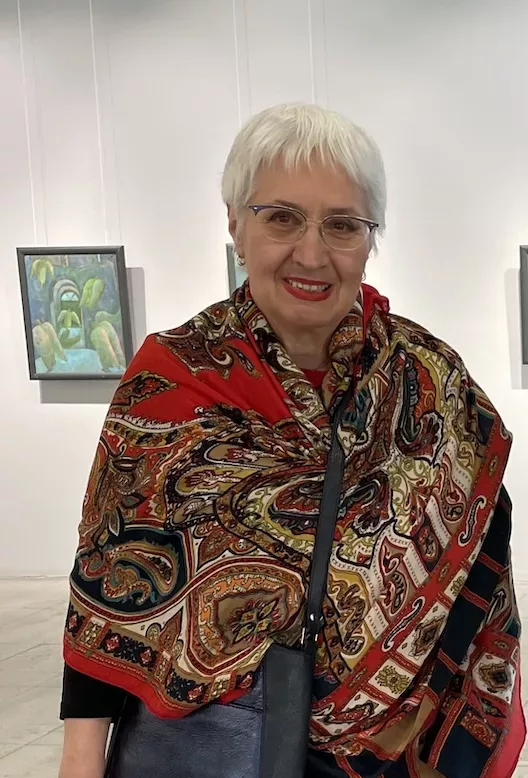
Portrait of Nadezhda Kuteva, April 2022
Angelov, Valentin, Разходка из естетиката [A Walk Through Aesthetics], Veliko Turnovo, “St. Cyril and St. Methodius”, University Press, 2025
→Angelov, Valentin, “Nadezhda Kuteva – Known and Unknown”, Democracy, 84, year VII, 8th of April 1996, p. 8
→Ruenov, Ruen, “I am a Balkan artist. A conversation between Ruen Ruenov and Nadezhda Kuteva”, Art in Bulgaria, 3, 1993, pp. 4-5
From Samothrace to Sofia, Sofia City Art Gallery, Sofia, April – May, 2012
→Solo exhibition, Rayko Alexiev Hall, Union of the Bulgarian Artists, Sofia, 2001
→Solo exhibition, Museum of Foreign Art (now the National Gallery), Sofia, April 1996
Bulgarian painter.
Nadezhda Kuteva works in the field of painting and drawing. She is the daughter of the influential composer and conductor Philip Kutev, founder of the Philip Kutev State Folk Ensemble (1951). Although she is one of the best-known contemporary artists in Bulgaria, there are many discrepancies regarding the facts in her biography. In the available sources (no monograph has been written about her), there is inconsistency regarding her date of birth (1946 or 1948) and the period of her training in mural painting at the National Academy of Arts – according to the Union of Bulgarian Artists, she studied from 1964 to 1971, while other sources indicate that she graduated in 1972. In 1981, she specialised at the Corcoran School of Art in Washington, USA.
In critical analyses, she is referred to as a follower of Ivan Milev (1897–1927), one of the most influential representatives of symbolist painting and secession in Bulgaria. At the same time, N. Kuteva travelled extensively and undoubtedly drew inspiration from artists such as Paul Cézanne (1839–1906), Paul Gauguin (1848–1903), Georges Seurat (1859–1891), Camille Pissarro (1830–1903), Henri Rousseau (Le Douanier, 1844–1910), the Impressionists in general, but also the Futurists or Alexander Deyneka (1899–1969), and even from Renaissance painters such as Fra Angelico (1395–1544). Similar contextual parallels have been noted only by art historian Valentin Angelov, who has placed N. Kuteva’s work in a European context. In earlier interviews, the artist highlights the influence of Luis Buñuel’s (1900–1983) films, as well as musical forms. She is deeply fascinated by pagan and folk Bulgarian beliefs and myths.
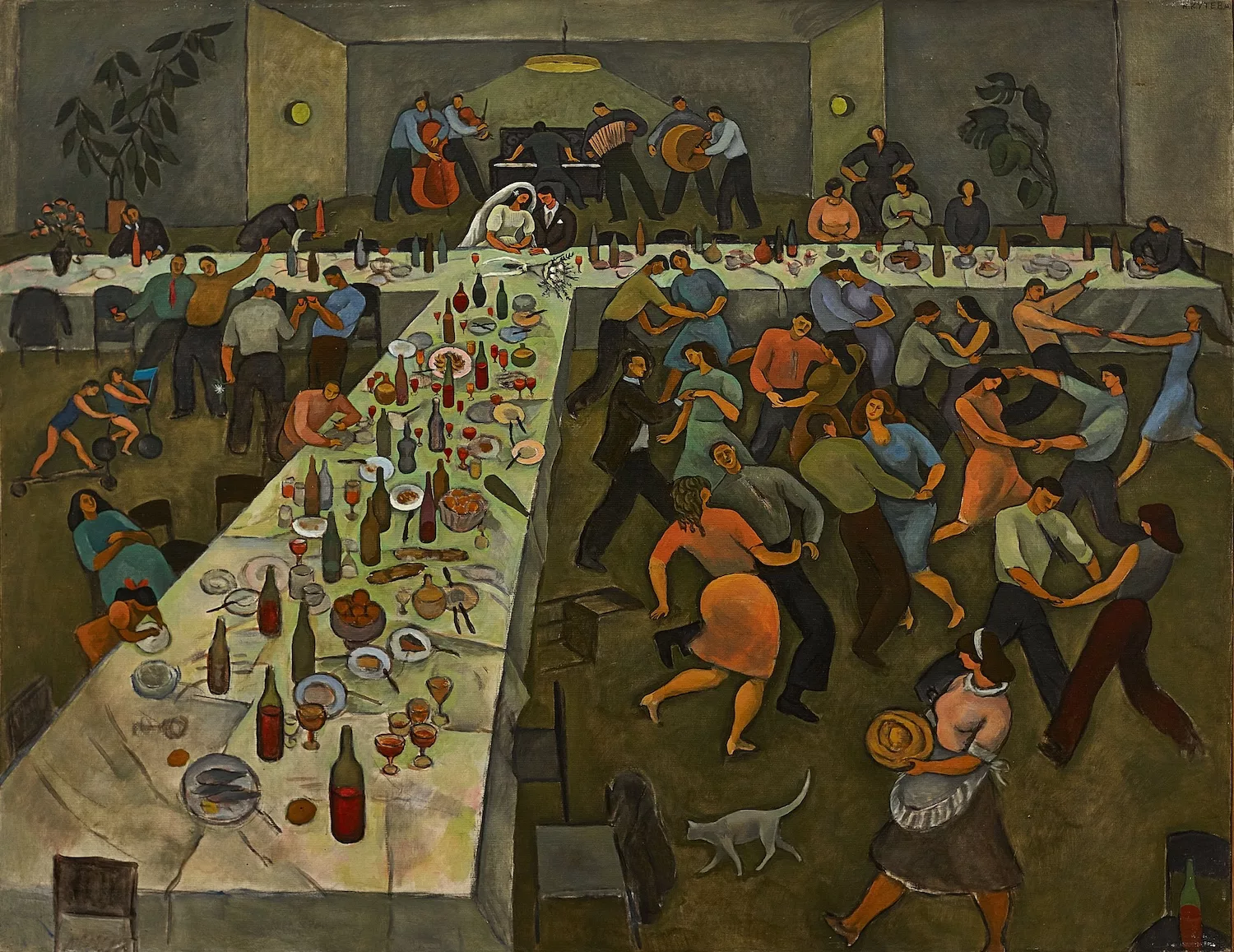
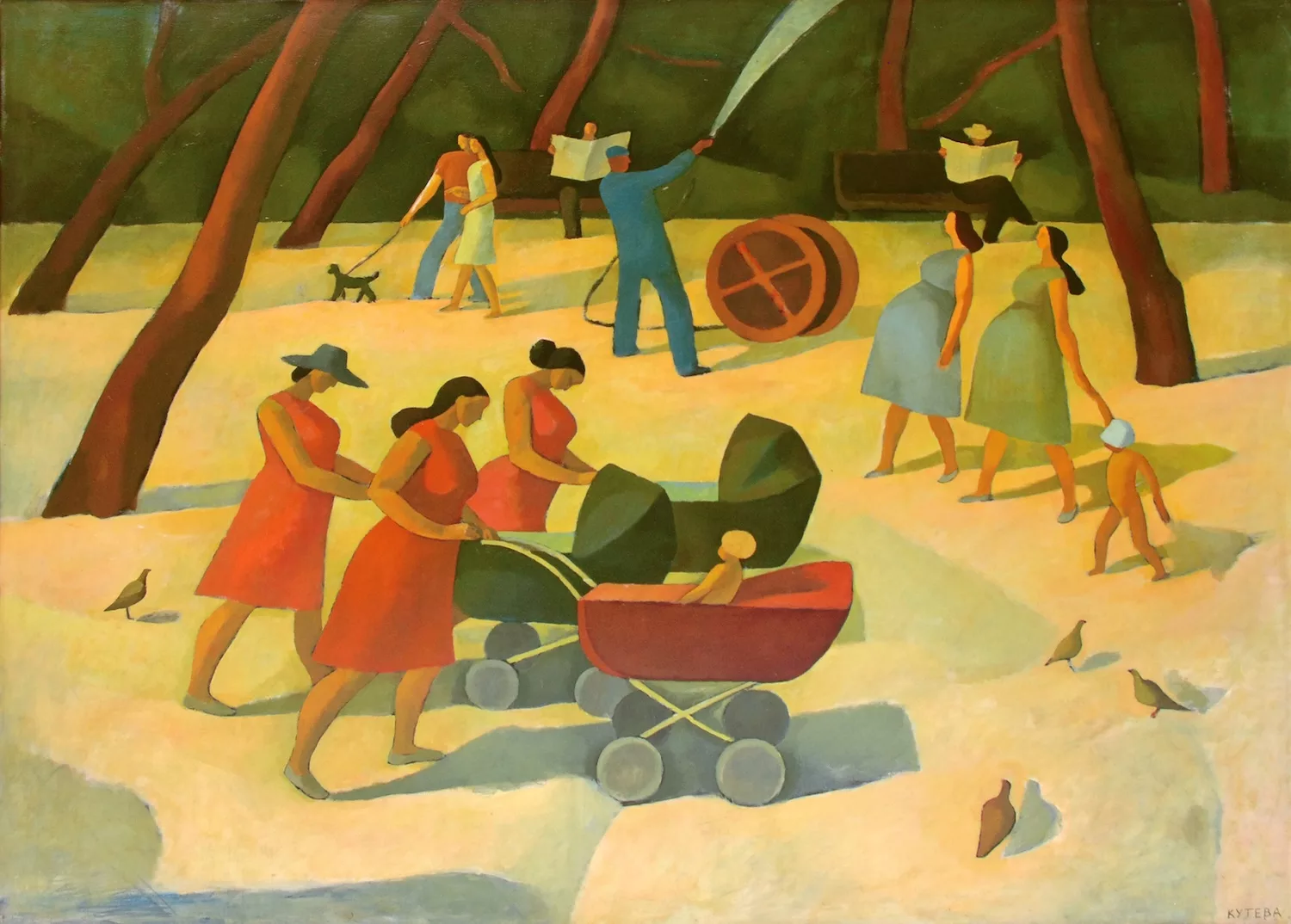
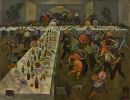
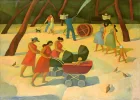
N. Kuteva has a distinctive style, particularly characterised by the stylised representation of the female body in her paintings. She often depicts group scenes involving female figures dancing, singing and performing pagan rituals, often around a fire, dressed in folk costumes or wearing masks. N. Kouteva’s women are exaggerated – large, strong, robust – a characteristic trend also of socialist realism, but in her work it is taken to a degree where the female body seems to proclaim itself omnipotent (Kрали Марко добива сила [Krali Marko Gains Strength, 1980]). Women also appear as hybrid, demonic figures, differing from the male figures only in their clothing and veiled hair. In other cases, where male figures are not present in the composition, women differ slightly from various animals or wear feathers that stick up vertically above their yellow headscarves like horns (Лазарки [Lazarki, 1986]) or are depicted with female bodies but animal heads as in Нощ [Night, 1990].
In recent decades, N. Kuteva has favoured religious and especially apocalyptic themes. Despite the change in thematic direction, the works from this period again show an increased interest in “creatures” – angels, griffins, seraphim, devils – figures that lend Kuteva’s painting a unique fantastical imagery, creating an alternative world, as if inspired by the worlds of Hieronymus Bosch (c. 1450–1516).
Her works are included in the collections of the National Gallery (Sofia), the Sofia City Art Gallery and city art galleries in major cities in Bulgaria, as well as the Museum of Contemporary Art in Szczecin, Poland, the National Gallery in Bratislava, and others. Between 1975 and 2005, she had solo exhibitions in Slovakia, Poland, Cyprus, Vietnam, Japan, Serbia, Macedonia, the Netherlands and Germany.


 Interview with Nadezhda Kuteva | June 2021 (Bulgarian)