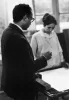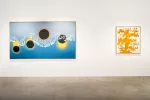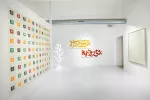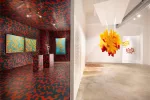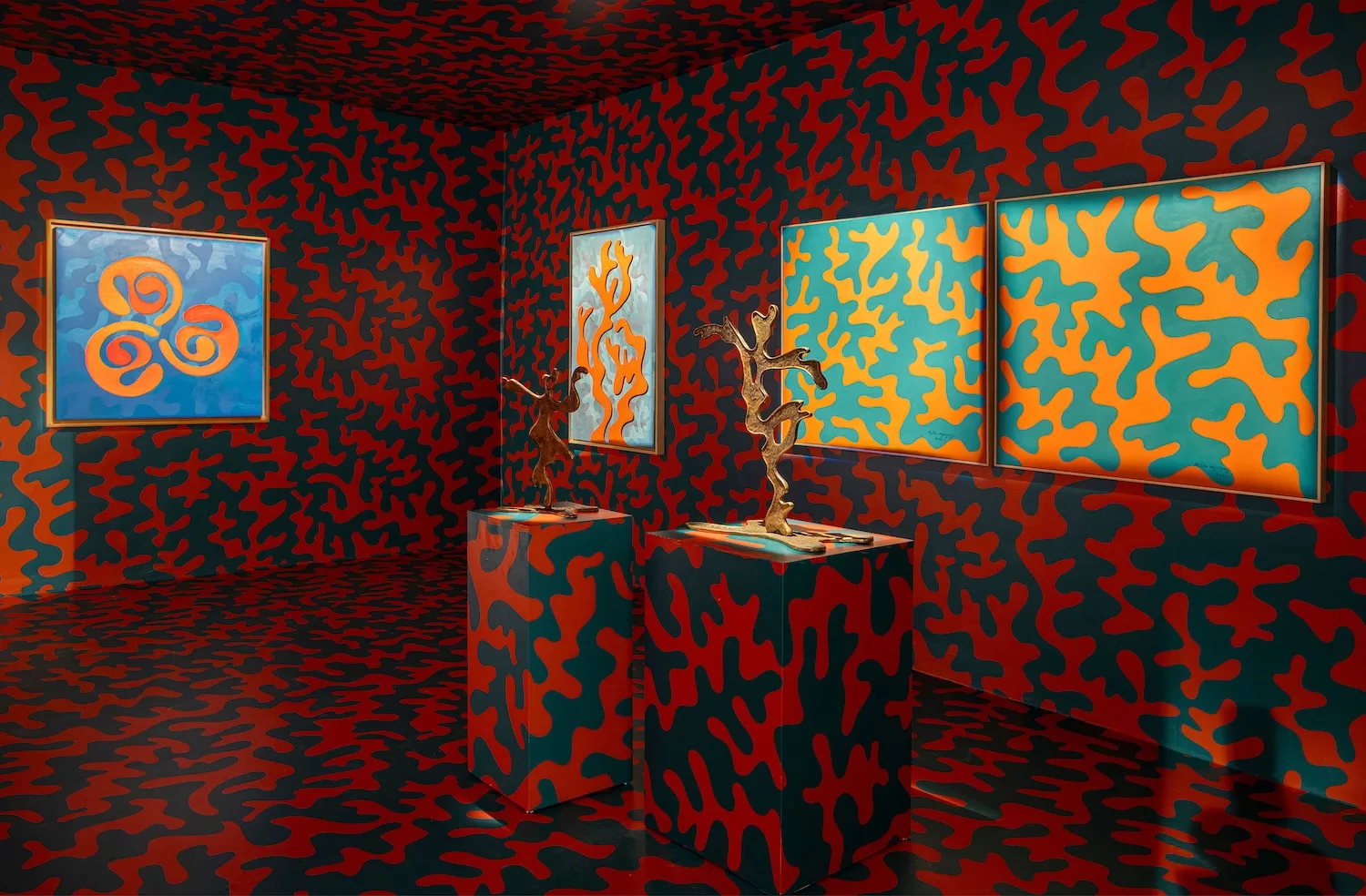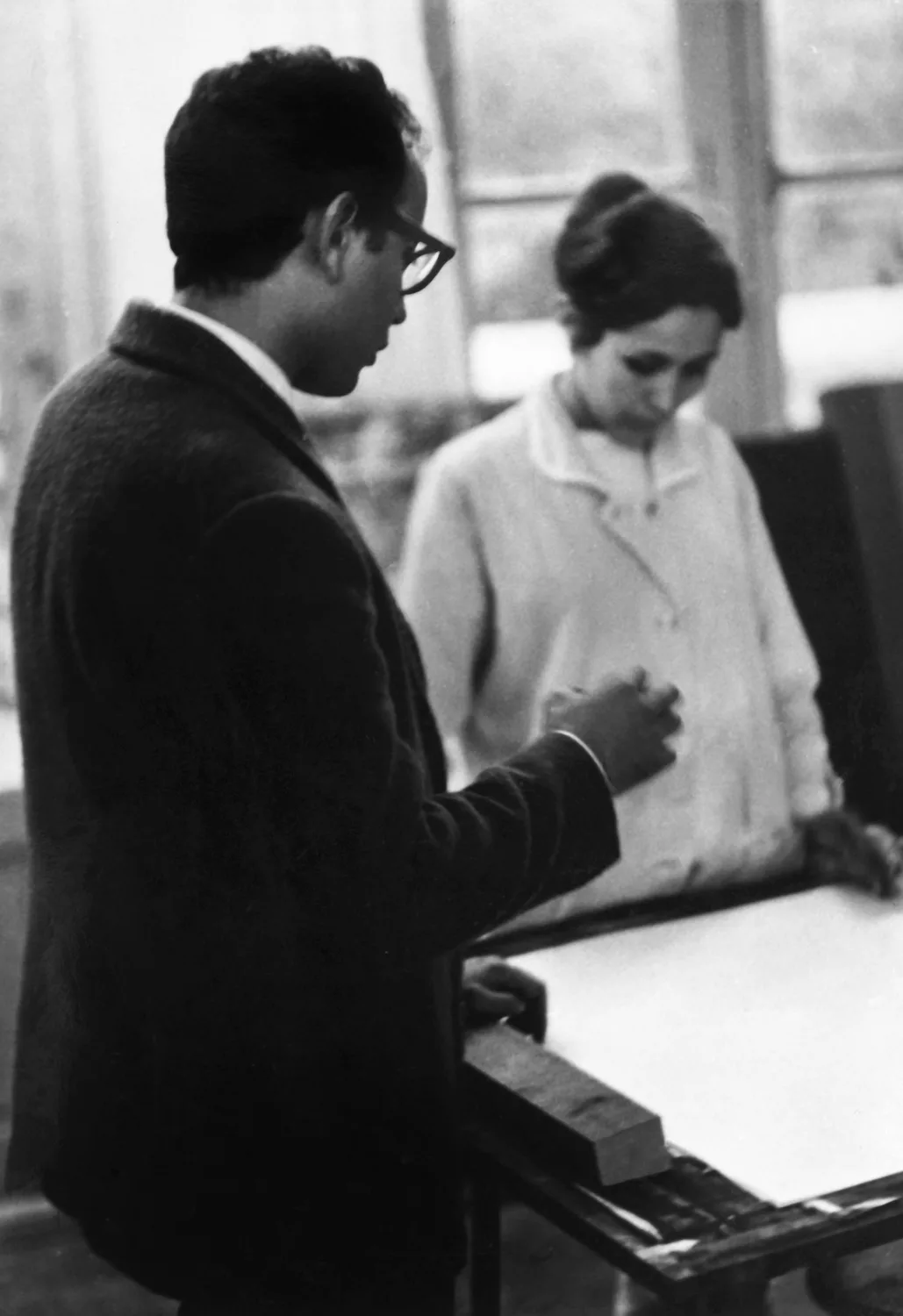
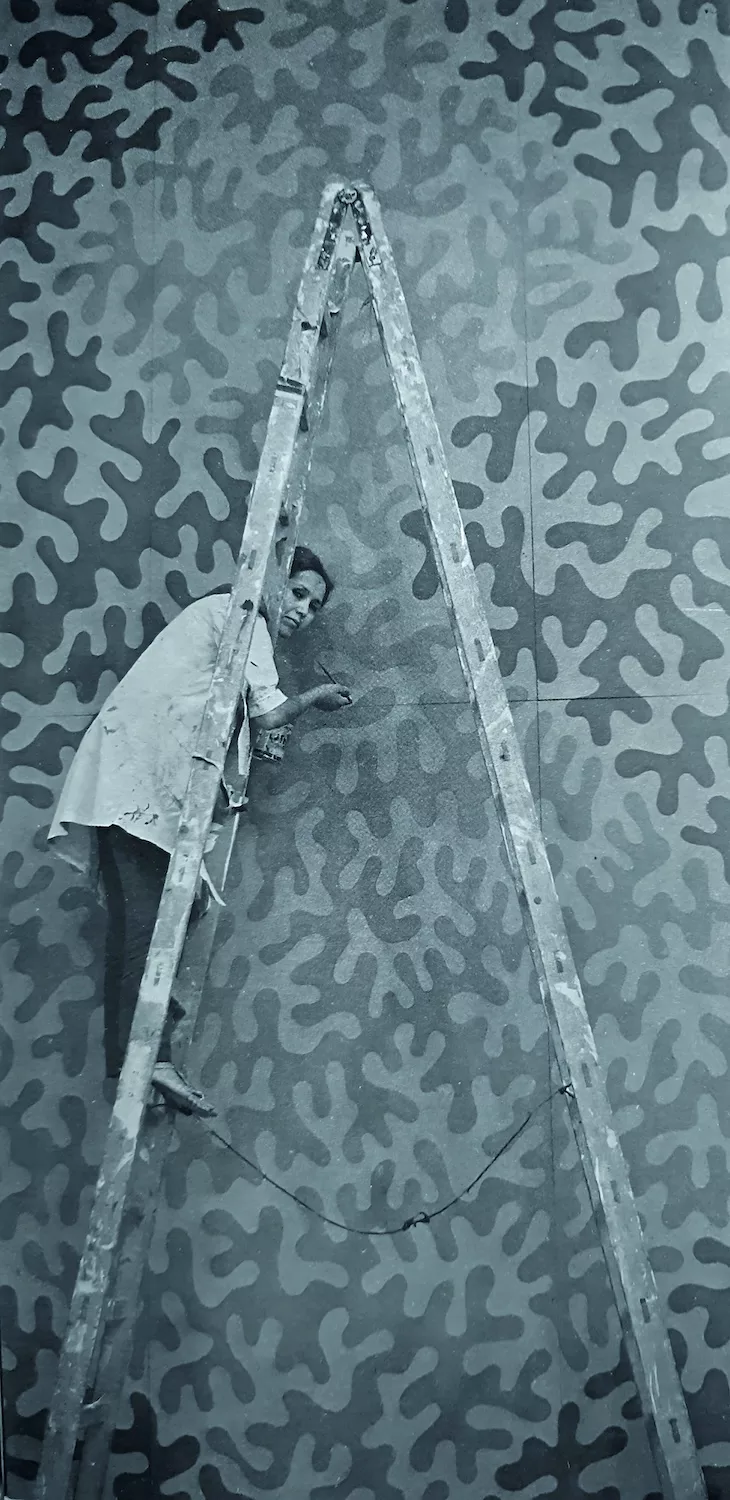
Malika Agueznay at work on Symbole féminin (1968), © Malika Agueznay
Powers, Holiday, “Opening the Path for a Feminine Abstraction: Malika Agueznay and the Casablanca School”, Post (MoMA), 2023
→Taking Shape: Abstraction from the Arab World, exh. cat., New York, Grey Art Gallery, 2020
→Fondation CDG and Fondation ONA, Tribute to Malika Agueznay, exh. cat., Rabat, Fondation CDG and Fondation ONA, 2015
The Casablanca Art School, Tate St Ives (United Kingdom), May 2023-January 2024, Sharjah Art Foundation (United Arab Emirates), February-June 2024, Schirn Kunsthalle Frankfurt (Germany), July–October 2024
→Moroccan Trilogy 1950–2020, Museo Reina Sofía, Madrid (Spain), March–September 2021
→Présence plastique, Jemaa el-Fna Square, Marrakesh (Morocco), 1969
Moroccan painter, printmaker and sculptor.
Malika Agueznay’s trajectory has been that of a pioneer of contemporary Moroccan art. As the first woman to attend the School of Fine Arts of Casablanca, one of Morocco’s first woman engravers and a founding member of the international cultural festival Moussem d’Assilah, her remarkable career did not afford her the same recognition as received by her male peers. For decades, Farid Belkahia (1934–2014), Mohamed Melehi (1936–2020) and Mohammed Chabâa (1935–2013), have been positioned as the central figures of the story of the Casablanca School, the subjects of numerous monographs and retrospectives, with M. Agueznay’s contribution relegated to the shadows. While her colleagues achieved sustained critical attention, the artist pursued her work with consistency and in relative silence – a silence long imposed on her by art criticism and art history.
Born in 1938 in Tameslouht near Marrakesh, M. Agueznay studied psychology in France before enrolling in 1966 at the School of Fine Arts of Casablanca, at the time directed by F. Belkahia, with M. Melehi and M. Chabâa amongst the teachers. She was the only woman within this hub of aesthetic protest, whose artists strove to liberate Moroccan creation from colonial Orientalism, developing a modernity nourished by local forms and savoir-faire such as Berber rugs, woodwork and calligraphy. In 1969 she was part of the exhibition-manifesto Présence plastique on Jemaa el-Fna Square. Though this momentous event was widely documented, M. Agueznay’s contribution has often been marginalised in historical narratives – one case among many that point to a phenomenon of invisibilisation of women artists in the Maghreb and the Arab world.
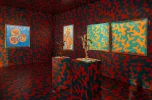
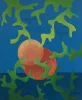
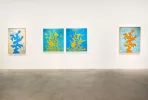
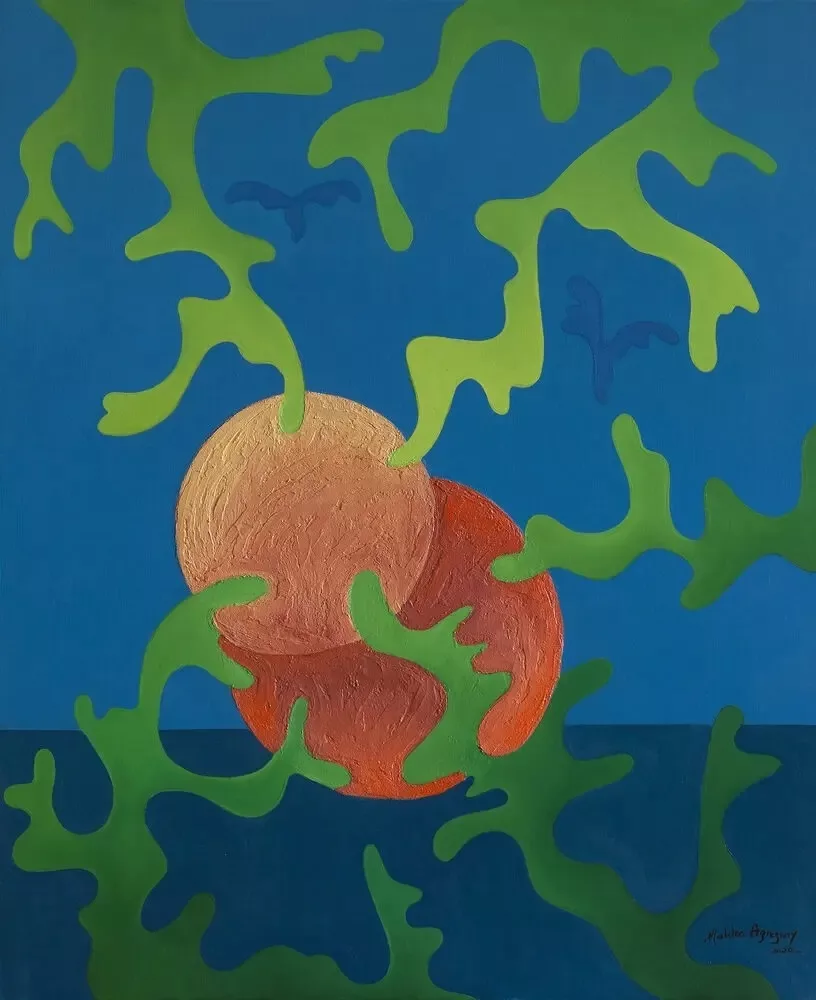
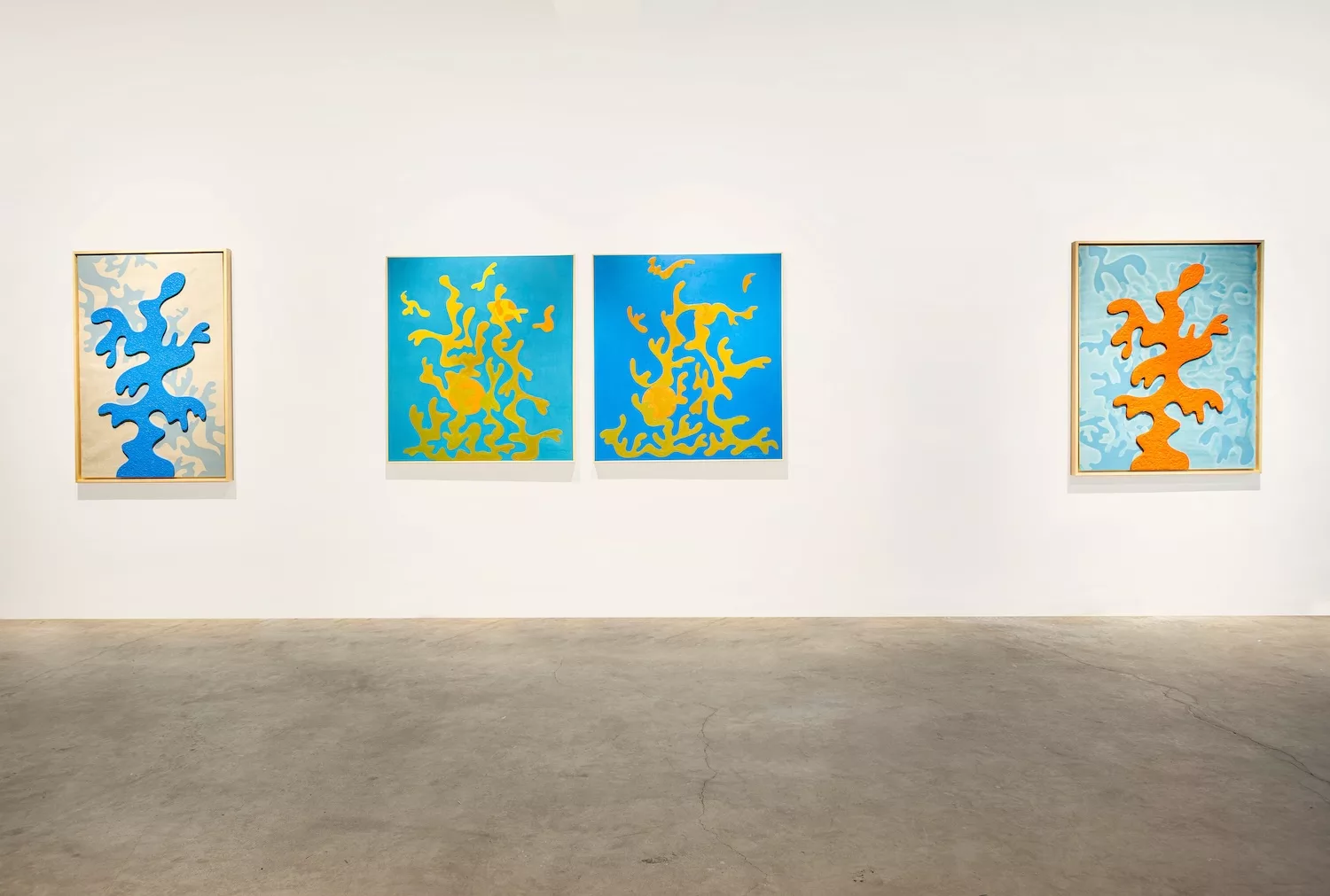
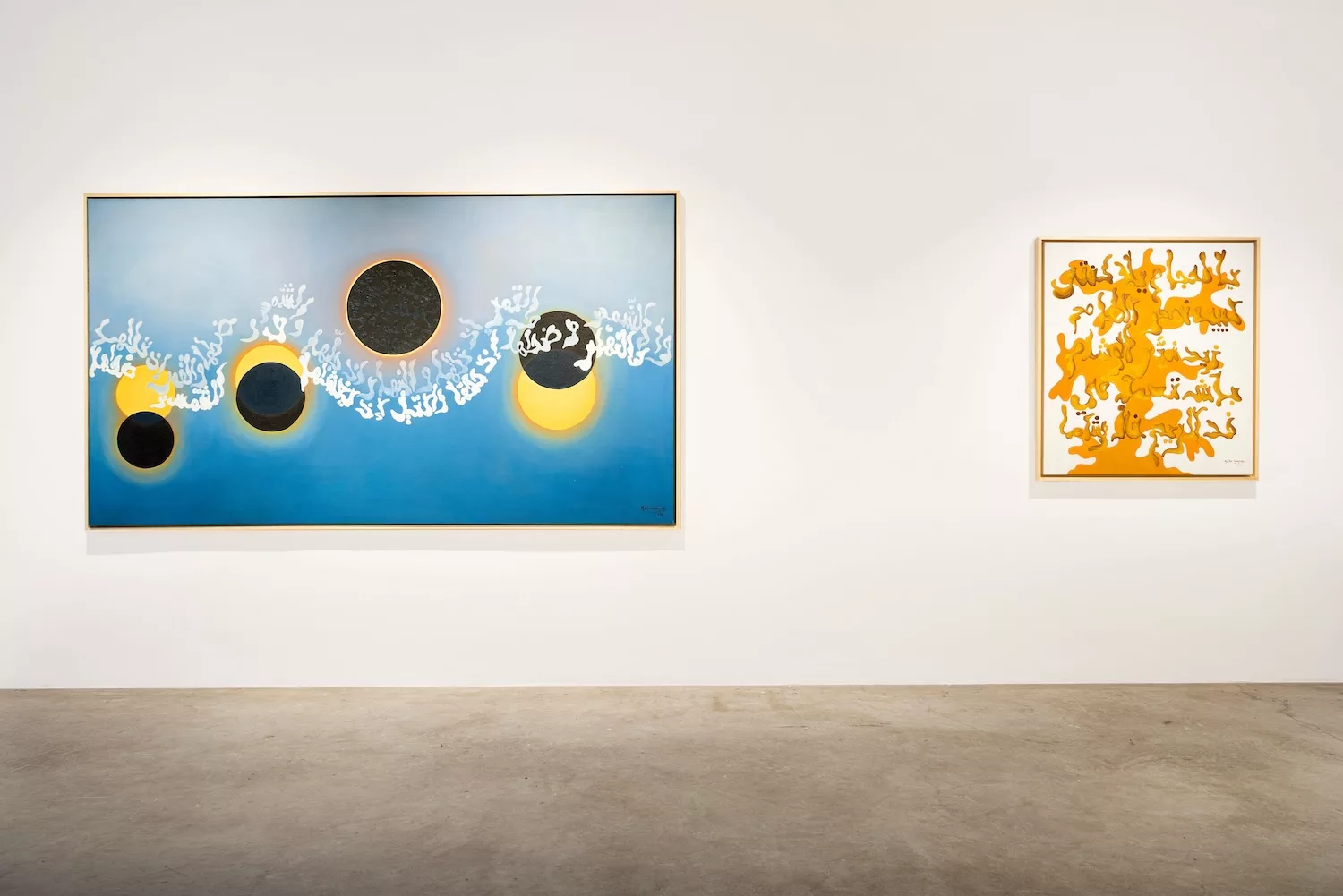
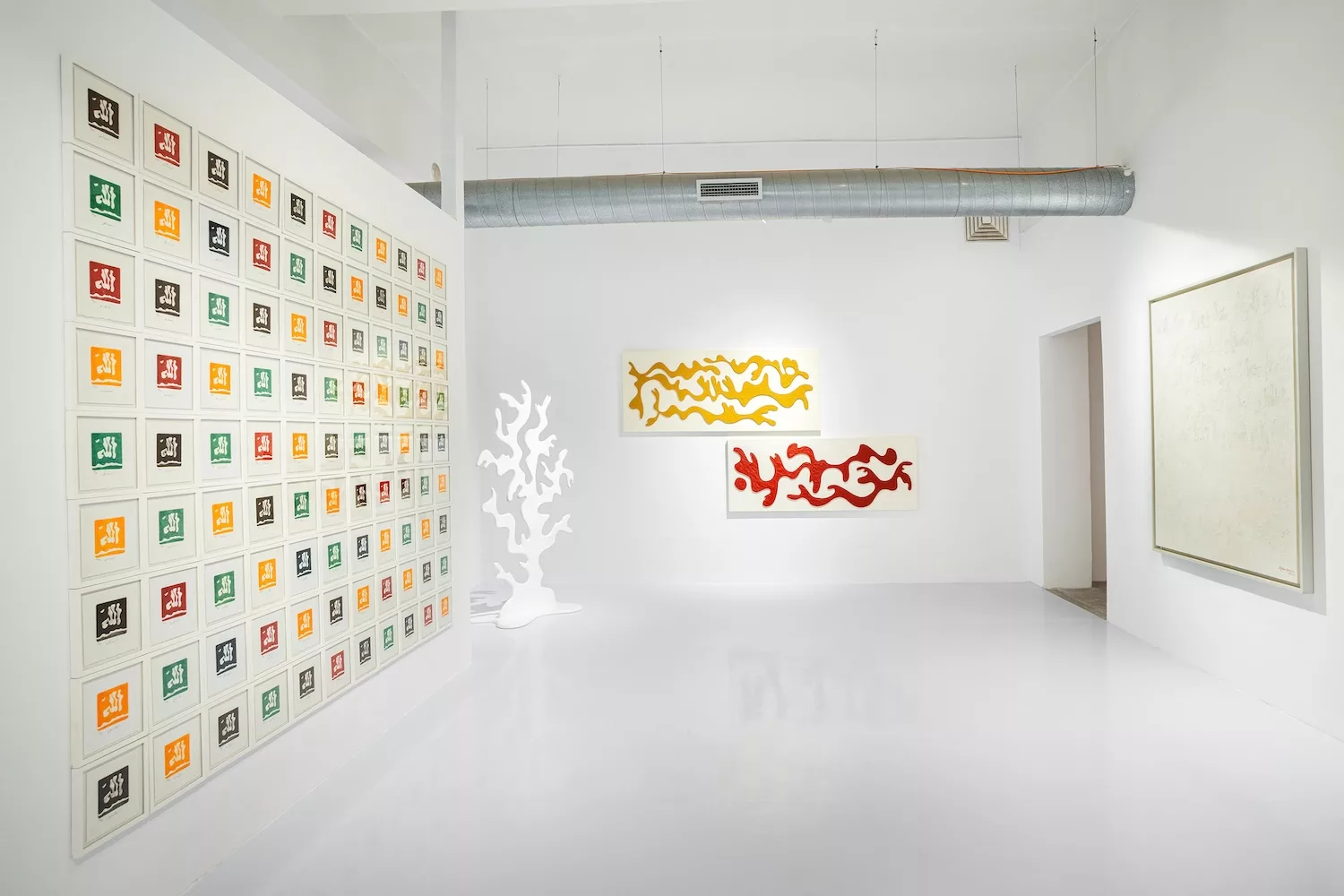
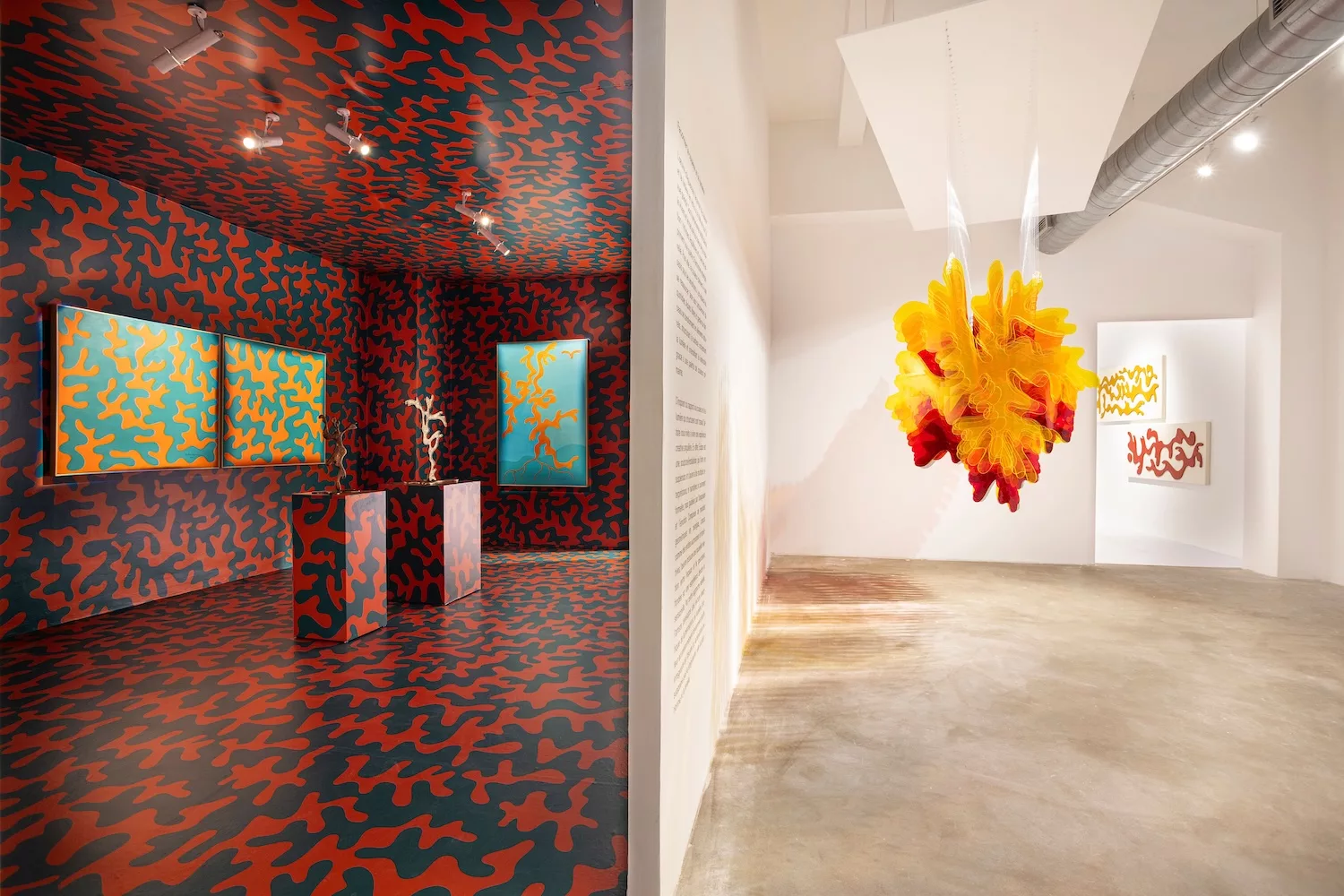
M. Agueznay’s oeuvre evolved around a motif discovered between 1966 and 1968: seaweed. This undulating vegetal form, considered a sign both open and polysemic – sacred and organic, and often associated with the female body – gradually took root as her visual signature. Reiterated across different mediums – engraved in copper, sculpted in bronze, painted on canvas – the artist explores its rhythmic and spatial potential. Remaining faithful to Islamic aniconism, she places Arabic calligraphy at the heart of her work – verses from the Quran and the ninety-nine names of Allah nestle amongst the hollows and sinews of the seaweed, transforming the surface into a space of scriptural meditation. Her art thus takes its place as part of the Hurufiyya movement, whose cornerstones were laid in 1949 by the Iraqi artist Madiha Omar (1908–2005).
M. Agueznay continued to pursue her artistic training: turning to printmaking, she studied in the studios of Mohammad Omar Khalil (1936–) and Robert Blackburn (1920–2003) in New York, then at Atelier 17 in Paris in 1990. She thus became one of Morocco’s first contemporary woman printmakers. She co-founded the Moussem d’Assilah in 1978, and worked within it for over twenty years as an artist and teacher. Transmission is central to her work, and she opened her printmaking studio to the numerous artists that she mentored. In 1981 she created a ten metre mural in collaboration with patients at the Berrechid psychiatric hospital, lending a collective and social dimension to her practice.
The work of M. Agueznay gained institutional recognition relatively late despite the real importance of her contribution. However, the imbalance began to be redressed during the 2010s. It is not insignificant that such belated recognition coincided with the gradual departure of other figures of the movement. In 2026 M. Agueznay is one of the last living voices of the Casablanca School. In 2015, the book that accompanied the retrospective exhibition Hommage à Malika Agueznay at the Villa des Arts de Rabat, published by the Fondation ONA and Fondation CDG, described her as a “pioneer among Moroccan women artists”. In 2023–2024 the travelling exhibition The Casablanca Art School, presented at Tate St Ives, the Sharjah Art Foundation and the Schirn Kunsthalle Frankfurt, restored her to her position at the heart of the movement. Her daughter Amina Agueznay (1963–), herself a renowned contemporary artist, carries forward her maternal heritage. Both mother and daughter will participate together in the 36th São Paulo Biennial (2025–2026).
A biography produced as part of the project Tracing a Decade: Women Artists of the 1960s in Africa, in collaboration with the Njabala Foundation
© Archives of Women Artists, Research and Exhibitions, 2026