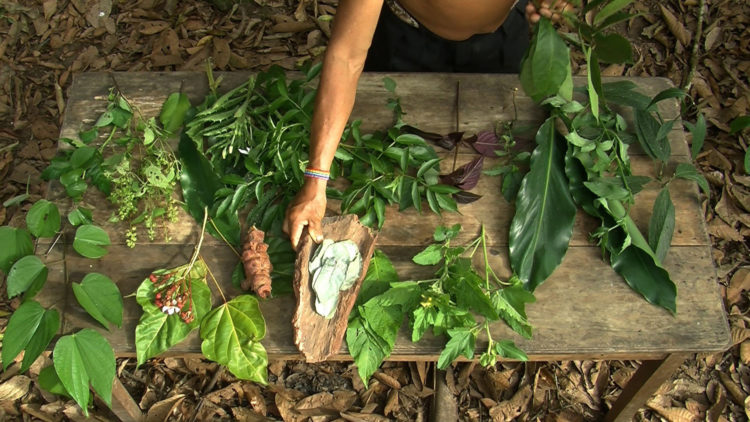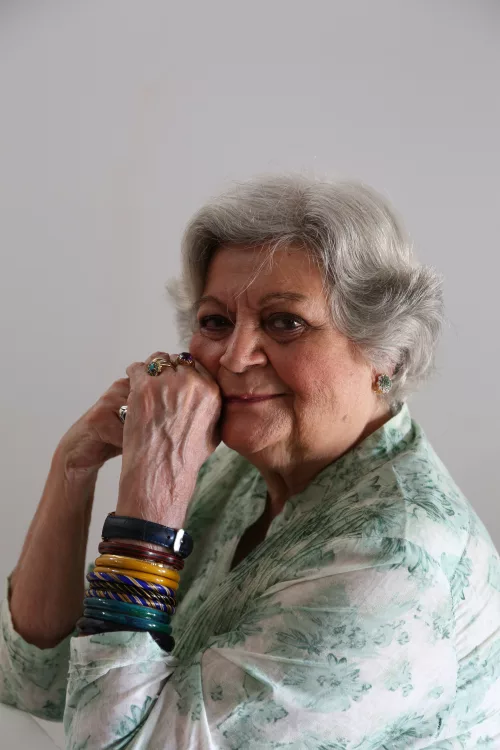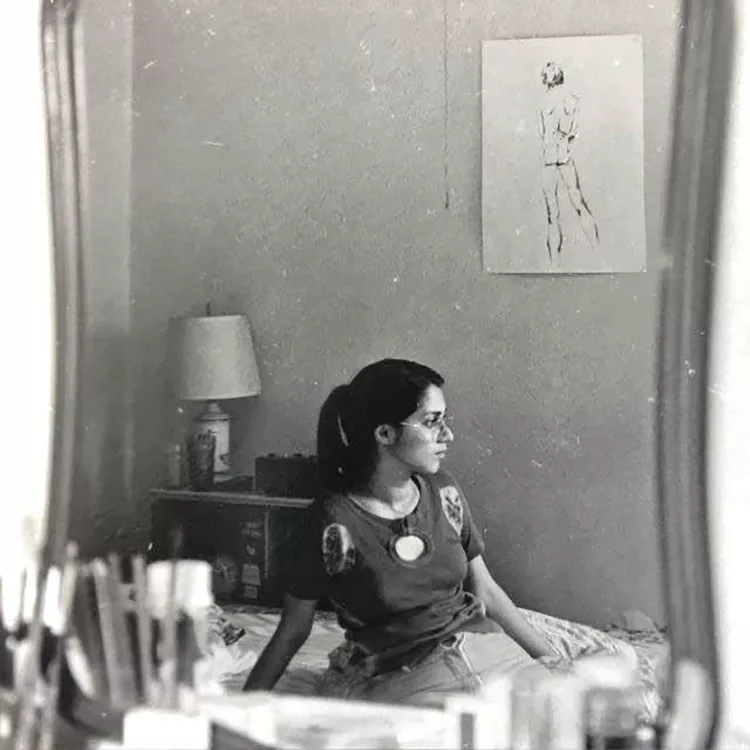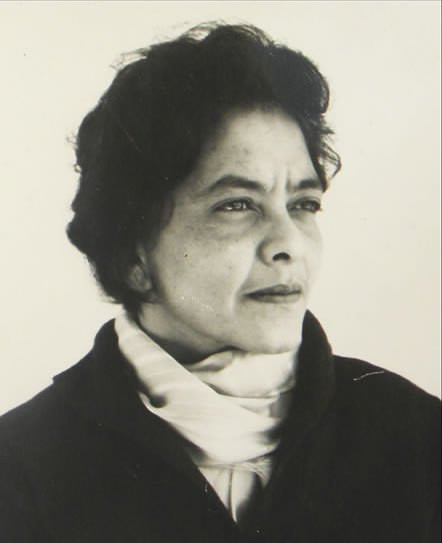
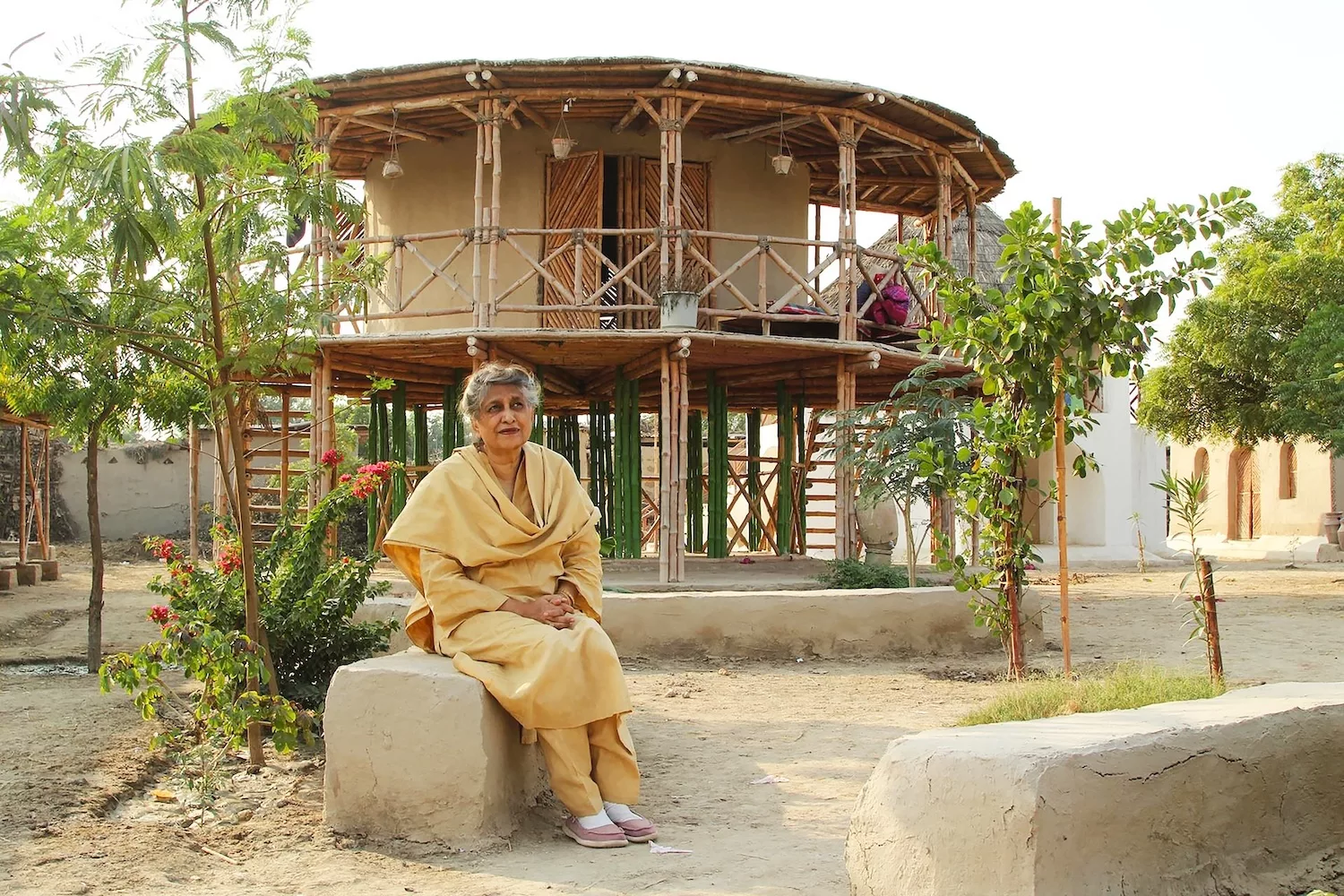
Yasmeen Lari at Women Centre
Angelika Fitz, Elke Krasny (eds.), Yasmeen Lari: Architecture for the Future, Cambridge, MIT Press, 2023
→Fabrizia Berlingieri, Emilia Corradi, Cassandra Cozza, Imma Forino, Yasmeen Lari: An Architect, Milano, Politecnico di Milano, Pearson, 2021
→Women in Architecture: Contemporary Voices from the Global South, 2020
Community Center, Qatar Pavillion, Venice Architecture Biennale, Venice, 2025
→Architecture of Decolonisation in South Asia 1947-1985, Museum of Modern Art, New York, February 2 – July 2, 2022
→Zero Carbon Futures, Politecnico di Milano, 2022
Pakistani humanitarian, historian and architect.
Yasmeen Lari is Pakistan’s first woman architect and one of the most influential figures in the Global South working at the intersection of design, climate and social justice. A trained architect who no longer identifies with the profession as it is conventionally defined, she is known as the ‘architect for the poorest of the poor’, creating holistic systems that enable the poorest communities to escape the poverty trap through self-reliance and village-to-village social enterprise.
Educated at Oxford School of Architecture (1964) and elected to the Royal Institute of British Architects in 1969, she returned home to found Lari Associates, a pioneering practice that introduced modernist design to post-independence Pakistan. Through landmark buildings such as the Finance and Trade Centre (1982) and the Pakistan State Oil Headquarters (1984) in Karachi, she became a leading voice in shaping the nation’s corporate skyline while breaking gender barriers in a newly forming profession.
As President of the Institute of Architects, Pakistan, she spearheaded a successful campaign against unqualified architects, which led to the announcement of the Pakistan Council of Architects and Town Planners (PCATP) Ordinance in 1983 for regulating the two professions. Thanks to her advocacy, the Sindh Cultural Heritage (Preservation) Act of 1994 was passed, protecting the first 600 historic buildings in Karachi, documented by the Heritage Foundation of Pakistan.
By 2000, Y. Lari had turned away from commercial commissions to focus on heritage conservation, co-founding the Heritage Foundation of Pakistan (1980). She led the safeguarding of major historic sites including the Lahore Fort and the Makli Necropolis, both UNESCO World Heritage Sites, and advocated for the integration of traditional materials and crafts into urban preservation.
Since the 2005 earthquake, Y. Lari has transformed her practice into what she calls ‘Barefoot Social Architecture’ (BASA) – a philosophy combining zero-carbon design, women’s empowerment and climate resilience. Working with displaced and landless communities, she has helped build over 60,000 bamboo-lime-mud structures and introduced the Pakistan Chulah, an earthen stove designed and built by women, which won the World Habitat Award (2018). Her initiatives now reach more than 100,000 people each year, promoting twelve of the UN Sustainable Development Goals and positioning architecture as a tool for both survival and dignity.
Y. Lari’s work insists that humanitarian architecture should not be peripheral or voluntary, but a legitimate professional path for young architects, one capable of incubating new models for climate justice and poverty alleviation. She advocates for mainstreaming humanitarian design so that ‘doing good’ becomes central, not exceptional, to the discipline.
Her contribution has received wide international recognition: the RIBA Royal Gold Medal (2023) – the first ever awarded to a Pakistani architect; the Fukuoka Prize (2016); the Jane Drew Prize (2020); and national honours including the Sitara-i-Imtiaz (2006) and Hilal-i-Imtiaz (2014). Recent accolades include The Kings Foundation Award for Innovation in Practice (2025), the Lisbon Triennale Millennium bcp Award (2025), the Commonwealth Association of Architects Lifetime Achievement Award (2024) and the José Rizal Heritage Award for Humanitarian Services (2024). She also received an Honorary Doctorate in Design from Oxford Brookes University (2023) and a Laurea Magistrale ad Honorem from the Politecnico di Milano (2021).
The major retrospective ‘Yasmeen Lari: Architecture for the Future’ (2023, Vienna) reflected on her shift from iconic modernism to self-build movements for climate refugees, presenting her life’s work as a call for architecture rooted in care rather than consumption. Through the Heritage Foundation’s Zero Carbon Campus and the ‘One Million Households at a Time’ programme, Lari shows that transformation begins when people – especially women – lead the process of rebuilding their lives. With simple tools, shared knowledge and community, they shape the conditions for dignity, creativity and resilience.
A biography produced as part of the programme “Common Ground”
© Archives of Women Artists, Research and Exhibitions, 2026


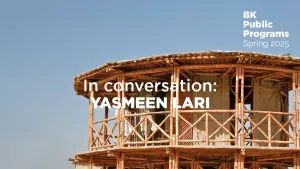 BK Talks. In conversation: Yasmeen Lari | BKTUDelft, 2025
 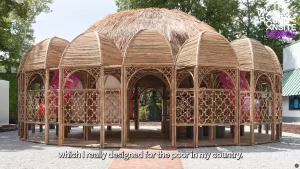 Yasmeen Lari on the Qatar Pavilion at the Venice Architecture Biennale | The World Around, 2025