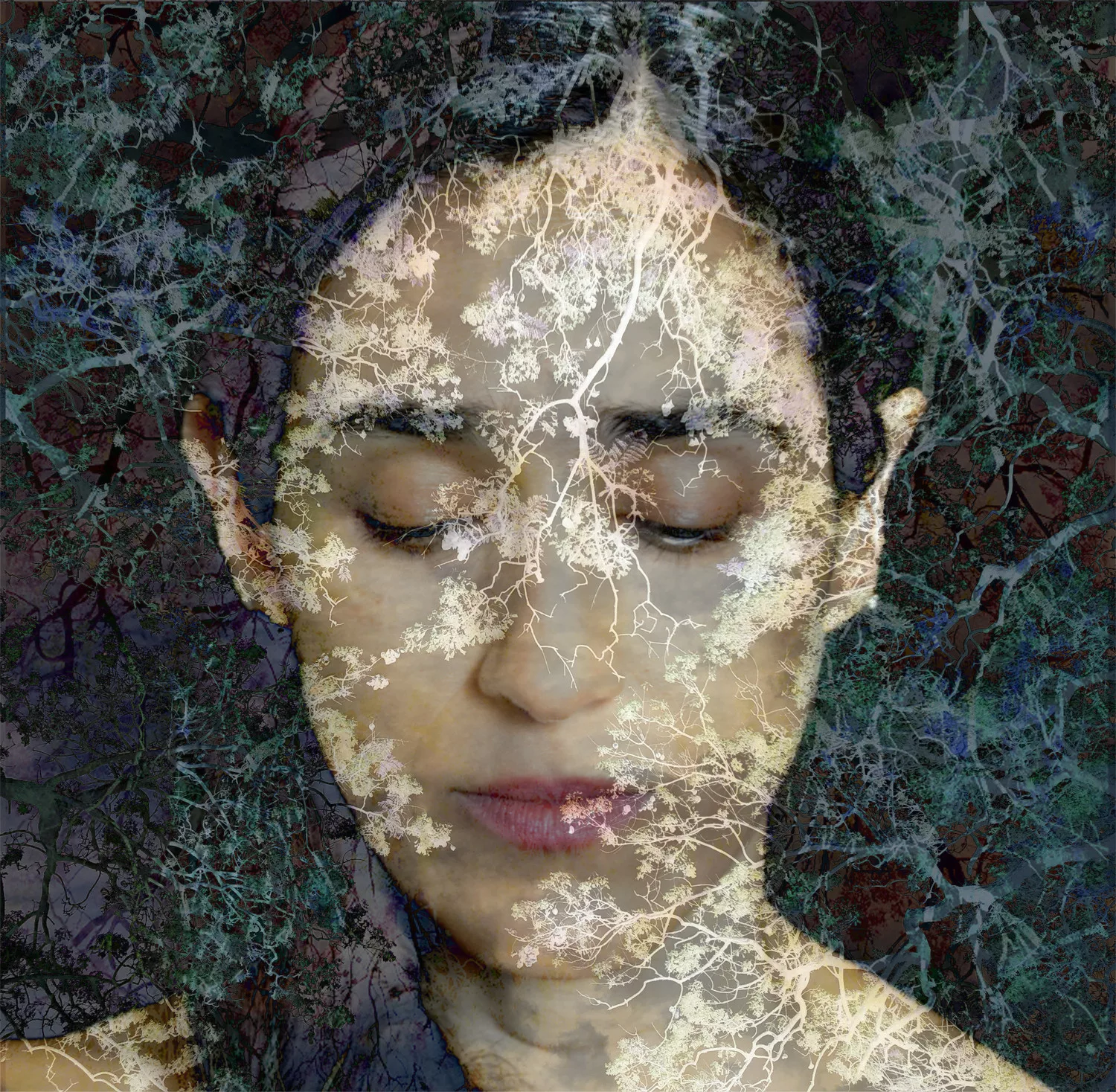
Tatiana Parcero, Consciousness Terra # 4, 2020, Inkjet print on Hahnemühle, 50 x 50 cm © Courtesy Tatiana Parcero
Since the 1990s the Mexican artist Tatiana Parcero (1967–) has been examining the nexus between identity and memory in relation to nature and the human body. She uses the genre of self-portraiture as a means to analyse how personal processes, social situations and natural catastrophes are interwoven in human lives, interpreting them as part of the same fabric in which individual elements and our collective memory are intertwined. She works with concepts such as maps, cartography and territory to explore different levels – physical, spiritual and symbolic – with the aim of raising awareness about the importance of taking care of and respecting nature.
Throughout her career Parcero has experimented with various media, such as video and photography, to create a personal language. Early on she developed her own unique technique, the superimposition of translucent black and white acetates over colour photos, to create the sensation that we are seeing through her body. She searches through a variety of iconographic sources and prints them on acetate to create a new visual territory.
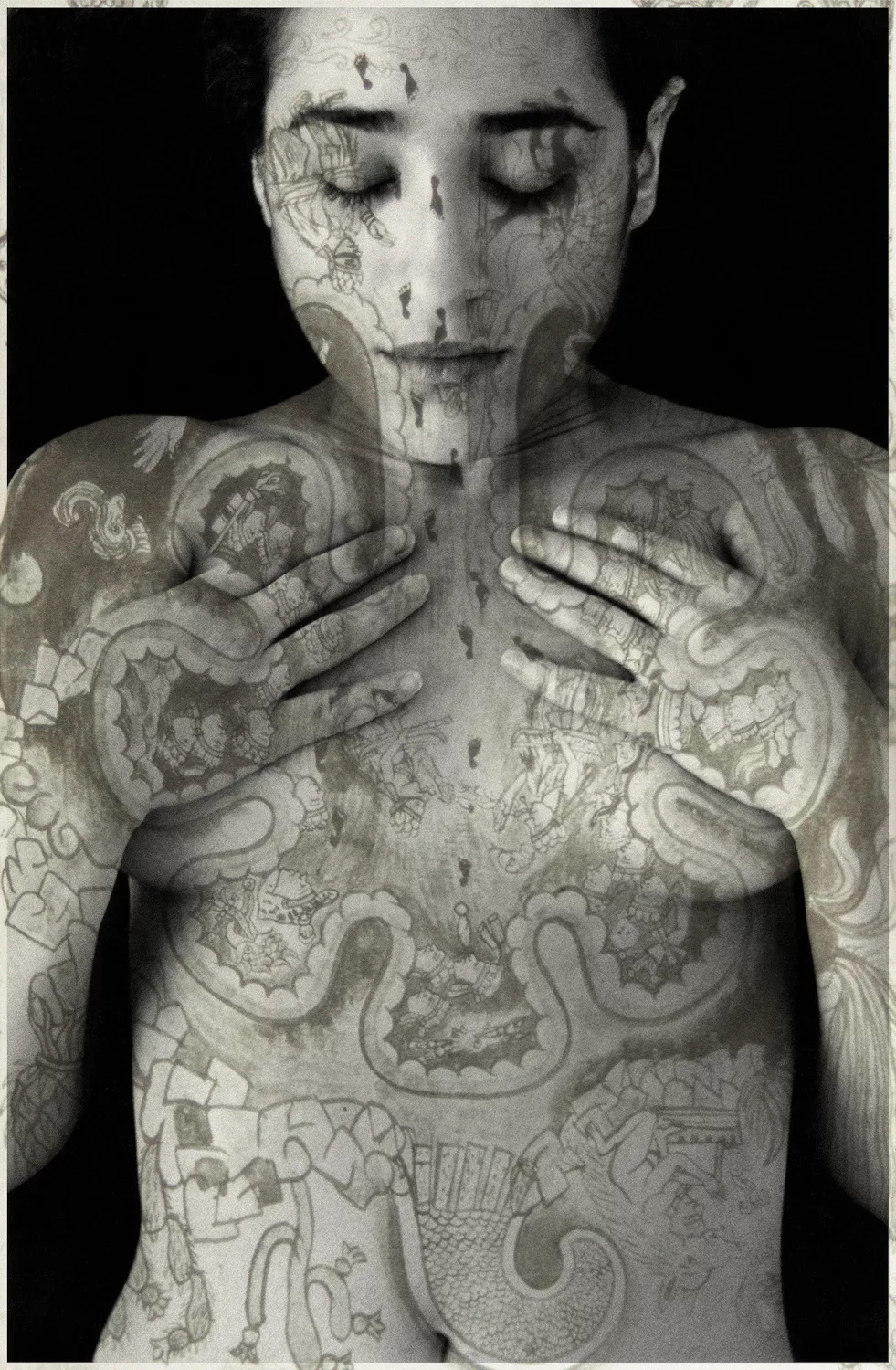
Tatiana Parcero, Cartografía interior # 44 [Inner Cartography # 44], 1996 © Courtesy Tatiana Parcero
Parcero studies pre-colonial peoples, highlighting their particular way of seeing the body and nature, a forerunner of eco-territorial concepts. Starting with her series Cartografía interior [Inner Cartography, 1994–1996], she began interpreting the body in holistic relation to nature, drawing on Mayan and Aztec cultural conceptions. Parcero points out that in indigenous world outlooks there is no separation between the human body and the rest of nature. “[T]hey saw the Earth… as a single entity in which both aspects are conjoined… rivers were associated with blood vessels, organs with lakes and the body itself as a single, highly symbolic territory.”1 She uses self-portraiture, broadly conceived, as a way to convey the destruction of nature’s impact on our lives. Her work brings out the association of the body, territory and the Earth developed by Latin American communitarian feminist currents, along with eco-feminist analyses that reveal how the domination and exploitation of women are closely linked to those same relationships with nature, in order to make us more aware of the urgent need to change our way of life. Finally, in her latest series, Parcero documents the multiplicity of bodies that came together in feminist marches in Mexico and Argentina (where she has lived since 2000), where her body has been fully engaged in collective social action.
In this article, I will focus on analysing work from her series Ossis Naturam Corporis (2018) and Consciousness Terra (2020), in which she foregrounds the planetary ecosystem crisis. Here Parcero’s holistic vision can be linked to new scientific views, such as those of the well-known biologist Sandra Díaz who coined the expression “a fabric of life view of the world” to highlight the interwovenness of natural processes and people that has developed over many thousands of years. Díaz emphasises the evolutionary kinship between humans and other living beings and our physical and cultural dependence on this relationship, and defends this expression as it visualises the latticework that sustains humanity and the enormous wealth that nature contributes to our lives.2
Since the 1970s, when the ecofeminist trend emerged from within radical liberation movements, pioneered by the French thinker Françoise d’Eaubonne, who argued that there is a correlation between overpopulation, the devastation of nature and male supremacy,3 there has been a growing repudiation of the false construct that asserts the superiority of the human species over the rest of the species on the planet, and consequently justifies the power and control that humans exercise over them. This situation, now worsening day by day, is the cause of today’s accelerating ecosystemic emergency.
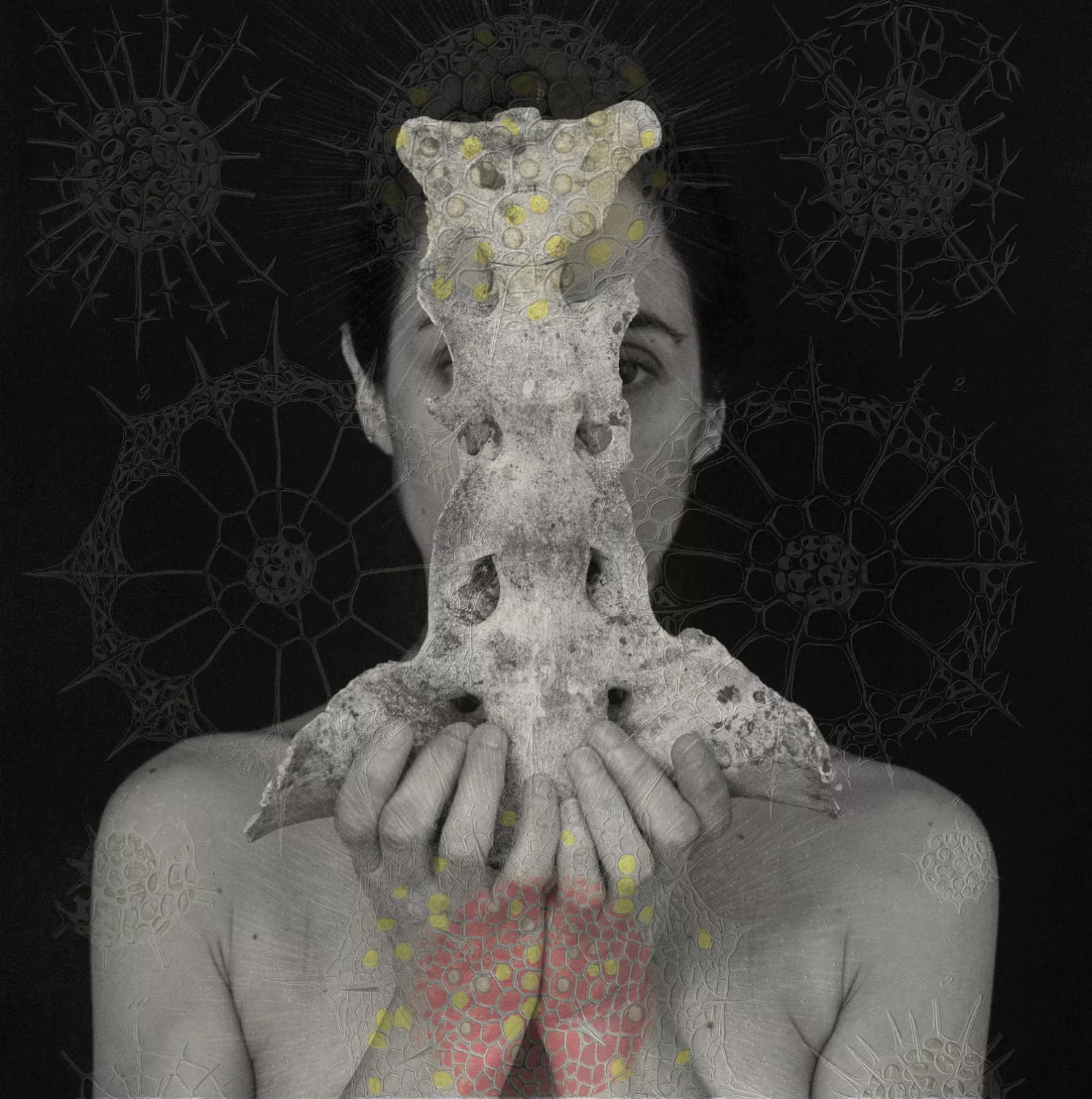
Tatiana Parcero, Ossis Natura Corporis # 5, 2018, Inkjet print on Hahnemühle, 100% cotton, 45 x 45 cm © Courtesy Tatiana Parcero
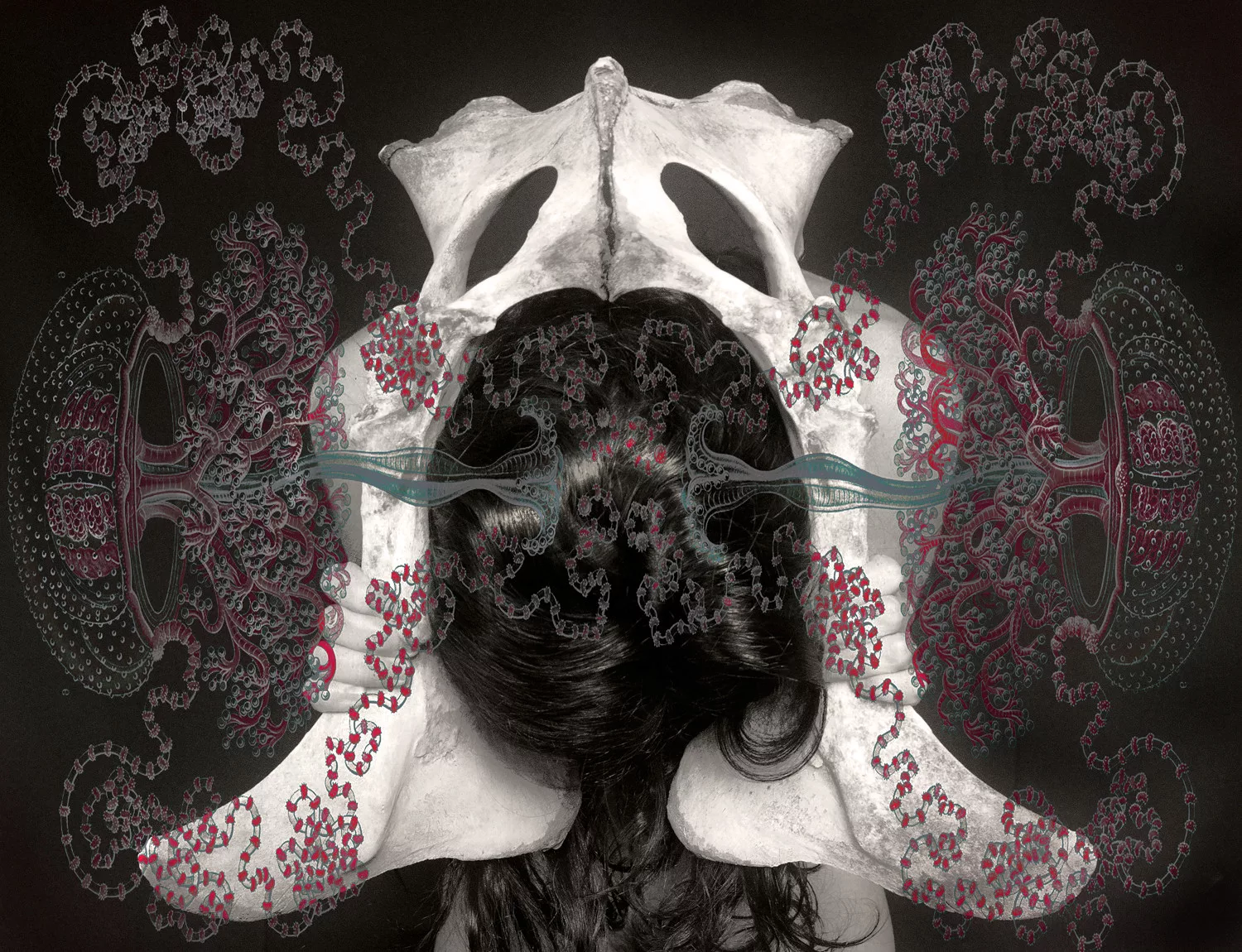
Tatiana Parcero, Ossis Naturam Corporis # 4, 2018, archival pigment print, 67 x 53 cm © Courtesy Tatiana Parcero
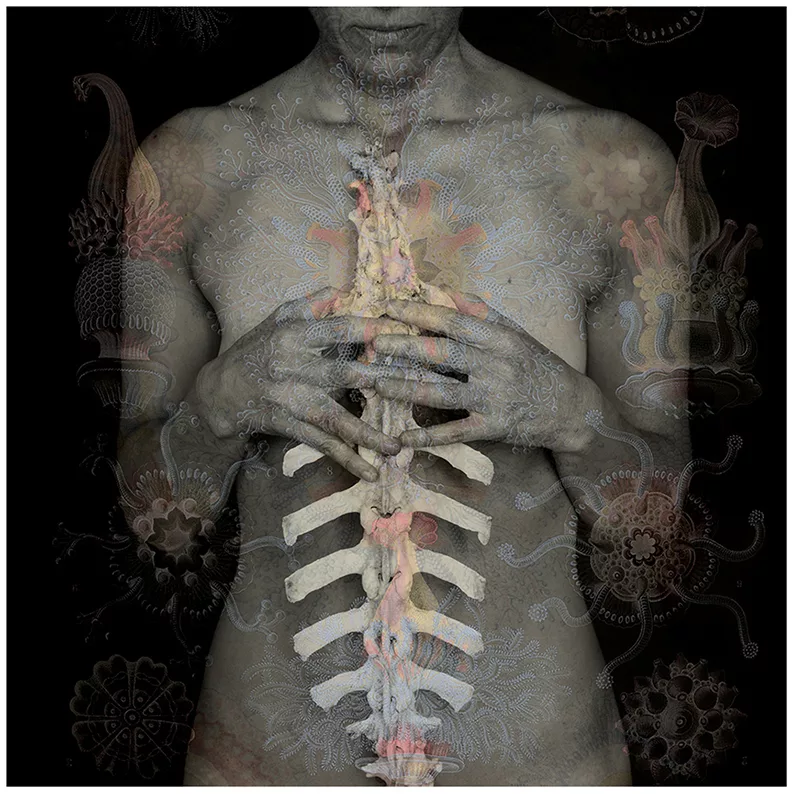
Tatiana Parcero, Ossis Natura Corporis # 2, 2018, Inkjet print on Hahnemühle, 100% cotton, 47 x 47 cm © Courtesy Tatiana Parcero
T. Parcero’s Ossis Naturam Corporis series sounds the alarm by incorporating cattle bones found in Brandsen, a rural area near Buenos Aires, alluding to the end of nature, and consequently the end of humanity, given the interdependence between species. In Ossis Naturam Corporis #5, her nude self-portrait merges with part of the animal’s spine, which she uses to cover her face, integrating herself into it and becoming part of a whole. On top of the two, as if it were a skin extending to the background of the work, the artist superimposes a series of illustrations of sea creatures created by the German naturalist and philosopher Ernest Haeckel (1834–1919), who was the first to use the term ecology. These forms refer to radiolarians, floating microscopic organisms that populate the world’s oceans, feeding on bacteria and phytoplankton. Incidentally, the latter produce about half of the Earth’s oxygen, an example of the links between the seas and both human and non-human life. In this work Parcero colours only certain areas of the radiolarians, the parts that extend across her hands and those located at the top of the cow sacrum she is holding. The communion between her body, with its illustrated skin, and the animal bone, speaks of the fabric made up of all the Earth’s inhabitants, and, at the same time, the urgency of becoming our planet’s caretaker.
The concept of nature’s holistic character and the interdependence of its elements is also addressed in the works Ossis Naturam Corporis #2 and #4. In the former, the animal’s spine rests on the artist’s, as if we could see the inside and outside of the same body. Here hydrozoan cnidarians, Porpema prunella and Porpita porpita, become the skin that covers Parcero’s body. About the first species, covering her chest, very little is known. There have been no confirmed sightings since its discovery in 1801 and its subsequent naming and illustration by Haeckel in 1888, so it may be extinct. Porpita porpita is found in tropical and subtropical areas of the Pacific, Atlantic and Indian oceans, and is common in the Gulf of Mexico due to the warmth of these waters. With the increase in ocean temperatures, its presence is growing.4 These species are testament to the aggressive effects of human actions on the ecosystem, whether by their absence, in the example of Porpema prunella, or their proliferation, in the case of Porpita porpita. In turn, the cow’s spine evokes meat-based diets, requiring herds of animals responsible for enormous methane emissions as well as solid waste and fertilisers that emit nitrous oxide, a substance more powerful than carbon dioxide (CO2). The livestock industry accounts for 14.5% of annual greenhouse gas emissions worldwide.5
In Ossis Naturam Corporis #4, Parcero sticks her head into a cow’s hip bone, producing a strange resemblance to a body on the gallows about to be executed. On top of this picture, she superimposes, like a skin or tattoo, two Thamnostylus dinema, arranged as if mirror images, their filaments spreading out like necklaces. The undulating forms of the cnidarian intermingle with those of the animal’s hip and the artist’s hair, creating the sensation of a crown about to roll off her head.
The multidimensional character of corporeality is emphasised by communitarian feminists, especially the activist Lorena Cabnal, who calls for reclaiming the body. “This is a feminist project that is part of the historic and daily struggle of our peoples to recover and defend their territorial land as a guarantee of a concrete territorial space where the life of bodies is manifested. This is one of the reasons why we communitarian feminists in the mountains of Xalapán have taken up the fight against metal mining, because the expropriation of land, due to the hegemony of the patriarchal capitalist development paradigm, is a grave threat to our relationship, as women and men, with the land and with life. It has devised the concept of land as private property, thus establishing the legal basis of its possession, to ensure that it can reign supreme in a specific space”.6 Thus Cabnal emphasises that in contaminated, exploited territories where women and children are constantly subjected to all kinds of violence it is not possible to achieve a dignified life. Bodies, territories and the Earth must be considered in terms of their close spiritual interrelationship and their care and preservation. Without a worldview that is sensitive to the transcendent and addresses the interdependence of species, we are at the mercy of utilitarianism and the exploitation of nature and bodies. In the Ossis Naturam Corporis series, Parcero addresses this issue through symbols associated with violence and death, in a way that is both subtle and profound.
Tatiana Parcero, Consciousness Terra # 4, 2020, Inkjet print on Hahnemühle, 50 x 50 cm © Courtesy Tatiana Parcero
Parcero made the Consciousness Terra series during the COVID pandemic, which heightened her concerns about the ecosystem. In Consciousness Terra #4 she superimposes over her face branches of Guandalay and Jacarandá trees, which bring back memories of her life in Mexico and Argentina. Jacarandas are native to South America, especially Argentina, Brazil and Paraguay. Their name means fragrant or perfumed in the Guarani language. In Mexico, where they were introduced in the nineteenth century, during the Porfirio Díaz era, they bloom in the spring, transforming the urban landscape with their lilac flowers, which create natural carpets when they fall. Because of the season in which they flower, they symbolise rebirth. Perhaps this is why she superimposed branches from a tree that brings hope for a new beginning onto her thoughtful and pensive face. During the pandemic, perhaps as never before, we witnessed cities where the air became purer through human inaction, plant species turning green again and animals returning to their natural habitats. Parcero depicts this moment of hope with a certain uncertainty through the self-absorption apparent on her face. This process concluded with the end of the pandemic, when humans reoccupied abandoned spaces with no self-reflection or awareness of what had occurred, nor memory of the fragility that had been revealed.
In conclusion, Tatiana Parcero’s works demonstrate feminist art’s commitment to raising awareness about the current eco-systemic crisis and promote the thinking and debate necessary for urgent behavioural change. Otherwise, the very existence of our species on this planet is imperilled.
María Laura Rosa is a professor of aesthetics at the Facultad de Filosofía y Letras (Universidad de Buenos Aires) and a researcher at the Consejo Nacional de Investigaciones Científicas y Técnicas. Her research focuses on feminist art in Argentina, Brazil and Mexico in the last three decades of the twentieth century. Together with Luana Saturnino Tvardovskas she edited O sexo da Arte. Teorías e críticas feministas (2023). She is the author of De cuerpo entero. Debates feministas y ámbito cultural en Argentina 1960-1980 (2021), amongst other books. She is curating the exhibition Tatiana Parcero. Tierra recuperada. Territorio. Cuerpo (2026).