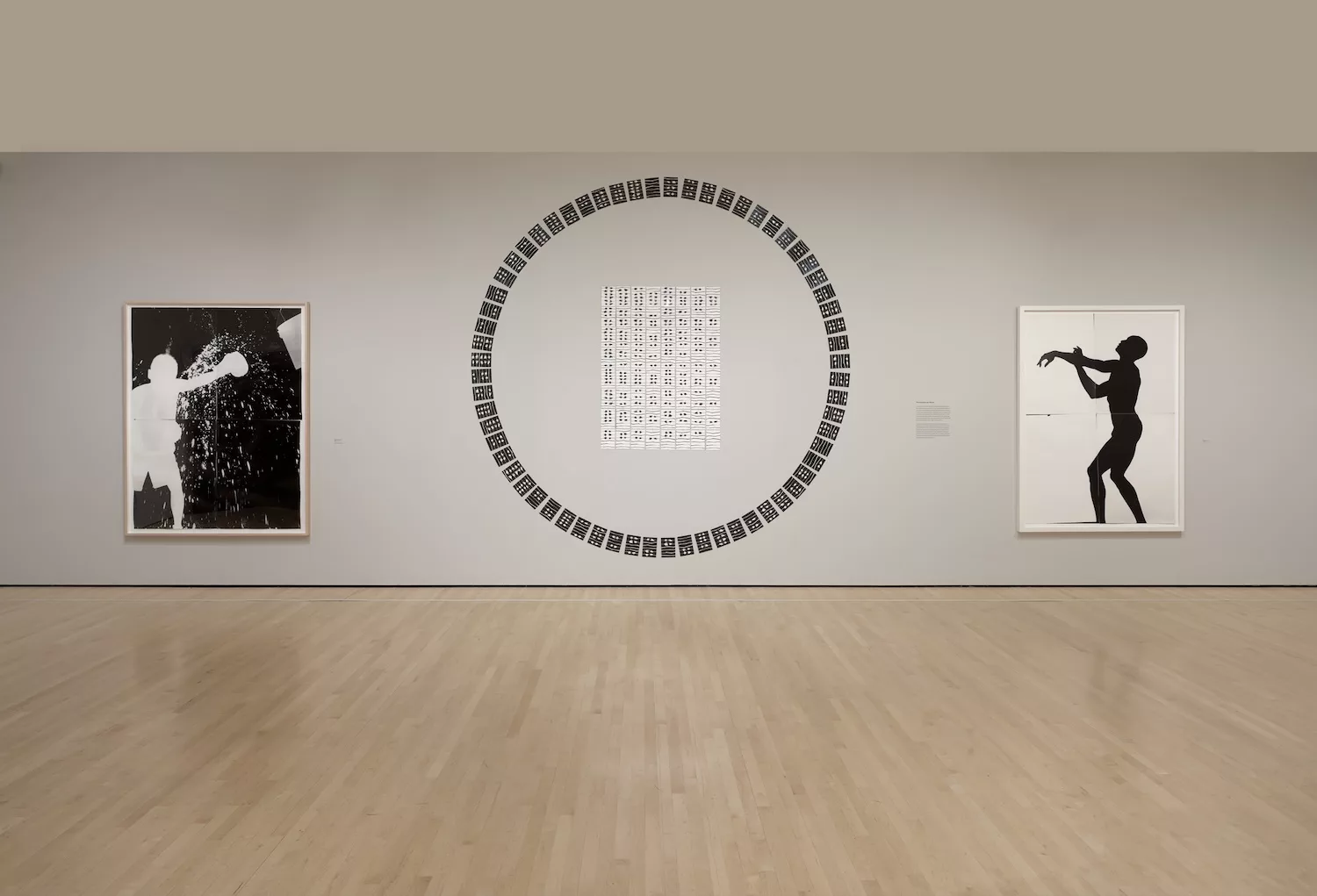
Kunié Sugiura: Photopainting, installation view at the San Francisco Museum of Modern Art, April 26 – September 14, 2025, photo: Don Ross
Kunié Sugiura (1942–) is an artist who has been working in New York since the 1960s. Her persistent attempts to expand the sphere of photographic expression, such as her Photopainting series (1968–), which blends photography and painting, and her experimental photograms, are once more drawing considerable acclaim. The exhibition Kunié Sugiura: Photopainting, held at the San Francisco Museum of Modern Art (SFMOMA) from 26 April to 14 September 2025, is K. Sugiura’s first major solo exhibition in the United States, and it has garnered a good deal of attention. In this interview, we spoke about her thoughts regarding this exhibition and her approach to her latest Photopainting series. (Interview Date: 22 September 2025)
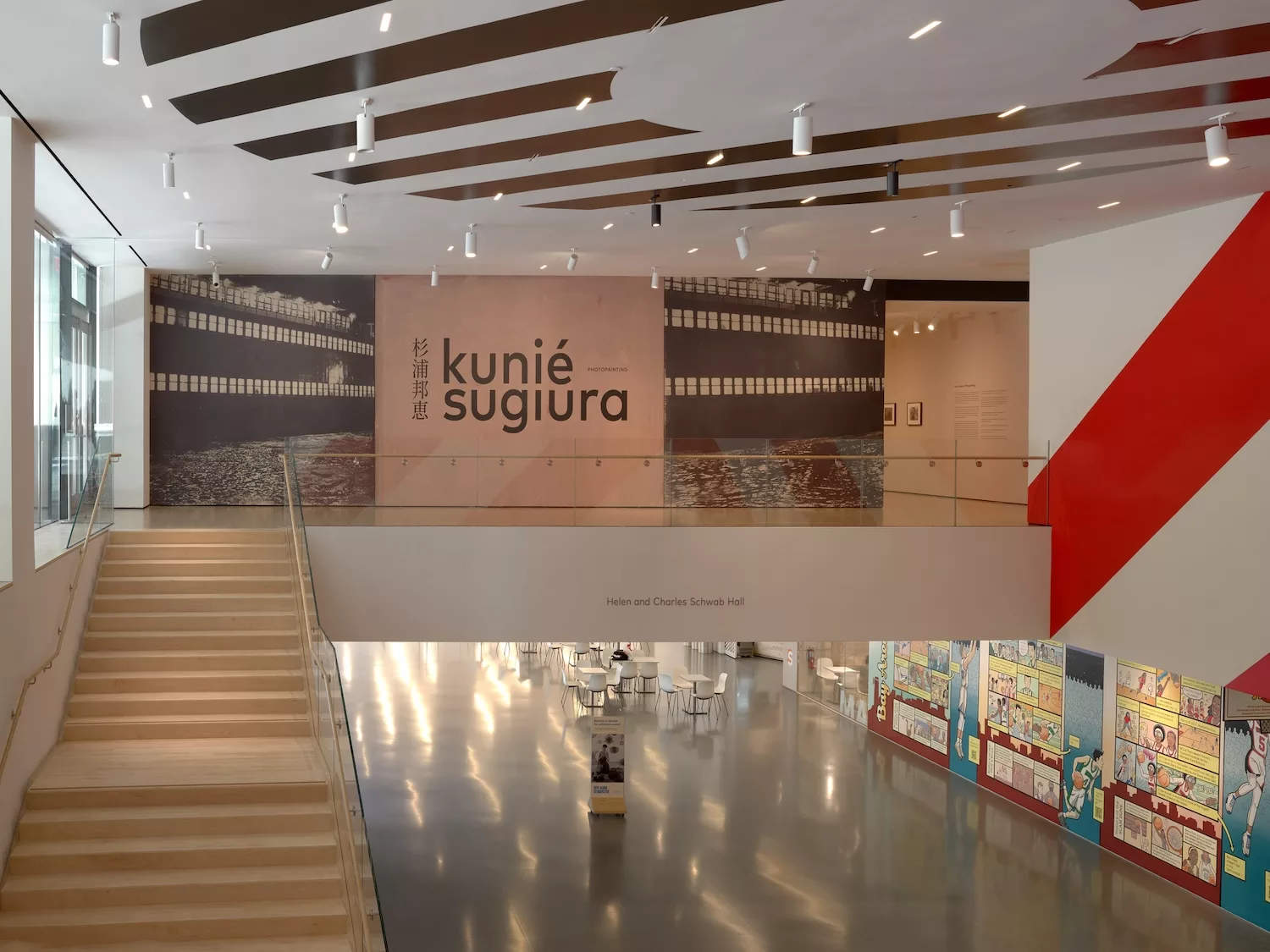
Kunié Sugiura: Photopainting, installation view at the San Francisco Museum of Modern Art, April 26 – September 14, 2025, photo: Don Ross
Sayuri Kobayashi: To begin, could we hear about the sequence of events that led to the opening of the recently closed exhibition, Kunié Sugiura: Photopainting?
Kunié Sugiura: Erin O’Toole, the SFMOMA curator who organised this exhibition, asked me about holding it in April 2023. She had seen my work at a New York art gallery around 2006 and had always wanted to one day hold an exhibition of it.
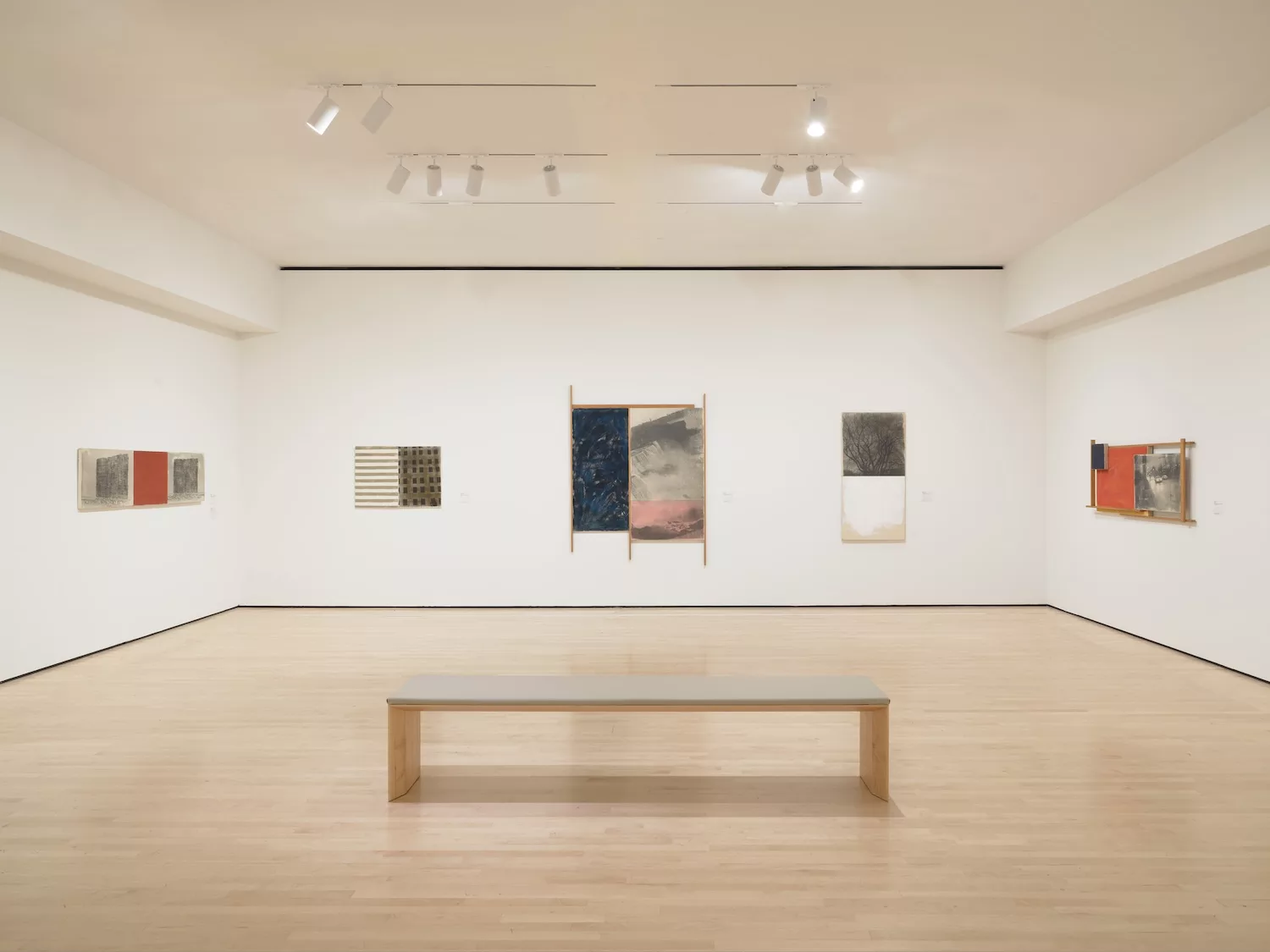
Kunié Sugiura: Photopainting, installation view at the San Francisco Museum of Modern Art, April 26 – September 14, 2025, photo: Don Ross
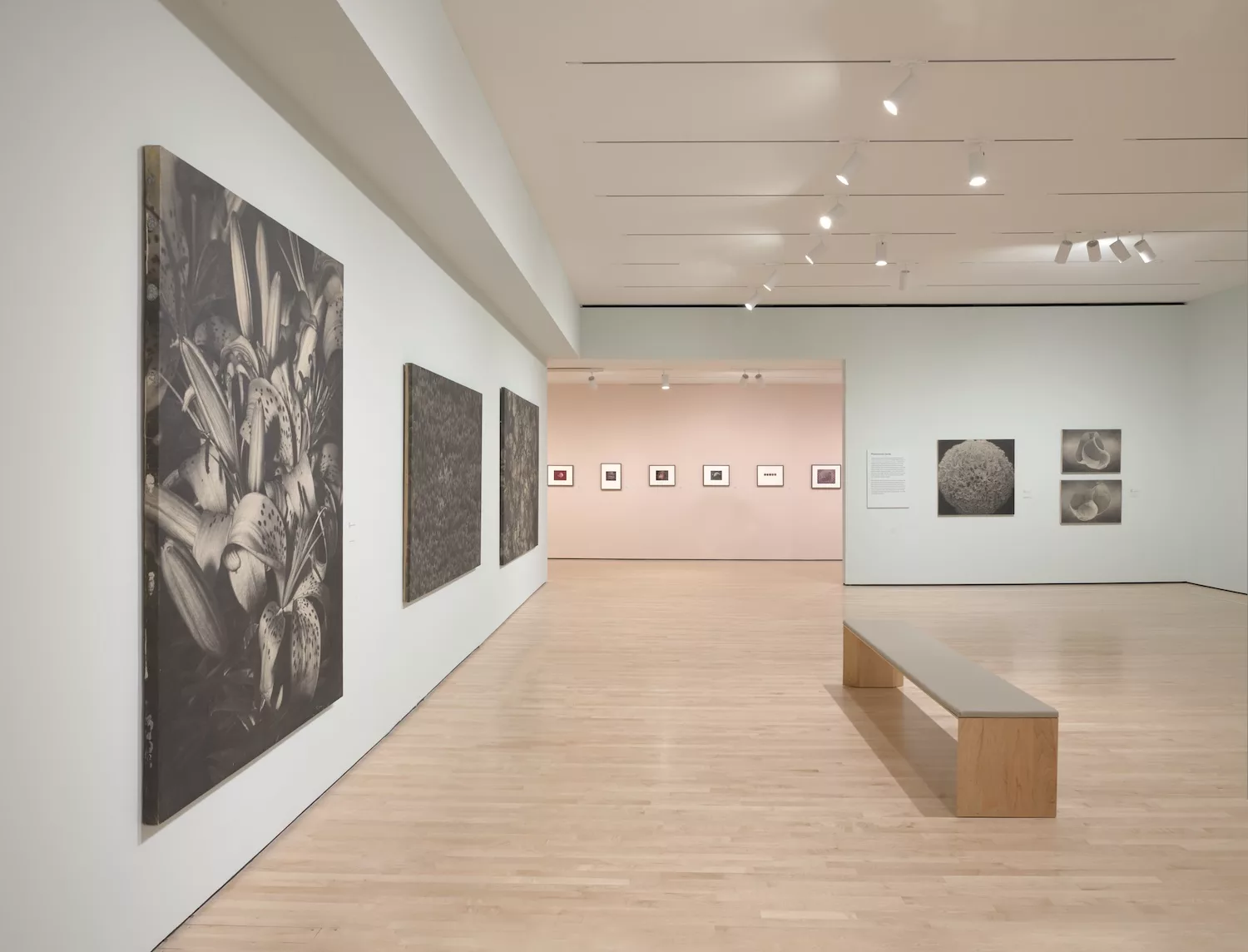
Kunié Sugiura: Photopainting, installation view at the San Francisco Museum of Modern Art, April 26 – September 14, 2025, photo: Don Ross
Kobayashi: How did you decide on the organisation of the exhibition?
Sugiura: In my more than sixty years of creative activity I have produced twelve series. I didn’t start off with the intention of ‘making series’. However, in tackling a single work, new directions and expressions naturally arose, as if branching off from that work, and expanded into diverse variations. Out of those, the Photocanvas and Photopainting series are particularly important to me. Because these were produced shortly after I moved to New York, from 1968 to 1981, I had never had an opportunity to properly present them in the United States until now. I conveyed my desire to have these two series centred at this exhibition. Because I was given total control of the exhibition layout, I was able to devote roughly two-thirds of the space to these series. I placed these series all together in two large exhibition halls. Another large hall displayed the photogram series, an X-ray photography series and recent works that blend photograph and canvas together. Additionally, I included my Cko series from the 1960s, which I hung in the corridor. Because the exhibition was organised in this way, the pieces weren’t lined up according to chronological order as is the case in so-called retrospective exhibitions. Put another way, it took the form of a survey.
Kobayashi: That gives me a good understanding of the perspective from which you organised this exhibition. What was the reaction of the visitors who saw the works?
Sugiura: When I held a solo exhibition at the Tokyo Photographic Art Museum,1 I had the impression that many people simply took the work as is and then just left the venue, but in the United States the discussion was lively. There were a bunch of questions about my work process, and I was able to learn a lot from my conversations with visitors. Also, compared with when I got started in the 1960s and ’70s, photography is now considered a major medium in the art world, and our daily lives are overflowing with photographs. For that reason, understanding of my work has increased to a level incomparable with how it was back then, and that pleases me no end.
At the same time, my work doesn’t end with ‘photography’. It is a form of expression that expands beyond photography. Naturally, I think that pure photography and straight photography are wonderful. However, nowadays, when you look at the New Photography exhibition at the New York Museum of Modern Art (MoMA),2 you’ll see pieces that integrate sculpture and photography and pieces that mix photography and other media together in large numbers; such forms of expression are no longer that uncommon. When I got started, though, that form of expression wasn’t readily accepted. People who did photography didn’t like my efforts. Painters occupied the sphere of painting, sculptors occupied the sphere of sculpting and each category was cleanly divided. I remember being regularly called out by people asking, “Why are your photographs being shown here?” But Andy Warhol and Robert Rauschenberg had already begun this practice in about 1963. They used familiar commercial photography as source material, but, in my case, I did the photography, I applied the chemical agents. I undertook the whole process myself, so my approach was completely different. In any event, the very attempt itself was, at the time, hard for a lot of people to understand. I was often asked “Why not [do] pure photography?”
I, however, don’t see photography as just the capturing of a moment; I believe it can connect a plurality of moments, constructing a sequence. I learned this perspective from Kenneth Josephson in my student days. I have felt, since that time, that photography has tremendous potential. I was also strongly influenced by Eikō Hosoe’s Barakei [Ordeal by Roses]3, which had been featured in a photograph magazine or something that was sent from Japan. Realising that it was possible to produce a cinematic worldview with photographs, I felt that I, too, could do something new. By the second half of the 1960s, I was already becoming aware of myself as an artist who created by using photography as subject matter and not as a so-called ‘photographer’.
Kobayashi: It seems to me that this SFMOMA exhibition has tremendous significance in introducing your Photocanvas and Photopainting series as truly pioneering works, which, though overlooked at the height of the straight photography era, forged a new path between photography and painting.
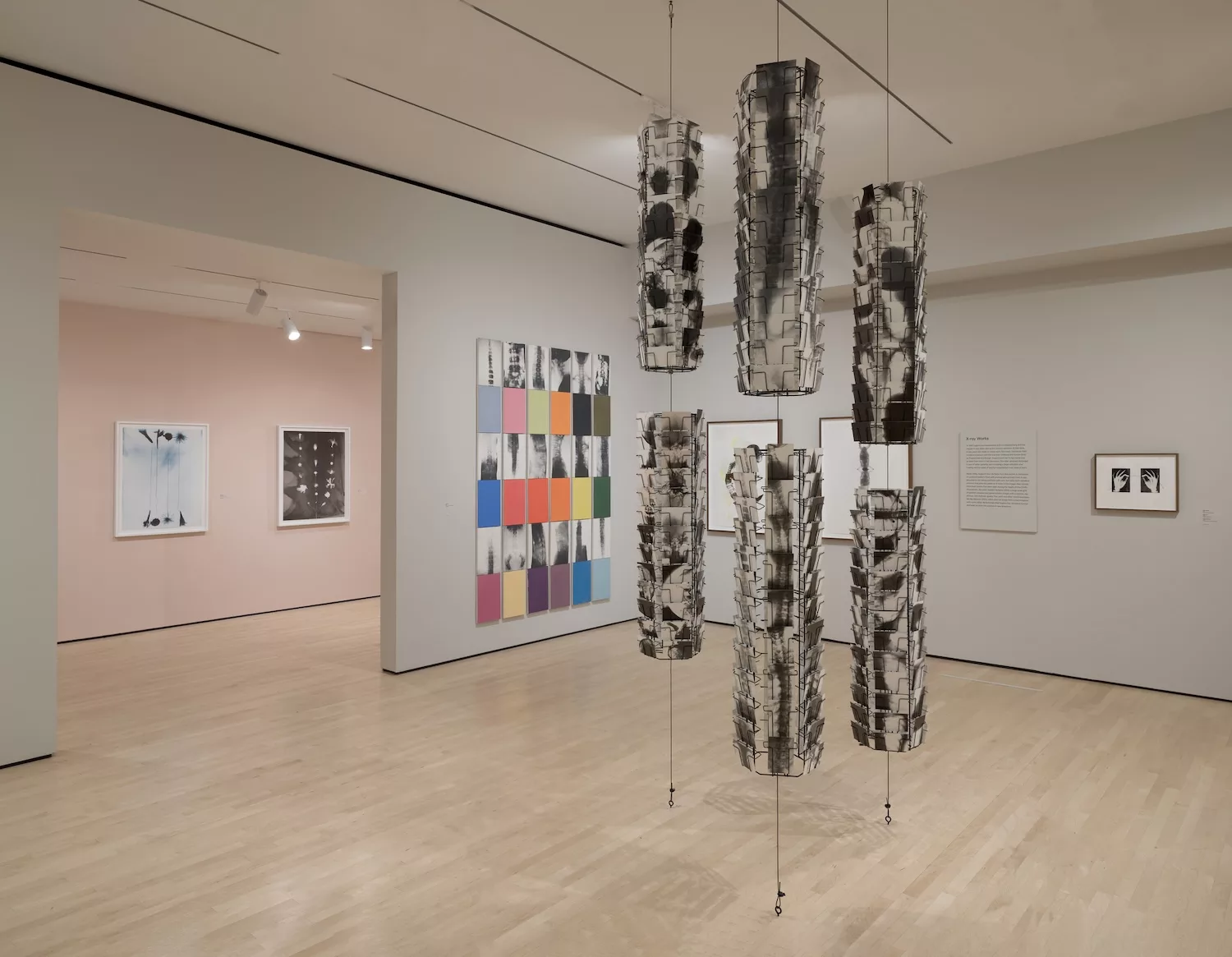
Kunié Sugiura: Photopainting, installation view at the San Francisco Museum of Modern Art, April 26 – September 14, 2025, photo: Don Ross
Sugiura: I didn’t know at first whether Erin would accept my proposal to devote two-thirds of the venue to the Photocanvas and Photopainting series. However, she supported me 100%. Thanks to that support, the last one to two years of preparation have been an extremely fruitful and fulfilling time for me, even though it was difficult.
Kobayashi: After speaking with you here, I feel like the SFMOMA exhibition was an opportunity for you to present the works you yourself wanted to introduce in an ideal manner. This exhibition displayed works as recent as 2021, but could you tell us more about your outlook going forward and your new creative directions?
Sugiura: I’m presently working with both X-ray photography and nature as motif as part of a new Photopainting series. Originally, the X-ray series was something I created in the 1990s after I became ill. I still have a lot of the X-ray film that I collected at that time, and when the COVID-19 pandemic forced me to live without direct contact, I once more realised “Illness and death are not just all around me, they are within me”. This realisation motivated me to look at X-rays carefully and without fear. When I did, I noticed many interesting images, and I began to feel that I wanted to use them to express myself anew. When I began actually using them to create works, I was able to transition smoothly into a new style of expression. I still don’t know myself how these two directions in this current Photopainting series will come together in the future, or if they’ll exhibit an entirely different evolution. For this reason, I want to use the next year or so to explore how my work will develop.
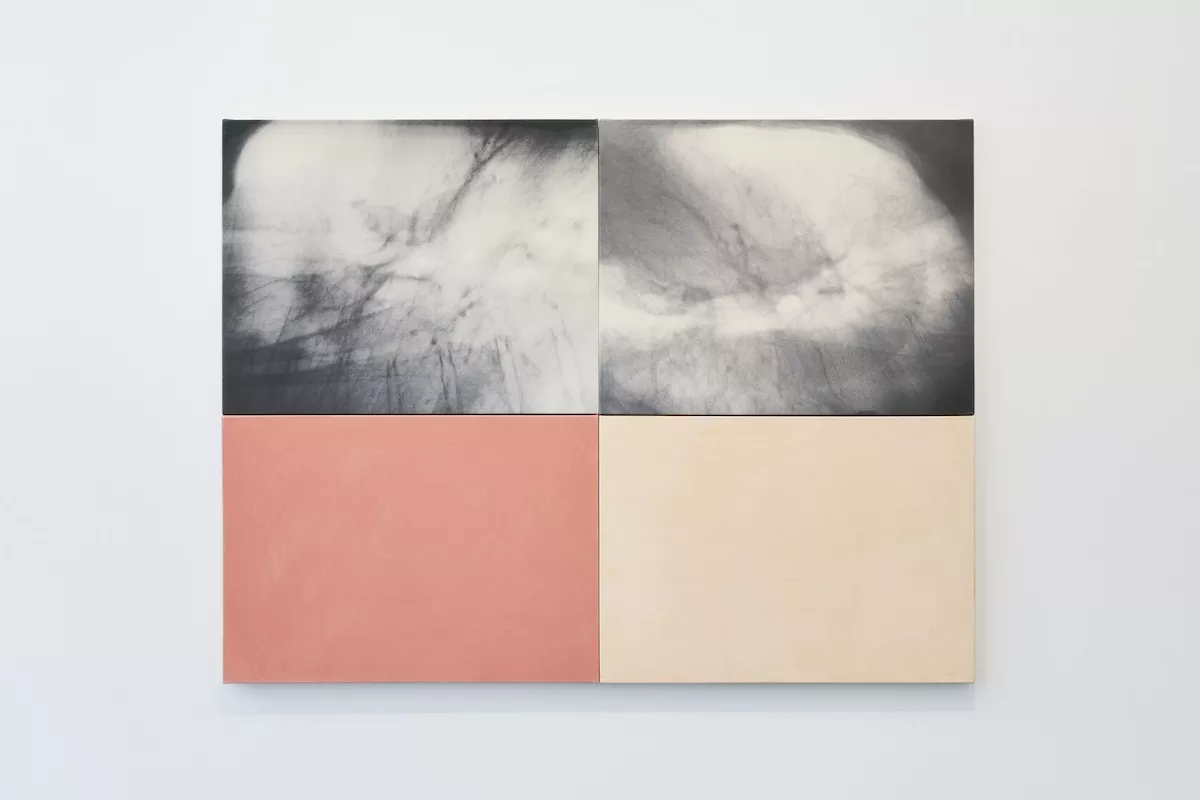
Kunié Sugiura, Fever, 2021, Pigment print, acrylic on canvas, 106.6 x 142.2 cm © Kunié Sugiura, Courtesy of Taka Ishii Gallery, photo: Kenji Takahashi
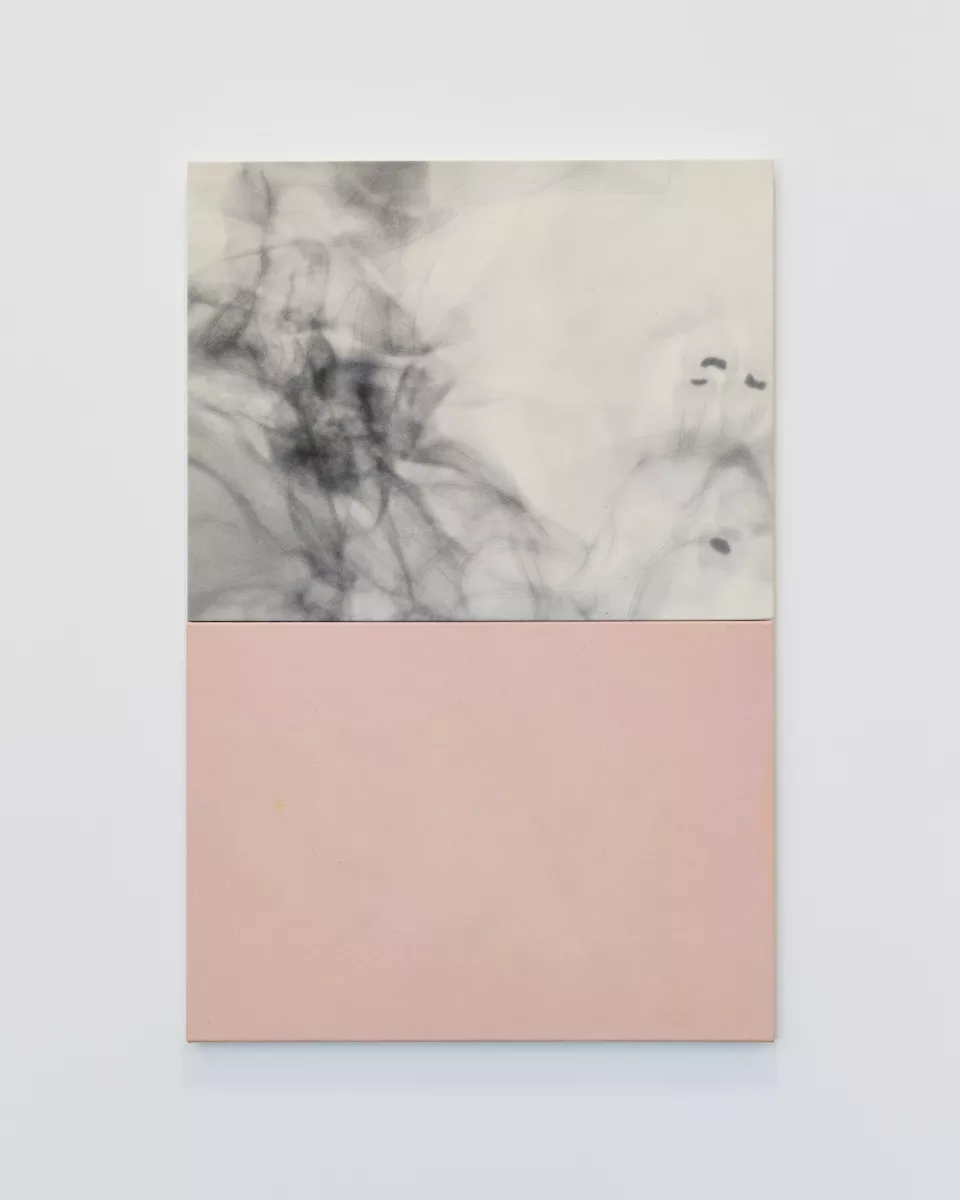
Kunié Sugiura, Oral, 2022, Pigment print, acrylic on canvas, 106.7 x 71.1 cm © Kunié Sugiura, Courtesy of Taka Ishii Gallery, photo: Kenji Takahashi
Kobayashi: There were three examples of these X-ray photography works displayed in your solo exhibition, Kyōkai to Kyōzon [Boundaries and Coexistence] (19 July–23 August 2025), which was held at the Taka Ishii Gallery in Roppongi last month, weren’t there? Fever (2021), Oral (2022) and Nina’s Pelvis & Leg (2025).
Sugiura: Fever and Oral were produced around the time that the COVID-19 pandemic was in full swing. Fever is composed of four separate canvases; one incorporates an X-ray photograph of my lung and another incorporates that of a friend. First, these X-ray photographs were digitised and enlarged. Then they were printed onto canvas using the pigment print method and combined with painted [solid colour] panels. This is a technique that blends different image planes together; it’s an extension of the Photopainting series that I began in the 1970s. Moreover, in juxtaposing differently toned canvases, I’m cognisant of providing the viewer with visual stimulation. Regardless of one’s gender or race, X-rays yield a shared anatomical image, which I find makes them an extremely easy material to work with.
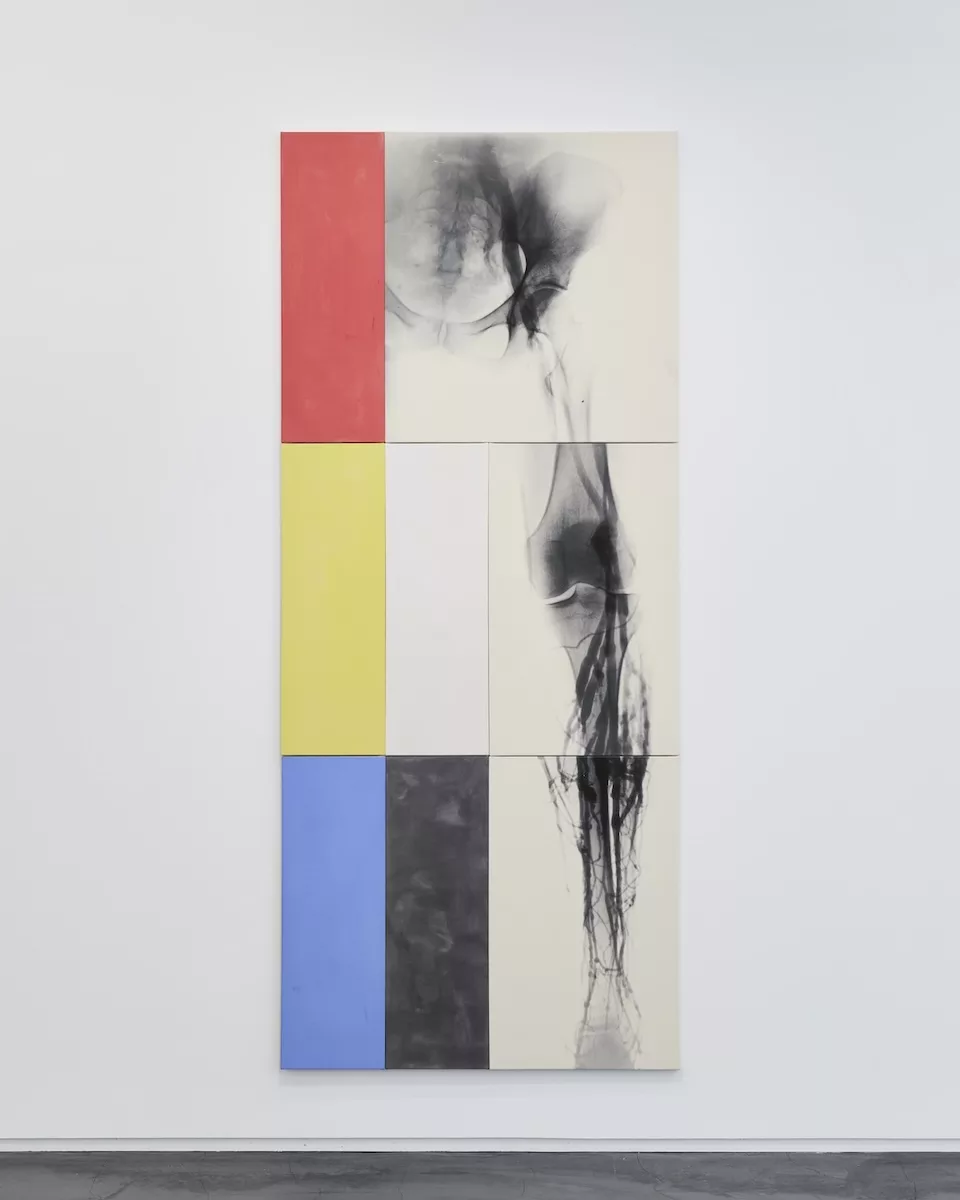
Kunié Sugiura, Nina’s Pelvis & Leg, 2025, Pigment print, acrylic on canvas, 91.4 x 274.3 cm © Kunié Sugiura, Courtesy of Taka Ishii Gallery, photo: Kenji Takahashi
Kobayashi: Fever and Oral employ warm pink panels, while Nina’s Leg & Pelvis use panels in the three primary colours, what significance do these colours have?
Sugiura: I incorporated colour panels because many people find the act of looking at X-rays frightening. This is, I think, because they are associated with death and illness. The reason I appended light [primary colour] panels is because seeing colour indicates the existence of light, and the existence of light indicates the potentiality of life. In other words, it’s a positive message. These works are also akin to a kind of ‘prayer’. Placing images that are liable to evoke fear alongside colour softens the impression of them, conveying the sense that “there is also hope” to the people who see them. I think that pairing them together, rather than pushing them apart, leads to a bit of relief.
Sayuri Kobayashi is an assistant curator at the National Museum of Modern Art, Tokyo. Her publications include “Josei shashinka no fuzai o megutte: ‘New Japanese Photography’ ten ni okeru giron no saikō” [On the Absence of Female Photographers: Reconsidering the Response to the ‘New Japanese Photography’ Exhibitions] in Bulletin of the National Museum of Modern Art, Tokyo, 27 (2023), amongst others.
Kunié Sugiura was born in Nagoya; she currently lives and works in New York. She graduated from the School of the Art Institute of Chicago in 1967. Her numerous unique works expand the possibilities of photography through experimental pieces that blend photography and painting and collections like her photogram series.