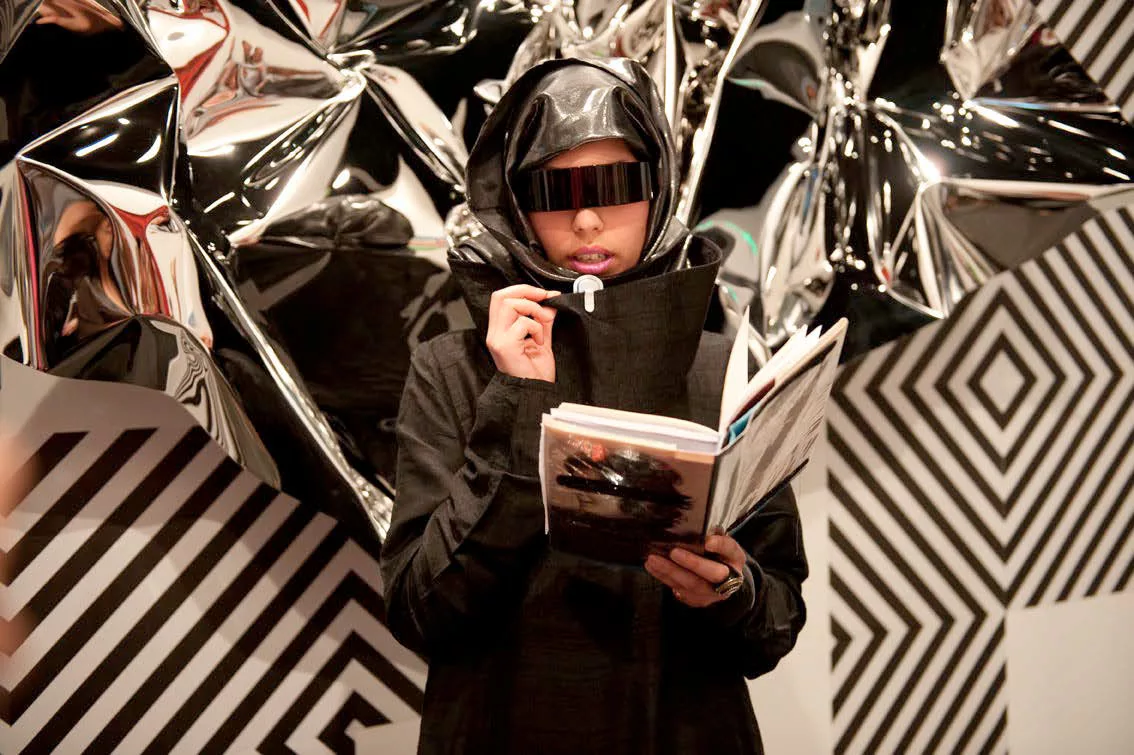
Sophia Al-Maria, Future Tents, 2010, detail from the performance, Art Dubai, artist’s collection & The Third Line, Dubai © Reserved rights
Along the Gulf Arab states, urban spaces have undergone a radical transformation, becoming places of mass consumption and leisure that reflect a hyper-capitalist logic and globalised lifestyle. Numerous examples may be cited: Doha’s Villaggio Mall, celebrated for its Venice-inspired architecture; Palm Jumeirah, an artificial island in Dubai renowned for its luxury hotels and panoramic coastal views; or the massive redevelopment that rendered Abu Dhabi’s Saadiyat Island a vast complex of tourism and culture. This phenomenon may seem to incarnate the idea of Gulf Futurism, but far from it: the concept is not a philosophy of development but an artistic critique of such transformations. Born in the 2010s, Gulf Futurism has significantly evolved since its beginnings. At the heart of this evolution is Sophia Al-Maria (born 1983), a Qatari-American artist, writer and filmmaker, whose works and interventions over time have shaped and redefined the concept. How has Gulf Futurism developed from its emergence? In what ways did S. Al-Maria contribute to its ongoing reinvention? To what extent can we consider it a tool for the social and cultural critique of Gulf societies? These questions remind us of the importance of reimagining methods and historiographies if we are to write an art history of the concept, using the key contributions of S. Al-Maria, while exploring the ways in which her vision has adjusted, over more than a decade, to the sociocultural dynamics of the Gulf and the contemporary art world.1
The roots of Gulf Futurism go back to 2008, when S. Al-Maria self-published The Gaze of Sci-Fi Wahabi: A Theoretical Pulp Fiction and Serialized Videographic Adventure in the Arabian Gulf.2 The work, part theory, part science-fiction, sets out the conceptual bases of Gulf Futurism, among them the idea of the “threshold”, a liminary space between reality and fiction in which we may explore the rapid transformations of Gulf societies.
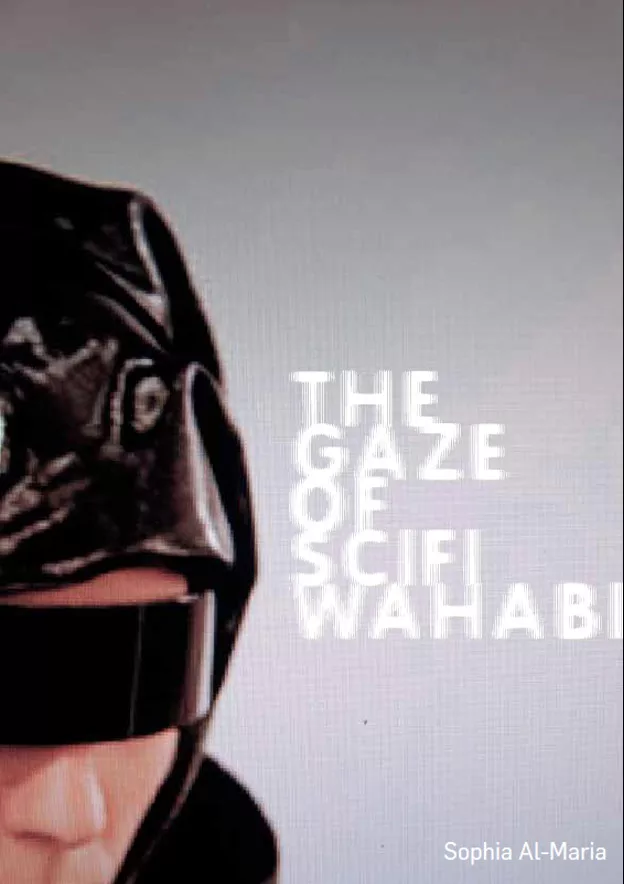
Sophia Al-Maria, cover for The Gaze of Sci-Fi Wahabi. A Theoretical Pulp Fiction and Serialized Videographic Adventure in the Arabian Gulf, Doha, self-publication, 2008, artist’s collection & The Third Line, Dubai © Reserved rights
The text introduces Sci-Fi Wahabi, an alter-ego who allows the artist to reflect on and critique themes such as the impact of new technologies, accelerated urbanisation and the tensions between tradition, modernity and the contemporary. She draws inspiration from Western science fiction and Muslim mysticism, adapting them to the specific context of the Gulf and thus forging what would become Gulf Futurism.
This first formulation focused on social critique and explored the effects of petro-culture on Gulf societies. Yet the work is not pure documentary, thanks to its science-fiction elements: the concept of time-travel and the sub-genre of cyber punk. In effect, the artist seeks not only to formulate a critique but to imagine a space for creation. S. Al-Maria would go on to reuse Sci-Fi Wahabi in other works, such as in her performance Future Tents, presented for the first time at the Art Dubai fair in 2010. It was at this event that she would meet Kuwaiti musician Fatima Al Qadiri (born 1981), who attended the performance and would go on to become one of the artist’s collaborators.
Sophia Al-Maria, Future Tents, 2010, detail from the performance, Art Dubai, artist’s collection & The Third Line, Dubai © Reserved rights
In 2010 S. Al-Maria and F. Al Qadiri joined forces to give a more formal definition to Gulf Futurism, creating together the videos Warn U (2010) and How Can I Resist U (2011). Of course, each may still use Gulf Futurism as part of their respective individual productions, as can be seen on F. Al Qadiri’s 2012 album Desert Strike, or S. Al-Maria’s 2011 video Liminal: A New Fragrance by T.A.Z. Both artists experiment with the aesthetic between sound, image and text.
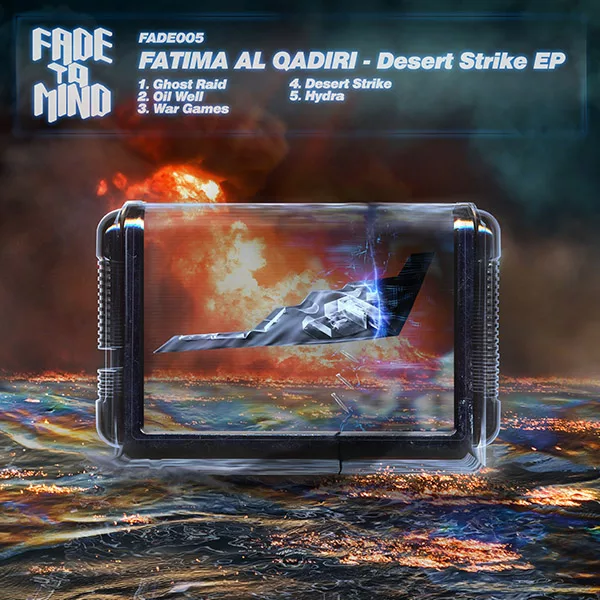
Fatima Al Qadiri, record sleeve for Desert Strike, Extended Play Los Angeles, Fade to Mind, 16 min 38 sec, 2012 © Reserved rights
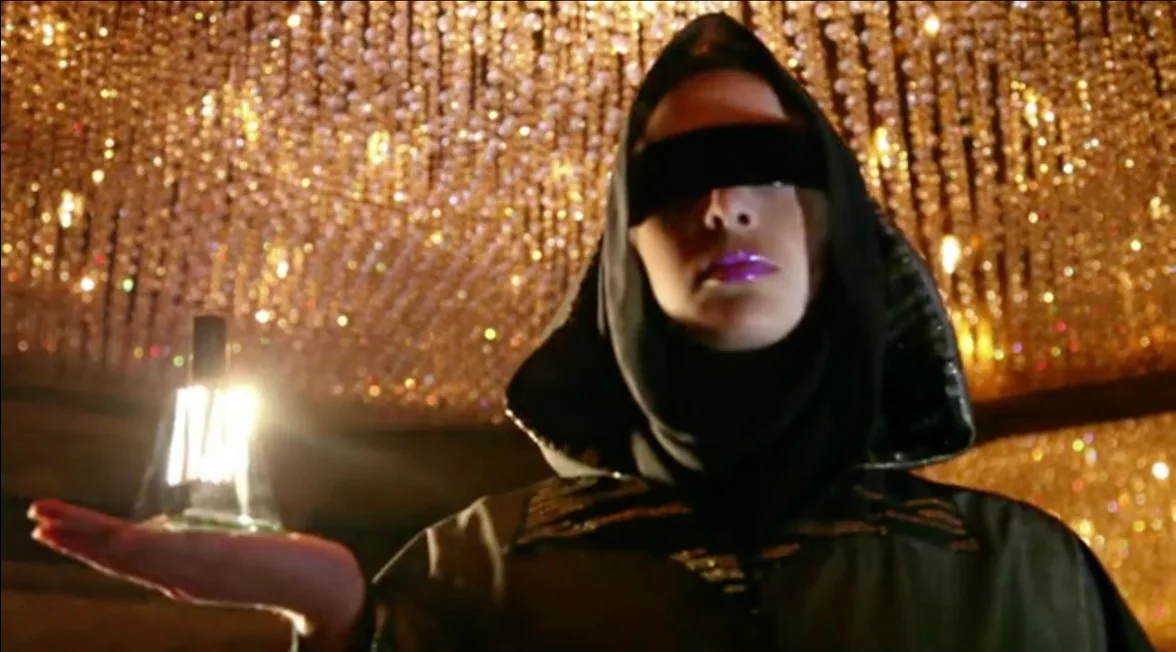
Sophia Al-Maria and Fatima Al Qadiri, Liminal: A New Fragrance by T.A.Z., 2011, still from single chanel HD video, colour, sound, 1 min 15 sec, artist’s collection © Reserved rights
The collaboration led to an interview in British magazine Dazed & Confused in November 2012, followed a few days later by an article-manifesto published on the magazine’s online platform, Dazed Digital. The two texts present Gulf Futurism as an artistic response to the rapid transformations of Gulf societies over the previous fifty years. S. Al-Maria and F. Al Qadiri’s argument is illustrated with tangible examples: for instance, the Sheraton Hotel in Doha and Kuwait City’s water towers offer a perfect testament to the retro-futurist Gulf Arab states architectural trend of the 1970s and 1980s. Elsewhere, the proposed extension of the Great Mosque of Mecca involves both the destruction of cultural heritage and ecocide. Despite such radical changes, civil society continues to adapt to the phenomenon, as demonstrated by the authors’ example of CEO Ahmed Al Jaber, said to own a DeLorean as well as his gold Mercedes and Kawasaki.
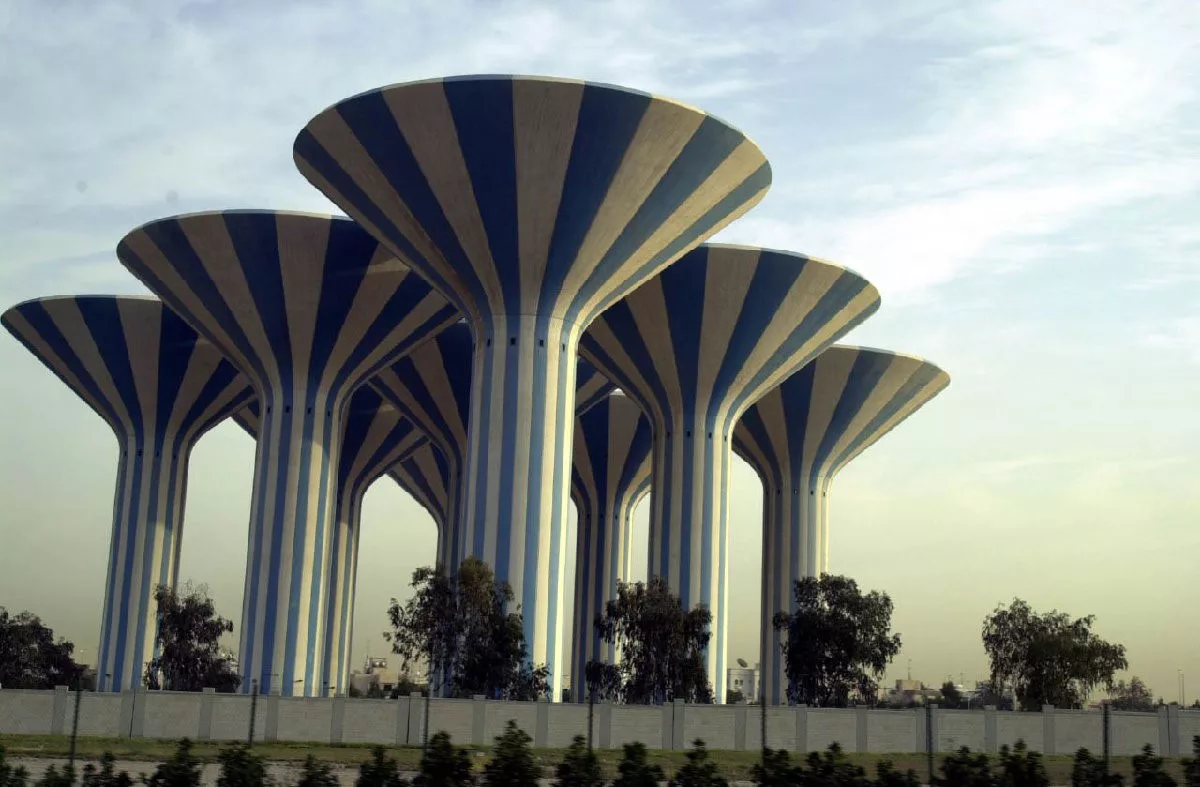
Image of Kuwait City’s water towers published in the article by Sophia Al-Maria and Fatima Al Qadiri “On Gulf Futurism”, Dazed Digital, 14 November, 2012 © Reserved rights
These visual definitions widen the scope of the concept beyond the two artists’ own works, establishing Gulf Futurism as a critical aesthetic in its own right. It also emphasises the links between Gulf Futurism and other artistic movements, notably European futurism of the early 20th century and American retro-futurism and kitsch of the later 20th century. The Dazed & Confused text proved a decisive moment, propelling the artists onto the international contemporary art scene. The publication was in English and was not translated into Arabic: Gulf Futurism was transcending its geographic origins. The ideas the text conveyed rebounded not only in the globalised art circles of the Gulf, but also in the cultural milieux of North America and Western Europe.
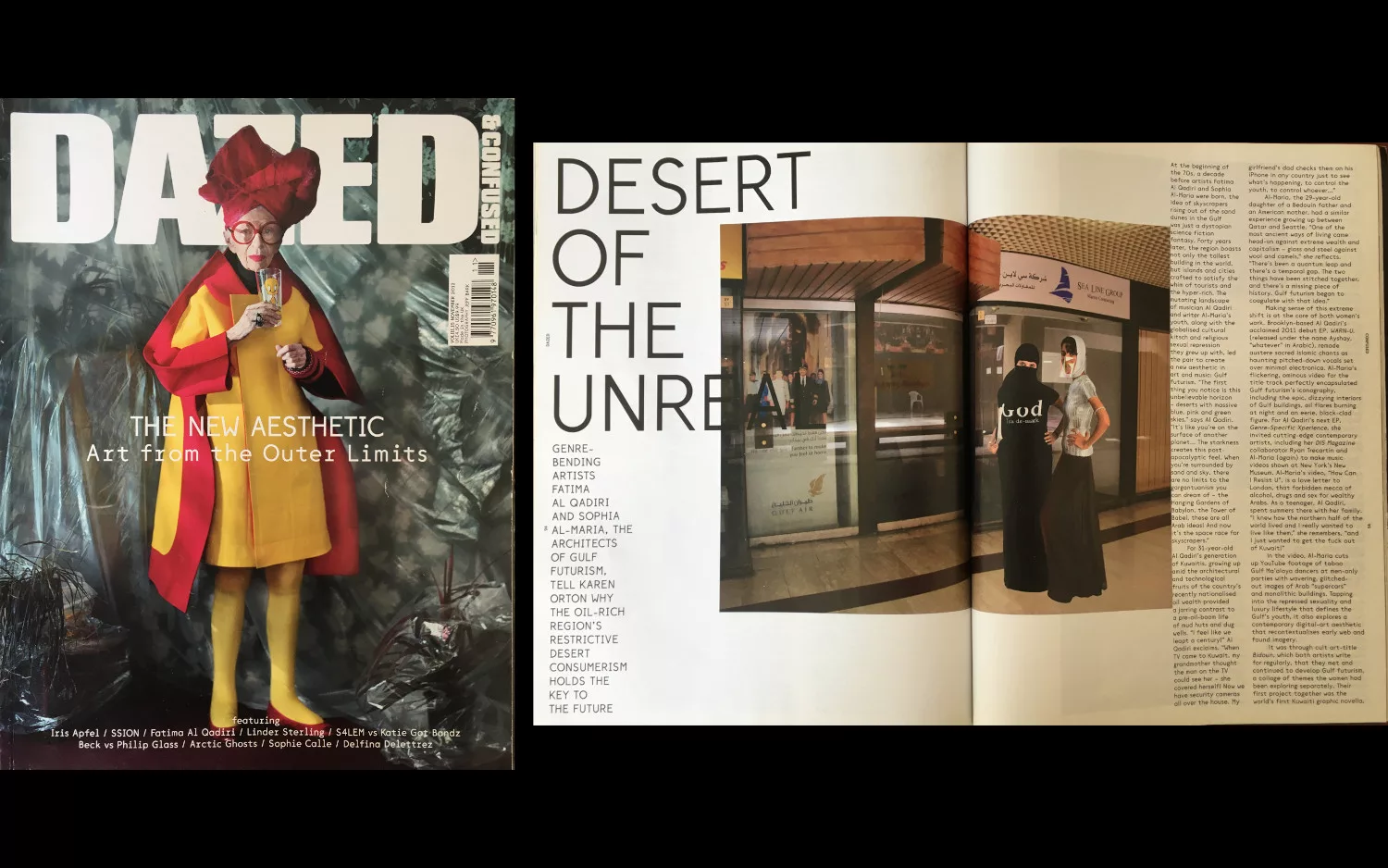
Cover and details of the first pages of Karen Orton’s interview with Sophia Al-Maria and Fatima Al Qadiri, “The Desert of the Unreal”, Dazed & Confused, vol. 3, no. 15, November, 2012, p. 94-99. Photos: Joan Grandjean © Reserved rights
Over the following years, S. Al-Maia would continue to add nuance and depth to her vision of Gulf Futurism. In her conference series “The Future of the Future” at the Vancouver Art Gallery in 2014, she revisited the concept, expressing her ambivalence in the face of the rapid popularisation of Gulf Futurism while it had still been at an experimental stage.3 She notably referred to a controversial article entitled “Gulf Futurism is Killing People”, which had appropriated the concept as a means of criticising the working conditions of the migrant workers constructing the futuristic buildings of the Gulf, such as the Jeddah Tower or the Burj Khalifa in Dubai.4
The way the term was reused in the media was far removed from S. Al-Maria’s original intentions, but it unexpectedly rekindled interest in Gulf Futurism, as much in artistic circles as journalistic ones. Faced with interpretations that reduced the term to a contemporary aesthetic, the artist used the conference to clarify her vision, elaborating on the examples she had cited in Dazed and exploring their evolution through her visual and written productions. For example, her memoir of her childhood, The Girl Who Fell to Earth, is a personal account of the region’s transformations in the 1990s and 2000s, which even at the time she perceived as science fiction.5 She also broadened the scope of Gulf Futurism to include environmental preoccupations in her video A Whale is a Whale is a Whale: Swan Song for the Arabian Humpback (2014), in which she retraces the story of the near-extinction of the creature, from hunting to the destruction of its habitat caused by massive industrialisation in the region since the 1960s.
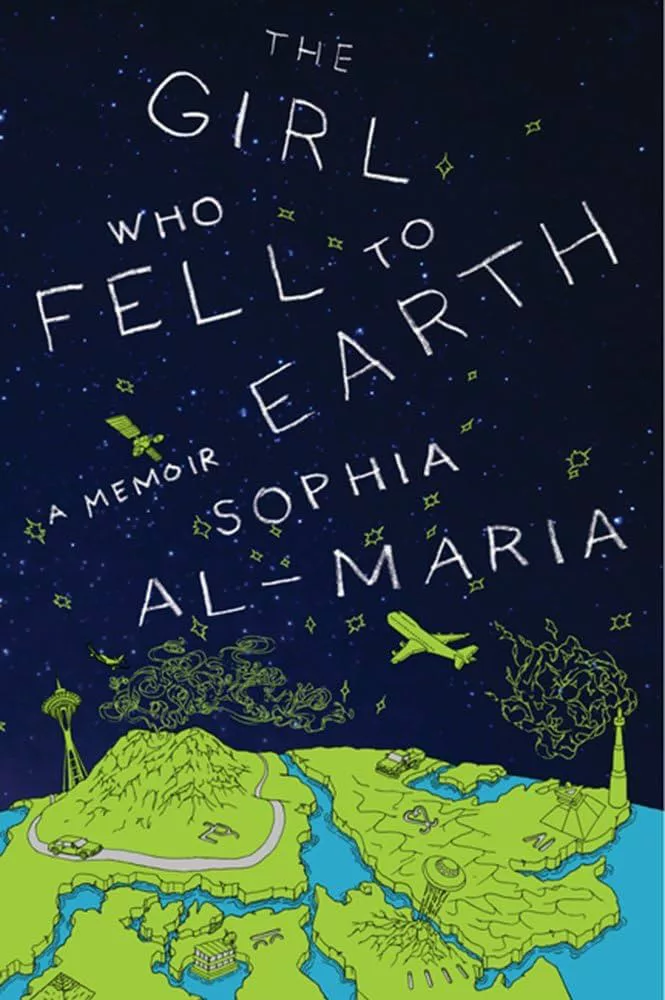
Sophia Al-Maria, cover for The Girl Who Fell to Earth: A Memoir, New York, HarperCollins, 2012 © Reserved rights
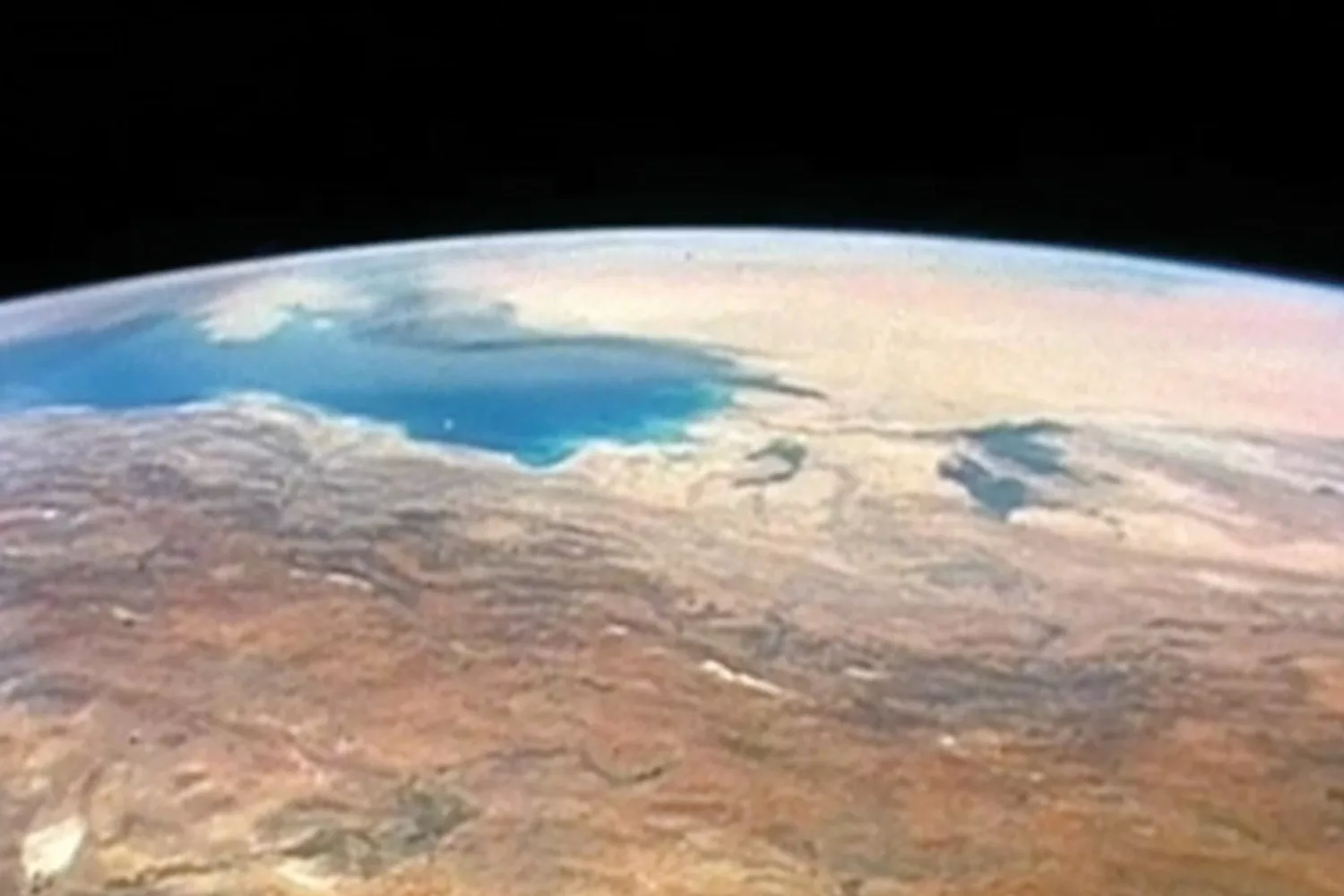
Sophia Al-Maria, A Whale is a Whale is a Whale: Swan Song for the Arabian Humpback, 2014, video still, single chanel HD vide, colour, sound, artist’s collection, with the autorisation of Creative Time Reports © Reserved rights
After producing work on the theme of the desert and travel through ancient temporalities in the videos The Future Was Desert Part 1 & 2 (2016) S. Al-Maria turned her attention to consumer society and the shopping mall. She continued this research across other typical Gulf Futurist landscapes, for instance materialised in the installation Black Friday (2016), created and presented at the Whitney Museum of American Art in New York as part of her first solo exhibition in the United States.
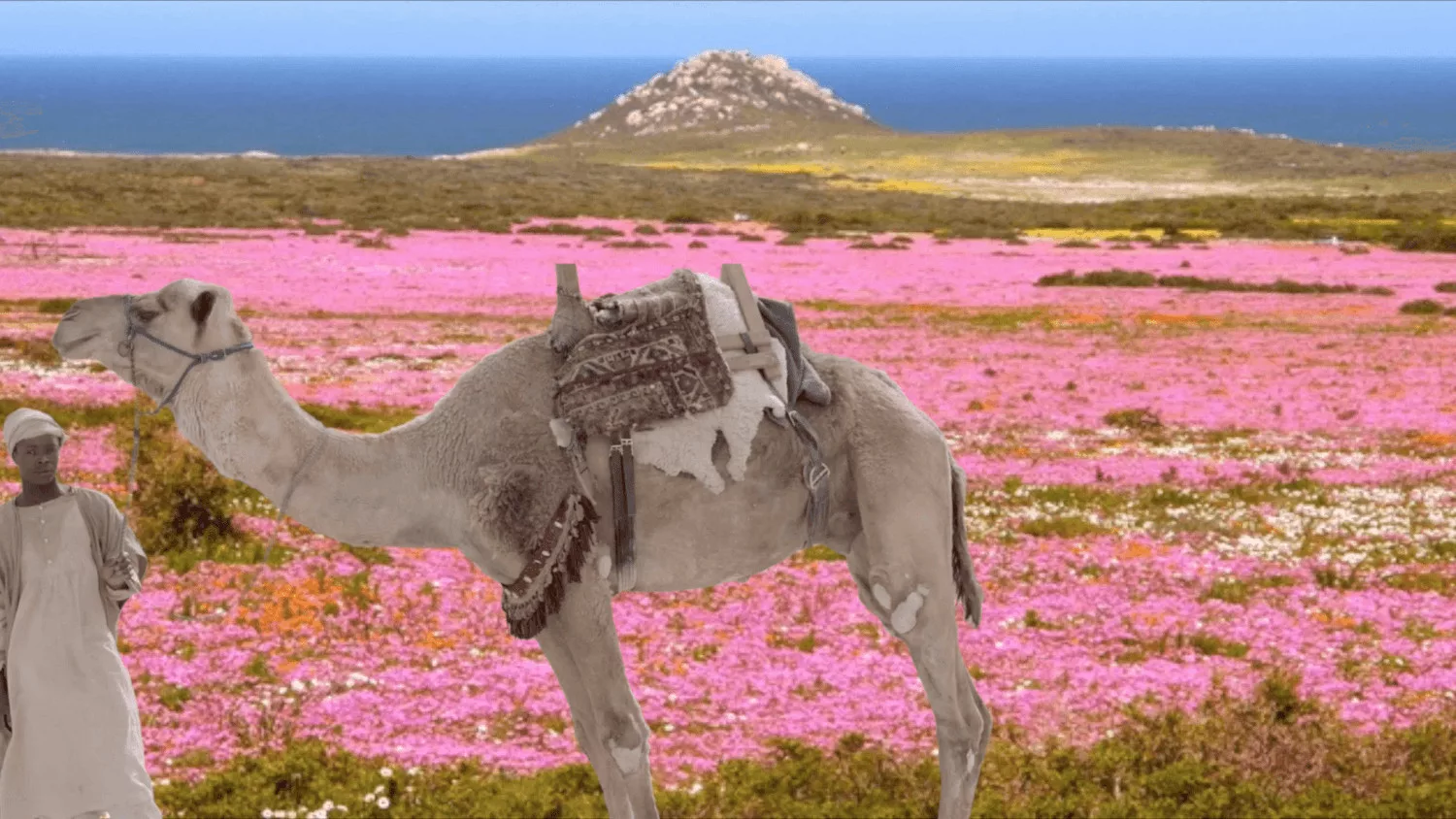
Sophia Al-Maria, The Future Was Desert (Part I & II), 2016, video still, single chanel HD video, colour, sound, 5 min 17 sec, artist’s collection, with the autorisation of Project Native Informant, London © Reserved rights

Sophia Al-Maria, Black Friday, 2016, video still, digital video vertically projected, colour, sound, 16 min 36 sec, artist’s collection, with the autorisation of The Third Line, Dubai © Reserved rights
As the artist is careful to remind us, Gulf Futurism is not an approach that attempts to discuss art and social changes through science and technology, in the same way as Finno-Ugric Ethnofuturism or Afrofuturism, as defined in the 1980s and 1990s. Rather, it is an aesthetic intended to critique the way in which considerable scientific and technological developments set in motion huge social and political changes in Gulf countries. It is a vision of a past future in perpetual reinvention, necessitating an ongoing reformulation of the critical framework.
Through her many works, S. Al-Maria is constantly redefining and enriching the concept of Gulf Futurism, whose evolution reflects not only the rapid evolution of Gulf societies, but also sweeping transformations across the contemporary art world. As of 2016, her approach no longer solely encompasses the Gulf. It is an approach imbued with science-fiction, and adapts in favour of a global geography of humanity.
Yet the artist would revisit the concept in her collection of texts Sad Sack (2019), in an essay entitled “Gulf Futurisms”.6 In this retrospective reflection on a concept that she had temporarily forsaken, she examines the evolution and impact of Gulf Futurism, regarding its adoption by a new generation of Gulf artists not without pride. In its closing lines she cites Monira Al Qadiri’s (1983–) video Behind the Sun, describing it as “a beautiful expression of Gulf Futurism in the end times.”7 More recently, she has observed that the concept has become a rallying point, facilitating connections between young creators who share similar interests.8 Thus we can trace a transformation of Gulf Futurism as it has passed from emerging idea into influential artistic genre, a creative catalyst and starting point for cultural conversations for anyone who wishes to rise up against systems they disagree with.
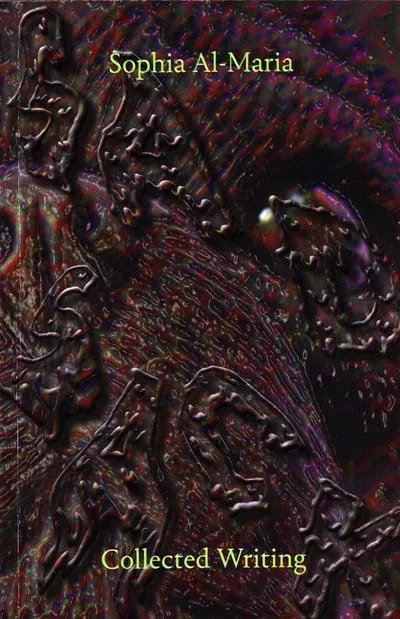
Sophia Al-Maria, cover for Collected Writing, London, Book Works, 2019 © Reserved rights
As Gulf Futurism has evolved, S. Al-Maria has not only theorised but embodied the paradoxes and creative potential of a region undergoing major transformations. More than simply a concept, Gulf Futurism is a kind of Perseus’ mirror held up to the Medusa – a critical reflection constantly repolished by those who wield it. It enables us to confront and deconstruct the vertiginous aspirations and petrifying contradictions of a region that, like the Gorgon, is as fascinating as it is disturbing.
Dr. Joan Grandjean is an art historian and a lecturer in contemporary art history at the Department of Visual Arts at the University of Rennes 2, affiliated with PTAC (Practices and Theories of Contemporary Art) research unit. His research focuses on the intersection between contemporary art, globalisation and imagined futures in South West Asia and North Africa. He co-directed “Photographie et politique”, a double issue of Tumultes, and the exhibition catalogue Arabofuturs. Science-fiction et nouveaux imaginaires at the Institut du Monde Arabe. He is involved in a variety of research associations such as ARVIMM, he also co-founded the Manazir platform.