
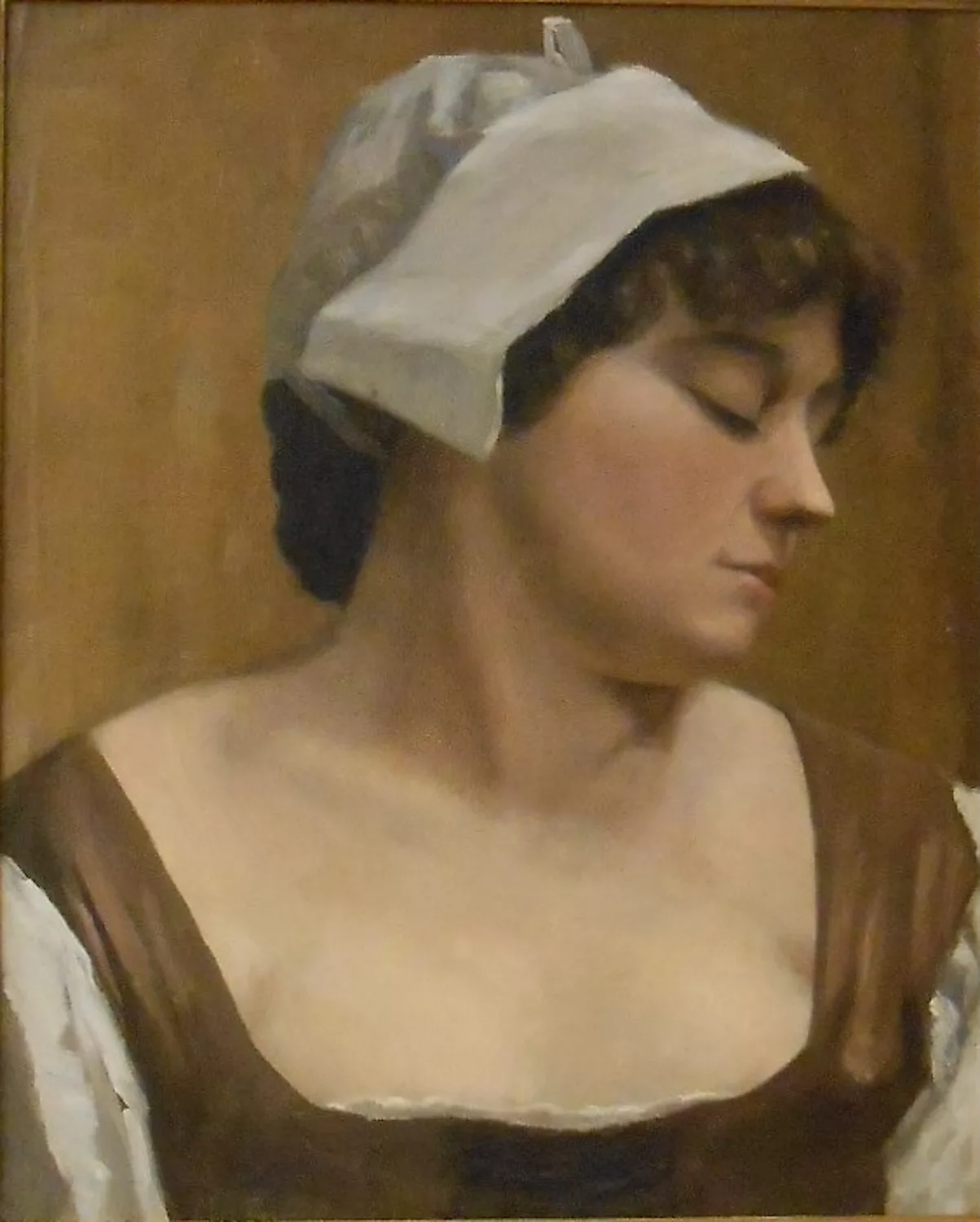
Marie Luplau, Woman with a White Bonnet, 1882, The Varde Museums
In the early 1880s, Paris played an important role as a meeting place for Nordic artists, including pioneering women painters who travelled to France to further their education and learn the French naturalist painting style. From the late 1870s onwards, they sought training opportunities unavailable at home, forming networks that would shape Nordic art for decades to come. Letters and memoirs from Finnish, Swedish and Norwegian artists paint vivid portraits of the artistic environment in Paris, yet the published literature and sources, remains sparse, especially regarding early Danish painters such as Marie Luplau (1848–1925), Emilie Mundt (1842–1922) and Anna Petersen (1845–1910). By referring to the existing Nordic documentation and using the painting of the Nordic artists as a form of silent sources, the intention here is to gain insight into the education they received, their relationships and setting in which they found themselves.
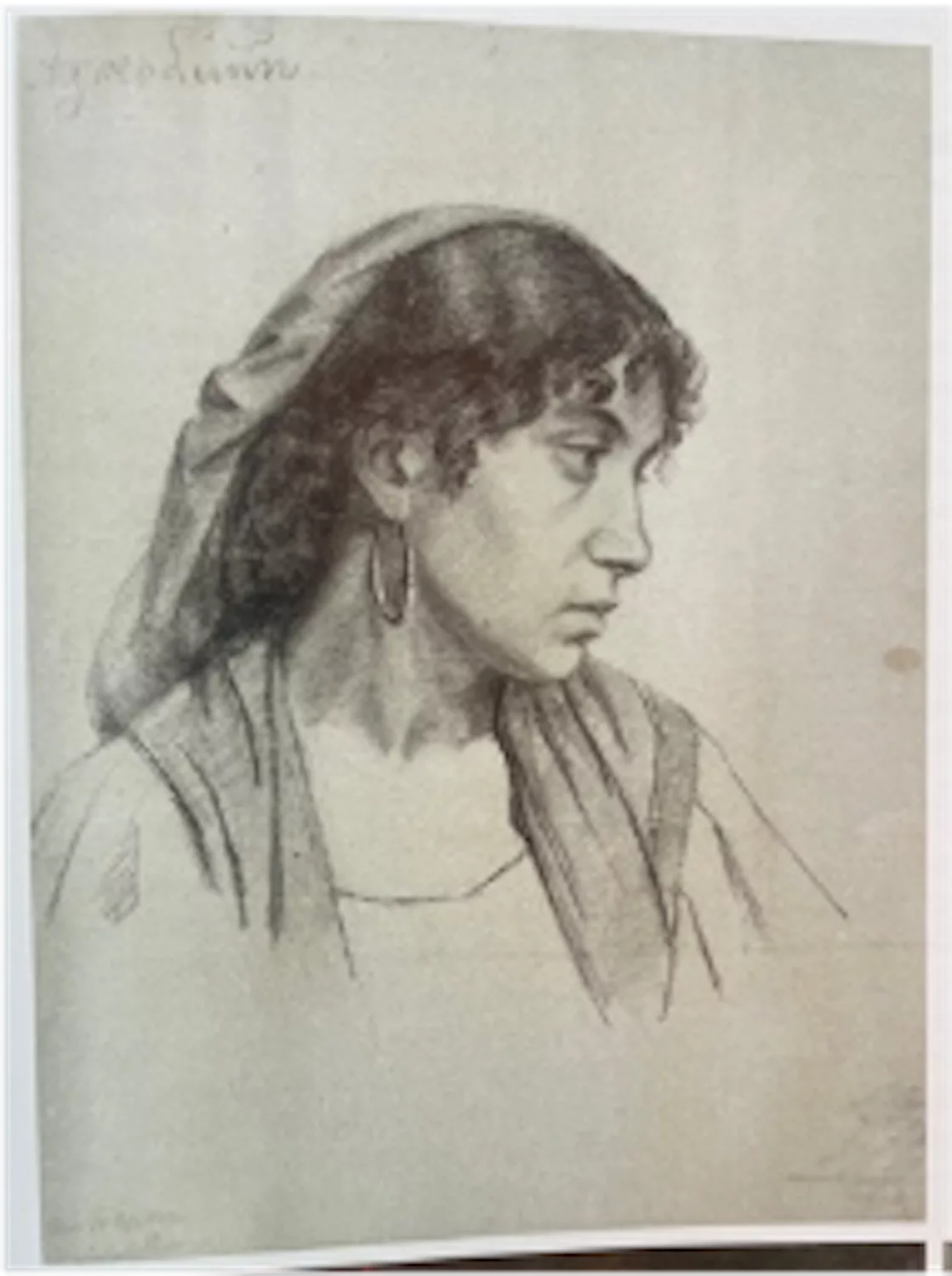
Agens Lunn, Italian Model, 1880, charcoal on paper, 61 × 47 cm, private collection
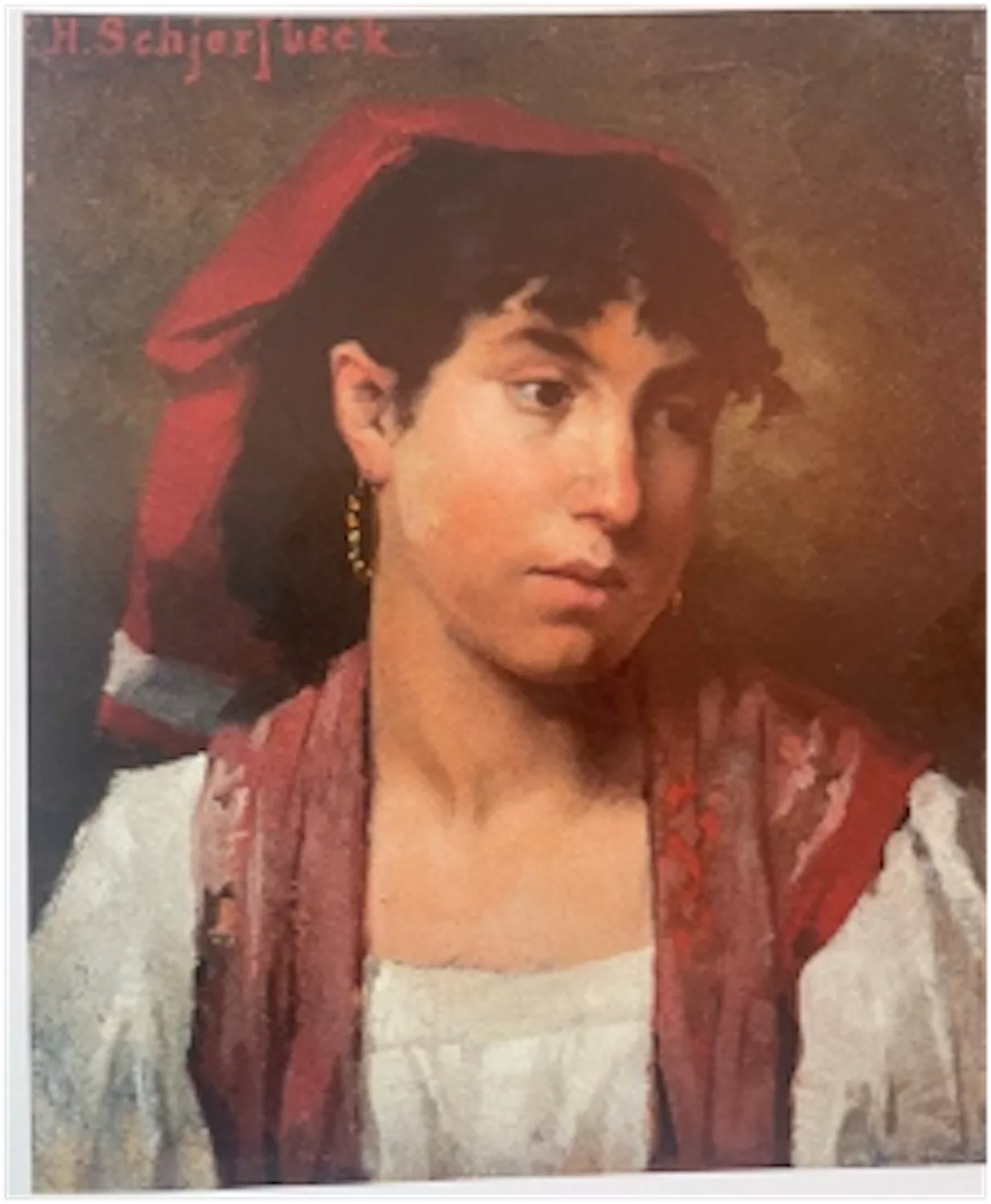
Helene Schjerfbeck, Portrait of a Young Woman, 1880, Aune & Elias Laaksonen’s Collection, HAM Helsinki Art Museum
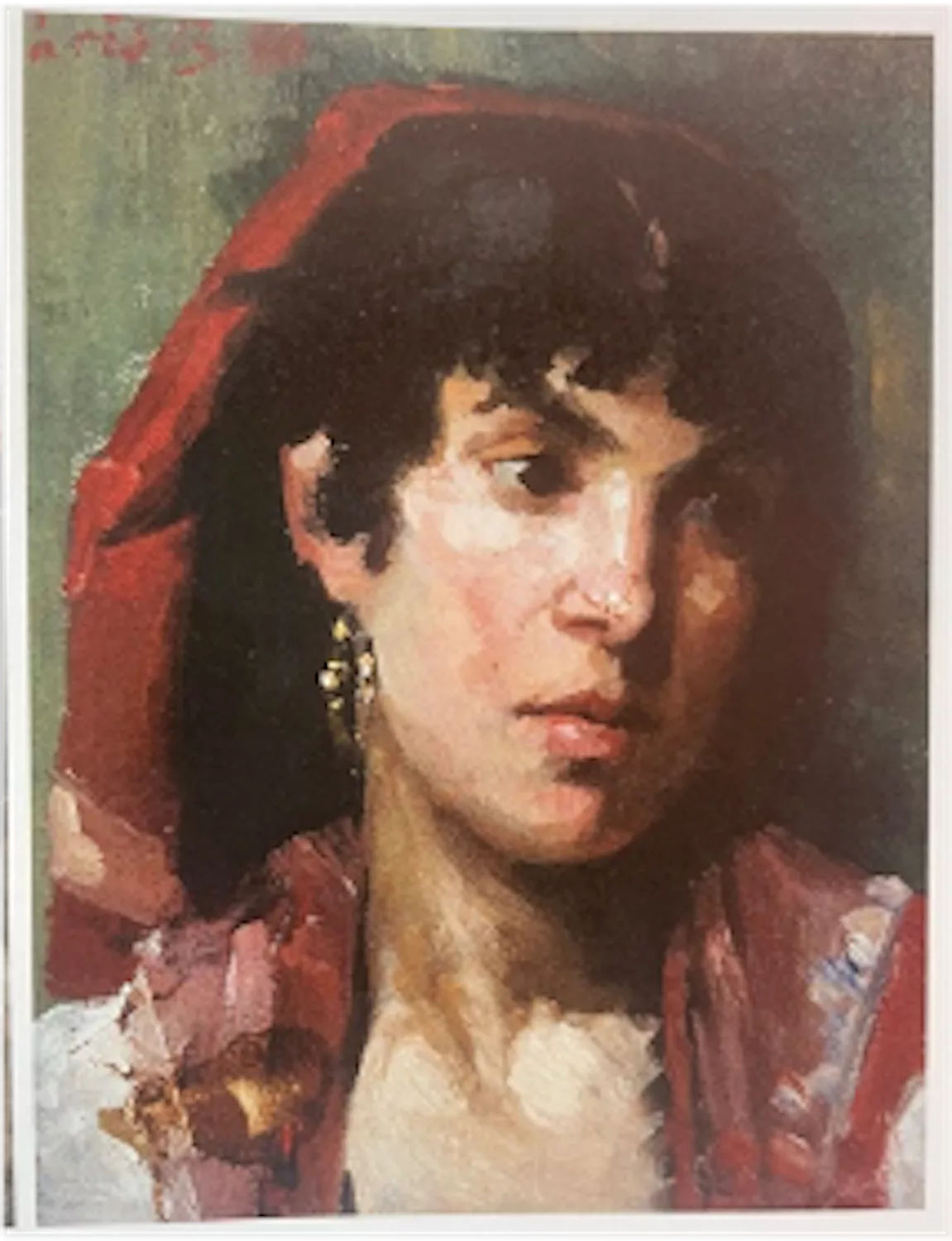
Helena Westermarck, Head of a Woman, 1880, private collection
The Parisian Academies
In Paris, women did not have access to the official French École des Beaux-Arts, nor to the professorial studios that their male colleagues sought out with great success. However, by around 1880, three important schools accepted women: Atelier de Madame Trélat de Vigny, Académie Julian and Académie Colarossi. Trélat’s atelier had a strong reputation, attracting visiting artists such as Léon Bonnat (1833–1922), Jean-Léon Gérôme (1824–1904) and Jules Bastien-Lepage (1848–1884), who critiqued student work. Amongst the students were Norwegian painters Kitty Kielland (1843–1914) and Harriet Backer (1845–1932), and Danish artists including Bertha Wegmann (1846–1926), who attended from 1879, and Agnes Lunn (1850–1941). A drawing dated December 1880 indicates A. Lunn studied there alongside Finnish painters Helene Schjerfbeck (1862–1946) and Helena Westermarck (1857–1938), as all drew the same recognisable model that day.
Trélat’s school closed in early 1881 due to teaching disagreements. H. Westermarck wrote in her memoirs, “At the end of January, we Finns and some Danes decided to transfer from Madame Trélat’s studio to a new student studio which had just opened at this time and would later become very well known under the name of Atelier Colarossi.”1 Filippo Colarossi (1841–1906), an Italian sculptor, had reopened a declining academy in Montparnasse in 1879, transforming it into a renowned institution at 10 Rue de la Grande-Chaumière. Danish painters A. Petersen and Augusta Dohlmann (1847–1914) studied there alongside H. Westermarck, H. Schjerfbeck, Ada Thilén (1852–1933), Julia Beck (1853–1935) from Sweden, and Austrian Marianne Preindlsberger (1855–1927).
Many Swedish artists attended the Académie Julian instead, including Maria Wiik (1853–1928), and Amélie Lundahl (1850–1914) was amongst the first Finnish women to study in France in the 1870s. Meanwhile, M. Luplau and E. Mundt, who had previously studied life drawing in Munich and opened Copenhagen’s first drawing school for women, arrived in Paris in January 1882 and enrolled at Colarossi. Here, they met M. Preindlsberger. Classes included nude models from 8 am to noon, costumed models from 1 to 5 pm, and optional life drawing classes in the evening for particularly tenacious students. Teachers Gustave Courtois (1853–1923) and Raphaël Collin (1850–1916) visited weekly to critique students’ work.
Marie Luplau, Woman with a White Bonnet, 1882, The Varde Museums
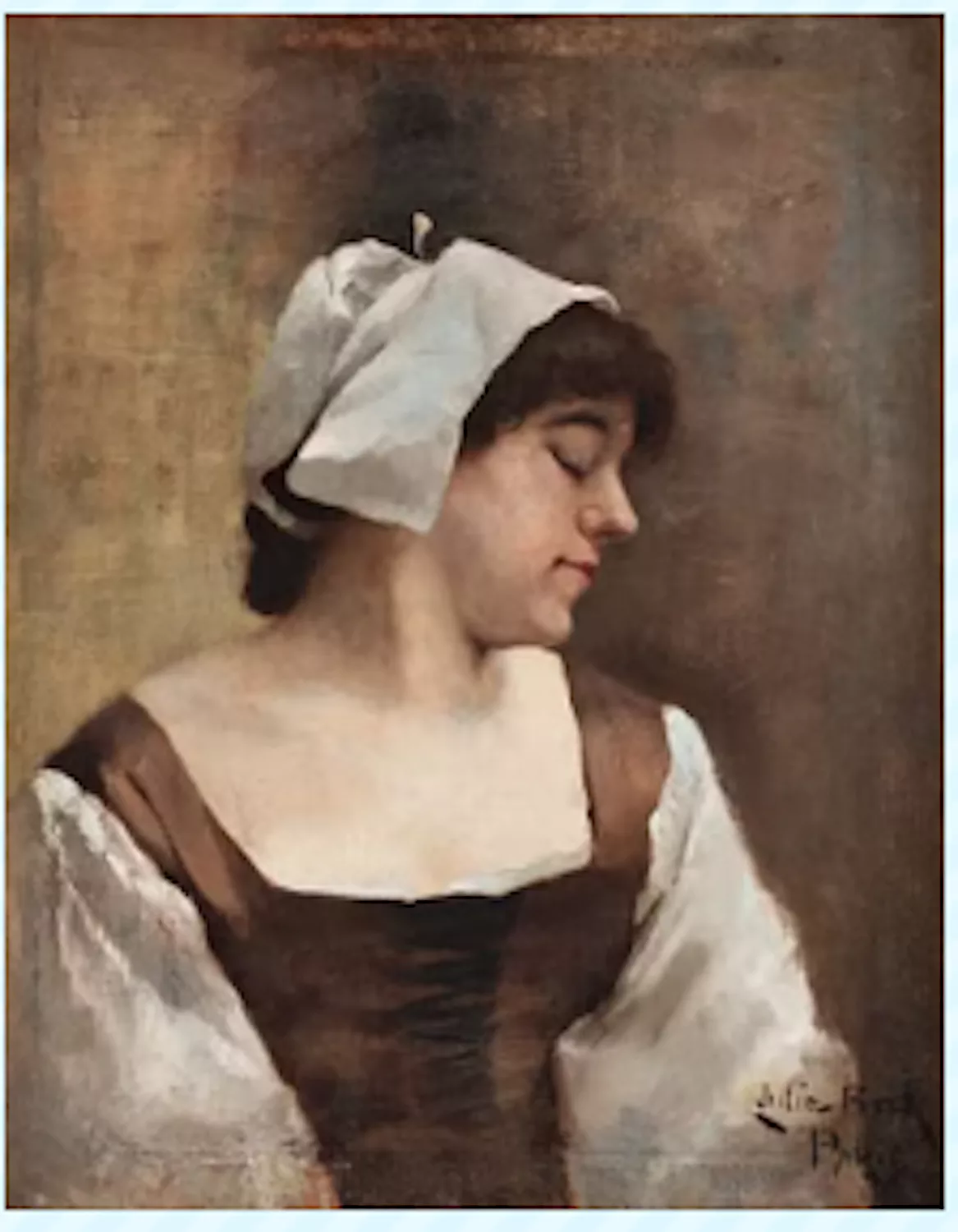
Julia Beck, Woman with a White Bonnet, n.d., oil on paper on panel, 40 × 32 cm, private collection
Drawing and painting from nude models formed the foundation of artistic training. However, costumed model studies were equally important, preparing students for painting genre and historical scenes. Italian models from the Abruzzi region, wearing ciociaria costumes, were particularly popular, alongside Arabs, North Africans, elderly toothless women and models dressed as court jesters and Spanish toreadors. Sixteen known studies by M. Luplau and E. Mundt survive from Colarossi, approximately half featuring costumed models. One session in December 1882 included a seated young woman in a white cap with her eyes closed. M. Luplau painted her in profile and J. Beck slightly to her left. Swedish painter Eva Bonnier (1857–1909) described painting a “handsome negro in an Arab costume”2 at Colarossi, and a small study shows that M. Luplau must have participated in the same session.3 Such costumed studies have often been overlooked by art historians, yet they reveal the training behind later genre scenes.
The fact that the women participated in the same classes does not necessarily mean that they socialised. However, the classes seem to have been small, and the Nordic students at Colarossi must have been quite dominant. Judging by H. Westermarck’s account, some sense of fellowship prevailed. She has provided a vivid description of the cheerful atmosphere during lunch breaks, where many stayed in the studio to eat their packed lunches. Afterwards, they would drink ‘café noir’, meticulously brewed on a spirit stove, which allegedly prepared the students for the next four hours of work.4
A Nordic Artists’ District
Scandinavian artists clustered in Montmartre and Montparnasse, while on the left bank, near the university and École des Beaux-Arts, affordable lodgings attracted Nordic women painters. M. Luplau and E. Mundt, who had fought in vain for women’s access to the Royal Danish Academy of Fine Arts in Copenhagen, arrived in Paris in January 1882. This was a remarkable time: the newly formed Union des Femmes Peintres et Sculpteurs had successfully launched a major annual exhibition exclusively for women artists at the Palais de l’Industrie on the Champs-Elysées. M. Luplau and E. Mundt lived at 14 Rue de l’Université in 1882, near K. Kielland and H. Backer at No.19. J. Beck lived nearby at 12 Rue Jacob, while M. Preindlsberger lodged at No.14. The Hôtel du Mont-Blanc on Rue de Seine housed Lundahl, M. Wiik and H. Schjerfbeck at various times. M. Wiik and H. Schjerfbeck also shared a studio at 4 Passage Dulac.
We can summarise it by saying that this quarter, which teemed with cafés and cheap crèmeries, was a haunt for these Danish, Norwegian and Finnish women painters living in close proximity. Women often lived together for safety and companionship in an unfamiliar city. The so-called Finnish ‘painter sisters’ knew each other from their training back home in Helsinki, and M. Preindlsberger had become an integral part of their community. They were roughly the same age, most of them in their twenties, while the Danish and Norwegian women mentioned here were well over a decade older. However, attending the same classes had brought them together. One of the meeting places for Finnish and other Nordic artists and writers was the spacious studio of the sculptor Walter Runeberg (1838–1920), where large parties were held. Here, H. Backer and K. Kielland could be found amongst the guests. However, the summer stays in the French artists’ colonies would be especially significant.
The Finnish and Danish Painters in Brittany
When classes ended for the summer, Nordic artists were eager to go outside and practice plein air painting. In 1882 M. Luplau and E. Mundt stayed in Pont-Aven. They returned in 1883, again staying at Pension Gloanec, famous for its long communal dining table where artists discussed work and ideas late into the night. H. Schjerfbeck, M. Preindlsberger and M. Wiik lodged at the nearby Hôtel des Voyageurs, often joining meals at Gloanec.
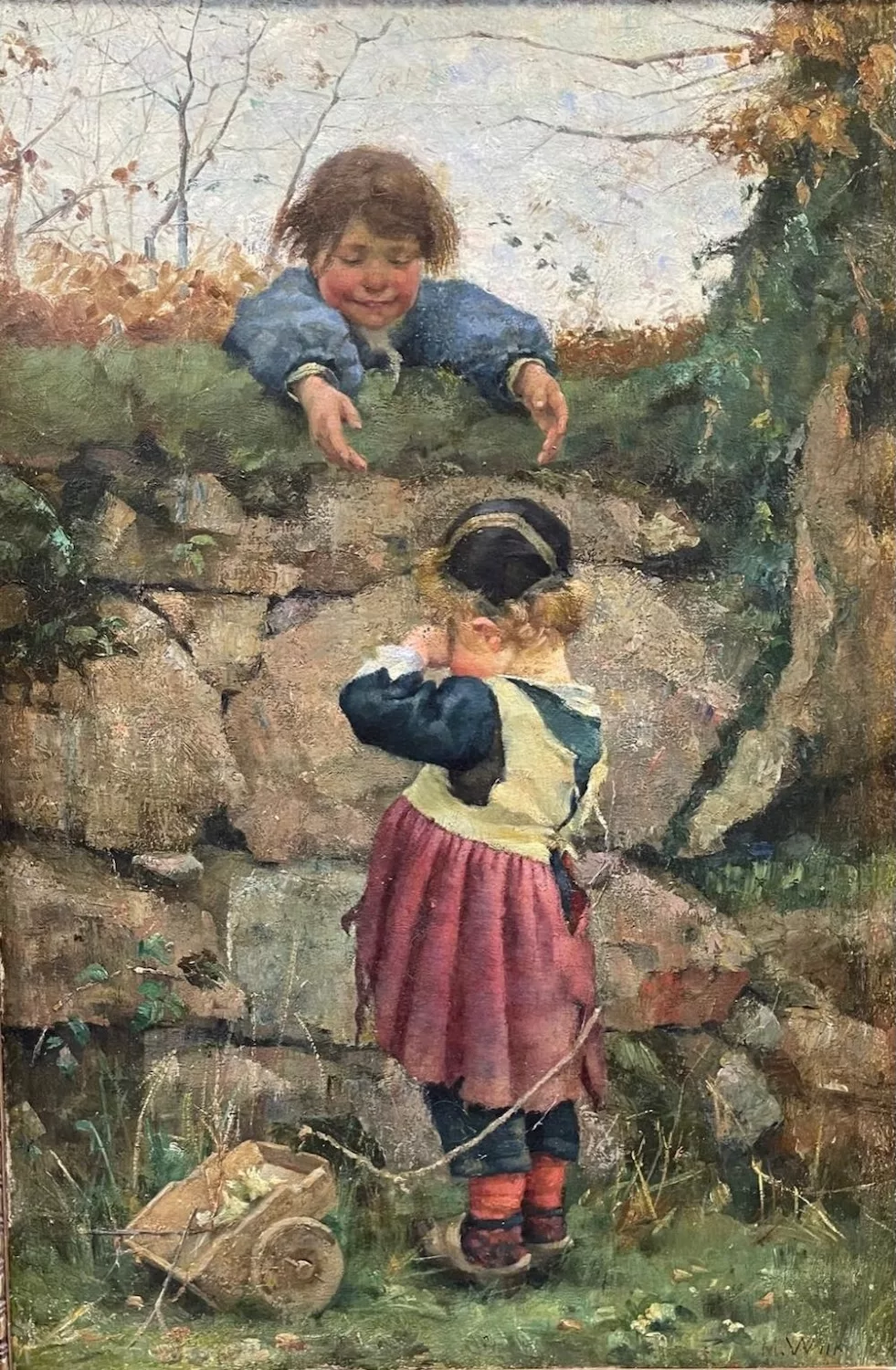
Maria Wiik, The Obstacle, 1883, oil on canvas, 80 × 54 cm, private collection
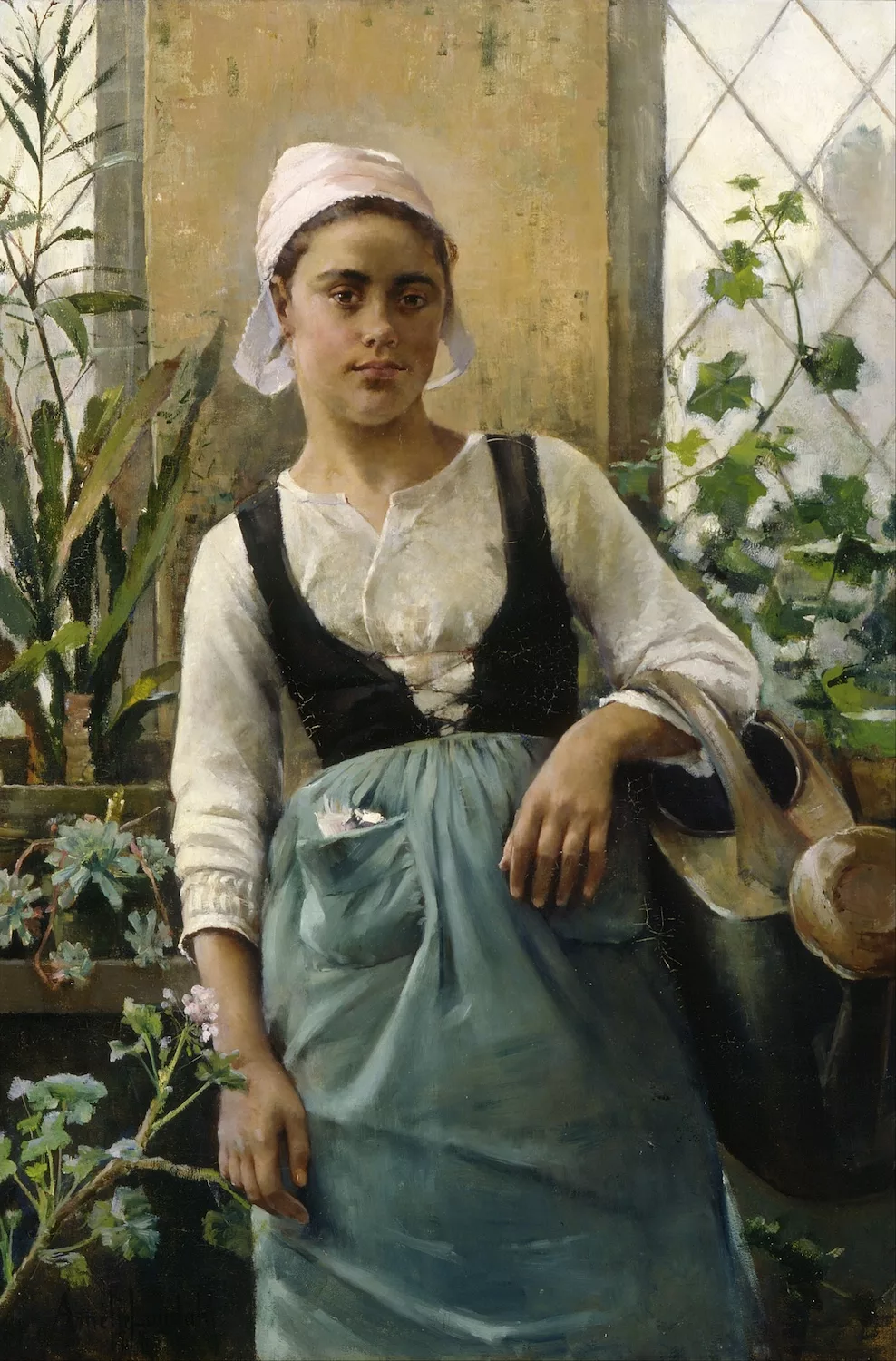
Amélie Lundahl, The Garden Girl, 1885, oil on canvas, 100 × 67 cm, Finnish National Gallery Collection / Ateneum Art Museum
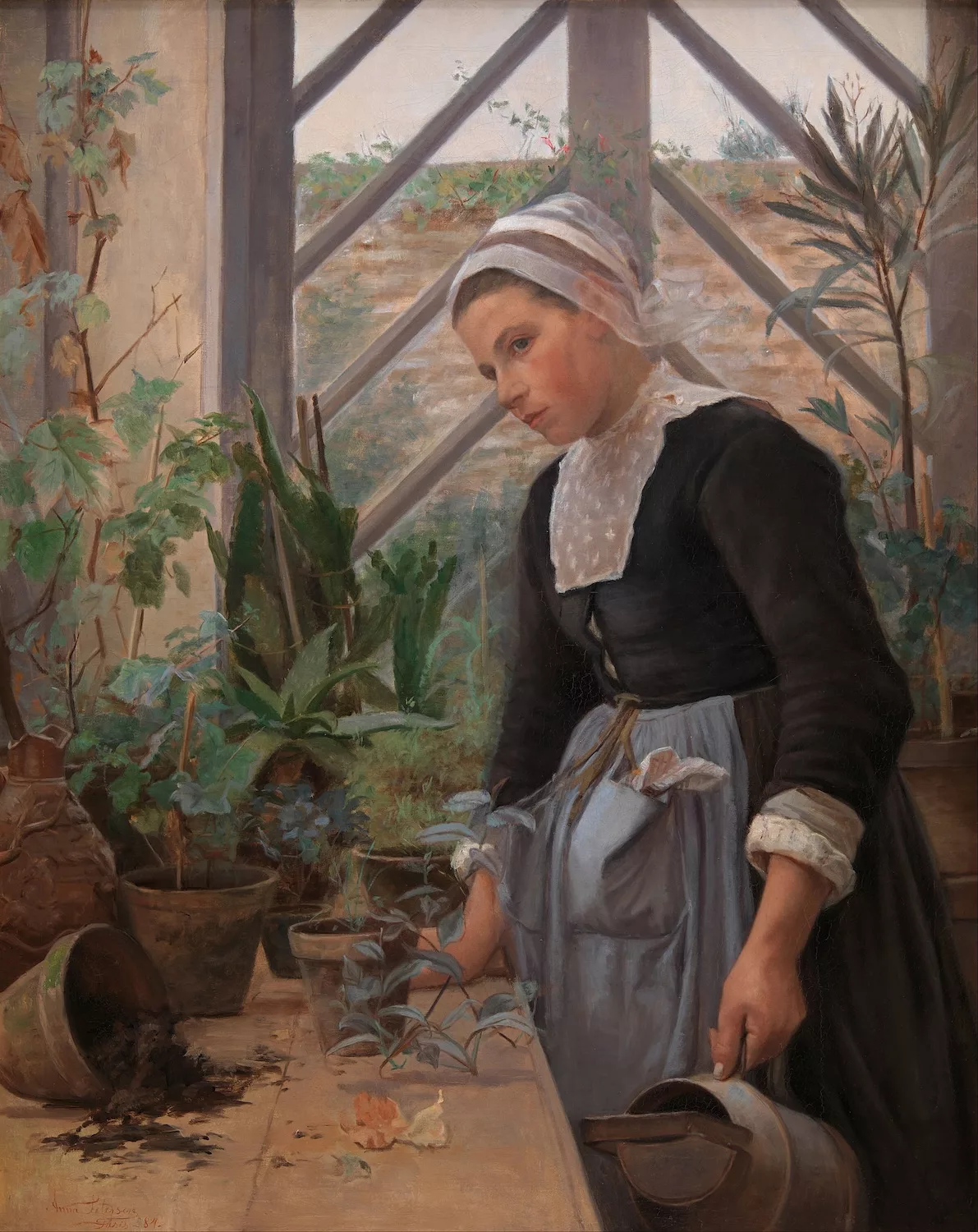
Anna Petersen, Breton Girl Looking After Plants in the Hothouse, 1884, oil on canvas, 121 × 110 cm, SMK – National Gallery of Denmark
Unlike their male colleagues, who often painted dramatic genre scenes of Breton life, the women artists focused on children at this time. M. Wiik’s first plein air painting The Obstacle depicts a laughing girl helping a crying boy up a stone wall. E. Mundt painted what seems to be the same boy, Tamec, from a slightly different angle in Tamec Buying Apples, exhibited at Charlottenborg in 1884.5Tamec and his sister Fine were popular child models. H. Westermarck described them as “filthy and ignorant children who wandered the roads and pathways” adding they were excellent models “if they could be captured and tamed”.6 Tamec appears in works by E. Mundt, M. Wiik, H. Westermarck and Agda Lindqvist (1860–1889), who painted him watching an elderly Breton woman knitting. That woman, instantly recognisable in her red stockings and white cap, also featured in a plein air painting by E. Mundt from 1882.7
After visiting Pont-Aven in 1883, M. Luplau and E. Mundt returned to Paris and Colarossi before heading home in early 1884. H. Schjerfbeck, M. Wiik and M. Preindlsberger remained in Brittany, joined in January by A. Lundahl, who had spent time in Finland before returning to France. M. Lundahl had previously painted in the fishing town of Concarneau. In 1884 she exhibited The Garden Girl, showing a girl standing in a greenhouse. A. Petersen painted a similar subject signed “Paris 1884”. Though depicted from different angles, the works share identical interiors, suggesting they painted side by side.
The unique greenhouse was unusual for Concarneau’s fishing community, but a group photograph from August 1882 shows Swedish artists outside photographer Albert Gasc’s (1838–?) villa which served as residency for artists. One of the people in the photograph was the Swedish painter Anna Gardell-Ericson (1853–1939), who recalled breakfasts in A. Gasc’s dining room that opened onto a greenhouse.8 Although Madame Gasc had died by 1884, it is probable that M. Lundahl and A. Petersen were allowed to paint there.
Looking at the Nordic artists in a collective perspective has been rewarding. It has demonstrated that a special relationship existed between the painters during their time in Paris and Brittany. Attending classes at the private academies in Paris was a full-time occupation. This meant that many of the Nordic women artists spent much of their time together. Half of the classes were dedicated to costumed models, a genre that is somewhat overlooked today but was very popular at the time. The artists’ use of the same models speaks both of their interpersonal relationships and their shared concerns for painting subjects. The foundation of the relationships between the Nordic women painters presented here is largely based on statements derived from their work. Written sources are few, but by looking at the pieces in a collective perspective and decoding the information they hold as wordless sources, it has been possible to gain insight into the artists’ educational situations, study trips and overall shared artistic goals. The picture emerging here contributes only some of the pieces of the puzzle depicting the role of Nordic women artists in the late nineteenth century.
Marianne Saabye (1945–) holds a Master’s degree in Art History and has served as the director of Vestsjællands Kunstmuseum, Sorø (1975–86), and the Hirschsprung Collection (1986–2016). She also held a research fellowship (2017–2018) from the New Carlsberg Foundation at SMK – National Gallery of Denmark. She has organised numerous exhibitions focusing on 19th century Danish art, and within this period she has authored numerous articles for Danish and international books, exhibition catalogues and journals. In 2001 she published the anniversary book Hirschsprung – kunstsamler og mæcen [Hirschsprung – art collector and patron] and in 2025 the book Stemningsmaleri. Franske inspirational i nor disk kunst [Evocate paintings. French inspiration in Nordic art].
Published in partnership with SMK – National Gallery of Denmark, as part of the exhibition Against All Odds: Historical Women and New Algorithms


