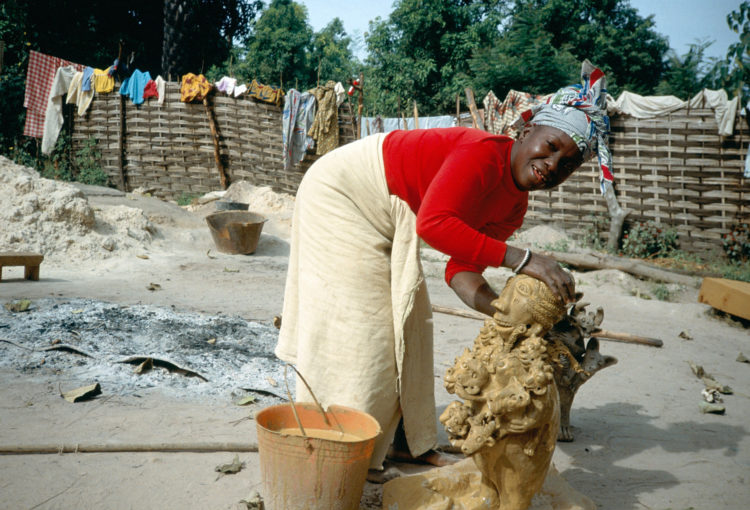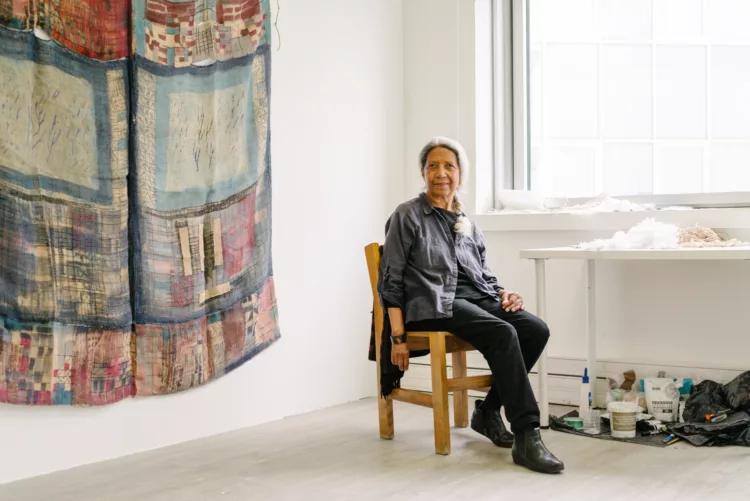
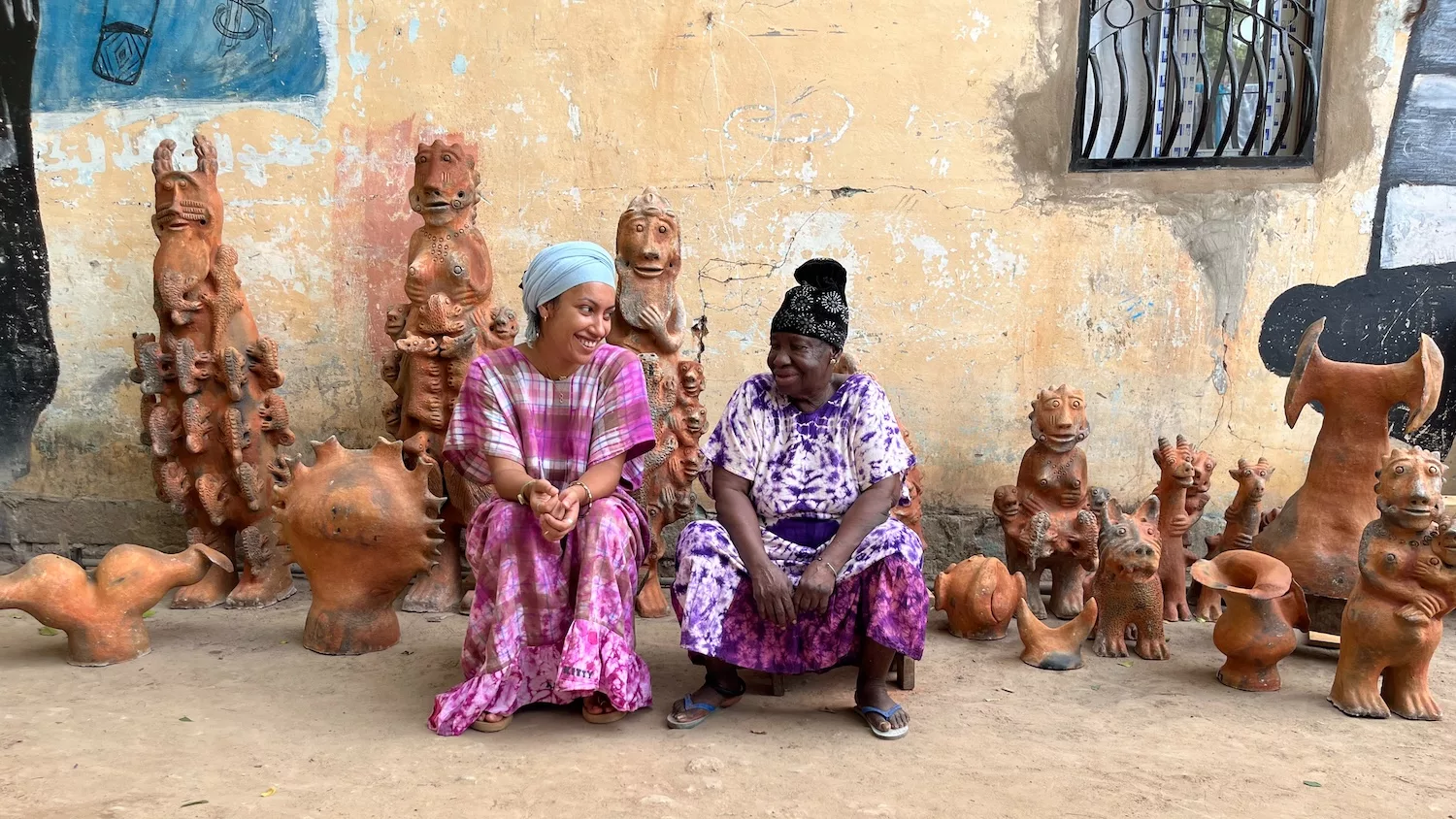
Seyni Awa Camara and Carla Gueye at the conclusion of the residency, Bignona, 2025, © Carla Gueye
Born from an encounter in Casamance, this text traces the intimate, artistic and spiritual bond that developed between Carla Gueye (1997–) and the Senegalese sculptor Seyni Awa Camara (c. 1945–2026). As these pages were being edited, Seyni’s passing profoundly altered their resonance. The narrative thus becomes, beyond the testimony of a transmission, a heartfelt tribute to a body of work and to a presence that continues to inhabit the earth.
I am a caïlcédrat.
I come from Senegal; I stretch along the Avenue Lamine Gueye.
I have multiple, magical scales; my flesh is brown, pinkish – they call me mahogany.
My trunk is a mass of growths forming clusters of breasts, of different sizes, some even amputated.
At my feet, the world of spirits is consulted; I stand in sacred groves, I am full of powers…
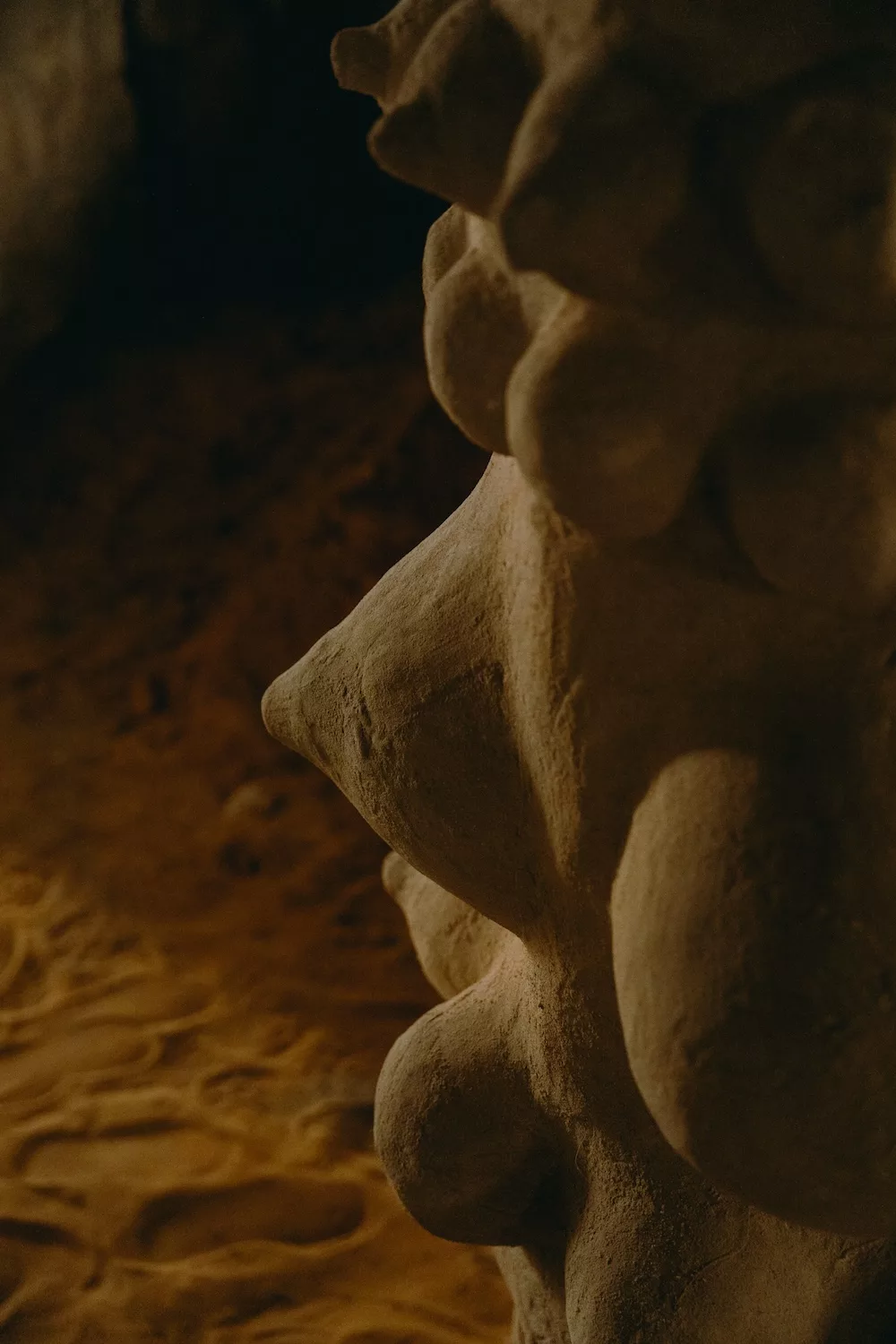
Carla Gueye, Je suis un caïlcédrat, 2023, Dakar © Ibra Wane
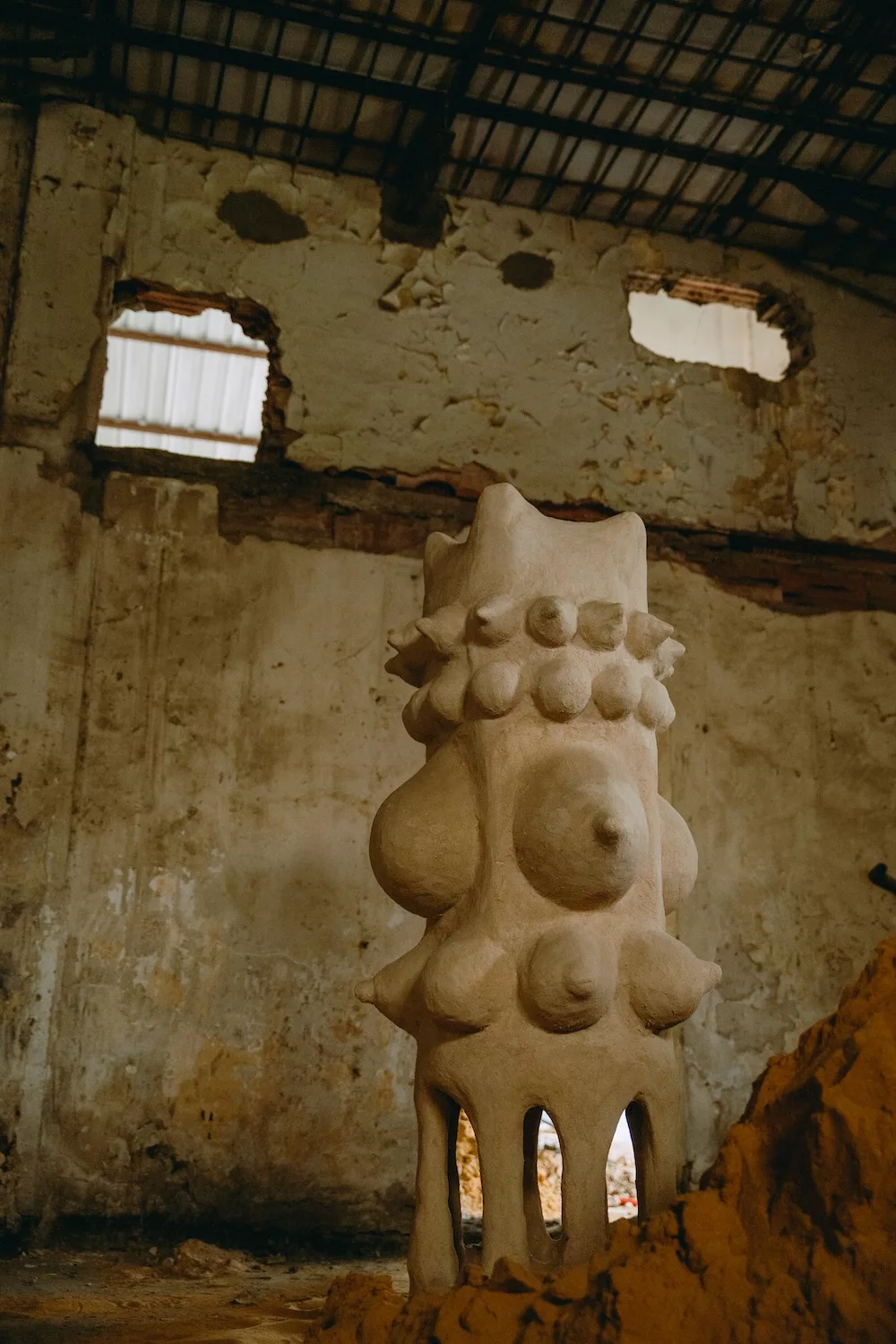
Carla Gueye, Je suis un caïlcédrat, 2023, Dakar © Ibra Wane
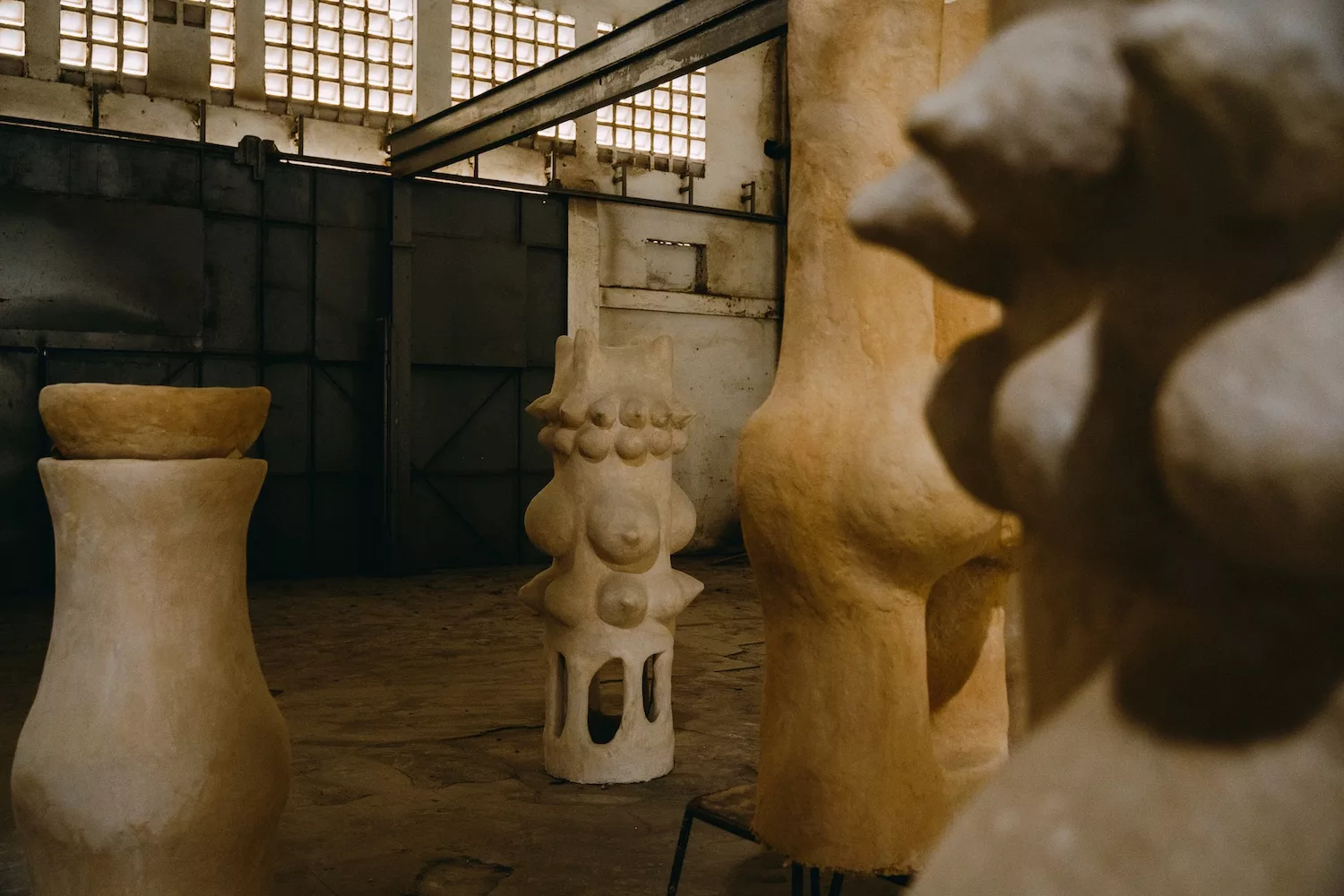
Carla Gueye, Sisters and I, 2023, Dakar © Ibra Wane
May 2023. I leave my friend Fama’s apartment in the Comico Mermoz neighbourhood of Dakar and step into a taxi: “Salam,1 Avenue Georges Pompidou, after La Galette, niat ala?”2 My driver speeds past the Elton roundabout, follows the Olympic Pool, then takes the Corniche toward the Plateau. Before the entrance to Sandaga Market, we turn onto Avenue Lamine Gueye, named after the first president of Senegal’s National Assembly and eponymous author of the law incorporated into the Constitution of the French Fourth Republic that extended citizenship to the “natives of the colonies” – a status from which my paternal grandfather was able to benefit. I contemplate the caïlcédrat trees lining the road and their striking, deformed trunks. These protuberances result from a process of healing: the bark of the tree, commonly used in traditional medicine, is harvested repeatedly, causing these swellings. The caïlcédrat thus joins the family of trees considered sacred in Senegal, alongside the baobab and the kapok tree (or fromager). The transformations inflicted on these beings – these arboreal marks of aggression and repair – resonate with my own intimate history: I see again my mother’s body metamorphosing under the effect of the illness that would eventually take her life. From this entanglement of memory, body and wound emerges Sisters and I (2023), a group of five sculptures inspired by the caïlcédrat, arranged as a space for gathering and reflection, in the spirit of the palaver tree or the toguna.3
On 31 May 2023, on the eve of the verdict in the trial of Ousmane Sonko – political opponent of President Macky Sall – I open my solo exhibition Dans la chambre je suis… at Quatorzerohuit in Dakar. It is on that occasion that, for the first time, I hear about Seyni Awa Camara. The images of her clay sculptures immediately strike me. I ask questions. Then, almost like a rumour: “You know, she must be dead by now”.
A few months later… late 2023.
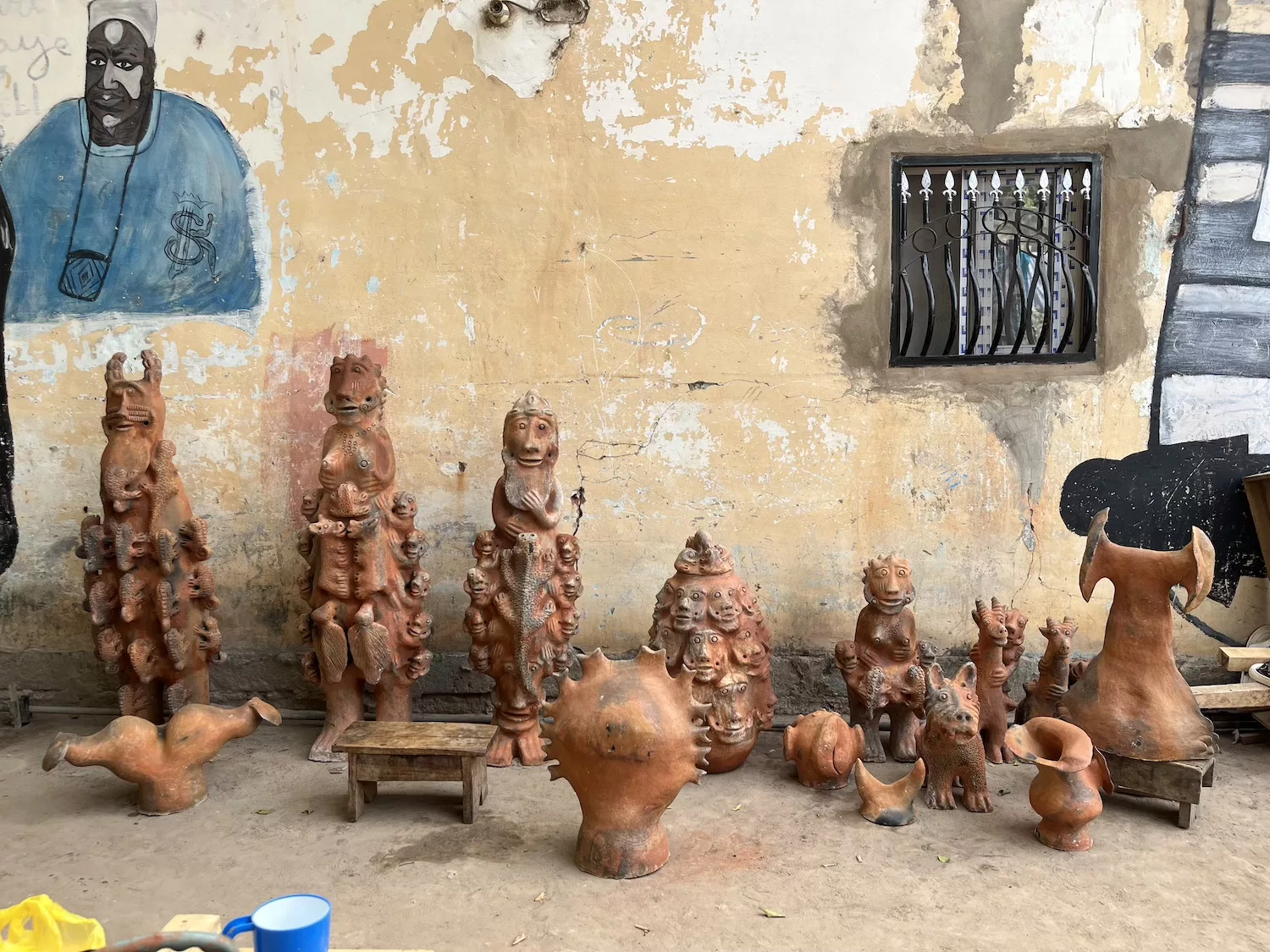
Sculptures by Seyni Awa Camara and Carla Gueye (Corps immergés), Bignona, 2025, © Carla Gueye
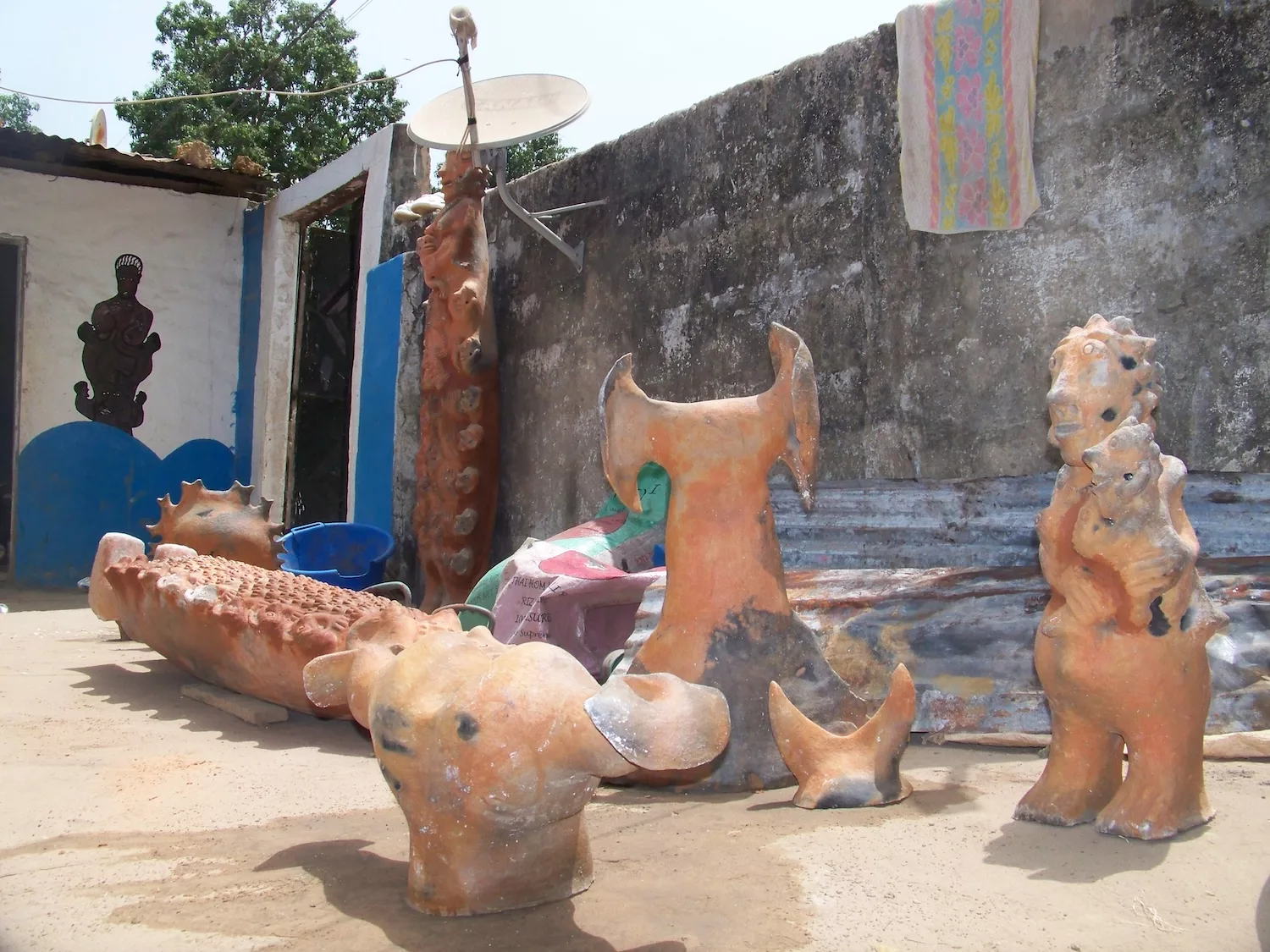
Sculptures by Seyni Awa Camara and Carla Gueye (Corps immergés), Bignona, 2025, © Carla Gueye
Our vehicle crosses the Casamance River via the bridge in Ziguinchor, from where the memorial to the ship Le Joola comes into view. Mangroves cover the opposite bank, into which we eventually plunge to reach Bignona. A blue house with compartmentalised volumes stands out, forming a kind of second horizon; on its façade, a mural depicting Serigne Touba4 and the family’s marabout. We still have to walk a few steps into the courtyard, where sculptures in the process of drying and others just taken out of the fire offer themselves to our gaze, before entering a first room.
The owner of the place – whom I would later call Seyni, or ameroaw5 – is wearing a yellow dress and sitting on a wooden stool, surrounded by okra, chilies and dried fish that she continues to sell in the neighbourhood, as she did when she worked at the market. She keeps working on the sculpture placed on her workbench and follows our arrival out of the corner of her eye. The air is heavy, dense with heat and silence. I am invited to take a seat on a chair and watch her. She greets us with a simple nod of the head. I try to relax, as best I can; Seyni and her circle – her sons Aliou, Ibrahima, Momodou and Saliou, their wives and children – seem accustomed to this type of visit.
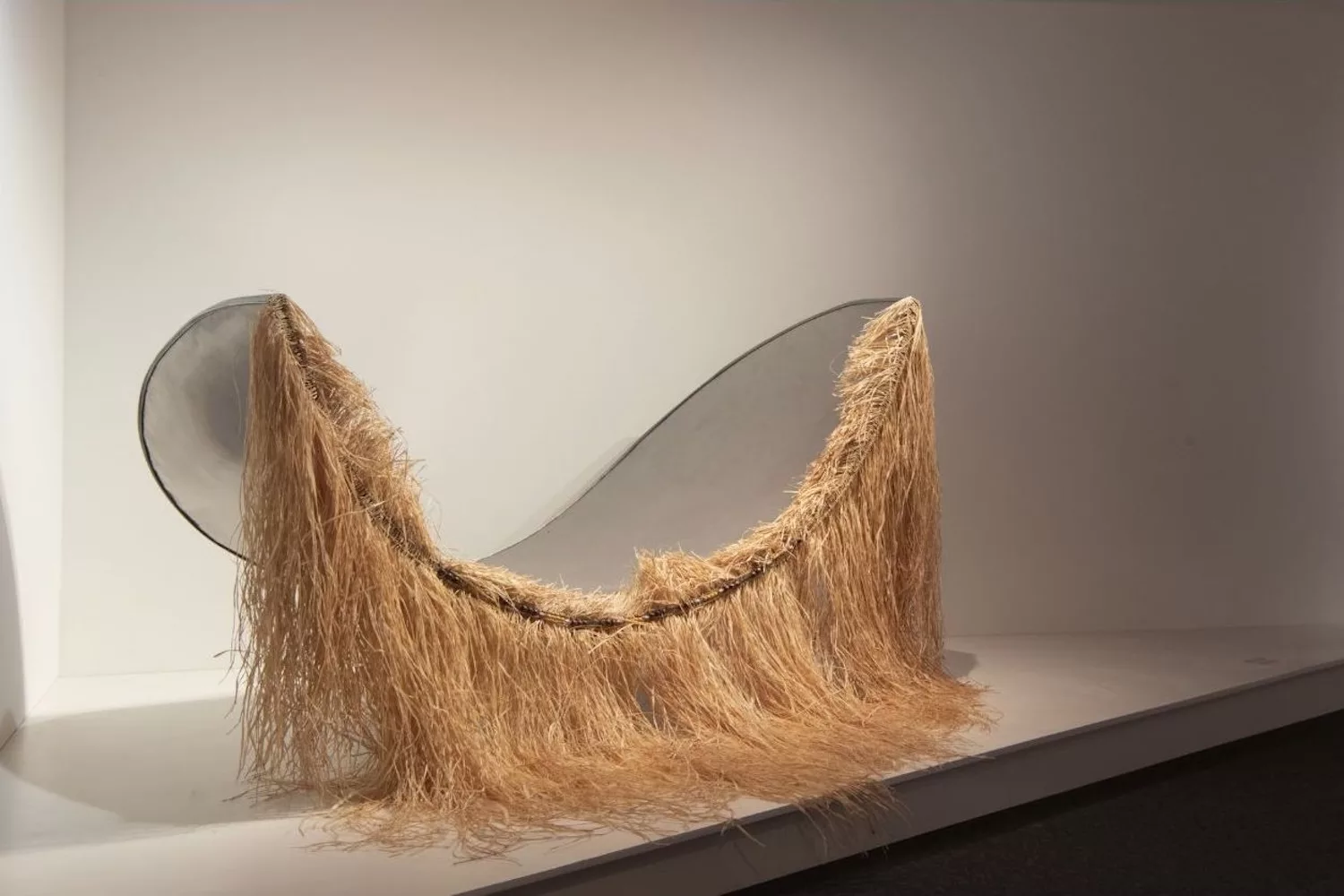
Carla Gueye, Berceuse, 2024, exhibition view, Pays Bassari (2024–2025), Musée dauphinois, Grenoble, © Musée dauphinois
Knowing that I am an artist, Ibrahima strikes up a conversation, curious to know more about my work. After I show him a few images from my series Sisters and I, he concludes that I work with my hands – and that this is important. As a child, I used to watch my father spread lime on the walls of our house – a barn in Charente, ready to collapse. We had to abandon that refuge after my mother’s death, with everything it contained, in order to build another one. By instinct of survival, memory grows hazy, but certain gestures persist. I have kept the one with which she used to rock me in the cradle of her crossed legs – a movement that in 2022 became the work Berceuse. My practice has helped soothe a latent pain, even if one never truly heals from the loss of a mother. Like Ibrahima and his brothers, and Seyni before them, I too inherited a gesture, a form of knowledge.6
I leave Bignona for the banks of Ziguinchor with several unanswered questions: where did the rumour of Seyni’s death originate? How does her work circulate, from Casamance to Paris and elsewhere? Why does she live in these conditions when her work is shown in major contemporary art exhibitions? I meet Ibrahima again a few days later in a maquis [small bar-restaurant] whose terrace is strewn with mangrove oyster shells. After an hour of discussion that feels like a test, he finally invites me to the family workshop to try “something”. On a Monday at ten in the morning, I arrive in Bignona after a long journey by djakarta [motorbike taxi] and clando [seven-seat shared taxi]. I cross the town – its central market, its bus station, its Muslim and Catholic cemeteries – along dirt roads gradually paved with concrete, until I reach Seyni’s compound.
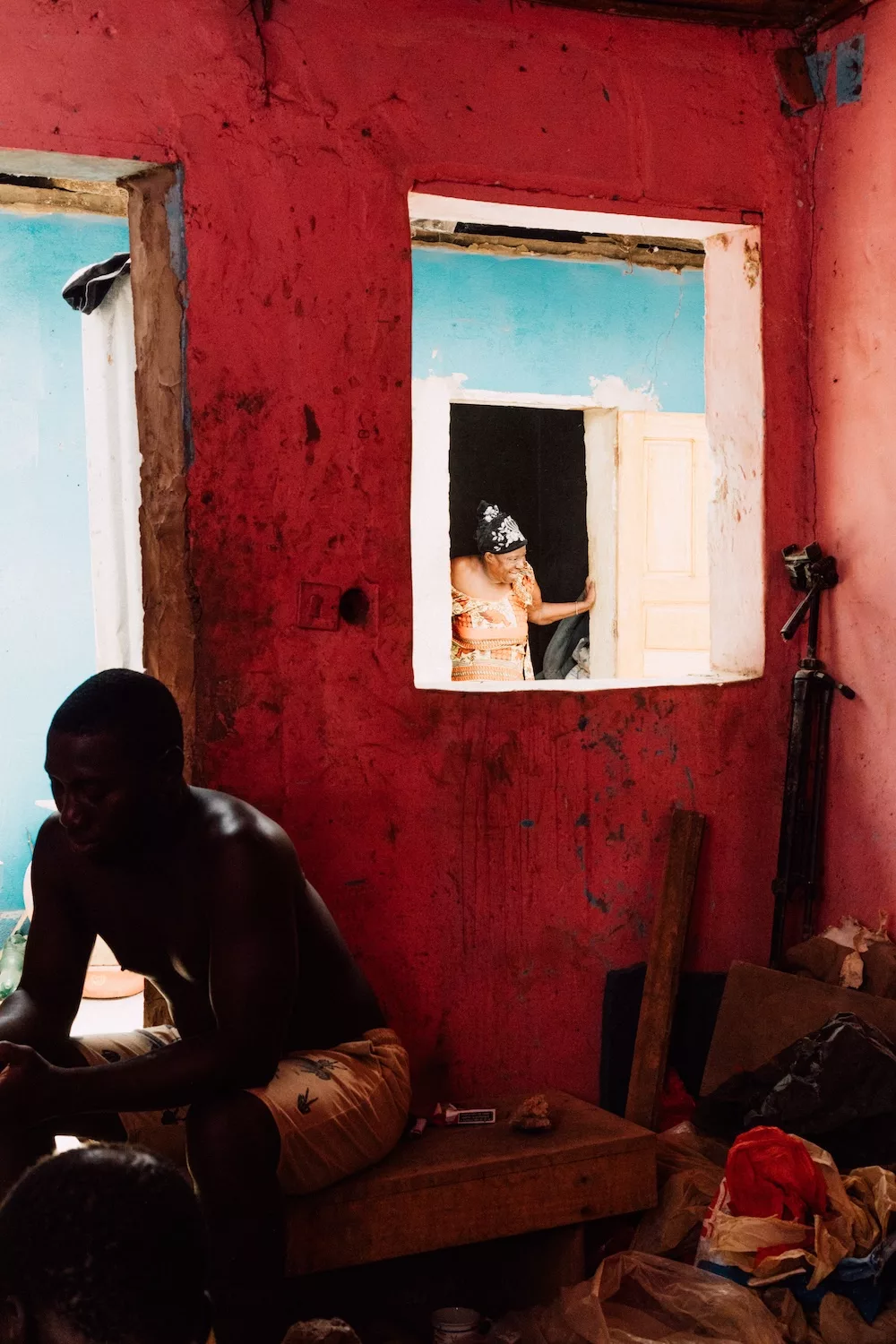
Seyni Awa Camara stepping out into the courtyard; in the foreground, her son Momodou seated in the studio, Bignona, 2025, © Ibra Wane
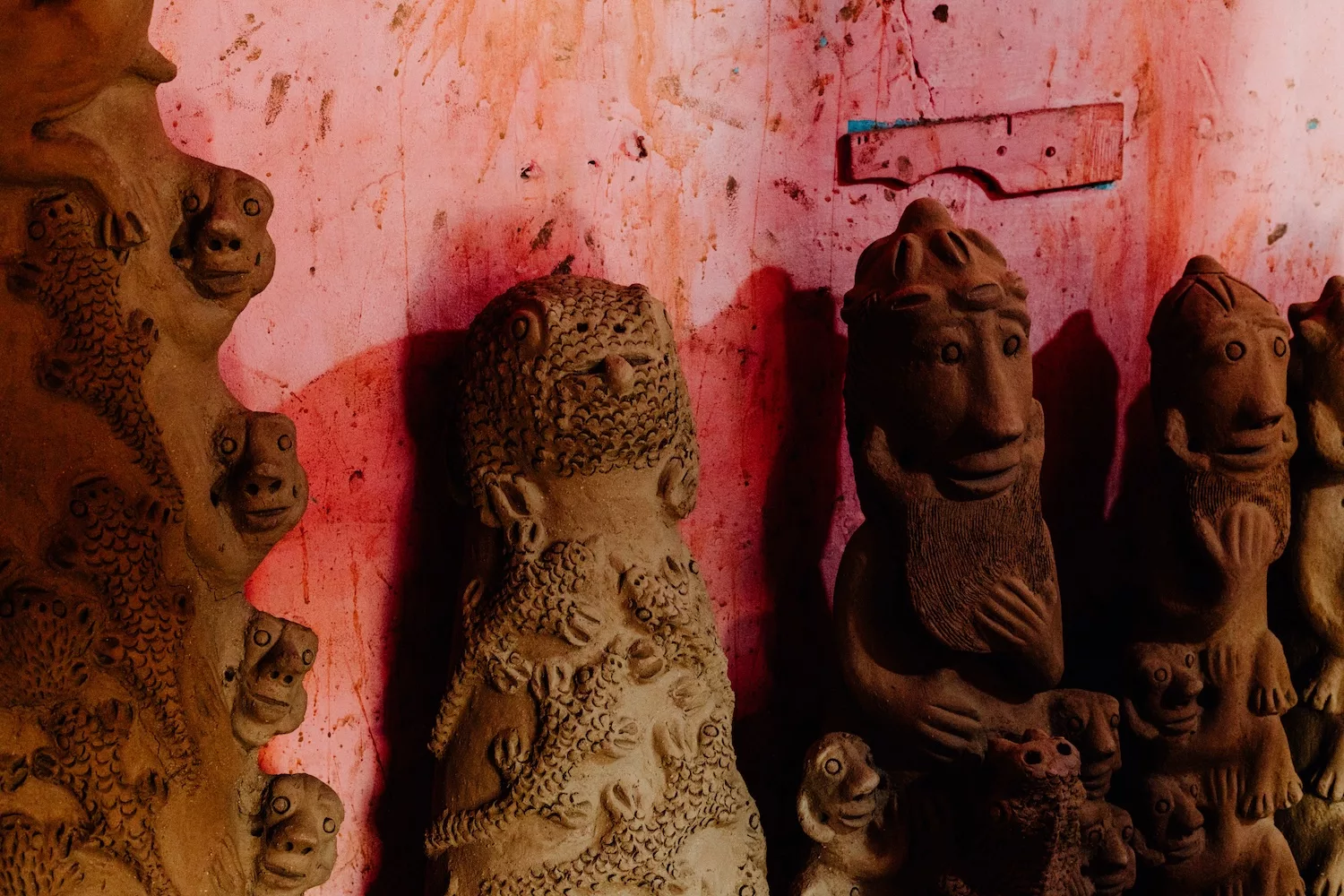
Group of sculptures awaiting firing, Bignona, 2025, © Ibra Wane
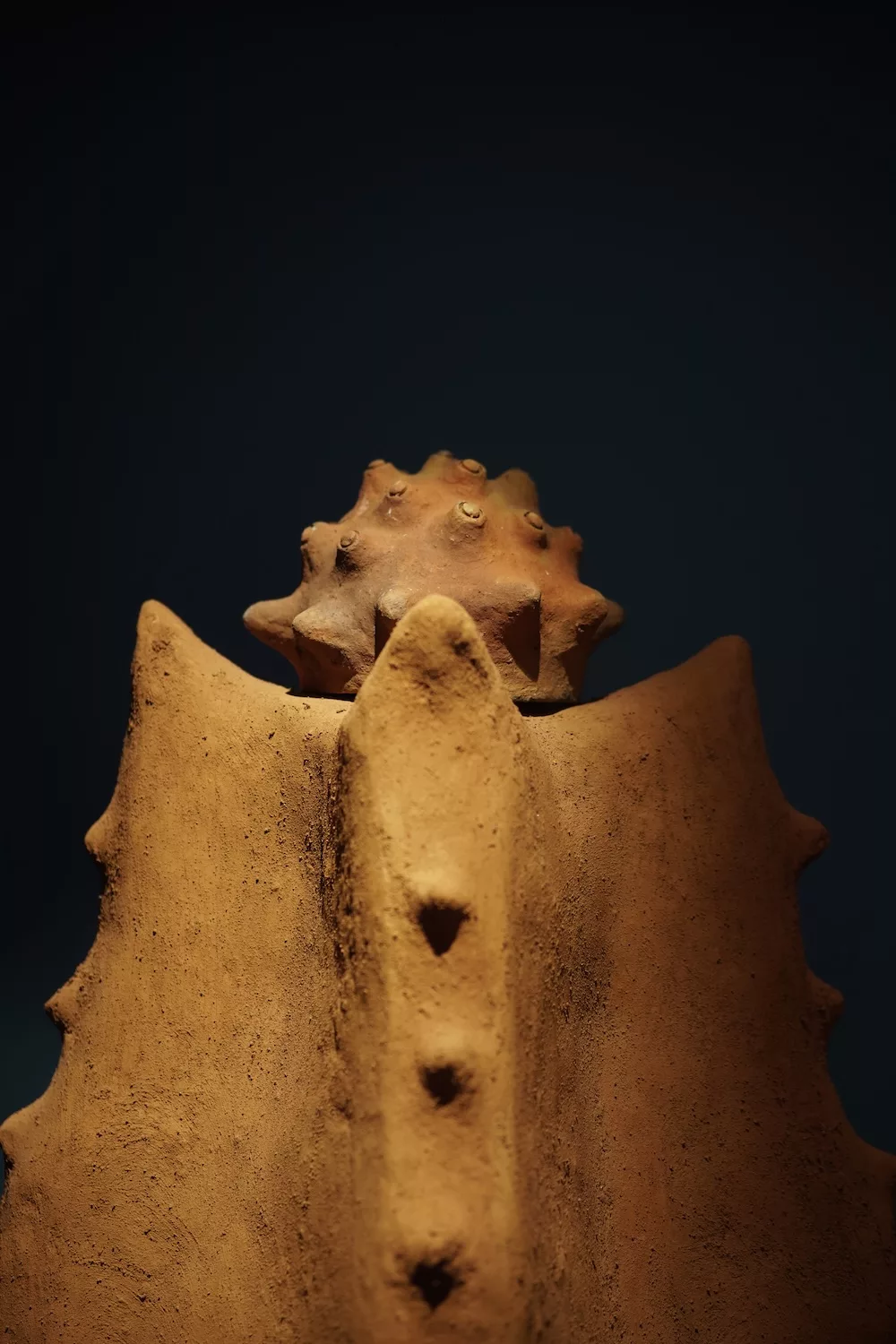
Carla Gueye, Aline Sitoé Diatta, 2024, exhibition view, Comme un œil qui voudrait voir, Le Manège, Institut français de Dakar, © Khalifa Hussein
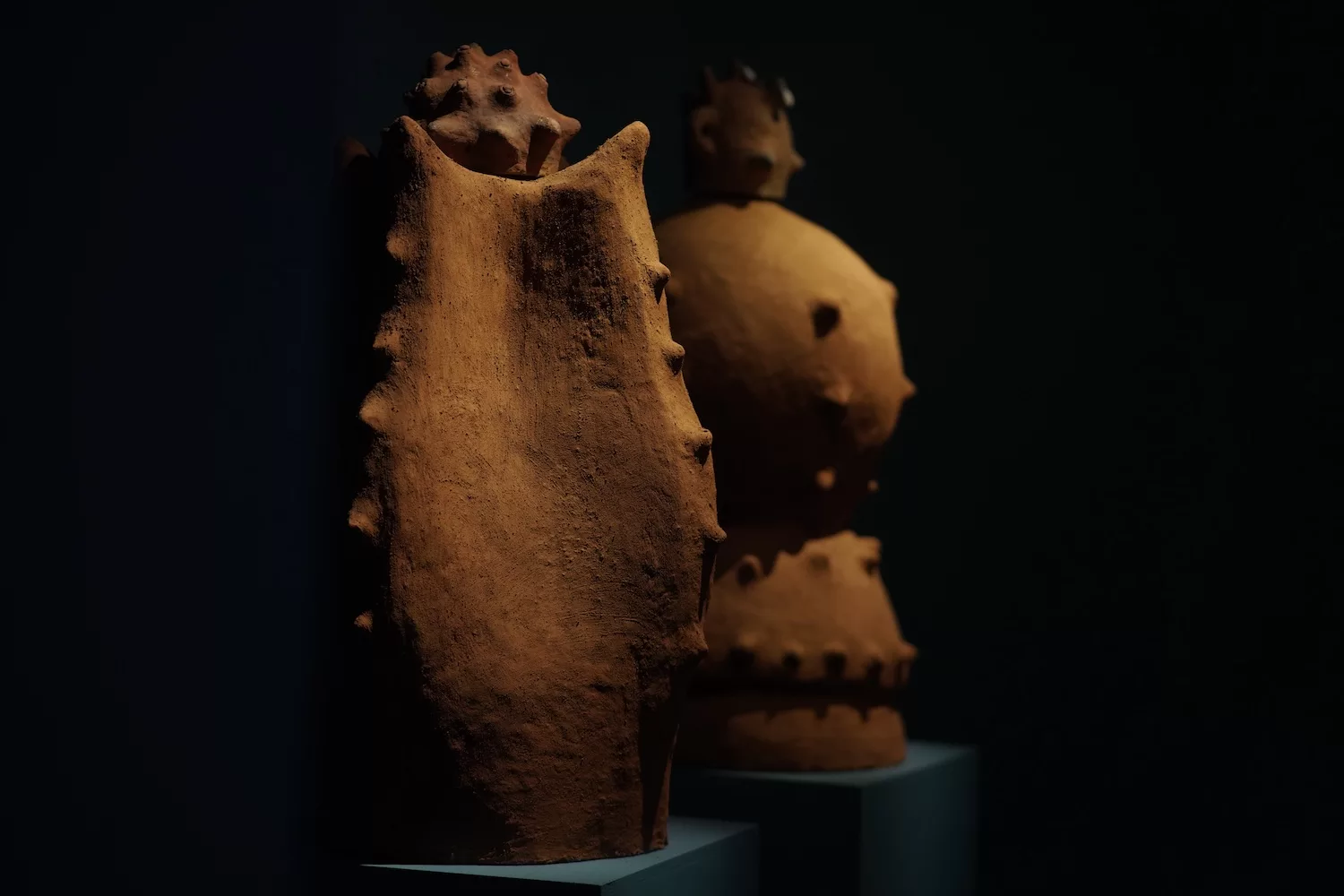
Carla Gueye, Aline Sitoé Diatta et Mère Ana, 2024, exhibition view, Comme un œil qui voudrait voir (2024), Le Manège, Institut français de Dakar, © Khalifa Hussein
Before taking my place in the pink-walled workshop where Aliou, Ibrahima and Momodou spend their days assisting their mother, I first greet the family members encountered in the courtyard. Meanwhile, ameroaw keeps discreetly in the background, withdrawn from the compound. She uses the lunch breaks to slip into the room to assess my progress. As my visits continue, she eventually sits down beside me and joins in my work. Seyni and I do not speak the same language,7 but gestures and glances are often enough for us to understand one another when no translator is present. During this first “residency” with her, I had the good fortune to produce two sculptures: two heads covered with self-defence spikes, like those developed by kapok trees to protect themselves from attackers. I later assembled them with bodies made of lime and laterite, giving birth to Aline Sitoé Diatta and Mère Ana (2024), presented in the exhibition Comme un œil qui voudrait voir at the Manège of the Institut français in Dakar, curated by Olivia Marsaud and Franck Hermann Ekra. This work grew out of my encounter in Oussouye with Mother Ana. A traditional healer, she recounted me her first visions: in her youth, Aline Sitoé Diatta (1920–1944), a historic figure of Senegalese resistance to French colonisation, is said to have visited her in a dream and guided her to Kabrousse to be initiated into water rites. I was deeply moved by her accounts of transmitted knowledge and purifying rituals. The connections seemed obvious to me – between the story of Aline Sitoé Diatta, the practice of Mother Ana, and Seyni’s work. Like her, Aline Sitoé Diatta and Mother Ana, each invested in their own way with a spiritual and social role, were first ostracised before eventually being fully embraced by their community.
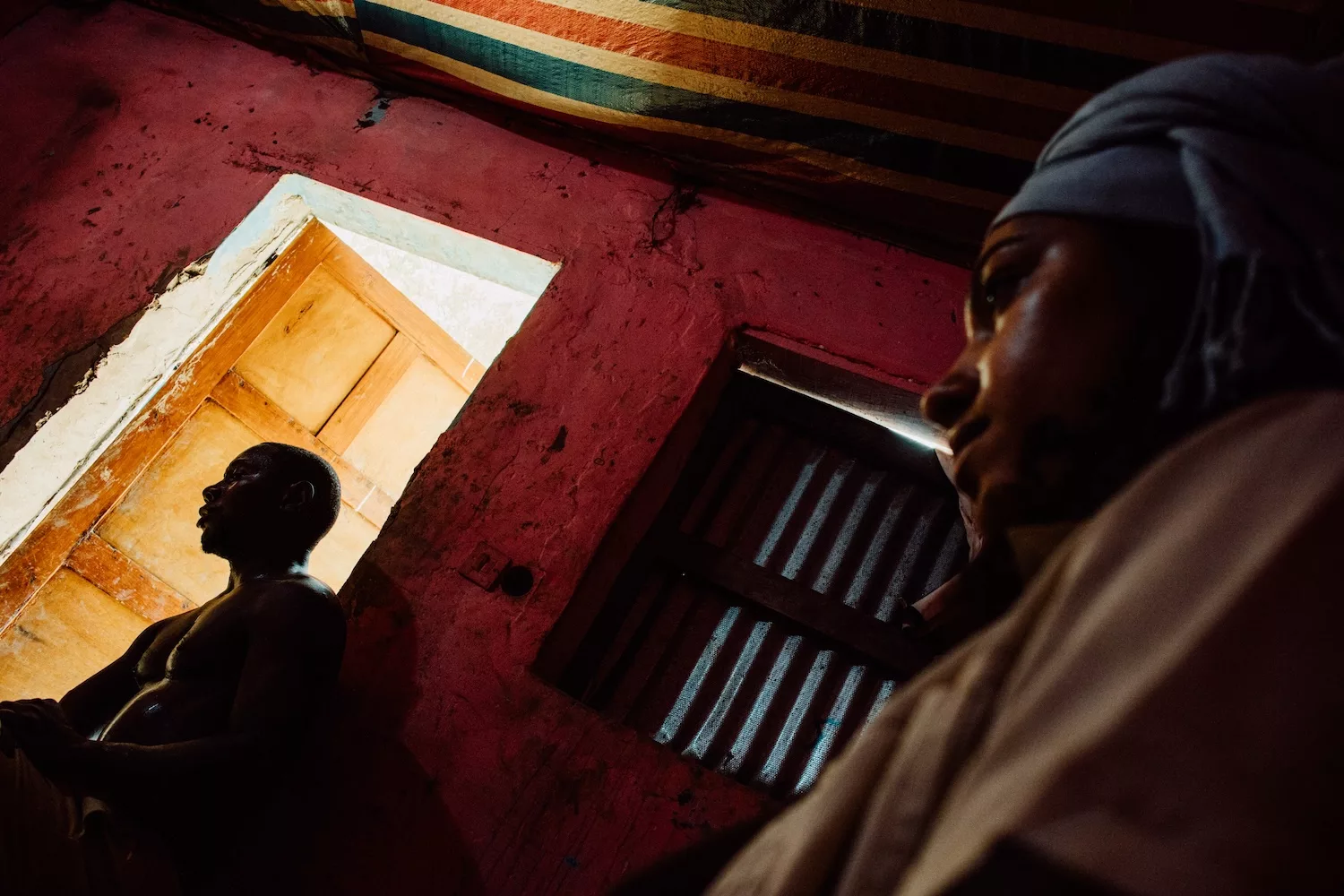
Momodou and Carla Gueye in Seyni Awa Camara’s studio, Bignona, 2025, © Ibra Wane
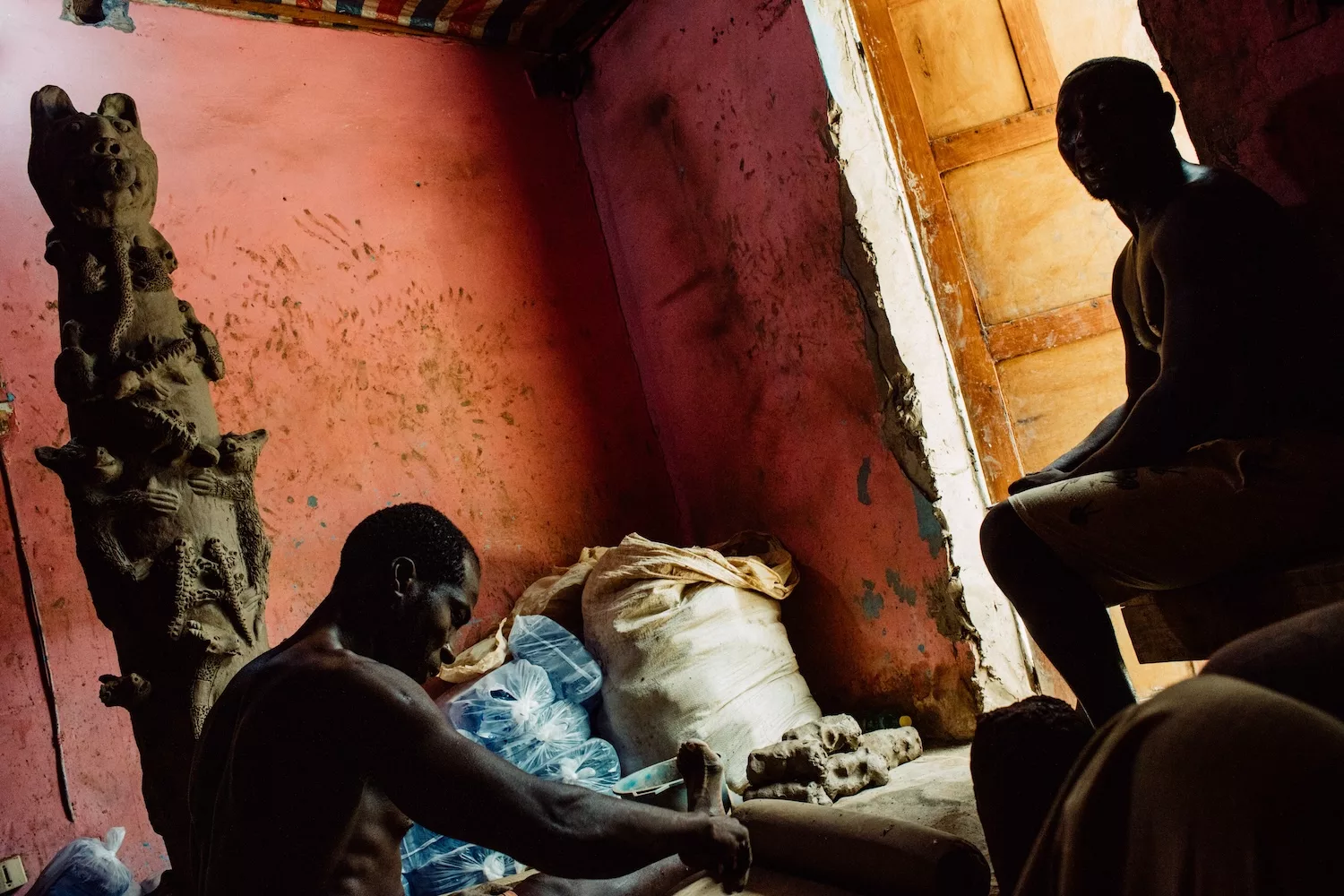
Aliou and Momodou in their mother Seyni Awa Camara’s studio, Bignona, 2025, © Ibra Wane
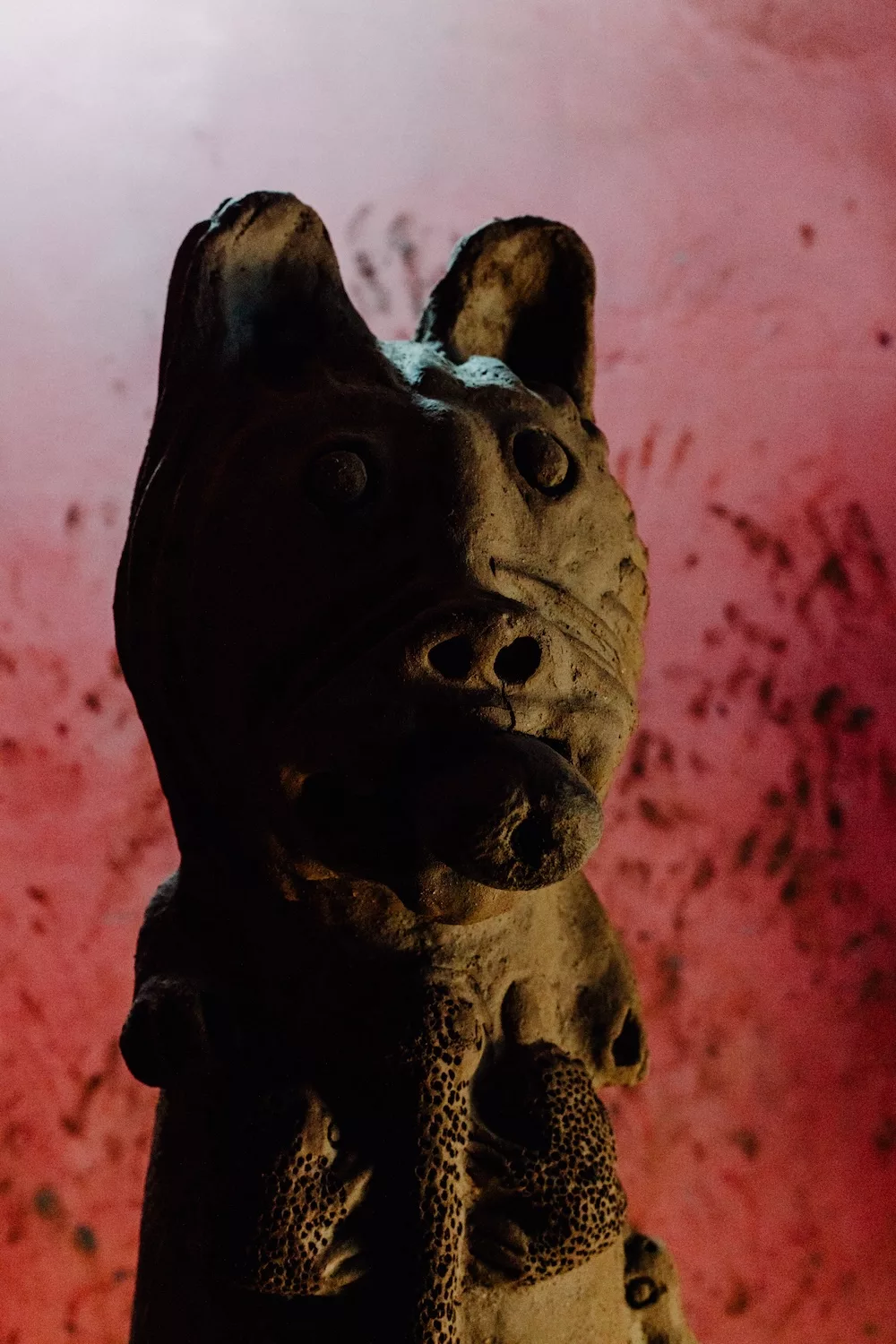
Detail of a work drying, Bignona, 2025, © Ibra Wane
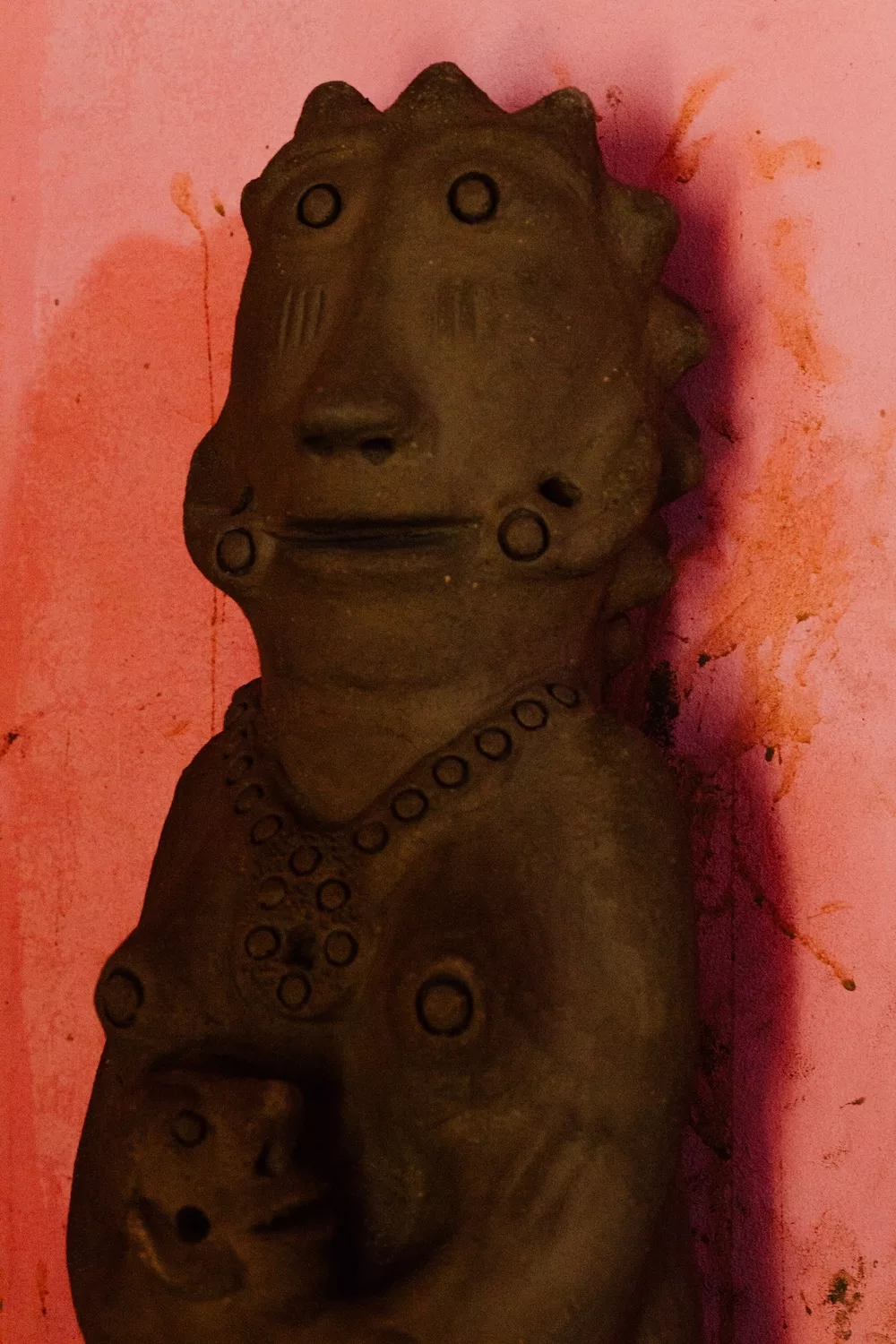
Work drying in Seyni Awa Camara’s studio, Bignona, 2025, © Ibra Wane
As the days go by in Bignona, conversations within the workshop and the compound are shaped by comments heard on the radio. We meander our way between personal and current affairs: my complex relationship with Senegal, the result of a fragmented family heritage; the differences between Casamance and the north of the country; the political conflict between Ousmane Sonko and Macky Sall – before finally turning to Seyni’s story. She shares anecdotes, comparing some of my pieces to the toys she made with her own hands in her youth. Over a crackling of static, I learn from other family members that she is not the biological mother of some of the sons in the household, who are in fact the children of her co-wives. Seyni also confides that she lost several children: in retrospect, I tend to think that she continues to give them life through her sculptures. With her sons, I eventually bring up the rumour of her supposed death – in fact it is the woman living in Dakar who had been plagiarising her work who has died – as well as her entry into the art market. As a younger woman, Seyni had been offered the opportunity to travel to Europe, misled by the false promises of an unscrupulous gallerist. From that tour, she received nothing. She was stripped of her work, while the art-market ecosystem built around her an exoticising, mystical, reductive and fantasised discourse. I am thinking, for instance, of the catalogue text of the exhibition Magiciens de la terre, presented in 1989 at the Centre Pompidou and the Grande Halle de la Villette, which states that Seyni “exhibits her eccentricity, her fantasies and the ‘evil spirits’ that inhabit her” and “ostentatiously displays her erotic sculptures and other monsters, alongside yams and tomatoes.”8
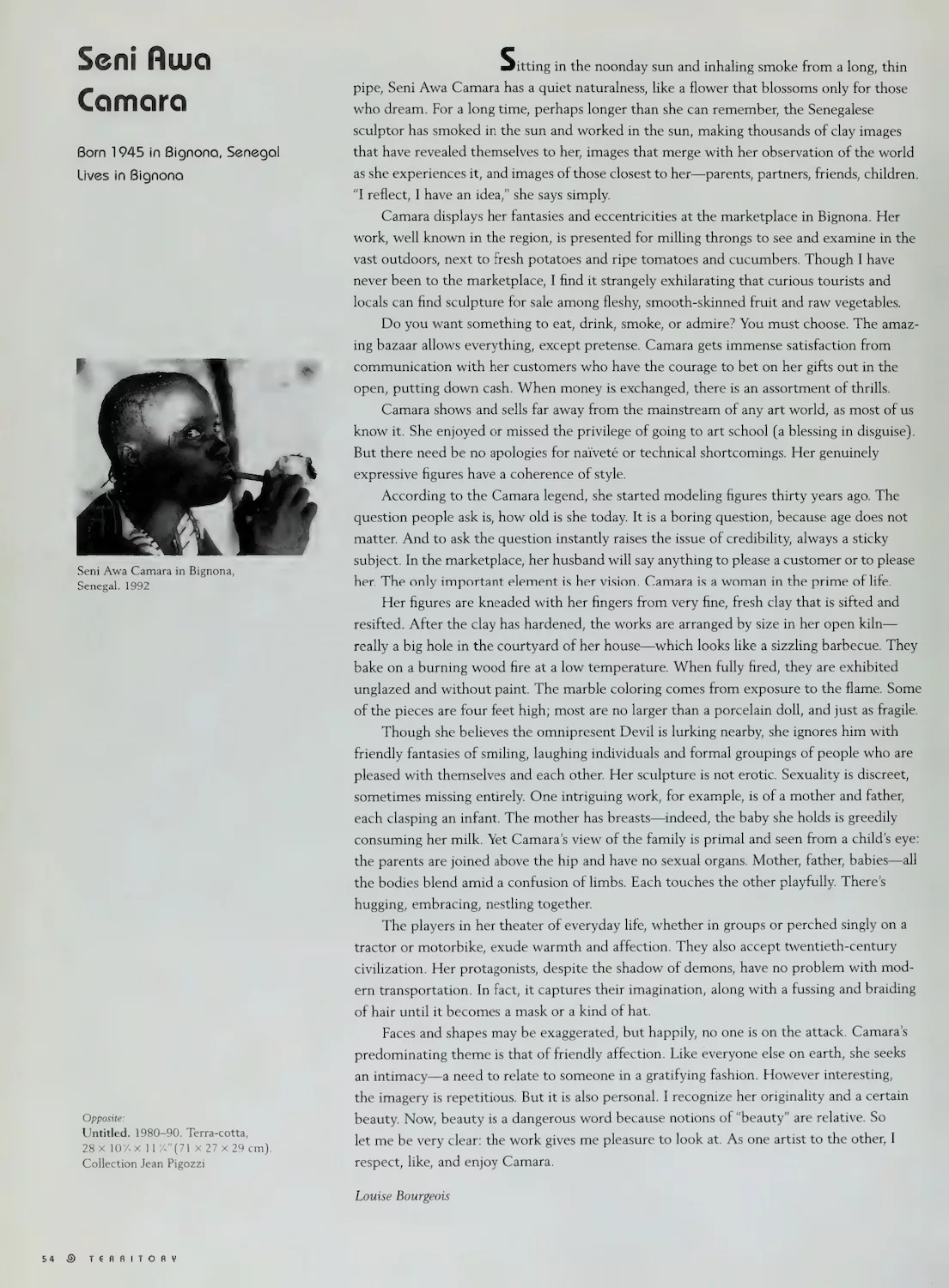
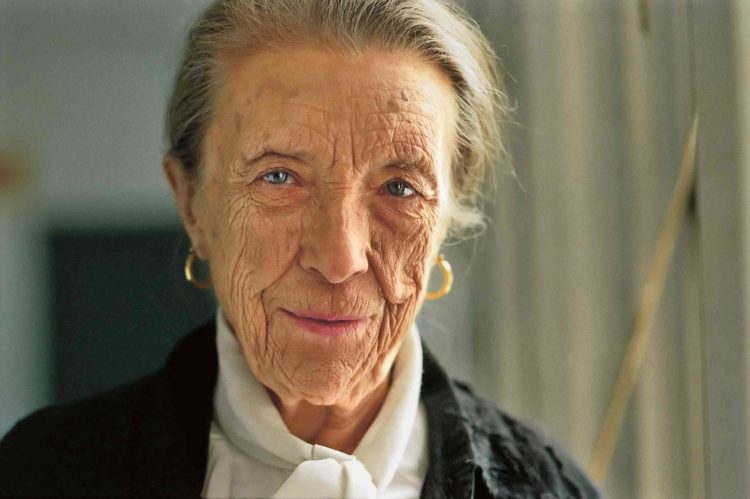
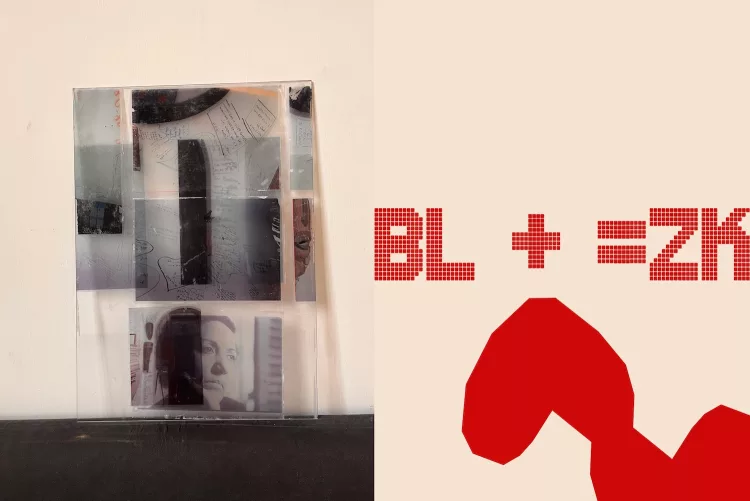
Louise Bourgeois, “Seyni Awa Camara,” in Contemporary Art of Africa, ed by André Magnin and Jacques Soulillou, 1996, p 54, All rights reserved
How great was my surprise, while reading Contemporary Art of Africa (1996),9 to uncover a critical text on Seyni’s work by Louise Bourgeois (1911–2010), one of my earliest artistic references. In this text, L. Bourgeois sees in Seyni’s forms the coherent expression of a worldview structured around family, memory and everyday life. She firmly contradicts the eroticisation of Seyni’s sculptures found in the Magiciens de la terre catalogue and highlights the aspects of her work that had been obscured or distorted: the consistency of a style, the mastery of gesture and the intimacy of the relationships Seyni maintains with her subjects. “As one artist to the other, I respect, like, and enjoy [Seyni Awa] Camara.”10 It is hard to know whether ameroaw remembered L. Bourgeois – or even whether she ever truly grasped the stakes of that encounter – but this text remains the trace of a shared moment.11
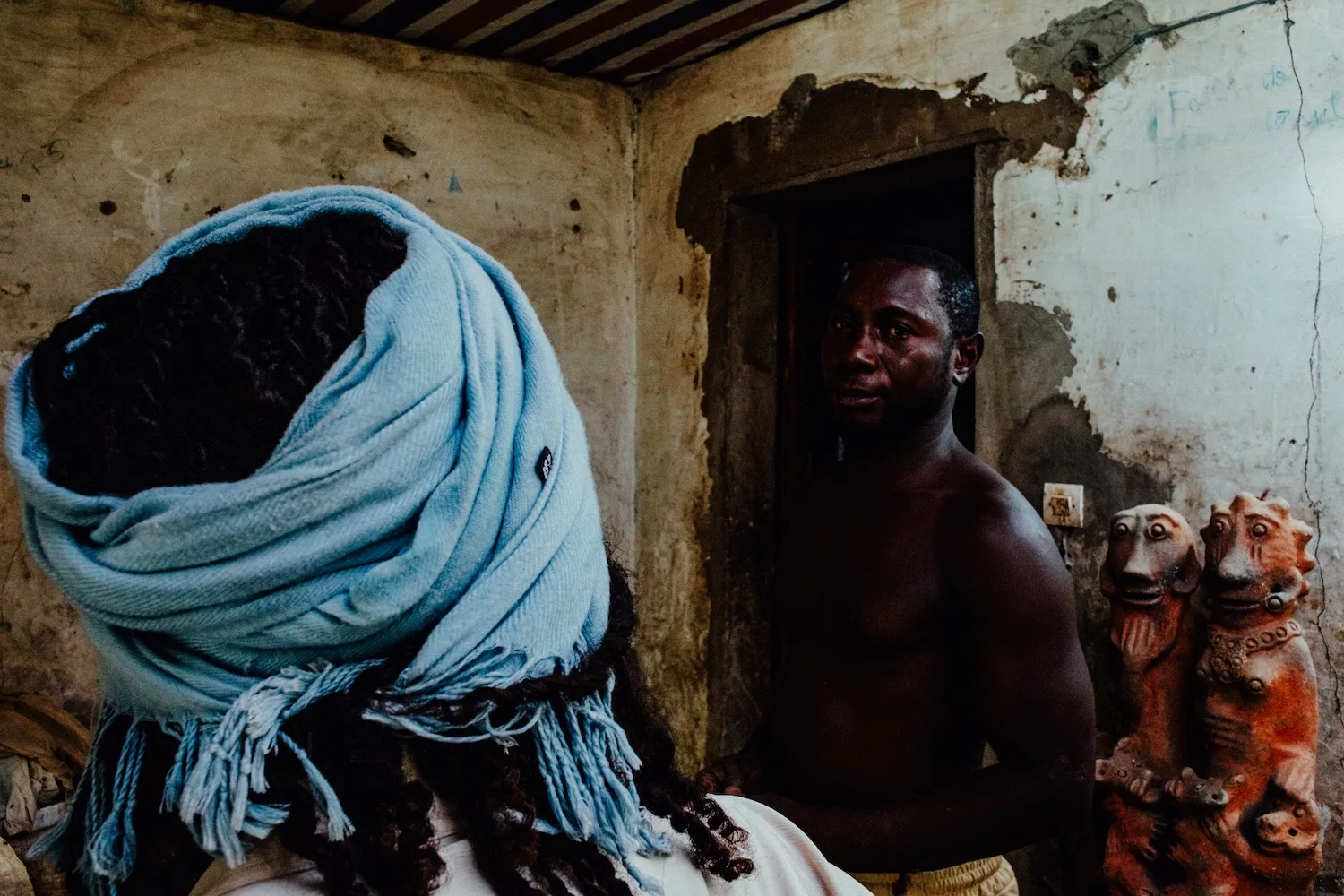
Carla Gueye and Momodou, one of the sons of Seyni Awa Camara, Bignona, 2025, © Ibra Wane
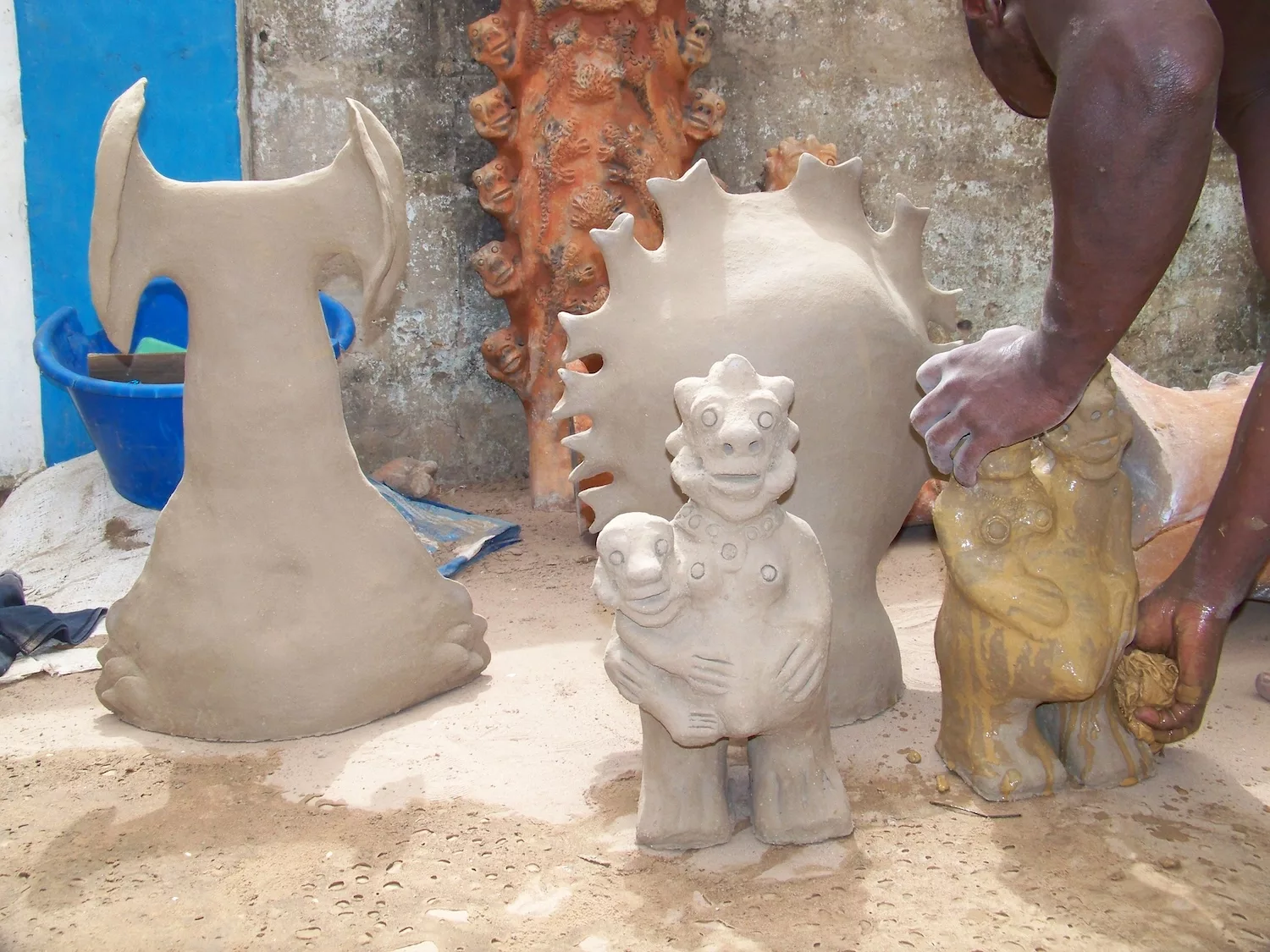
Momodou, son of Seyni Awa Camara, applying slip to his mother’s sculptures and to those of Carla Gueye (Corps immergés) prior to firing, Bignona, 2025, © Carla Gueye
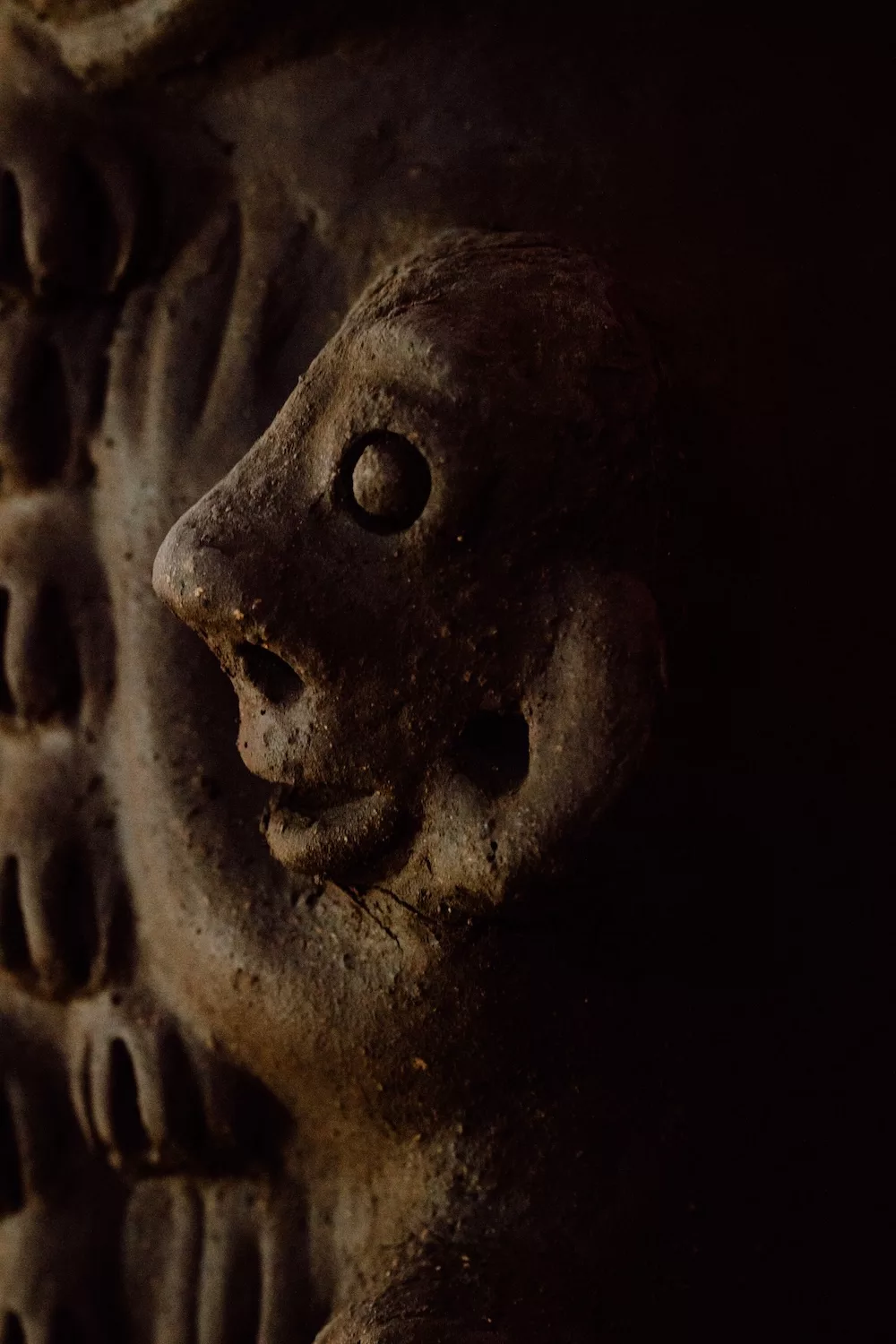
Detail of a work drying in Seyni Awa Camara’s studio, Bignona, 2025, © Ibra Wane
Through her sons, who helped me preserve the precious bond I had formed with Seyni, I learned of her wish for me to return so that she could teach me more. So, at the first opportunity, in 2025, I went back to see her. I will never forget the moment she held me in her arms after more than a year apart. Ameroaw was growing older, and I became acutely aware that our paths might very well never have crossed. This return thus became a true initiation: Seyni explained to me the family techniques of shaping and building, the drying of the pieces according to their size, and the firing process. Eventually, her sons invited me to join them in searching for the right clay, and I was given permission to view the earth reserve for the year. In the past, Seyni herself would walk for kilometres with a heavy bucket balanced on her head, going back and forth to replenish her stock. When success came, her husband took over this task so that she could devote herself fully to creation.
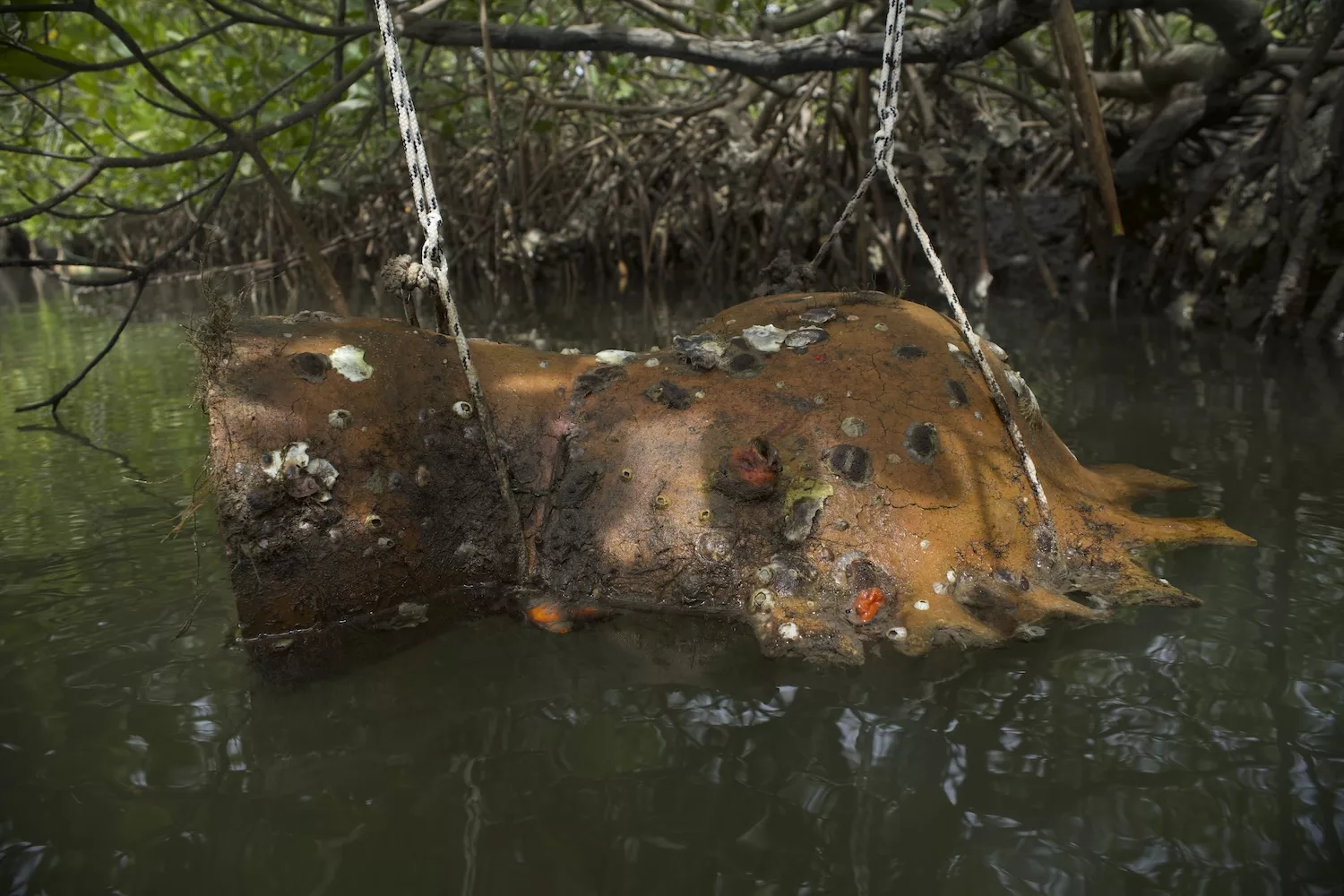
Observation of a sculpture from the Corps immergés series (Carla Gueye) in the mangroves of Mangagoulack, 2026 © Ibra Wane
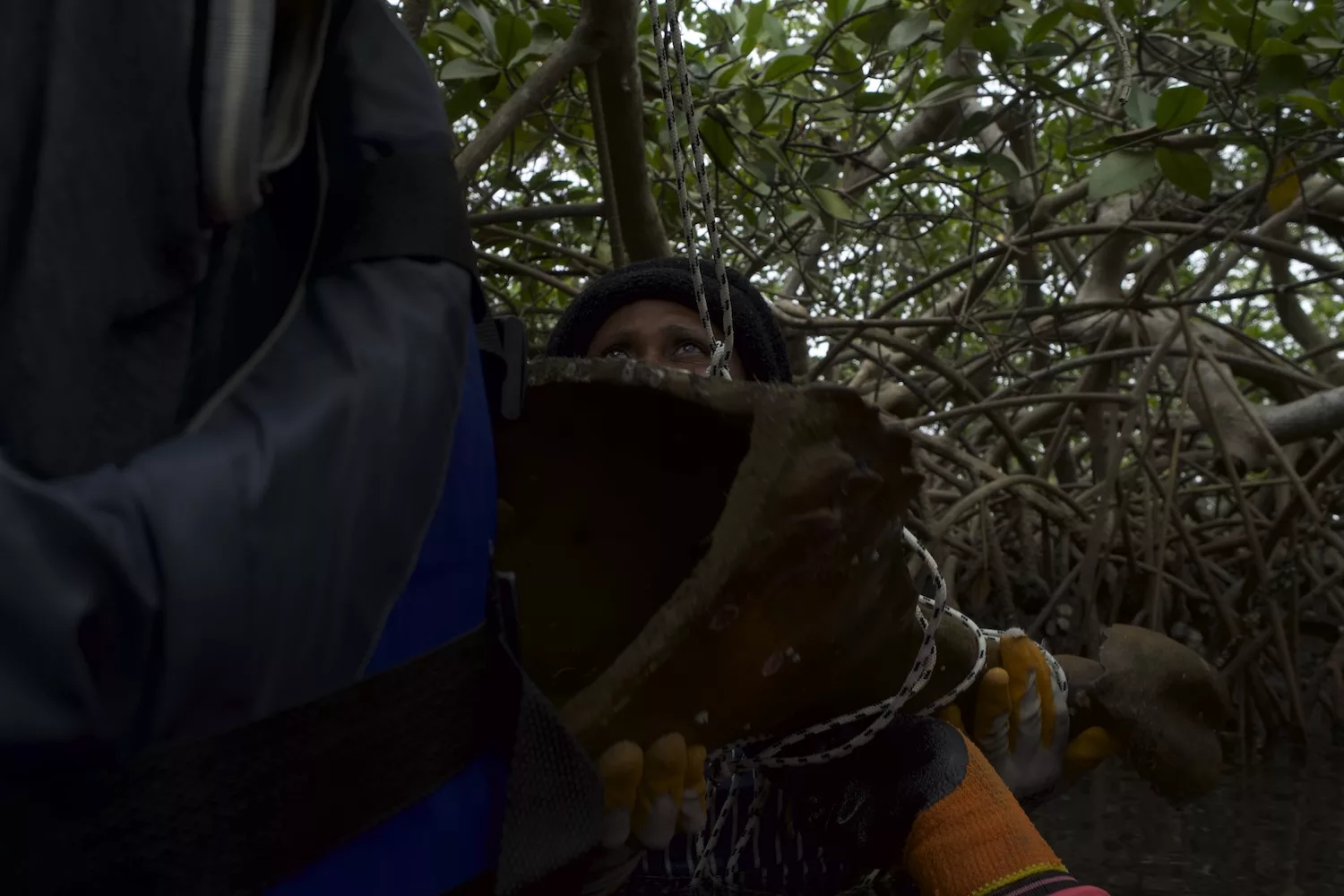
Installation of a sculpture from the Corps immergés series (Carla Gueye) in the mangroves of Mangagoulack, 2026 © Ibra Wane
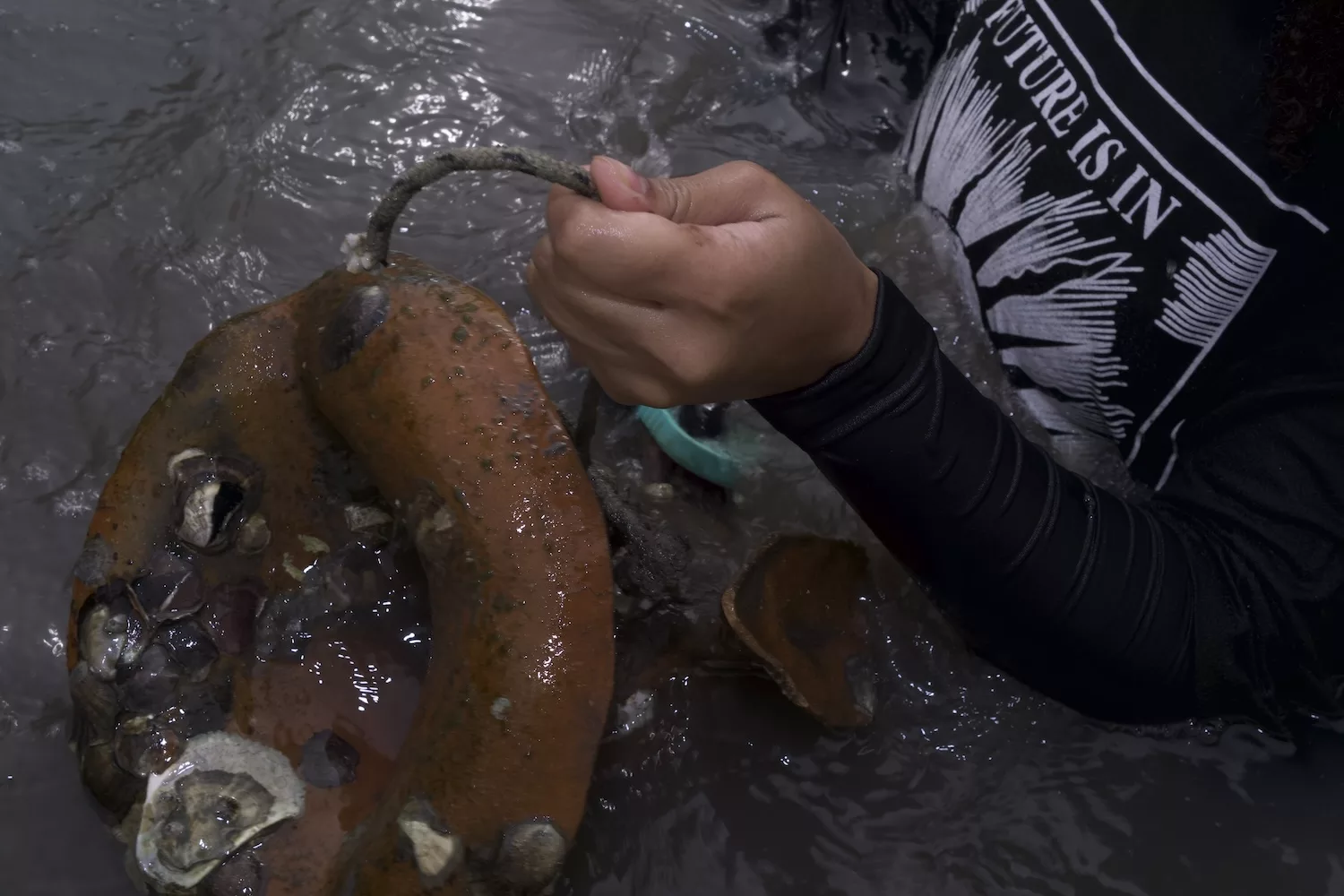
Maintenance of a sculpture from the Corps immergés series (Carla Gueye) in the mangroves of Mangagoulack, 2026 © Ibra Wane
The pieces produced during this second stay were immersed shortly after their making in the mangroves of Mangagoulack, still in Casamance. In the region, artisanal oyster farming is a major economic activity, and nearly all of the workforce is made up of women. For generations, they have passed down traditional know-how, from oyster gathering to the maintenance of mangroves. Now trained in modern oyster farming techniques, their labour, often little recognised, contributes not only to the economic survival of local communities but also to the preservation of these vital ecosystems, which are essential to the area’s ecological balance. Since mid-2025, Awa, Benna, Seynabou and Sona – four oyster farmers from the cooperative I work with – have been watching over the installation of the project Corps immergés [Submerged Bodies], with the support of aquaculture researcher Ibrahima Thiao.12
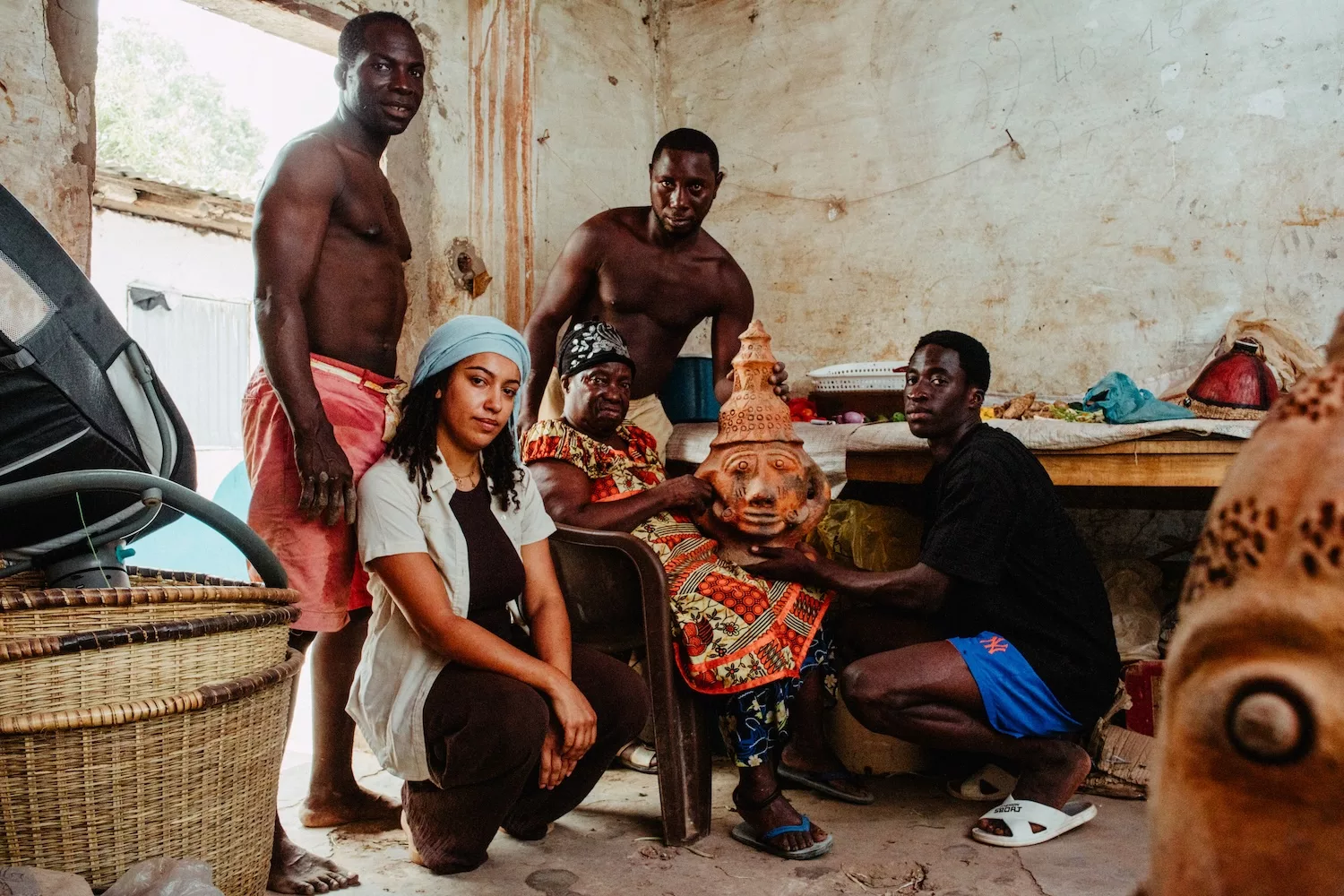
Aliou, Carla Gueye, Seyni Awa Camara, Momodou and Boully, Bignona, 2025, © Ibra Wane
Like so many before me, I crossed that courtyard to meet Seyni – or rather the image others had fashioned of her, that of a woman described as a magician, a keeper of secrets. I neither sought them nor uncovered them. Her transmission took other paths: in a look, a slow gesture, a way of doing shared without words. I was struck less by her legend than by the reality of her life. Indeed, her living conditions stood in stark contrast to the market that surrounds her works and sends them far from Bignona. And yet she continued. She shaped the earth every day, lived from it and enabled those around her to live. Her work remained above all a space of survival and solidarity, where her entire family stood together.
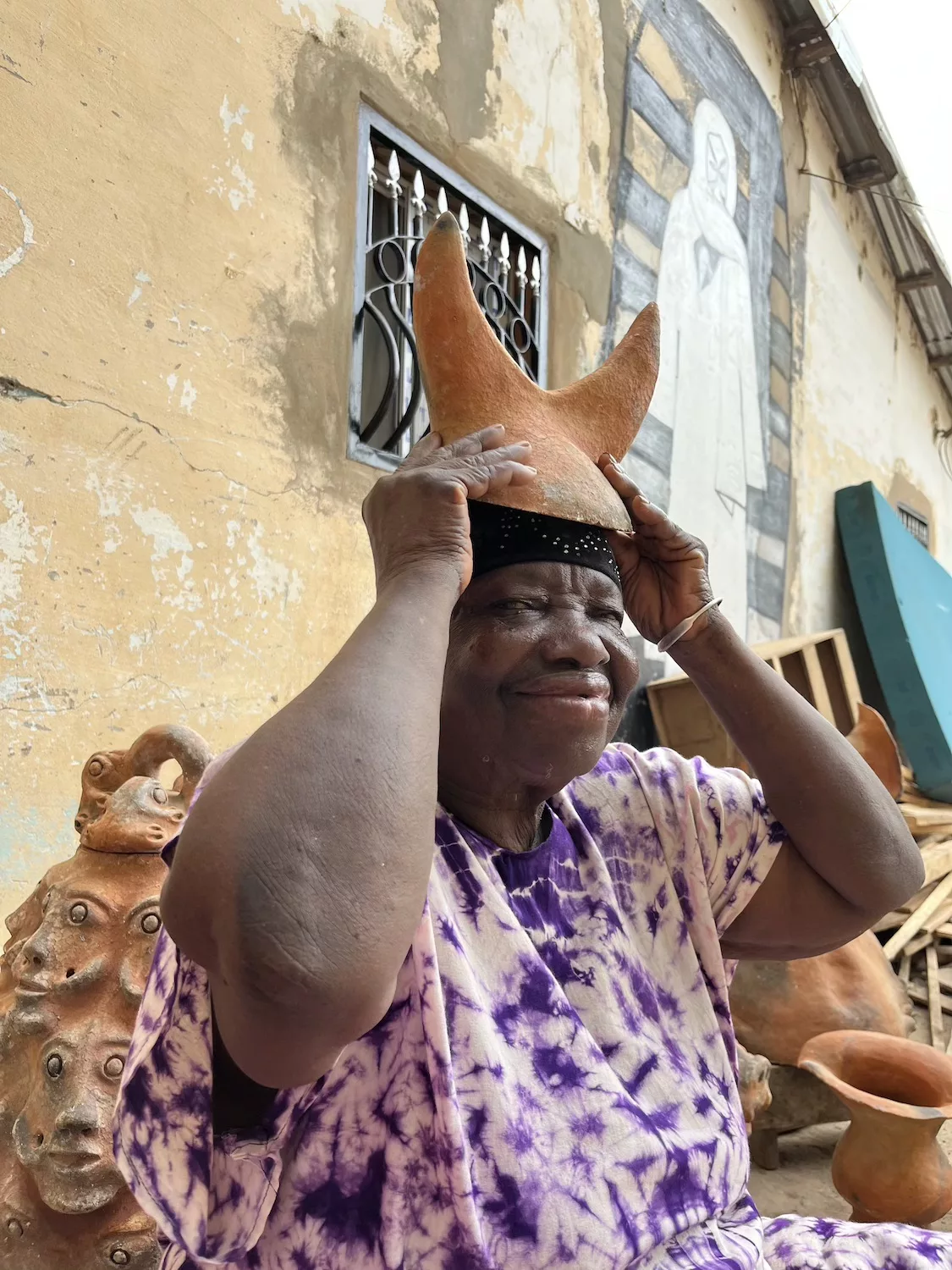
Seyni Awa Camara carrying on her head Carla Gueye’s work, Bignona, 2025. © Carla Gueye
When I left Bignona, I gave up the idea of departing with a truth. I will never know the mysteries attributed to Seyni. From her I received something else, more fragile and more enduring: a way of inhabiting the earth, of listening to what is transmitted beyond words, of recognising the strength that persists in daily practice. This presence continues to work within me.
Carla Gueye (born 1997 in Saint-Michel, near Angoulême) is a multidisciplinary artist based in Paris. She graduated from the Cergy School of Art in 2022. She was awarded the Ateliers Médicis mention at the COAL Prize 2024, and the Grand Prize of the International Sculpture Biennial of Ouagadougou (BISO) in 2025. Her work has been exhibited at Quatorzerohuit in Dakar (2023), at the Grande Halle de la Villette as part of 100% L’Expo (2024), at the Galerie Le Manège at the Institut Français in Dakar (2024), at the Musée Dauphinois in Grenoble in the exhibition Pays Bassari (2024–2025), at the Salon de Montrouge (2025), at the 36th São Paulo Biennial (2025) and at the MAIF Social Club in Paris (2025–2026).