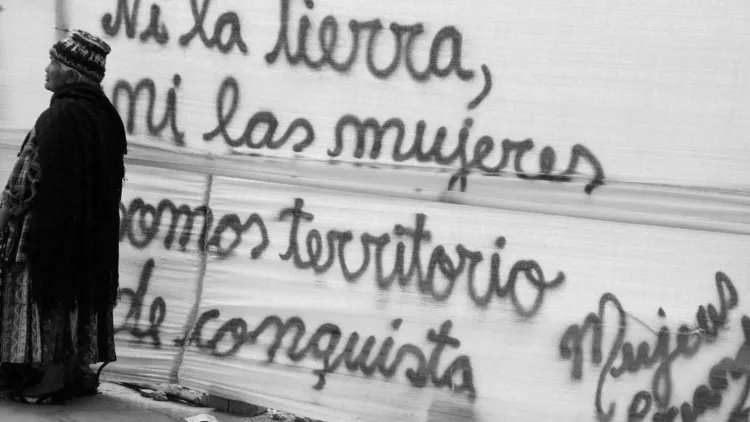
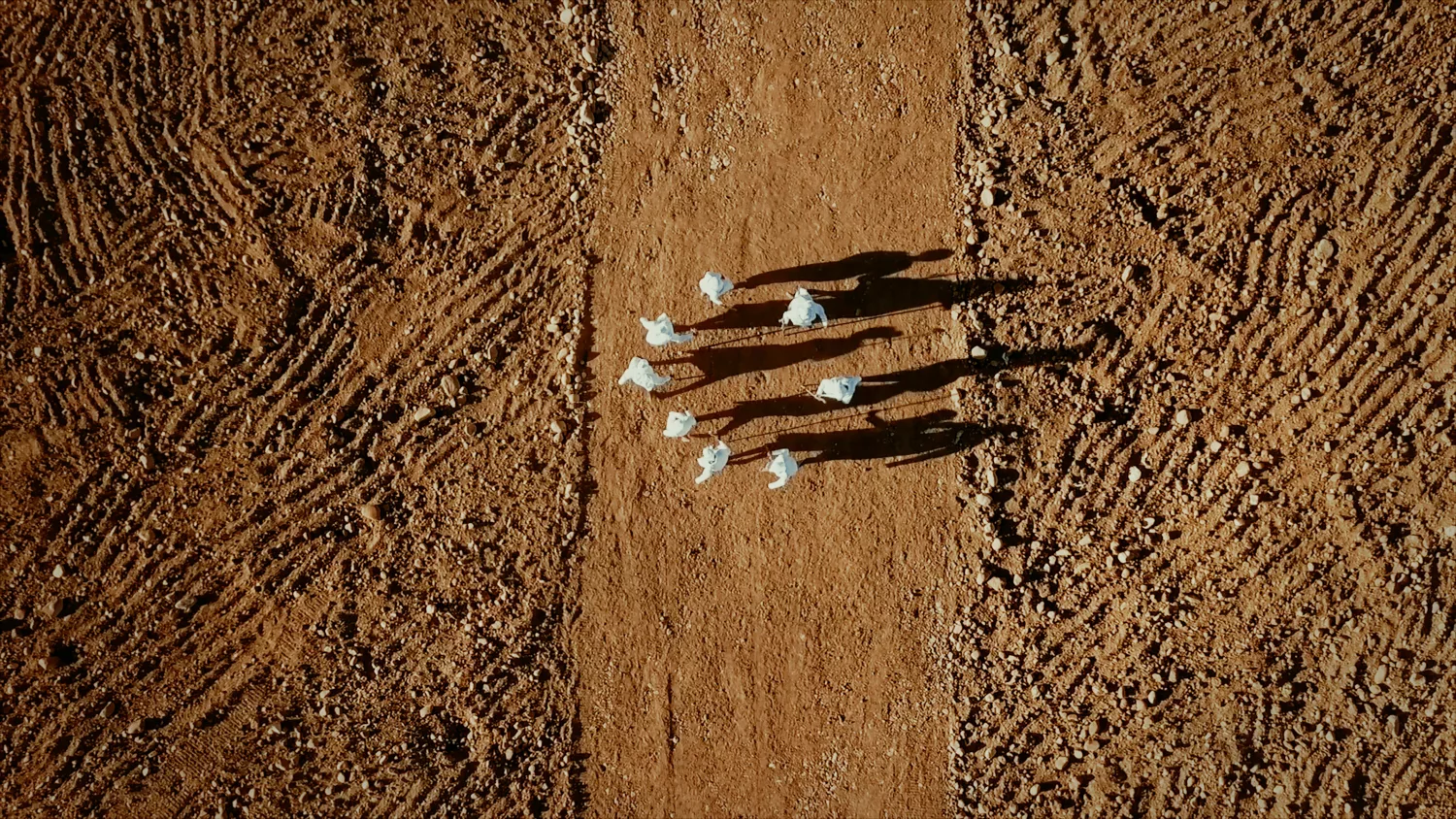
Buhlebezwe Siwani, Amahubo, 2018 © Buhlebezwe Siwani
Montparnasse – Bienvenüe metro station, Exit 2, Lines 4, 6, 12 and 13
Villa Vassilieff is accessible to visitors using wheeled devices or who have mobility difficulties thanks to special facilities (access ramp, adapted toilets, and a lift).
In addition, several reserved parking spaces are available close to the Villa Vassilieff:
• in front of 4 rue d’Alençon, 75015 Paris
• in front of 7 rue Antoine Bourdelle, 75015 Paris
• in front of 23 rue de l’Arrivée, 75015 Paris
Consult the map of adapted parking spaces in Paris here.
The session, organized as part of Common Ground: Feminist and Decolonial Ecologies research programme and curated by Nkule Mabaso, is grounded in the awareness that today’s environmental challenges are deeply connected to histories of colonialism, land dispossession, and struggles for Indigenous rights. It explores how contemporary artists engage with climate narratives through a critical lens. Recognizing that the climate crisis is inseparable from broader social and political histories, the artists featured in this session examine the relationships between land, resources, and climate change across diverse geographies.
Their works employ speculative and poetic vocabularies—mobilizing metaphors and analogies often absent from mainstream climate communication—to imagine new ways of understanding and responding to environmental and historical entanglements. Through film and conversation, Climate Fictions reflects on the strategies artists use to address a world shaped by settler colonialism and by the intersections of Indigeneity, ecological transformation, and the financialization of the natural world.
The session will begin with an introduction by curator Nkule Mabaso and Common Ground coordinator Anaïs Roesch, followed by a conversation with artists Eline Benjaminsen, Ola Hassanain, and Buhlebezwe Siwani, as well as community leader and land rights advocate Elias Kimaiyo and sociologist and historian Brice Molo, who will provide contextual insights connecting the ideas and frameworks that inform this shared moment of reflection and inquiry.
Films screening:
Buhlebezwe Siwani, AmaHubo, 2018 – 14’31’’
Eline Benjaminsen et Elias Kimaiyo, Footprints in the Valley, 2024 – 09’05’’
Ola Hassanain, The Watcher, 2024 – 19’19’’
Practical information
Friday, December 12, 2025 from 6:00 to 9:00 pm
Free entry with registration here
The event will be held in English and in French
Eline Benjaminsen works are attempts at observing the always weird, often violent and mostly invisible spaces where market fundamentalism and ecological crisis meet. A camera-based ‘follow-the-money’ approach fuses techniques associated with a documentary photography tradition and experimental representations. Video works, print- and publication-making are central within her practice. She collaborates with a variety of platforms and individuals, from researchers and activists to the financial press. Recent exhibits of her work include Fotonoviembre, Tenerife (ESP), Høstutstillingen/Kunstnernes Hus (NO), Oslo Kunstforening (NO), Radius Centre for Art and Ecology (NL), Wereldmuseum Amsterdam (NL) and KunstHaus Wien (AUST).
Ola Hassanain trained her focus on the subtle politics of space—namely, how built spaces react to and reinforce violence from state entities, which in turn, creates a built environment that reflects, responds to, regulates the lives of those who inhabit it. Her most recent work explores an idea of “space as discourse,” an expanded notion of space that encompasses political and environmental questions. Her work tries to develop a spatial vocabulary that follows how ruptures presented by ‘political events’, make it possible to aspire to new kind of ecologies. Ola’s development of critical spatial practice is party informed by her post-academic training which includes an ongoing Ph.D. in Practice candidacy at the Academy of Fine Art, a BAK fellowship 2017-2018, and teaching in HKU University of the Arts Utrecht and Sandberg Institute amongst others.
Elias Kimaiyo lives and works in Embobut/Kenya , is a Sengwer indigenous community leader from Embobut forest. He is also a land and human rights defender as well as a community journalist. Together with other community leaders he lobbies for ancestral land tenure rights and recognition. He works closely with community allies like civil societies, journalists, researchers, and paralegals to raise awareness about the violence that is taking place towards his people as a consequence of neoliberal conservation. In 2017 he was the declared Human Rights Defender of the Year by Defenders Coalition.
Nkule Mabaso is a curator, artist, and researcher. She currently serves as Director of Fotogalleriet in Oslo. As PhD researcher at HDK-Valand, University of Gothenburg, Mabaso investigates curatorial practices across postcolonial and ecological frameworks. She holds an MA in Curating from the Zurich University of the Arts and a BFA from the University of Cape Town. Her practice emphasizes collaboration, decolonial methodologies, and reimagining art’s social and political potential.
Brice Molo holds a PhD in History (University of Yaoundé I, Cameroon) and Sociology from EHESS (Paris, France). He is assistant professor of sociology at the Catholic Institute of Paris, where he teaches the history of ecological thought, the sociology of risk and the epistemology of social sciences. His research focuses on risks, disasters and mass deaths in colonial and post-colonial situations. See his research on Brice Molo.
Anaïs Roesch is a researcher and activist involved in ecological transition within the visual arts. A graduate of Sciences Po Grenoble, the Andean University Simón Bolivar in Quito, and the Academy of Fine Arts in Leipzig, she is currently preparing a sociology PhD (Paris 1 Panthéon-Sorbonne) on the ecological engagement pathways of visual artists in France. In 2015, she produced ArtCOP21, a festival dedicated to climate issues, for the COAL association. In 2019, she initiated and then co-led the project on decarbonizing the cultural sector within the think tank The Shift Project. In 2021, she published, together with David Irle and Samuel Valensi, Decarbonizing Culture: Facing Global Warming, the New Challenges for the Sector (Presses Universitaires de Grenoble). She teaches at Sciences Po Paris and regularly works with the visual arts sector on these issues. She has also worked for ten years in international cooperation for various organizations.
Buhlebezwe Siwani works with performance, photography, sculpture and installation. Siwani’s work interrogates the patriarchal framing of the black female body and black female experience within the South African context. As an initiated Sangoma, a spiritual healer that works within the space of the death and the living, Siwani focused her artistic practice into rituality and the relationship between Christianity and African spirituality. Central to her work is her own body, which operates in multiple registers as subject, object, form, medium, material, language and site.