Symposium
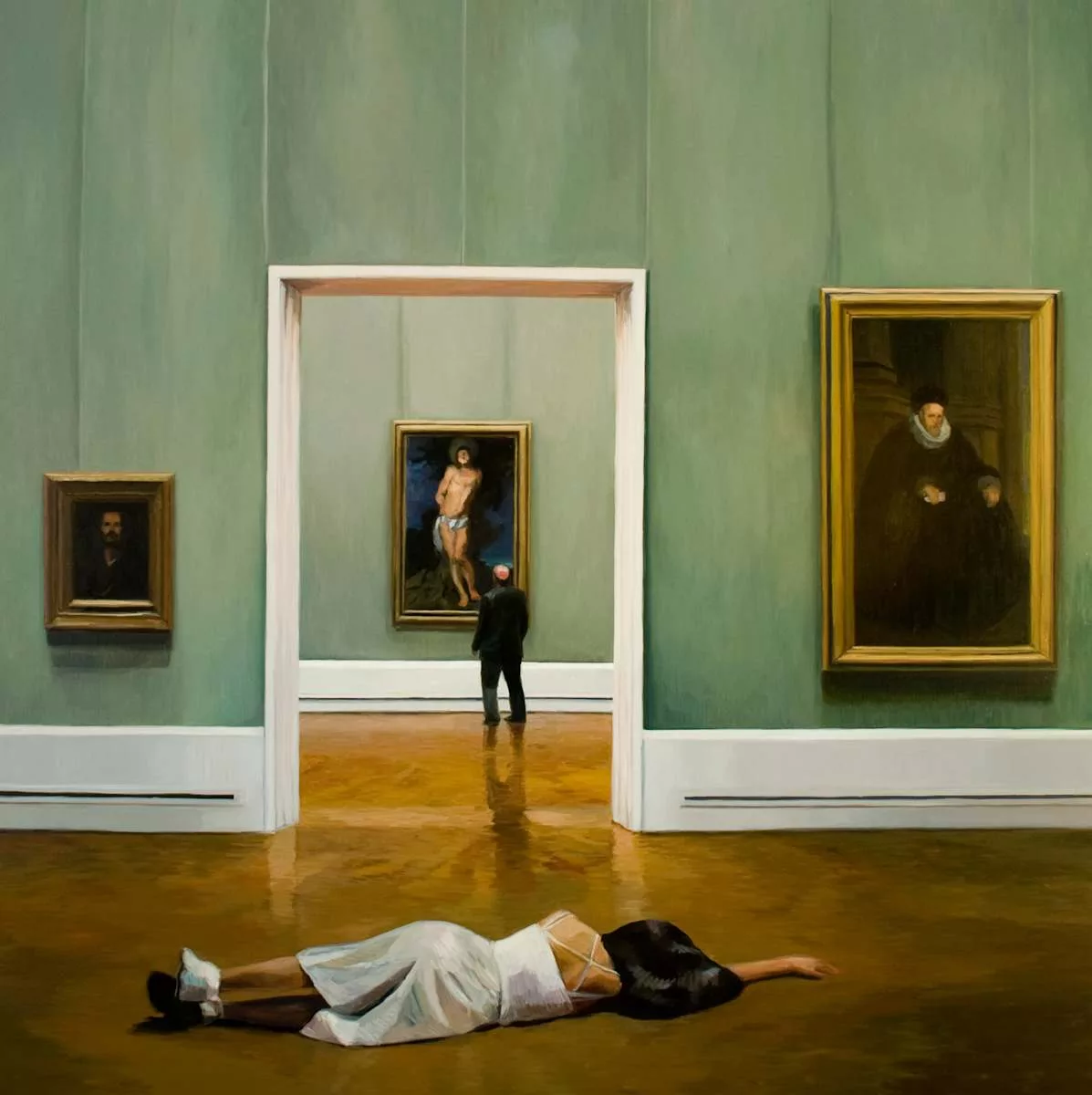
Sandra Gamarra, Milagros, 2008, c. Sandra Gamarra, courtesy of the artist
In 2014, the Musée du Louvre held a lecture series, entitled Women artists at the museum? Current perspectives. Building on this line of thought, the present symposium moves beyond acknowledging the underrepresentation of women artists in permanent collections: through a combination of theoretical approaches and real-world case studies, this symposium aims to explore the epistemological shift that must occur for women artists to take their rightful place in museum collections.
Museums play a key role in society as spaces of knowledge and, by extension, of power. By rendering objects visible and inscribing them within cultural narratives, museums contribute to creating dominant frameworks and, through them, collective imaginaries. Scholarship in art history, museology and, in particular, gender studies, challenges the existing hierarchies among artists, artworks and techniques, and critically examines the conditions under which artists trained and worked. This feminist approach, which also draws on postcolonial theory, is driving change in museum practices. By focusing on the permanent collections of historical art, an area still less studied from this angle than temporary exhibitions and modern or contemporary collections, this symposium will explore museum initiatives that generate new ways of seeing and understanding. Many historical art museums have launched research programmes, experimented with innovative display strategies, and developed new narratives and modes of transmission.
Such work challenges evaluation criteria grounded in the established canon and pushes back on the enduring myths and misconceptions that continue to shape art history. This naturally gives rise to pressing questions: Can gender studies play a role in fundamentally reconfiguring museums? Does a radical approach necessarily lose its force when articulated within an institutional setting? What initiatives of this kind, both past and present, have already been carried out, and with what outcomes?
Organised jointly by the non-profit organisation AWARE: Archives of Women Artists, Research and Exhibitions and the Musée du Louvre Museum Studies and Research Support Department, this international symposium will bring together curators, academics and artists working at the intersection of art history, museology and gender studies, to harness the transformative potential that this interdisciplinary space holds for building the museums of tomorrow.
Practical information
Monday, February 16, 2026 from 9:30 am to 7:00 pm
Tuesday, February 17, 2026 from 9:30 am to 6:00 pm
École du Louvre
Amphithéâtre Michel-Ange
Palais du Louvre, Porte Jaujard
Place du Carrousel 75001 Paris
Free and open to the public upon registration here
The event will take place in French, English and Spanish (with consecutive interpretation)
For all questions regarding this symposium, you can send an email to the following address: [email protected]


Programme
Mon. 16 February 2026
École du Louvre, Amphithéâtre Michel-Ange
École du Louvre, Amphithéâtre Michel-Ange
9:30-9:45 am
Françoise Mardrus, Musée du Louvre, and Camille Morineau, AWARE, MNAM-Centre Pompidou
Françoise Mardrus, Musée du Louvre, and Camille Morineau, AWARE, MNAM-Centre Pompidou
Welcoming remarks by the Louvre Museum and AWARE
Read more
Françoise Mardrus, Director of Musée du Louvre’s Museum Studies and Research Support Department
Camille Morineau, Heritage Curator, Musée National d’Art Moderne-Centre Pompidou and Co-Founder of AWARE: Archives of Women Artists, Research and Exhibitions
followed by
Julie Botte, Projects coordinator at the Musée du Louvre’s Museum Studies and Research Support Department
Matylda Taszycka, Head of Research Programmes at AWARE: Archives of Women Artists, Research and Exhibitions, National d’Art Moderne-Centre Pompidou
Read less
9:45-10:15 am
Introduction by Griselda Pollock: "Method or Ideology? What’s at Stake? Possible Strategies"
Read more
Griselda Pollock, Feminist Art Historian, Professor Emerita, University of Leeds
Abstract: Has half a century of feminist critique substantially impacted museum practice and public consciousness? In Old Mistresses, 1981 / Maîtresses d’autrefois, 2023, Roszika Parker and I identified the structural hierarchy in the discipline of Art History / Museum Culture valuing men over women, Western art over other world cultures, painting and sculpture over art with thread, cloth, or ceramic, etc. Marxist and post-colonial critical Museology identified museums as ideological producers of national identity and acculturation while also enshrining colonialist hierarchies. Neither can be corrected by mere addition. The problem is not museological but still brutally ideological, thus denying the public access both to understanding of official culture’s servicing of power and its hierarchies of class, gender, race, and sexualities and to transformative encounters with works of art presented as equivocal agents of cultural meaning and sites of human diversity and complexity. How can these become curatorial strategy?
Griselda Pollock, professor emerita of Social & Critical Histories of Art, University of Leeds, received 2024 Nessim Habif World Prize (Geneva), 2020 Holberg Prize, 2023 CAA Life-time Achievement Award for Writing on Art, 2010 CAA Distinguished Feminist Award for Promoting Equality in Art. Texts include Old Mistresses: Women, Art and Ideology with Rozsika Parker (1981; 4th edition: 2022, now in Japanese, Spanish, French, Italian & Polish), Encounters in the Virtual Feminist Museum (2007), Differencing the Canon (1999), Charlotte Salomon in the Theatre of Memory (2018), Killing Men & Dying Women: Imagining Difference in 1950s New York Painting (2022), WOMAN IN ART: Helen Rosenau’s ‘Little Book’ of 1944 (2023).
Read less
10:15-10:30 am
Questions
10:30 am-1:15 pm
Moderator : Chương-Đài VÕ, Curator, Writer, Editor and Professor, ENSAPC
Moderator : Chương-Đài VÕ, Curator, Writer, Editor and Professor, ENSAPC
Session 1: Mapping Presence: Revisiting Permanent Collections
Read more
Chương-Đài Võ is a curator, researcher and editor based in Paris, and a professor at École Nationale Supérieure d’Arts de Paris Cergy. Her current projects include an exhibition at Cité internationale des arts about sites of internationalism in Paris, co-curated with Charles Esche; and a book about the Prague-based, artist-run space Display and the development of contemporary art in post 1989, former Eastern Europe. Most recent, she was Artistic Director of the Africa-Asia Festival in Dakar and co-editor of The Museum is Multiple: Van Abbemuseum 2004-24.
Read less
10:30-11:00 am
Annabelle Ténèze: "Being a Woman in the Galerie du temps"
Read more
Annabelle Ténèze, Director, Louvre-Lens Museum
Abstract: An emblematic space of the Louvre-Lens bringing together more than 5,000 years of history, the Galerie du temps has presented, since December 2024, a renewed display expanded in both geography and chronology. This approach is accompanied by an unprecedented participatory mediation project carried out with two hundred women and men from the local community, including the association Femmes en avant of Liévin. By juxtaposing works, their contexts, and at times the silences of history, the museological itinerary offers a renewed reading of the collections, paying new attention to representations of women across the centuries and to women artists, long marginalized and insufficiently identified within the narrative of art history. Mythological figures, saints, queens, allegories, models, women artists, anonymous representations… the works testify as much to the ways women have been viewed as to the societies that produced them. Informed by recent research, by the perspectives of contemporary artists, and by those of the public, this approach conceives the museum as a living, open, and inclusive space, where works from the past enter into dialogue with contemporary issues of equality and transmission, across territories and eras, and without hierarchy—neither among the arts nor among people.
Annabelle Ténèze has been Director of the Louvre-Lens since 2023, where she is leading the project Louvre en partage (A Shared Louvre). Since her arrival, she has overseen the renewal of the Galerie du temps, and the Louvre-Lens has presented the exhibitions Exiles: Artists’ Perspectives (2024), Icons from Ukraine (2024), Dressing Like an Artist: The Artist and Clothing (2025), and Gothics (2025). A graduate of the École nationale des chartes and the Institut national du patrimoine, Annabelle Ténèze began her career in 2006 as curator in charge of the graphic arts collections at the Musée national Picasso–Paris. In 2012, she was appointed Director of the Musée d’art contemporain de la Haute-Vienne – Château de Rochechouart. In 2017, she became Director General of Les Abattoirs, which brings together the Musée d’art moderne et contemporain de la Ville de Toulouse and the Fonds régional d’art contemporain Occitanie. She has co-organized several exhibitions devoted to women artists (Peindre, dit-elle, 2015–2017, Musée d’art contemporain de Rochechouart; Musée des Beaux-Arts de Dôle; L’Iris de Lucy: Contemporary African Women Artists, 2015–2016, MUSAC, León; Musée d’art contemporain de Rochechouart; CAAM, Las Palmas de Gran Canaria) and has curated numerous retrospectives of women artists, including Marion Baruch, Jacqueline de Jong, Hessie, ORLAN, Niki de Saint Phalle, Carolee Schneemann, among others.
Read less
11:00-11:30 am
Ilaria Miarelli Mariani and Ilaria Arcangeli: "Women Artists and Rome’s Civic Museums: Rethinking Collections and Narratives"
Read more
Ilaria Miarelli Mariani, Director, Museum of Rome and the Municipal Museums of the City of Rome, and Ilaria Arcangeli, researcher
Abstract: Over the past years, a sustained research and curatorial programme has focused on rediscovering and reappraising women artists in Rome’s civic museum collections. The exhibition Roma Pittrice proved pivotal in fostering a renewed valorisation of these works and led to the decision to establish a permanent room displaying a selection of the works presented on that occasion. The project has developed through systematic cataloguing campaigns of the nineteenth-century collections, begun before the exhibition and still ongoing, leading to new identifications and reattributions of works previously considered anonymous or attributed to male relatives. More recently, at the Gallery of Modern Art, the mural paintings by the Carmelite nun Eufrasia, preserved in the former convent complex now serving as the gallery’s seat, have been returned to public view, further extending this strategy of recovery and reintegration of women artists into museum narratives.
Ilaria Miarelli Mariani is a Full Professor of Museology and Art and Restoration Criticism at La Sapienza University of Rome. Since 2023, she has been Director of the Civic Museums of Rome and is President of CUNSTA. She is a member of doctoral and museum boards, including the Galleria Borghese. An expert in Roman art, museology, collecting, and the history of taste, she has published over one hundred scientific works, including important monographs. For the Musei Civici, she curated the catalogue of 19th-century painting at Palazzo Braschi and major exhibitions such as Tiziano, Lotto, Crivelli and Guercino. The Masterpieces of the Podesti Pinacoteca, Roma Pittrice. Women Artists at Work between the 16th and 19th Centuries, and Impressionismo e oltre. Masterpieces from the Detroit Institute of Arts, devoted to European painting from Impressionism to the early avant-garde.
Ilaria Arcangeli earned her PhD in Cultural Heritage Studies from the University of Chieti-Pescara in May 2025, with a dissertation focused on early modern women artists active in Rome between the 16th and 17th centuries. Her broader interests include early modern art collecting, documentation photography, and cultural heritage conservation. Arcangeli has collaborated with major Italian institutions such as the Borghese Gallery, the Barberini Corsini National Galleries and the Royal Museums of Turin. She co-curated the exhibition Roma Pittrice at the Museum of Rome and currently collaborates with the same museum. She is also a researcher at the University of Perugia on a project related to the digitisation of heritage affected by earthquakes in central Italy.
Read less
11:30-11:45 am
Questions
11:45 am-12:00 pm
Break
12:00-12:30 pm
Fabienne Dumont: "Françoise d’Eaubonne: The Battle of the Sexes through Works from the Musée du Louvre"
Read more
Fabienne Dumont, Art Historian, Art Critic and Professor at Jean-Monnet-Saint-Etienne University
Abstract: Histoire de l’art et lutte des sexes was published in 1978 by Françoise d’Eaubonne. In this book, the pioneer of ecofeminism draws on numerous works from the Musée du Louvre, which she approaches through her passionate, learned, and iconoclastic feminist gaze. Engaging with the debates of her time and aligned with a social and Marxist history of art, she draws on multiple disciplines to decipher the position of women in representations. She situates these analyses within a broader consideration of the position of artists in the art field, in relation to their patrons, the sexual morality of their era, and other contextual factors. This presentation revisits several examples while also outlining the intellectual trajectory of Françoise d’Eaubonne.
Fabienne Dumont is Professor of Contemporary Art History at Jean Monnet University Saint-Étienne. Her publications include Des sorcières comme les autres – Artistes et féministes dans la France des années 1970 (PUR, 2014); (ed.), La rébellion du Deuxième Sexe – Art History through the Lens of Anglo-American Feminist Theories (1970–2000) (Les presses du réel, 2011); Nil Yalter – At the Confluence of Migrant, Feminist, and Working-Class Memories and Mythologies (MAC VAL, 2019); Nil Yalter – An Interview with Fabienne Dumont (Manuella Éditions/Aware, 2019); (ed.), Alice Neel (ER Publishing, 2022); and (ed.), Françoise d’Eaubonne, Art History and the Battle of the Sexes [1978] (Les presses du réel, 2025).
Read less
12:30-1:00 pm
Gloria Cortes: "’I Had Believed That We Had The Right To Go To Museums’. Gender and Museum Practices at the Museo Nacional de Bellas Artes, Chile"
Read more
Gloria Cortes, Curator at the Fine Arts Museum of Chile
Abstract: Drawing on a quote from the Argentinian poet Alfonsina Storni (1919), this presentation will review the methods and systems employed by museums to incorporate women into their core agendas. More specifically, we will examine the initiatives implemented at the Museo Nacional de Bellas Artes de Chile and the challenges it has faced in developing a gender agenda that ensures the inclusion and equality of women, girls and adolescents in its programmes and in its critical review of its collections.
Gloria Cortes is an art historian and curator at Museo Nacional de Bellas Artes, Chile. Her areas of specialisation include gender studies, feminism, and networks and associations in 19th- and 20th-century modern art. Author of Modern Women: Stories of Women in Chilean Art (1900–1950). She has curated exhibitions such as “(en)clave Masculino (2016)”, “Desacatos. Feminine Artistic Practices, 1835-1939” (2017) “Yo soy mi propia musa. Latin American female painters between the wars (1919-1939)” (2019); “Laura Rodig. What the soul does to the body, the artist does to the people” (2020) and “Luchas por el arte. Map of relationships and disputes over the hegemony of art (1843-1933)” (2022-204), all of which were developed at the MNBA.
Read less
1:00-1:15 pm
Questions
1:15-2:30 pm
Lunch break
2:30-5:15 pm
Moderator: Stéphanie Deschamps-Tan, Heritage Curator, Louvre Museum
Moderator: Stéphanie Deschamps-Tan, Heritage Curator, Louvre Museum
Session 2: Beyond the Fine Arts: Hierarchies of Genre and Gender
Read more
Stéphanie Deschamps-Tan is a graduate of the École du Louvre, the Sorbonne-Nouvelle, and the Institut national du Patrimoine. She is a curator at the Louvre Museum’s Sculpture Department, where she is responsible for the sculpture collections from the first half of the 19th century. She worked on the French sculptress Noémi Constant. Her present research focuses on French Neoclassicism, particularly Joseph Chinard and François-Joseph Bosio, and the influence of Antonio Canova in France. She also teaches at the École du Louvre and has curated numerous exhibitions, most recently on the representation of childhood (Le Mans, Bordeaux, 2025).
Read less
2:30-3:00 pm
Andaleeb Badiee Banta: "Making Her Mark: Lessons Learned from a Woman-Centered History of European Art"
Read more
Andaleeb Badiee Banta, Andrew W. Mellon Senior Curator of Prints and Drawings, National Gallery of Art, Washington D.C.
Abstract: In 2023-24, the exhibition “Making Her Mark: A history of women artists in Europe, 1400-1800” was intended as an ambitious corrective to widely held—if not always openly acknowledged—assumptions that women artists of this period were rare, or that their works were less significant than those by their male counterparts. The project presented an alternative narrative of European art that prioritized women’s artistic production across media and apart from traditional male-centered standards. This talk will share insights gained about methodology, limitations, and historical/current biases that inform approaches to materiality and gender in museum practice.
Dr. Andaleeb Badiee Banta is the Andrew W. Mellon Senior Curator of Prints and Drawings at the National Gallery of Art in Washington. A specialist in Renaissance and Baroque European art, Dr. Banta has held curatorial positions at the Allen Memorial Art Museum at Oberlin College and the Baltimore Museum of Art. She has particular interest in the material and social aspects of works of art, and in illustrating the relevance of historical art. Her work has been supported with fellowships and grants from the Fullbright Foundation, the American Academy in Rome, and the National Endowment for the Humanities.
Read less
3:00-3:30 pm
Manon Lecaplain and Camille Belvèze: "The Museum in Poitiers: History and Future of a Commitment to Women Artists"
Read more
Manon Lecaplain, Director and Heritage Curator, and Camille Belvèze, Heritage Curator, Musée Sainte-Croix, Poitiers
Abstract: In 2024, the museums of Poitiers were enriched by an exceptional acquisition: the La Musée collection, comprising more than 500 works by women artists. Featuring pieces dating from the 17th to the 21st century, this collection represents, for its donor Eugénie Dubreuil, a counter-proposal to the dominant narrative that excludes women from art history. This donation confirms the identity of the Sainte-Croix Museum as a reference institution for the promotion and recognition of women artists in France, in line with an approach initiated as early as the 1980s. The accompanying financial endowment will enable the Poitiers institution to deepen this long-standing commitment by strengthening its ties with academic research.
Camille Belvèze and Manon Lecaplain are heritage curators at the museums of Poitiers. They curated the exhibition “La Musée: A Collection of Women Artists”, presented at the Sainte-Croix Museum from 6 December 2024 to 18 May 2025. In partnership with the F.A.R. collective (Femmes Artistes en Réseaux) and the University of Poitiers, they organize the Rencontres de La Musée, bringing together art professionals and researchers around issues related to the promotion of women artists. The first edition of these public events will take place on 23 and 24 April 2026 at the Sainte-Croix Museum in Poitiers.
Read less
3:30-3:45 pm
Questions
3:45-4:00 pm
Break
4:00-4:30 pm
Liliane Cuesta Davignon: "Revisiting Collections through the Lens of Gender: Two Projects at the National Museum of Ceramics and Decorative Arts of Valencia (Spain)"
Read more
Liliane Cuesta Davignon, Heritage Curator, González Martí National Museum of Ceramics and Decorative Arts of Valencia
Abstract: Starting from the premise that gender can be a useful tool for interpreting collections, the National Museum of Ceramics and Decorative Arts has developed two projects. Led by the University of Valencia, the project “Re-readings: Museum Itineraries through the Lens of Gender” connects 18 museums by creating interpretive routes based on objects re-examined from a gender perspective. Using an intersectional approach, the project “The Dos Aguas Palace as a Domestic Space: A Gender- and Class-Based Perspective” aims to construct a new narrative around the building that houses the museum.
Liliane Cuesta Davignon studied Art History and Museology at the École du Louvre and earned a Master’s degree in Art History from Paris IV–La Sorbonne. Since 2005, she has been a museum curator at the National Museum of Ceramics and Decorative Arts. Since 2017, she has been a member of the working group “Museums and Gender” within the Network of History Museums of Catalonia and has participated in the project “Re-readings: Museum Itineraries through the Lens of Gender.” She is the author of Rethinking the Museum: A Feminist Guide to Reflection and Action (2025). In 2023, she co-chaired UNESCO’s regional consultation on arts and cultural education. She has been a member of ICOM since 2012.
Read less
4:30-5:00 pm
Iris Moon: "Rethinking Porcelain in Monstrous Beauty"
Read more
Iris Moon, Associate Curator, European Sculpture and Decorative Arts, Metropolitan Museum of Art
This talk explores the exhibition, Monstrous Beauty: A Feminist Revision of Chinoiserie (2025), and how the decorative arts, especially a “minor” genre like porcelain, can operate as an unexpected site for powerful revisionist frameworks that challenge past assumptions. When porcelain arrived in early modern Europe from China, it led to the rise of Chinoiserie, a decorative style that encompassed Europe’s fantasies of the East and fixations on the exotic, along with new ideas about women, sexuality, and race. Far from being trivial, this exhibition explored how porcelain shaped both European women’s identities and racial and cultural stereotypes around Asian women.
Iris Moon is responsible for European ceramics and glass at The Metropolitan Museum of Art, where she recently curated the exhibition, Monstrous Beauty: A Feminist Revision of Chinoiserie (2025). In addition to her curatorial work, she is the author of Melancholy Wedgwood (2024) and Luxury after the Terror (2022), and co-editor with Richard Taws of Time, Media and Visuality in Post-Revolutionary France (2021). She earned her PhD at Massachusetts Institute of Technology and has taught at Pratt Institute, Cooper Union, and The Institute of Fine Arts, New York University.
Read less
5:00-5:15 pm
Questions
5:15 pm
End of the first day
Tue. 17 February 2026
École du Louvre, Amphithéâtre Michel-Ange
École du Louvre, Amphithéâtre Michel-Ange
9:30-9:45 am
Carolina Hernández Muñoz and Matylda Taszycka, AWARE
Carolina Hernández Muñoz and Matylda Taszycka, AWARE
Welcoming Remarks
Read more
Carolina Hernández Muñoz, International networks project manager & coordinator, AWARE : Archives of Women Artists, Research and Exhibitions
Matylda Taszycka, Head of Research Programmes at AWARE: Archives of Women Artists, Research and Exhibitions, musée national d’Art moderne-Centre Pompidou
Read less
9:30 am-1:00 pm
Moderator: Clovis Maillet, Performance Artist and Medieval Historian
Moderator: Clovis Maillet, Performance Artist and Medieval Historian
Session 3: Collections as Polysemous Spaces: Narrating Multiple Histories
Read more
Clovis Maillet is a medieval historian and artist. He has published La parenté hagiographique (2014), Les genres fluides (2020), Un Moyen Âge émancipateur (with Thomas Golsenne, 2021), and Ecotransféminismes (with Emma Bigé, 2025). Since the early 2000s, he has worked in performance, installation, and filmmaking, collaborating with Louise Hervé and other artists. He also co-wrote the performance Medieval Crack with the collective Foulles.
Read less
9:45-10:15 am
Isabella Rjeille: "To Make History, histories"
Read more
Isabella Rjeille, Curator, Museu de Arte de São Paulo Assis Chateaubriand
Abstract: Since 2017, the Museu de Arte de São Paulo Assis Chateaubriand (MASP) has organized its annual program around different Histórias [Histories], an initiative led by its Artistic Director, Adriano Pedrosa. The word Histórias, in Portuguese, encompasses fiction and non-fiction, personal or political accounts, possessing a speculative, plural, and polyphonic character. This lecture will analyze how these cycles, such as Afro-Atlantic Histories (2018); Women’s Histories, Feminist Histories (2019) and Queer Histories (2024), has impacted and reshaped MASP’s collection, known to be the “most important collection of European art in the Southern Hemisphere”. This presentation will draw on the Museum’s history and how architect Lina Bo Bardi’s ideas inspired a new approach to a more inclusive and diverse collection.
Isabella Rjeille is a curator, writer and editor. She works as curator at Museu de Arte de São Paulo Assis Chateaubriand (MASP) and is currently working as a co-curator, along with Vivian Crockett, of the Sixth New Museum Triennial, opening in 2026 in New York. At MASP, she has curated and co-curated monographic and group exhibitions including Histories of Ecology (2025), Lia D Castro: Everywhere, Nowhere (2024), Melissa Cody: Webbed Skies (2023), Cinthia Marcelle: By Means of Doubt (2022), Brazilian Histories (2022), Maria Martins: Tropical Fictions (2021), Feminist Histories: Artists After 2000 (2019), Djanira: Picturing Brazil (2019), Lucia Laguna: Neighborhood (2018), among others.
Read less
10:15-10:45 am
Stephanie Sparling Williams: "A Black Feminist Ethics of Inclusion and Experiments in Polyvocality"
Read more
Stephanie Sparling Williams, Andrew W. Mellon Curator of American Art at the Brooklyn Museum
Abstract: Examining the 2024 transformation of the Brooklyn Museum’s American art collection galleries, this talk introduces new and experimental Black Feminist models for collection engagement and interpretation. Stephanie Sparling Williams argues that people outside of art institutions bring different questions, expectations, and experiences to this work than art historians and curators, and that myriad perspectives result in richer encounters with and understandings of museum collections. Through a range of voices across numerous (and often unexpected) formats, visitors to the Brooklyn Museum are invited to experience a world-renowned collection in groundbreaking new ways.
Stephanie Sparling Williams is the Andrew W. Mellon Curator of American Art at the Brooklyn Museum. Her curatorial practice is predicated on interdisciplinary research, writing, and teaching on American art, and foregrounds Black Feminist space-making. Her recent work, Toward Joy: New Frameworks for American Art reimagines how contemporary audiences experience historic American art. Disrupting traditional presentations of art from the Americas and offering a new set of approaches to collection display and interpretation, this reinstallation and accompanying publication reframes 2,000 years of art drawn from the world-renowned holdings of the Brooklyn Museum.
Read less
10:45-11:15 am
Sandra Gamarra Heshiki: "Mestizo Museum"
Read more
Sandra Gamarra Heshiki, artist
Abstract: I was born and raised in Lima, where I was educated in Western culture. A culture that promised development, unlike the Andean culture that, although it was a significant part of “Peruvianness”, anchored us in a “savage” past. The tensions between these two realities gave way to a terrible internal war that was understood as a confrontation between opposites, the primitive against the civilized, the past against the future, good against evil. My arrival in Madrid will confront me with a legacy and belonging to a culture that I thought was common, with the museum as a setting (never neutral).
Sandra Gamarra Heshiki studied fine arts at the Pontifical Catholic University of Peru. In 2002, due to the lack of a contemporary art institution in Lima, she created LiMac. This fictitious museum first established itself with its logo on merchandize (pencils, erasers, mugs or bags). Since then, LiMac produced collections, exhibitions, publications, an architectural project and its website. In 2003, she moved to Madrid to complete her art studies. She utilizes painting in a figurative way to conceptually cross-examine art and its mechanisms. Based on appropriations, her work acts as a mirror that displaces exhibition formats, alters the circulation of images, subverts the ownership of culture as well as the narrative between art and its viewer. Within this field of investigation, her peruvian background adds a sincretic gaze where pre-columbian, colonial and western cultures collide.
Read less
11:15-11:30 am
Questions
11:30-11:45 am
Break
11:45-12:15 am
Pawel Leszkowicz: "Ars Homo Erotica (2010) in Warsaw: An Early Case of Queering the National Museum Collection"
Read more
Pawel Leszkowicz, Art Historian and Professor of Contemporary Art and Curatorial Studies, Academy of Art, Szczecin
Abstract: Ars Homo Erotica (2010), exhibited at the National Museum in Warsaw, reinterpreted the museum’s historical collection and contemporary Central and Eastern European art through a queer curatorial lens. Presenting over 200 works from Antiquity to the twenty-first century, the exhibition was structured around thematic sections, including political struggle, the male nude, lesbian imagination, and transgender identities. This paper presents a queer feminist curatorial methodology, with particular emphasis on its homoerotic framework, foregrounding women artists’ engagements with the male nude as an alternative to the gendered norms of the museological canon.
Pawel Leszkowicz is an academic and a freelance curator specializing in LGBTQ+ studies and modern and contemporary art. He curated the Ars Homo Erotica (2010) exhibition at Warsaw’s National Museum and other queer and gender-related exhibitions and symposia in Poland and the UK. He has written four books: Helen Chadwick: The Iconography of Subjectivity (2001), Love and Democracy: Reflections on the Queer Question in Poland (2005), Art Pride: Gay Art from Poland (2010), and The Naked Man: The Male Nude in post-1945 Polish Art (2012). He is a member of AICA and the New University in Exile Consortium in NYC.
Read less
12:15-12:45 am
Zorian Clayton: "Activists on the inside: 20 years of the V&A LGBTQ Working Group"
Read more
Zorian Clayton, Curator of Prints, Victoria & Albert Museum
Abstract: For the past two decades, a cross-museum network of LGBTQ staff and allies have striven to illuminate the vast collections at the V&A through the broad lens of diverse gender identity and sexuality. From sharing research and cataloguing for better online visibility, to programming talks, gallery tours, performances and mini festivals, the V&A has been a leader in the field to improve access to queer narratives. Zorian Clayton has co-chaired the group since 2011 and will share key case studies emphasising our challenges and successes, also highlighting a recent Art Fund project to acquire works by transgender and non-binary artists.
Zorian Clayton is curator of prints (1850-now) at the V&A and co-chair of the museum’s LGBTQ Working Group, organising year-round events focusing on queer history across the collections. Current projects include the touring exhibition Aubrey Beardsley: A Singular Prodigy and Polish Posters Now! (V&A until February 2026). Recent publications include Calling the Shots: A Queer History of Photography (2024) and The Poster: A Visual History (2020). Since 2016, he is also a programmer for the British Film Institute Flare Festival.
Read less
12:45-1:00 pm
Questions
1:00-2:30 pm
Lunch break
2:30-5:30 pm
Moderator: Julie Botte, Project Coordinator, Department of Museum Studies and Research Support, musée du Louvre
Moderator: Julie Botte, Project Coordinator, Department of Museum Studies and Research Support, musée du Louvre
Session 4: Networks and Transmission: Working Collectively
Read more
Julie Botte holds a PhD in Museology, Aesthetics, and Art Studies from Sorbonne Nouvelle University. She has taught at Sorbonne Nouvelle, the University of Artois, ENS Paris-Saclay, and the University of Versailles Saint-Quentin-en-Yvelines Paris-Saclay. In 2021, she defended a dissertation entitled “Women’s Museums: Between Heritage and Social Engagement. Emancipating Women through the Museum?” The results of her research have been published in specialized journals in museum studies, including ICOFOM Study Series, Museum International, and Culture et Musées.
Read less
2:30-3:00 pm
Charlotte Foucher Zarmanian: "Professionals at the Louvre: From Shadow to Light"
Read more
Charlotte Foucher Zarmanian, Art Historian and Research Director, CNRS (National Centre for Scientific Research)
Abstract: As part of a reflection conducted over the past ten years on women and museums, this presentation takes the 19th- and 20th-century Louvre as its main focus. Building on an earlier article, “Le Louvre des femmes” (Sociétés et représentations, 2016), which sought to deconstruct certain gender assumptions, it will focus primarily on women who chose to join the Louvre staff: from the first graduates to the first tenured curators after World War II, including the indispensable assistants and collaborators who often worked behind the scenes.
Charlotte Foucher Zarmanian is an art historian and research director at CNRS (CRAL – Centre de recherche sur les arts et le langage, UMR 8566, where she serves as deputy director). Her work focuses on all women involved in the art world (18th–21st centuries). The concepts of creation, representation, and transmission have been central to her research for the past fifteen years, beginning with her doctoral thesis on women artists in Symbolist circles at the turn of the 19th–20th centuries, and more recently extending to art historians and museum professionals, resulting in the publication: La Conquête d’une autorité. Historiennes de l’art en France (Les presses du réel, 2026).
Read less
3:00-3:30 pm
Laurien van der Werff and Marion Anker: "Women of the Rijksmuseum: Striving Towards Lasting Change"
Read more
Laurien van der Werff, and Marion Anker, Heritage Curators and Co-Chairs of “Women of the Rijksmuseum”, Rijksmuseum, Amsterdam
Abstract: How can the Rijksmuseum – the national museum of the Netherlands – sustainably anchor women in art and history? This question lies at the heart of the Women of the Rijksmuseum research project. Over the past 5 years the project has conducted in-depth research and enriched the collection, focusing on women makers, women in history, and women as actors in the museum. Simultaneously, the project aimed to embed this topic structurally within the organization. This lecture highlights the necessity of combining scholarly research and collection display on the one hand, and organizational implementation on the other, demonstrating how their interaction is key to achieving sustainable, long-term change within the museum.
Laurien van der Werff is Co-Chair of the Women of the Rijksmuseum Project and Research Associate at the Rijksmuseum Print Room. She studied Cultural History at the University of Amsterdam and has been working for the Rijksmuseum since 2016. Specializing in early modern (art) history, works on paper, and paleography, she is particularly interested in the history of women’s labour in the arts. Archival research holds an important place in her work, as in her recent article on women in the sixteenth and seventeenth century print publishing and printing industry (The Rijksmuseum Bulletin, 2025-1).
Marion Anker is the Co-Chair of the Women of the Rijksmuseum Project and Research Associate at the History Department at the Rijksmuseum in Amsterdam. She has worked at the Rijksmuseum since 2019, starting off as a Junior Curator. Anker was one of the compilers of the Rijksmuseum exhibitions Point of View: A Gendered take on the collection (2024) and Revolusi! Indonesia independent (2022) on the Indonesian struggle for independence (1945-1949). Anker specializes in the socio-cultural history of the Netherlands, with a special interest in women’s, colonial and institutional history.
Read less
3:30-3:45 pm
Questions
3:45-4:00 pm
Break
4:00-4:30 pm
Noelia Perez Garcia: "The Prado Museum from a Female Perspective: A Gendered Reading of its Collections"
Read more
Noelia Perez Garcia, Research Director of El Prado en femenino, Prado Museum and Professor of Art History, University of Murcia
Abstract: The Prado Museum is arguably the European institution in which women played the most decisive role in shaping, preserving, and expanding its collections. To make this legacy visible and to foreground women as historical agents within the museum’s narrative, the project El Prado en femenino was launched in 2021. Conceived as a transversal initiative across all departments—Education, Publications, Communication, Digital Development, the Study Center, and the Conservation areas—it develops nine coordinated lines of action. This presentation will outline the project’s structure and goals, and examine how it reframes the Prado through a gender-conscious lens, transforming both the museum’s narratives and its relationship with the public.
Noelia García Pérez is Professor of Art History at the University of Murcia. Her research focuses on female artistic patronage and the intersections between art, power, and gender in the Renaissance. She has edited major collective volumes such as Mary of Hungary, Renaissance Patron and Collector (2020); The Making of Juana of Austria (2021); and Portraiture, Gender, and Power in Sixteenth-Century Art, and is currently editing Crafting a Legacy: Artists and Female Patronage in Early Modern Europe. She currently leads two research projects on the construction of the public image of female rulers in the Renaissance. Since 2021, she has served as Scientific Director of El Prado en femenino.
Read less
4:30-5:00 pm
Susanna Avery Quash: "Institutional efforts to reveal women’s roles in historic art collections"
Read more
Susanna Avery Quash, Senior Research Lead and Head of “Women in the Arts Forum”, National Gallery, London
Abstract: My presentation will offer an overview of work the National Gallery has been engaged with, increasingly systematically, over the past decade to explore its collections from angles which highlight stories of women, whether as creators, subject-matter, benefactors or employees. It will discuss the opportunities and challenges arising from both undertaking the research and disseminating that research to broad audiences through various channels. A focus will be on ‘working collectively’, not least how the Gallery has used external networks with other museums and universities to nurture its ambitions in relation to the new stories it wishes to share about women and its collections.
Susanna Avery-Quash is responsible for the National Gallery’s Women and the Arts Forum, a research and events initiative, which hosts annually a conference and The Anna Jameson Lecture. She co-organised a major conference which examined the role of English-speaking women as disseminators of knowledge about historical paintings and has published on the influential Victorian-era cultural voices, Elizabeth Eastlake, Anna Jameson and Mary Merrifield. She has also investigated 200 years of women’s benefaction at the National Gallery. Her review of the Berthe Weill exhibition at l’Organerie, Paris, featured in The Burlington Magazine for January 2026.
Read less
5:00-5:15 pm
Questions
5:50-5:30 pm
Conclusion by Anne Lafont, Art Historian and Research Director at EHESS (School of Advanced Studies in the Social Sciences)
Read more
Anne Lafont is an art historian and Director of Studies at EHESS. She focuses on art, images, and material culture of the Black Atlantic, as well as historiographical questions related to the notion of African art. She has published on art and knowledge in imperial contexts, including L’artiste savant à la conquête du monde moderne (2010, ed.) and 1740, un abrégé du monde (2012, ed.), as well as on gender issues in art discourse in the 18th and 19th centuries: Plumes et pinceaux. Discours de femmes sur l’art en Europe 1750-1850 (2 vols., 2012, ed.). She later studied different ways of visualizing pigmentation during the invention of dermatology, as well as the auxiliary sciences of racism and their methods of graphic notation. This research resulted in the book L’art et la Race. L’Africain (tout) contre l’œil des Lumières. Anne Lafont served on the scientific committee for the exhibition Le modèle noir de Géricault à Matisse (2019, Musée d’Orsay). In 2021 and 2022, she taught at Williams College as Clark Professor and conducted research in the southern United States on African American art through a Villa Albertine fellowship. Her most recent publication, co-edited with François-Xavier Fauvelle, is L’Afrique et le monde. Histoires renouées de la préhistoire au XXIe siècle (Paris: La Découverte, 2022).
Read less
The organisers would like to thank the École du Louvre and the French Institute in Spain for their support.