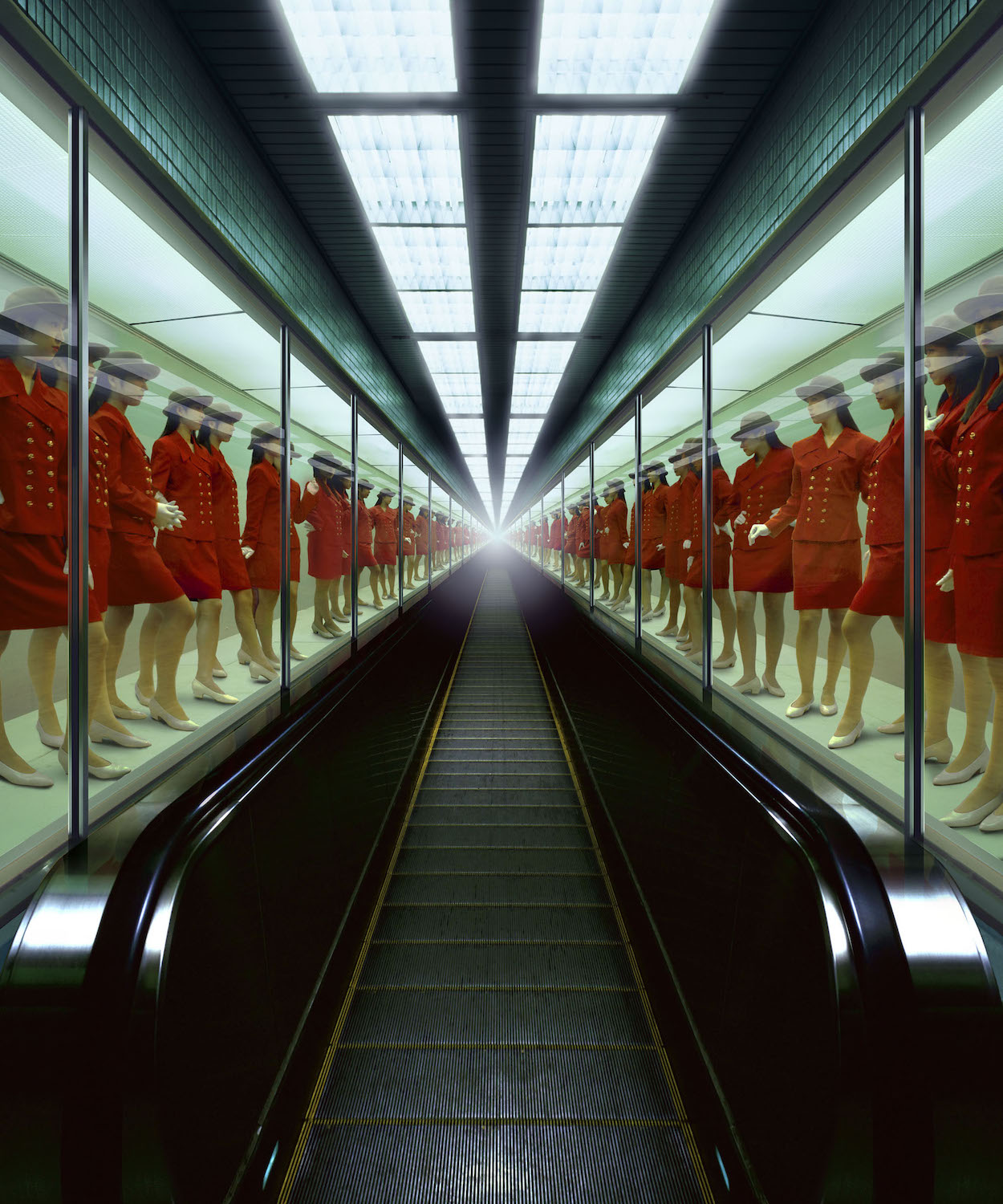
Miwa Yanagi, Elevator Girl House, from the Elevator Girl series, 1997, 240 × 200 cm, colour print, Courtesy of the artist
Organised in collaboration with the Bunkamura Museum of Art on the occasion of the Japanese presentation of the traveling exhibition I’m So Happy You Are Here, this roundtable will take place on August 12, 2026 at Hikarie Hall (Shibuya, Tokyo), the exhibition venue. Bringing together the work of thirty Japanese women photographers, this roundtable offers an opportunity to reflect on the histories, conditions, and futures of women artists in Japan.
Although the exhibition celebrates the remarkable achievements of Japanese women photographers, it also raises broader questions about the structures that have shaped artistic careers in Japan. How have women artists navigated the country’s artistic institutions, exhibition systems, and art market over the past century? What social, cultural, and professional conditions enabled—or constrained—their practices? And what remains to be done to ensure that their contributions become an integral part of art history rather than exceptional narratives?
Bringing together exhibition curator Mariko Takeuchi, curator and art historian Michiko Kasahara, whose pioneering work has profoundly advanced the study and visibility of women artists and photographers in Japan, and Marina Amada, representative of AWARE Japan, the discussion will explore the evolving landscape for women artists from historical, curatorial, and international perspectives. Drawing on their respective experiences in research, exhibition-making, and institution building, the speakers will reflect on the challenges and opportunities of expanding the visibility of women artists, while considering how international initiatives such as AWARE can contribute to a more inclusive understanding of Japanese art history.
The programme will begin with an introduction to AWARE: Archives of Women Artists, Research & Exhibitions, its international mission, and its current research programmes in Japan.
The title of the programme references Ishiuchi Miyako’s exhibition Mother’s 2000–2005: Traces of the Future, presented at the 2005 Venice Biennale and curated by Michiko Kasahara.
Practical information
Wednesday, August 12, 2026, from 5:00 to 6:30 pm
Registration opens at 4:30 pm
Special Event Space, at I’m So Happy You Are Here Exhibition
Hikarie Hall, Shibuya Hikarie 9F
2-21-1 Shibuya, Shibuya-ku, Tokyo 150-8510, Japan
Reservation required: Please register here
Michiko Kasahara is Director of the Nagano Prefectural Art Museum since 2024. Previously Deputy Director of the Artizon Museum, Ishibashi Foundation, Chief Curator of the Tokyo Photographic Art Museum, and Curator at the Museum of Contemporary Art Tokyo. A leading scholar and curator in the fields of photography and gender, she has organized numerous landmark exhibitions, including Exploring the Unknown Self: Self-Portraits of Contemporary Women (1991), Gender Beyond Memory: The Works of Contemporary Women Artists (1996), Love’s Body: Rethinking the Naked and the Nude in Photography (1998), Love’s Body: Art in the Age of AIDS (2010), and I Know Something About Love: Asian Contemporary Photography (2018). As Commissioner of the Japanese Pavilion at the 51st Venice Biennale, she presented Miyako Ishiuchi: Mother’s 2000–2005, Traces of the Future (2005). Her publications include Essays on Photography from a Gender Perspective (2018; Supplementary Edition, 2022) and Photography As a Bulwark Against Era (2002).
Mariko Takeuchi is a critic, writer, and curator specializing in photography. Born in Tokyo, she has contributed extensively to newspapers, magazines, artists’ monographs, and exhibition catalogues in Japan and abroad. As a Fulbright Scholar, she conducted research in the United States and has served as a Visiting Researcher at both the National Museum of Modern Art, Tokyo and the National Museum of Art, Osaka. She has curated numerous exhibitions, including the Japan presentations at Paris Photo and the Dubai Photo Exhibition. She is currently Professor at Kyoto University of the Arts. Her publications include Into the Sea of Contradictions and Silence and Images: Essays on Photography. She lives in Kyoto.
Marina Amada is the Representative of AWARE Japan and an independent curator. Her curatorial projects include the traveling exhibition REFLECTION 11/03/11: Japanese Photographers Facing the Cataclysm (Arles, 2024; Landskrona Foto, 2025), All Things Are Delicately Interconnected (Tokyo Gendai, 2024) Through the art collective SPECTRUM and AWARE, she works to expand discourse around gender and diversity in Japan. Her most recent publication is the essay “SPECTRUM: What Emerges Between Art and Gender—Reflections on Diversity and Solidarity from Art Practice,” published in the Keio University Art Center booklet Art and Gender.
The event is related to the AWARE Research Program Traces of the Future: Women Photographers from Japan / 「未来の刻印 」: 日本の女性写真作家たち