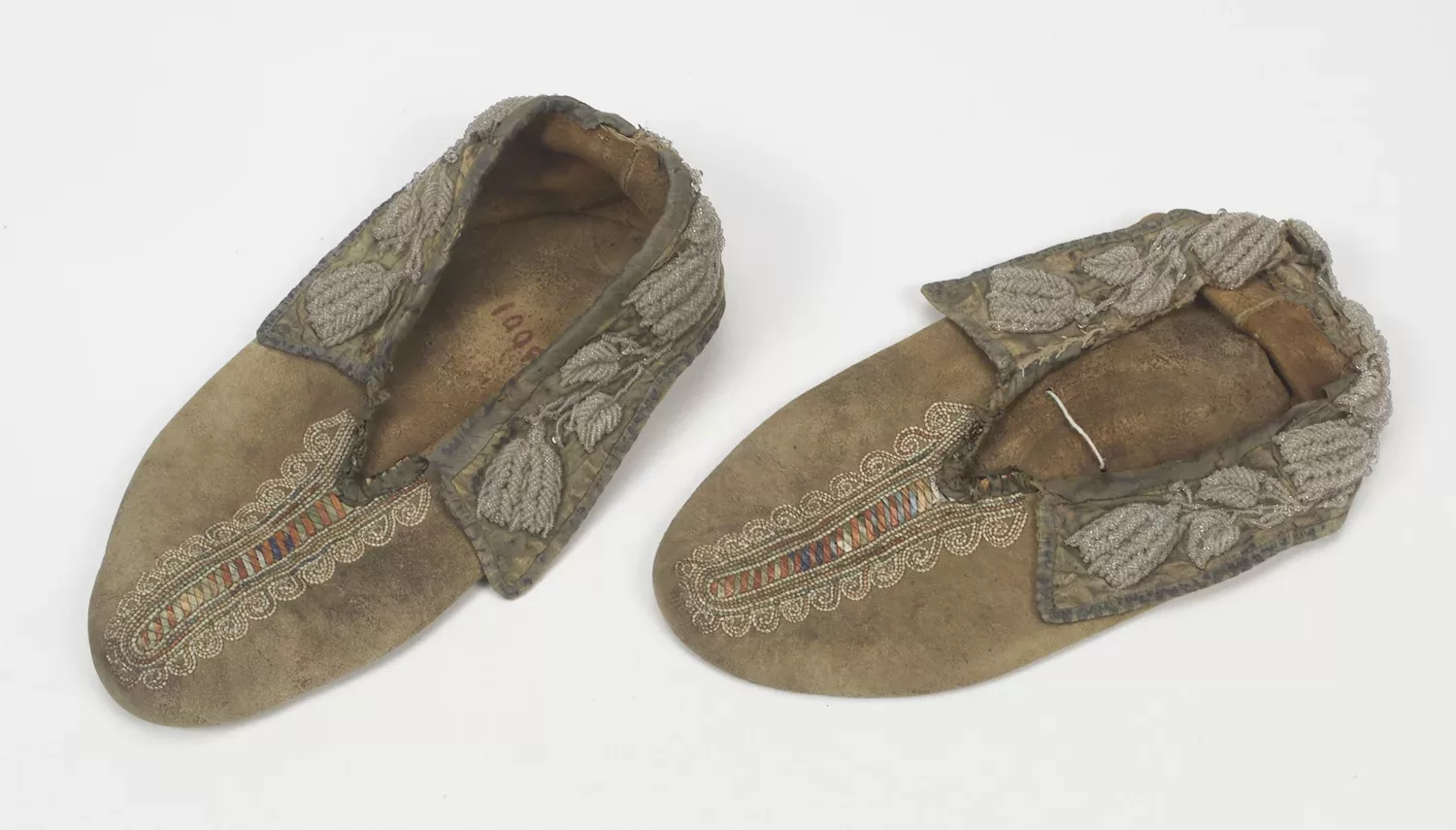
Lucy Tantaquidgeon Tecomwas, Mohegan mocassins with quill- and beadwork, c. 1767, hide, ribbon, pocupine quills, & glass beads, National Museum of the American Indian, Smithsonian Institute, Washington D.C.
Eighteenth-century Indigenous North American women were prolific and skilled artists. Yet they are mostly absent from art history. This absence occurs in part because the objects they designed or adorned—pottery, baskets, bags, clothing, weapons, etc.— historically were dismissed by the discipline as utilitarian or ceremonial artifacts and relegated to anthropology and natural history museums. This absence also occurs because museums rarely know the name of the Indigenous women artists who created the precious works in their collections. Soldiers, adventurers, tourists, and amateur ethnographers of European descent often originally acquired the items by purchase, theft, or gift from their makers. The art objects come to museums with little provenance and often second- or third-hand. Perusals of the online collection catalogues of the Metropolitan Museum of Art, the National Museum of the American Indian at the Smithsonian, the Penn Museum at the University of Pennsylvania, and the musée du quai Branly – Jacques Chirac in Paris amply demonstrate these issues. Most eighteenth-century Indigenous art objects in their collections have no known maker and were acquired from or donated by white men. Curators can often only estimate when and by which tribal nation an art object was made.
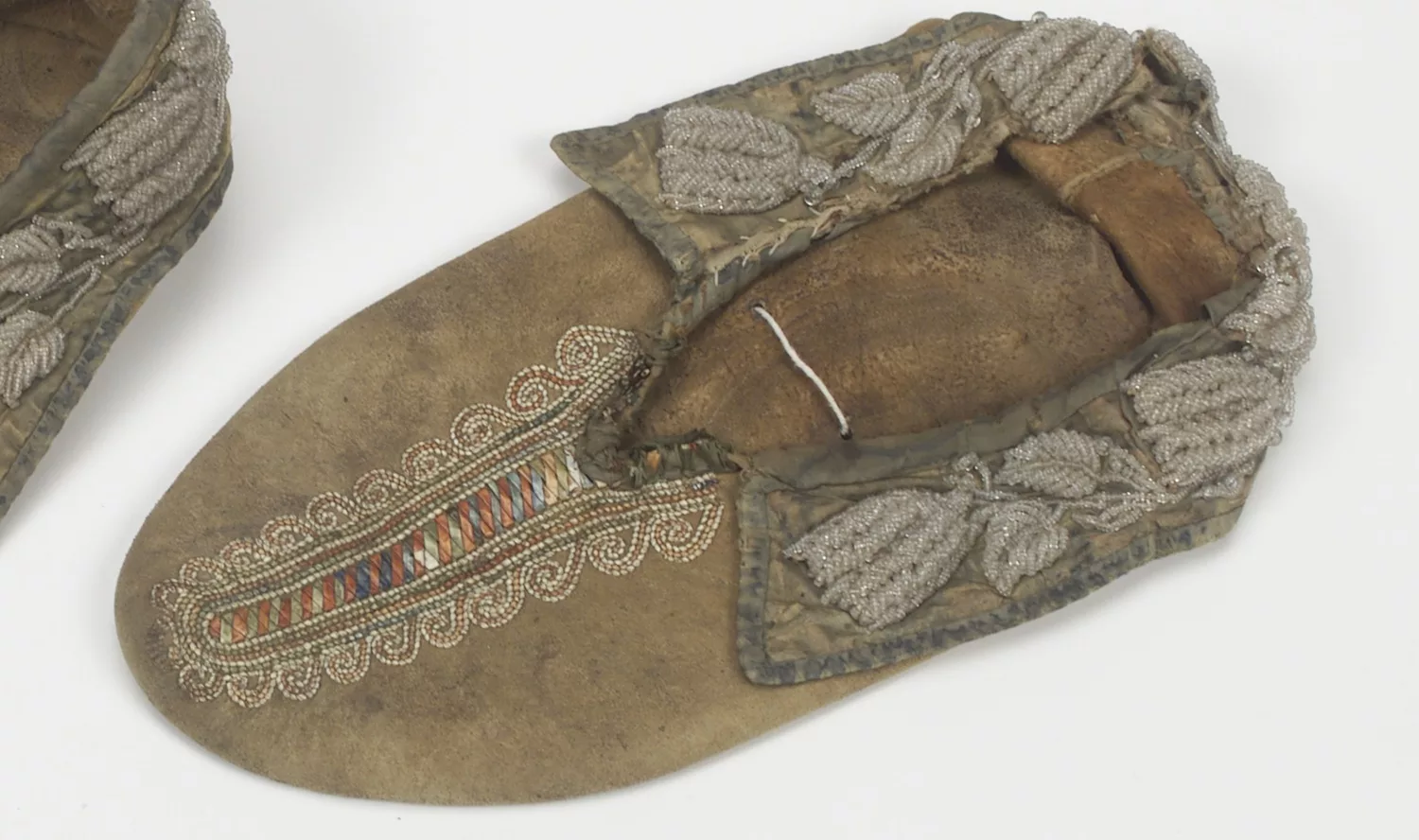
Lucy Tantaquidgeon Tecomwas, Mohegan mocassins with quill- and beadwork (detail), c. 1767, hide, ribbon, pocupine quills, & glass beads, National Museum of the American Indian, Smithsonian Institute, Washington D.C.
A pair of moccasins housed at the National Museum of the American Indian (NMAI) is a rare exception. Young Mohegan artisan Lucy Tantaquidgeon Tecomwas (1753-1834) made them around 1767. Now all but unknown outside of her tribal nation, Tecomwas was the daughter of Mohegan medicine woman Lucy Occom Tantaquidgeon and niece of famed Mohegan writer and Methodist minister Samson Occom. She married fellow Mohegan Peter Tecomwas, and they had three children. She was and is from a lineage of artists.
The Mohegan Nation is located in present-day Connecticut, United States, along the Thames River, which links the nation to the Atlantic coast and to the many trails and waterways that have long united the region’s Native peoples. European colonisation initially increased Mohegan power, as the nation allied with the British in such conflicts as King Philip’s War (1675-1678), but by the mid-eighteenth century, most citizens were living in poverty on the Mohegan reservation, sustaining themselves through farming, sailing, fishing, and making trade goods like spoons and baskets. The aforementioned Samson Occom, along with leaders from his own and neighbouring Native nations, advocated for removing to Haudenosaunee (Iroquois) territory and establishing a new Christian Native nation. Lucy Tantaquidgeon’s childhood would have been shaped by fierce written and oral debates regarding how to resist and survive as a people and whether to leave behind their homelands along with the violence, immorality, and exploitation of European colonies. Though delayed by the American Revolution, Samson Occom and his followers migrated northwest in the 1780s to establish the Brothertown Indian Nation. Lucy Tantaquidgeon Tecomwas remained in Mohegan with her mother, husband, and children, and the now far-flung family sent each other letters and art to maintain ties. Both nations thrive today, though Brothertown continues to fight for federal recognition from the U.S. government.
In making moccasins, a teenage Lucy Tantaquidgeon participated in a vital Indigenous art genre. Almost all North American Native peoples make moccasins. These are slip-on shoes made from soft leather and frequently embellished with techniques, materials, designs, and colours prized within a particular Indigenous community. To begin this pair, it is probable that Tantaquidgeon would have used her own feet as a pattern to cut correctly sized pieces of hide and then stitched together gathered seams stretching along the top of each foot. She then decorated the seams with plaited quillwork in blue and red—common Mohegan colours—though the dyes’ vibrancy has dulled with time. Quill embroidery borders the layered diamond arrangement produced by plaited quillwork and, in contrast, has been stitched in a curling curvilinear fashion that appears dotted, a unique interpretation of the Mohegan “Trail of Life” motif.1 Tantaquidgeon has covered the stitching that attaches the moccasins’ ears, or flaps, to the shoe as well as the ears’ edges with dark ribbon. She has encircled the ears with vines of leaves and flowers, worked in white glass beads. These are special moccasins, ones to be worn—as evidenced by signs of wear inside and on the toes—and also to be cherished and then given to a daughter to be passed on to other relatives. Later in life, a now-married Tecomwas gifted them to her daughter Cynthia Tecomwas Hoscutt (1778-1855). Hoscutt subsequently gifted the moccasins to her own daughter, medicine woman Rachel Hoscutt Fielding (1800-1860), who in turn presented them to her son Moses Fielding (1833-1897). Moses Fielding was the last Mohegan bearer of these moccasins. He sold them to Abel Brooks in 1887, and they are now housed in the NMAI.
While these are the only known extant artworks by Lucy Tantaquidgeon Tecomwas, they are beautifully and memorably crafted. The design combines components of Mohegan style with the artist’s personal innovations. These are not the rote repetition of an unchanging craft culture, but expressions of an artist’s eye and skill. Their presence in the NMAI reminds us simultaneously of the vast body of eighteenth-century Indigenous North American women’s art that is lost to history and of the many unattributed works that remain.
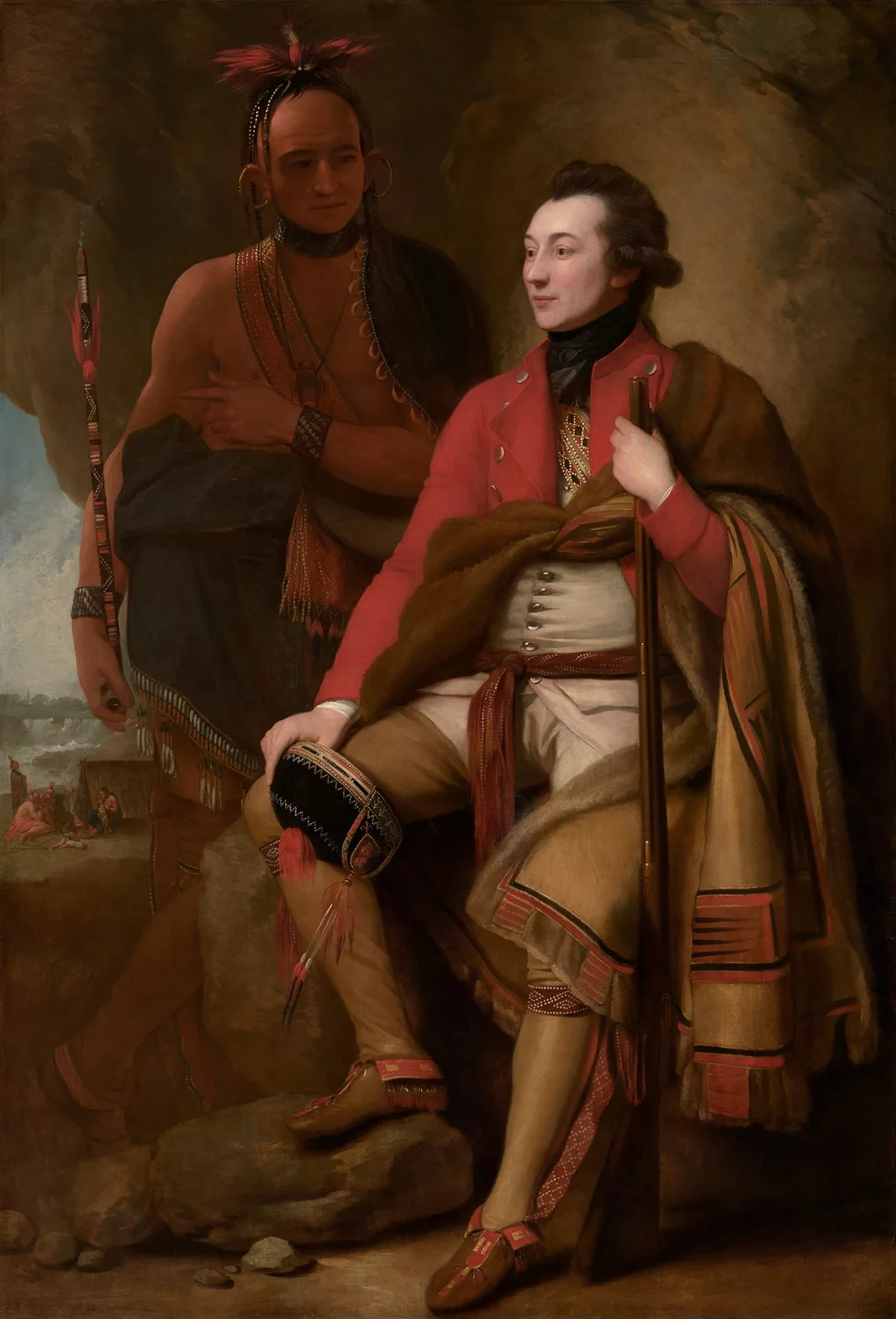
Benjamin West, Colonel Guy Johnson and Karonghyontye (Captain David Hill), 1776, oil on canvas, 202 x 138 cm, Andrew W. Mellon Collection, National Gallery of Art, Washington, D.C.
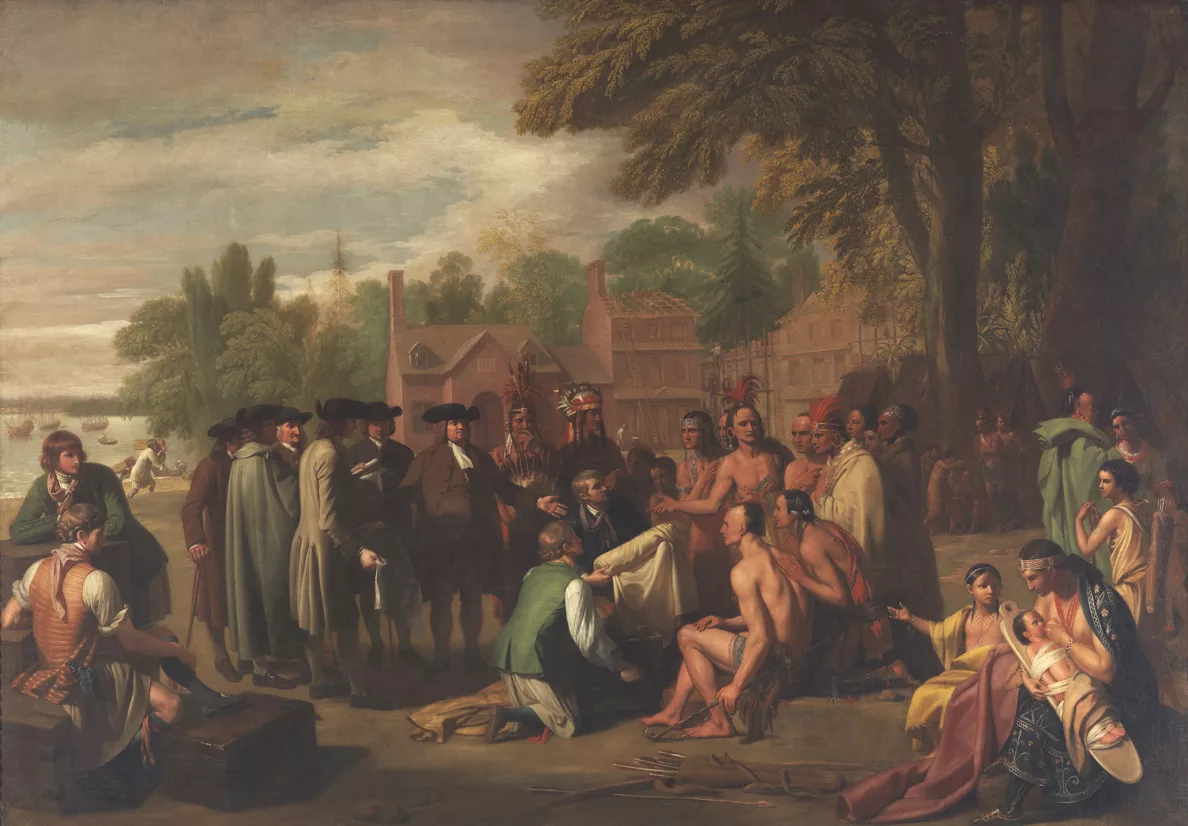
Benjamin West, William Penn’s Treaty with the Indian when He Founded the Province of Pennsylvania in North America, 1771, oil on canvas, 191.8 x 273.7 cm, Pennsylvania Academy of the Fine Arts Museum, Gift of Mrs. Sarah Harrison (The Joseph Harrison, Jr. Collection), Philadelphia
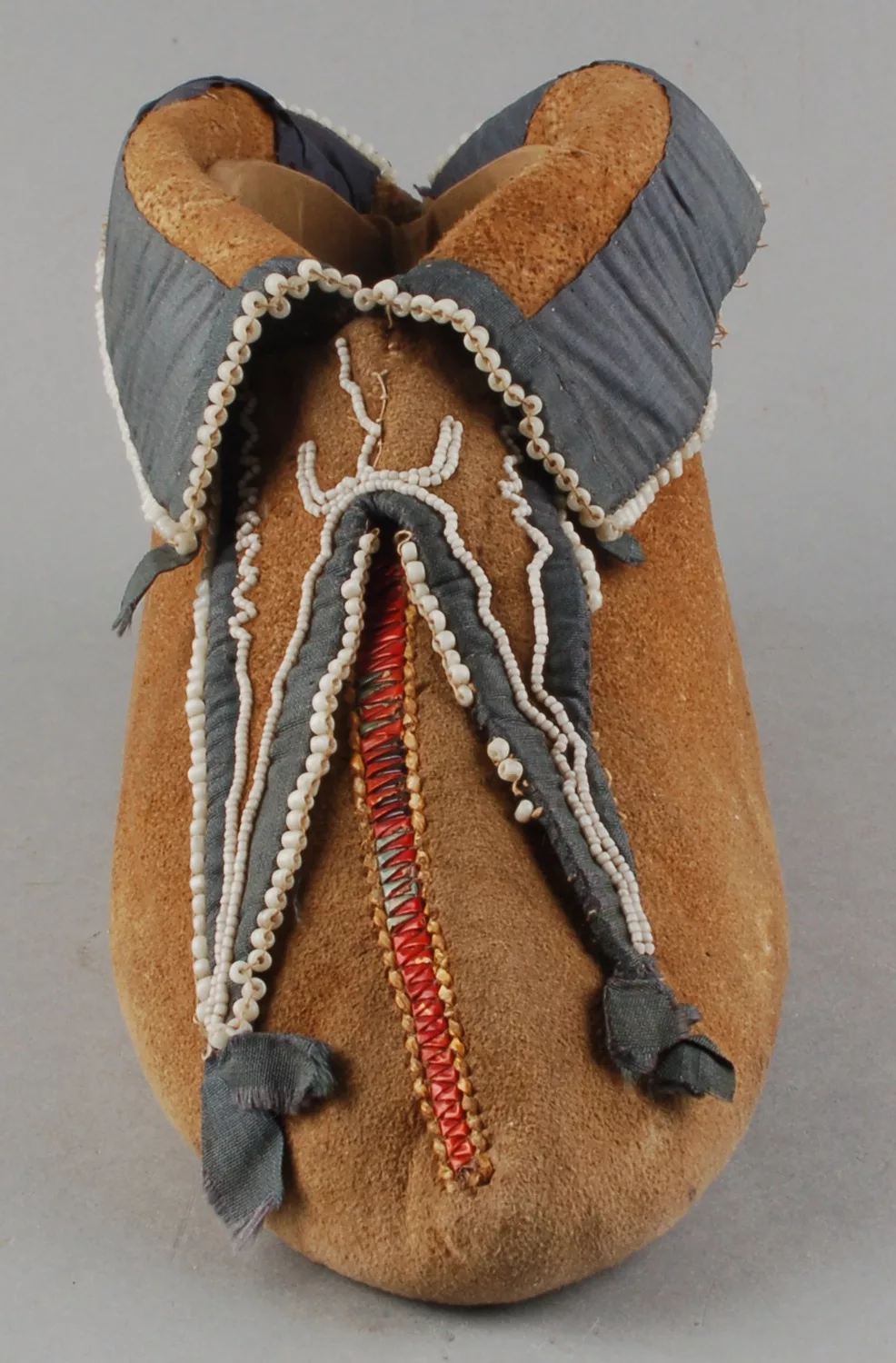
Unknown maker, Moccasins (Algonquian), before 1771, moose skin, sinew, porcupine quill, glass, cotton, silk?, British Museum, London, © The Trustees of the British Museum
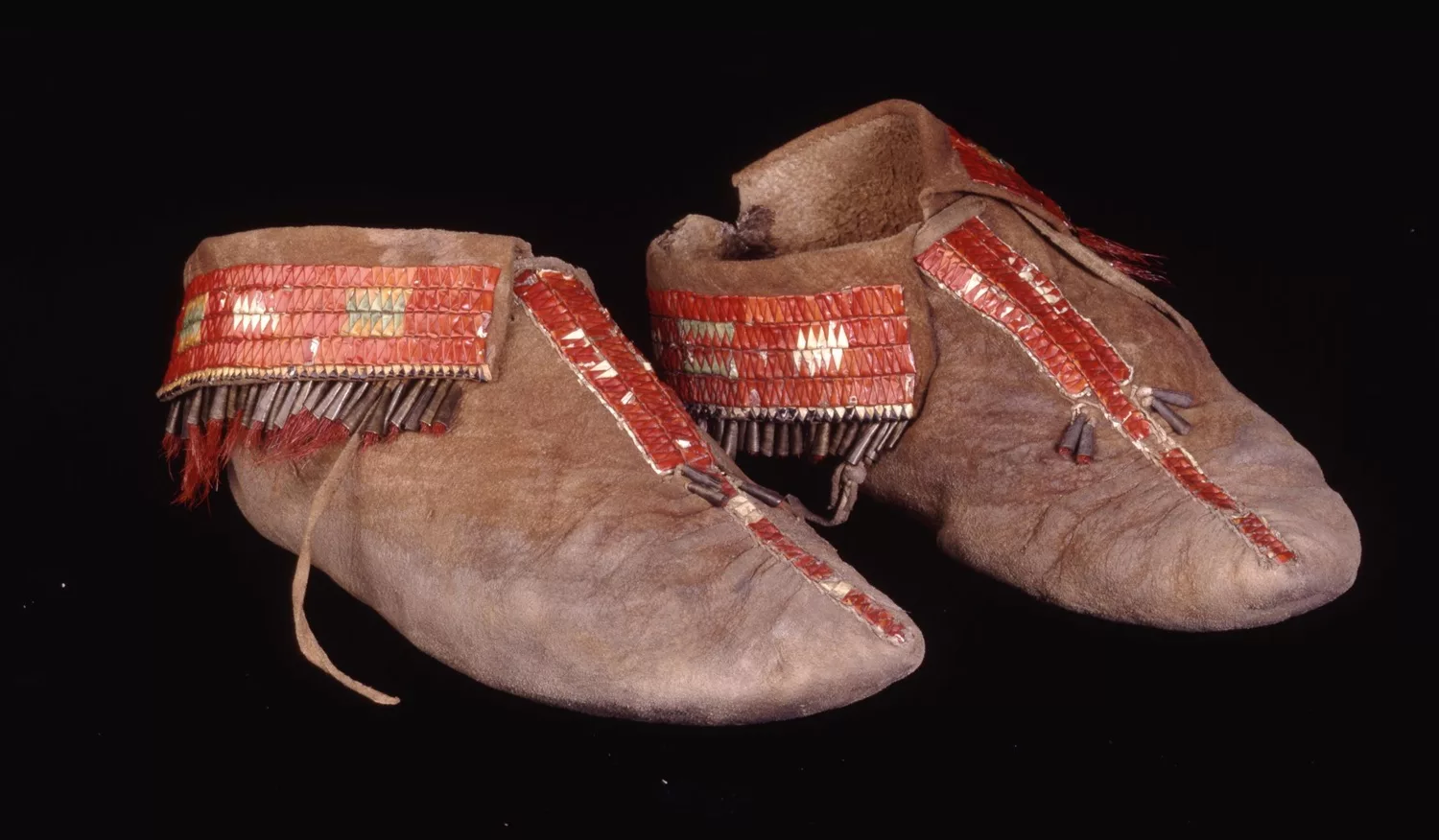
Unknown maker, Moccasins (likely Haudenosaunee), pre-1776, skin, metal, procupine quill, hair, vegetal, British Museum, London. © The Trustees of the British Museum
While we are unlikely to recover the names of these unknown artists, we can witness their presence and honour their important role in eighteenth-century art. That presence endures as physical moccasins in museums like those mentioned above, and also as depictions in other works of art. For example, Euro-American artist Benjamin West (1738 -1820) held two pairs of moccasins at his London studio that are now held in the collection of the British Museum. The moccasins appear in such West paintings as Colonel Guy Johnson and Karonghyontye (Captain David Hill) (c. 1767-1776) and William Penn’s Treaty with the Indians when He Founded the Province of Pennsylvania in North America (1771). Anthropologist and curator J.C.H. King reasons that they were given to West by William Johnson, Guy Johnson’s uncle and long-time British Superintendent of Indian Affairs, and Thomas Penn, son of William Penn, both of whom visited London and were known for possessing large collections of Native art objects.2
Given where William Johnson resided, the moccasins in Colonel Guy Johnson are likely Haudenosaunee (Iroquois), perhaps Kanien:keha’ka (Mohawk), a member of the Haudenosaunee Six Nations confederacy. Johnson’s long-time partner was Molly Brant, a powerful Kanien:keha’ka woman with whom he had lived since 1759 and fathered eight children. Perhaps Molly Brant or a member of her family made the shoes. They could have been a diplomatic gift or acquired at the trading post at their home in Kanien:keha’ka lands. Kanien:keha’ka women learn to make and adorn craftwork in the longhouse, a communal living space held in common by the women of the clan. The primarily red quillwork on this pair as well as the dyed hair tassels results in a striking pair of moccasins, and their presence in West’s painting on Colonel Guy Johnson’s feet balance the red of Karonghyontye’s feathered headpiece, ensuring that the eye travels the length of the twin portrait rather than remaining centrally focused on Johnson’s red coat and bright white face.
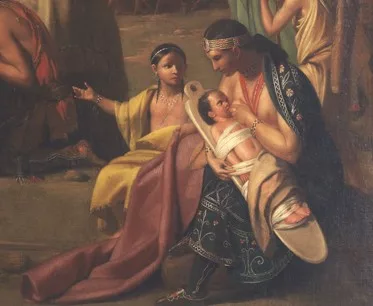
Benjamin West, William Penn’s Treaty with the Indian when He Founded the Province of Pennsylvania in North America [detail], 1771, oil on canvas, 191.8 x 273.7 cm, Pennsylvania Academy of the Fine Arts Museum, Gift of Mrs. Sarah Harrison (The Joseph Harrison, Jr. Collection), Philadelphia
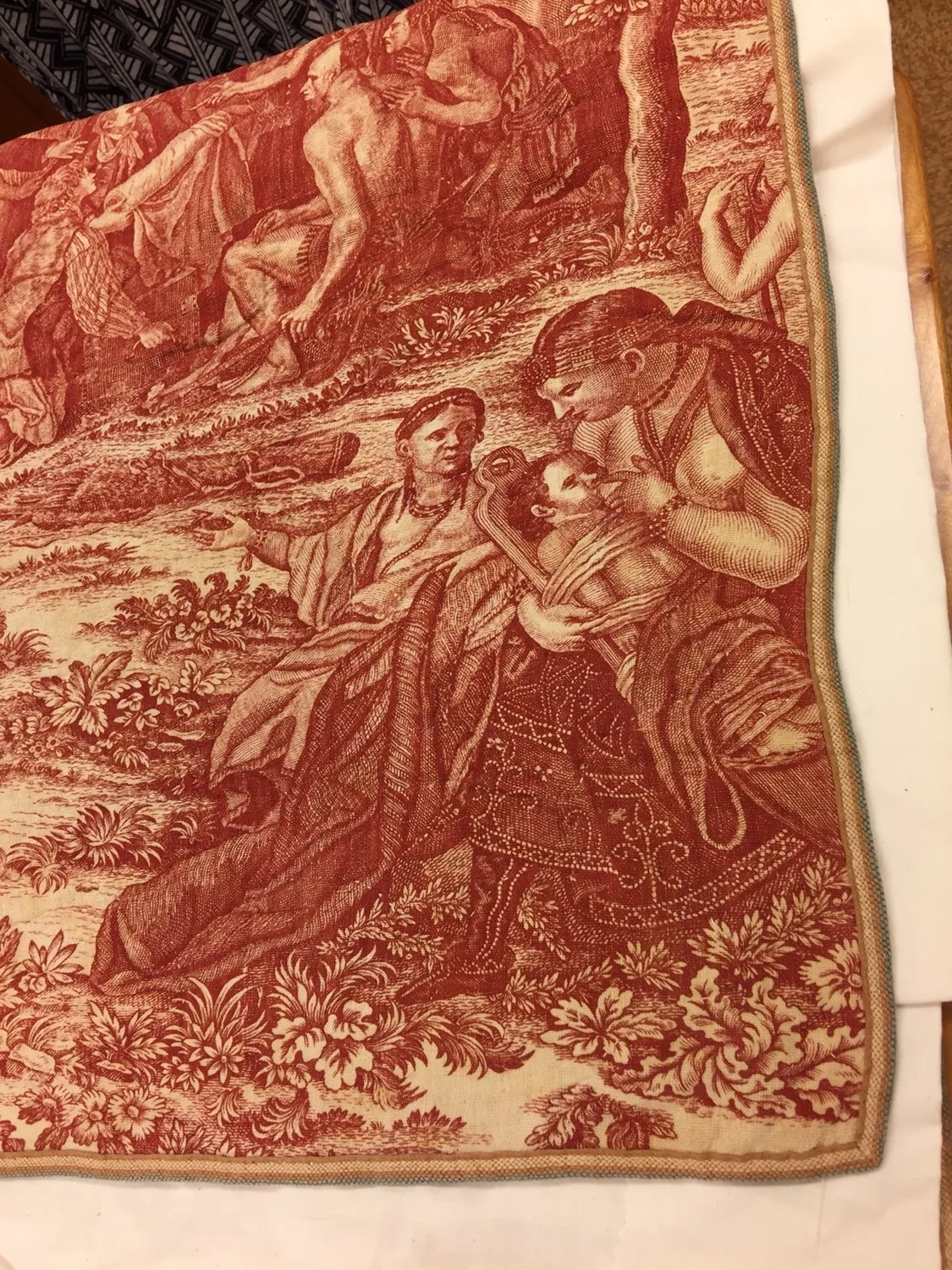
Detail from Wholecloth Quilt, c. 1785-1800, fabric copper-plate printed in London in 1785, Winterhur Museum, Delaware, © Photo by Caroline Wigginton.
It is arguable that the presence of moccasins and other Indigenous art objects in William Penn’s Treaty ensured the painting’s success as a faithful rendering of a crucial founding moment in Pennsylvania’s history from a century before. It also ensured British King George III’s patronage of West and his appointment as historical painter to the court. The painting even became the centrepiece of the transatlantic décor trend, and was adapted to framed prints, wall embroidery, painted glass, glazed earthenware, cloth for curtains and bedding, and wooden furniture.3
The child of innkeepers established outside Philadelphia, West’s memoir tells of a youth first learning to make paint and brushes from local Native people – probably Lenape – the nation with whom Penn made his treaty in 1683.4 Though likely a romantic embellishment, this story underscores West’s familiarity with the rich and pervasive material culture of Lenape communities. He knew that Indigenous art was essential to the painting’s verisimilitude and beauty. As shown in a detail of the painting, West depicts the studio moccasins held today at the British Museum on the feet of a kneeling Lenape man who also wears garters adorned in a similar style (Figure 3 bottom right). The Lenape woman nursing her child in the lower right corner wears strikingly embroidered moccasins and costume, an implicit acknowledgement of West’s aesthetic dependence on Indigenous women’s artistic ingenuity. Such details are not incidental to the painting’s aesthetic and commercial success. For example, even when translating the painting’s detailed image to wholecloth, period fabric makers include the moccasins.
An examination of moccasins made and adorned by eighteenth-century North American Indigenous women—whether the rare pair whose maker is known, like Lucy Tantaquidgeon Tecomwas, or the more commonly anonymous ones found in museums and depicted in art—demonstrates several under-recognized aspects of art history. First, these women were prolific and skilled artists, honoured by their communities even if collectors and history have not done the same. Second, their art helped shape the period’s transatlantic aesthetics across cultures. Finally, though much has been lost, much of their work also remains present and accessible. We must simply look outside the fine arts and instead regard the corners of visual art.5