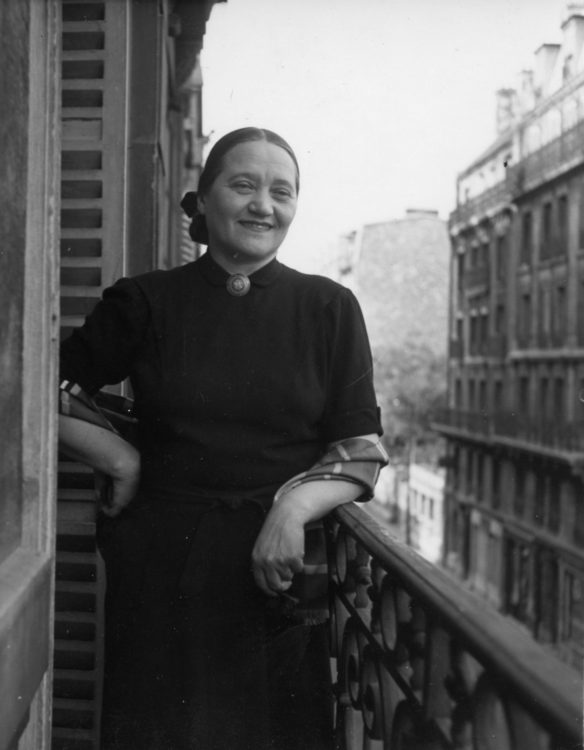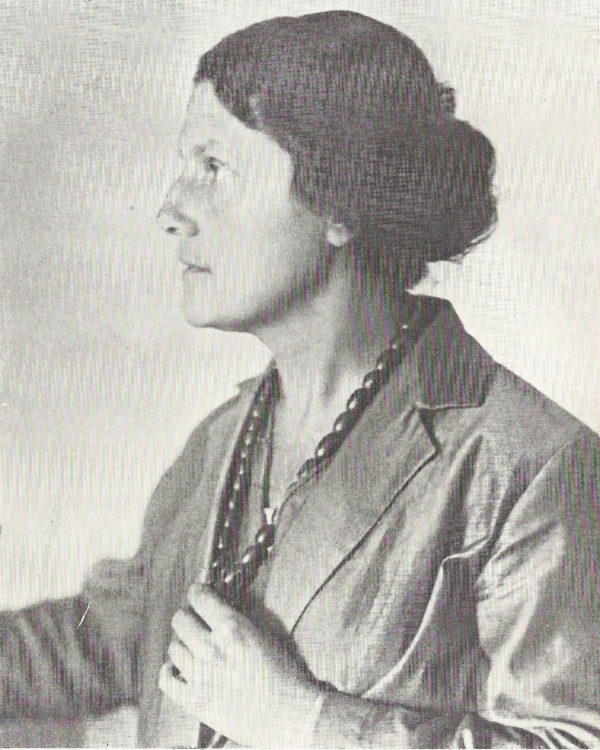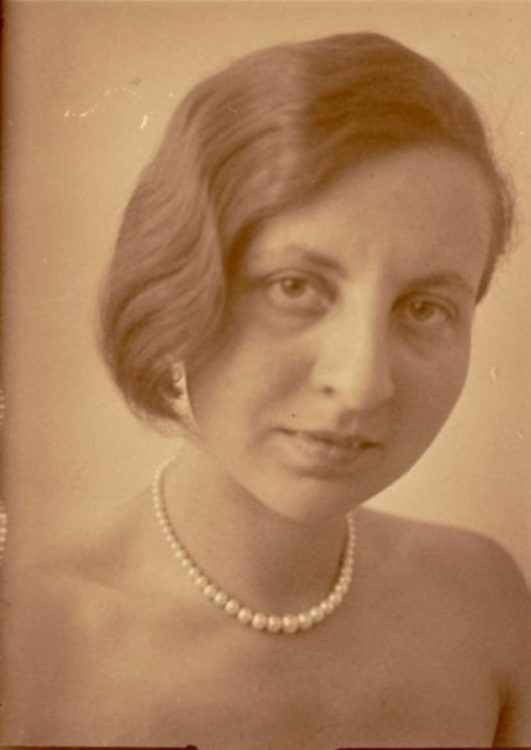
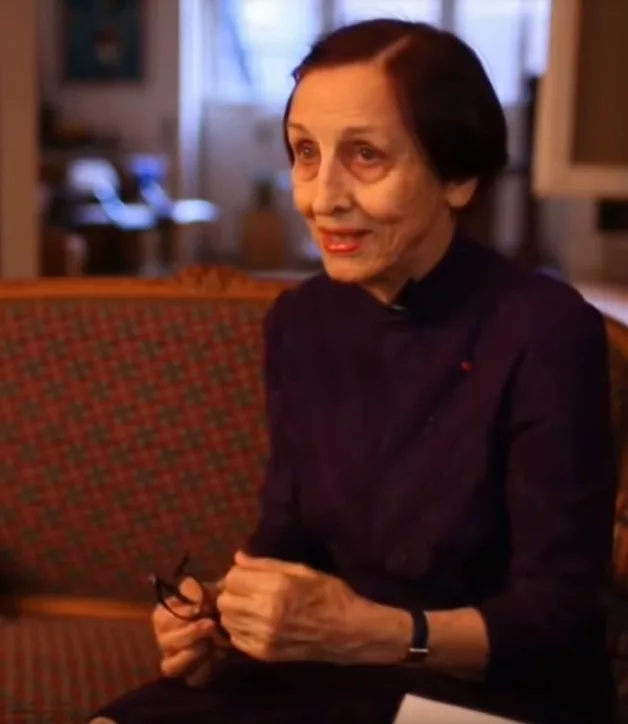
Portrait of Françoise Gilot
Annie Maïllis, Françoise Gilot, Françoise Gilot dans l’arène avec Picasso, interview with Annie Maïllis, Milan, Silvana Editoriale, 2021 (2004)
→Ingrid Mössinger, Françoise Gilot Painting-Malerei, exh. cat., Kunstsammlungen Chemnitz, Chemnitz (21 September-23 November 2003), Bielefeld, Kerber Verlag, 2003
→Mel Yoakum, Françoise Gilot. Monographie 1940-2000, Lausanne, Acatos, 2000
Françoise Gilot. Les années françaises, Musée Estrine, Saint-Rémy-de-Provence, July-December 2021
→Red, Elkon Gallery, New York, October 2019-January 2020
→Françoise Gilot Painting-Malerei, Kunstsammlungen Chemnitz, Chemnitz, September-November 2003
French-American painter and author.
Marie-Françoise Gilot, known as Françoise Gilot, was born into an affluent family. Thanks to her mother, the watercolourist Madeleine Renoult (1898-1985). In 1939, she met the Franco-Hungarian painter Endre Rozda (1913-1999) who helped shape her career and with whom she remained close throughout her life. During the French Occupation, she studied at various Parisian academies and art schools, including the Académie Julian in October 1943, and in the studio of Jean Souverbie (1891-1981) at the École nationale des beaux-arts in 1945. She moved in the social circles frequented by young artists of the Salon des Réalités Nouvelles group, and through them met Nicolas de Staël (1914-1955), whose work would have a lasting impact on her. Her early paintings were figurative, and mostly self-portraits (Autoportrait en noir (au travail), 1943) and portraits of the people in her life (Geneviève pensive, 1942; Ma grand-mère, 1943) among others.
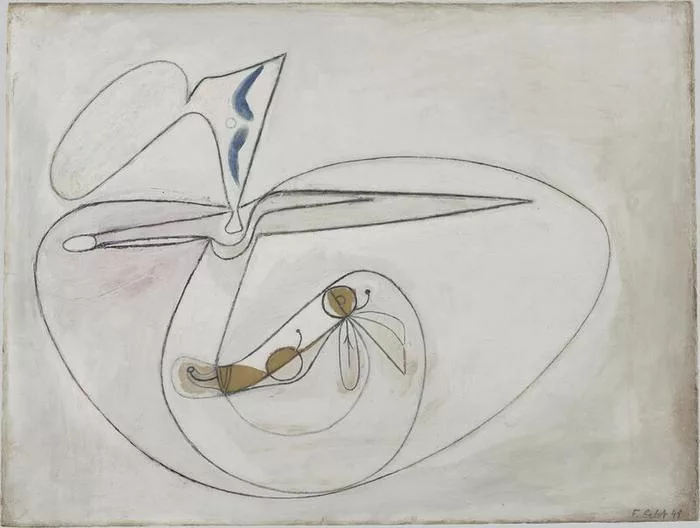
At the end of the war, F. Gilot met Pablo Picasso (1881-1973). It would be the beginning of a decade-long relationship, until F. Gilot left Picasso in 1953. The couple had two children together: Claude in 1947 and Paloma in 1949. Domestic and family life were an important source of inspiration for F. Gilot (Mes enfants dans ma cuisine, 1950; Liberté, 1952) and the subject of intense pictorial dialogue with P. Picasso. Through him, F. Gilot met Henri Matisse (1869-1954), whose work she cited as a source of inspiration. In this way, she would move between various influences during the 1940s and early 1950s, all the while advancing towards a more clearly defined style of her own.
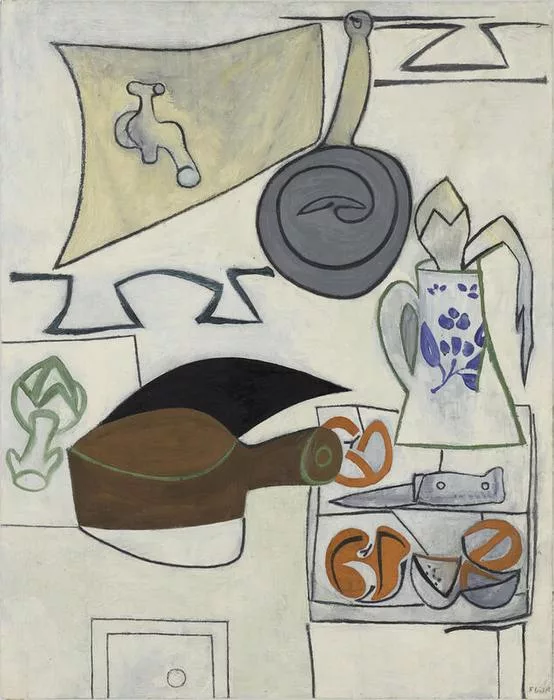
In 1952 her work was exhibited at Galerie Louise Leiris in Paris, and she became one of the few women artists to sign a contract with Daniel-Henry Kahnweiler. Works shown included some from her “white period”, which earned her a certain degree of recognition, particularly for the series Cuisines. One of the paintings, Évier et tomates (1951), was bought by the state for the French national collection; contracts with galleries in London and New York soon followed.
In the early 1960s her travels to Greece gave rise to the Labyrinthe cycle, inspired by the legend of Theseus and comprising some fifty canvases of profound lyricism. Completely abstract, they evoke elements of the myth through colours, shapes and rhythms (Labyrinth at Night, 1962; The Thread, 1962). Greek mythology would permeate F. Gilot’s work during the decade (Ruins at Delos, 1966), which would also see an increasing number of exhibitions devoted to her work at multiple European and American galleries.
During the decades that followed, F. Gilot kept her distance from the French art world. Her independence was only reinforced by her departure for the United States in 1970, where she would settle after marrying the biologist Jonas Salk. Her work came to resemble an ongoing dialogue between structured figuration and colourful abstraction. The artist’s canvases are recognisable by their “cut-out” shapes of flat colour and their intense chromatism, dominated by the red. The colour would become an emblem for F. Gilot, so much so that a recent exhibition of her work at the Elkon Gallery in New York in 2019 and 2020 was titled Red.
In the 1980s her experimentation with different formats led to her “floating paintings” (Sun Emblem, 1980). Taking Japanese kakejikus and large Tibetan thangka as her inspiration, the artist suspended large pieces of cotton from a wooden bar, ensuring the work’s stability but allowing the canvas to float freely. The nature of the medium calls for swiftness and lightness in the execution of these vibrant compositions, whose symmetrical planes of flat colour and imagined calligraphies inevitably impart a totemic dimension (Full Moon, 1983).
In addition to being a painter, F. Gilot wrote several books, including the famous account of her life with her first husband, Life with Picasso (1964). Describing her literary practice, she explained, “When I write, I try to adopt a style equivalent to my pictorial research. My technique lends itself to both.” In 1975 he published her autobiography, Le Regard et son masque (published in English in 1983 as Interface: The Painter and the Mask), testifying to her continuing engagement with the history of art; a collection of poems written in English, The Fugitive Eye, appeared in 1976; and in 1990 she published Matisse and Picasso: A Friendship in Art. Though F. Gilot was for many years principally confined in the public eye to the role of P. Picasso’s “muse”, over time her work has come to be seen and shown in its own right, starting at the end of the 1970s and, from the 1990s onwards, with increasing regularity.
This biography was produced in partnership with the Musée national Picasso-Paris.
© Archives of Women Artists, Research and Exhibitions, 2026


 Françoise Gilot – « Vous mettez votre énergie dans la peinture » | TateShots, 2013
  A conversation with Françoise Gilot (1998)