Akbar, Taufik, Kajian Bentuk, Gaya, Dan Makna Simbolik Keramik Noor Sudiyati, Master thesis, Institut Seni Indonesia Yogyakarta, Yogyakarta, 2014
→Sudiyati, Noor, Tanah ke tanah: Pameran seni keramik karya Noor Sudiyati Agung, exh. cat., Galeri Lontar, Jakarta (30 January–28 February, 2001), Jakarta, Galeri Lontar, 2001
→Akbar, Taufik, Een, Hendratno, “Membaca kecenderungan bentuk da nisi keramik kontemporer Indonesia”, Corak 9, no. 2, 2020, p. 101–118
Ritus Daun, Edwin’s Gallery, Jakarta, 9–19 September, 2004
→Bermula dari Segitiga, Pasca Sarjana ISI Yogyakarta, Yogyakarta, 2003
→Tanah ke tanah: Pameran seni keramik karya Noor Sudiyati Agung, Galeri Lontar, Jakarta, 30 January–28 February, 2001
Indonesian ceramic artist, lecturer and academic.
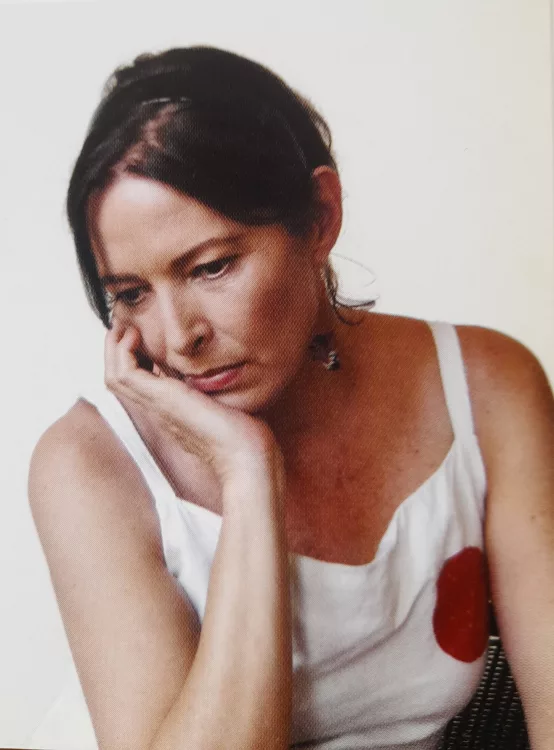
Noor Sudiyati became known for her clay artworks, paving the way for a new ceramic idiom in the 1990s in Indonesia. She grew up near Magelang, Central Java, in a large family that lived according to Javanese cultural and religious values. As a teenager, she left her hometown to attend the art high school in Yogyakarta and learn ceramics. In 1979 she began her training at the Sekolah Tinggi Seni Rupa Indonesia (STSRI, a higher art academy, the forerunner of the Institut Seni Indonesia ISI Yogyakarta). At the time, ceramics was only offered as a minor subject, and N. Sudiyati felt eager to learn more about this craft. From 1989 to 1990, she worked in Bali with Agung Oka (1935–c. 2013), with the ceramic studio Jati Agung Ceramics and with other ceramicists in Suwung and Dalung. After her return, she opened her studio in Yogyakarta together with her husband and started selling utility ceramics. In 1991, she began her long-term commitment as a ceramic lecturer at the ISI Yogyakarta, raised her three children and devoted much of her time to her artistic practice. The 1990s were her most creative period with works such as Donut Demokrasi [Donut Democracy, 1997], a gloomy oversized donut with thorns referring to a case of political injustice from 1996 where a journalist was murdered because of his articles critical to the state.
In 2000 N. Sudiyati took a master’s degree at ISI Yogyakarta and in 2012 she earned a PhD from Gadjah Mada University (UGM) in Yogyakarta.
Although N. Sudiyati is concerned with political and social issues, her artworks often deal with spiritual themes and the exploration of the materiality of clay. Her upbringing with Javanese customs and the local religion Penghayat Kepercayaan [the Faith of the Ancestors] influence her approach to ceramics. In her artistic practice, she draws much of her inspiration from her spiritual belief so that clay is not just a material, but a living matter with which she enters an appreciative and careful dialogue. Many of her artworks are unglazed or only partially glazed, with the intention to stay honest towards the material by maintaining its raw character. An example of such an artwork is Badan Alus Badan Kasar [Coarse Body Fine Body, 2016], a three-dimensional oval wide band with a rough unglazed exterior with elongated undercuts, creating dark caves and a smooth, glazed inner part. The piece refers to the human being having a coarse body – the physical body – and a fine body – consisting of the soul, the mind and the emotional world. N. Sudiyati’s ceramic objects show a high level of technical skill and the tactile and raw aspects of clay, which embody her spiritual connection to clay, the earth as the origin of humanity.
Six of her artworks, including Yin Yang 2 (1999), are part of the collections of The National Gallery of Indonesia.
A notice produced as part of the TEAM international academic network: Teaching, E-learning, Agency and Mentoring
© Archives of Women Artists, Research and Exhibitions, 2026