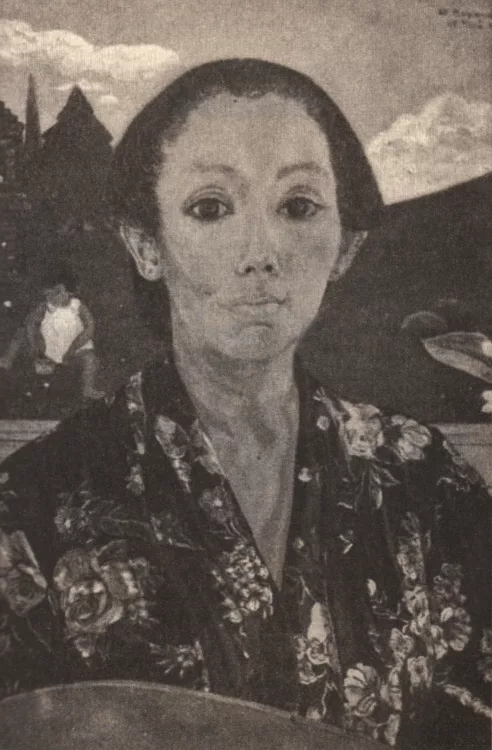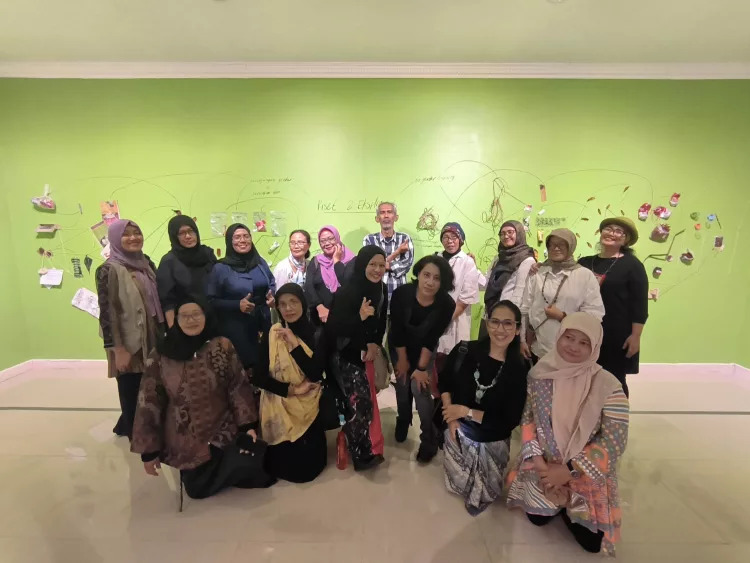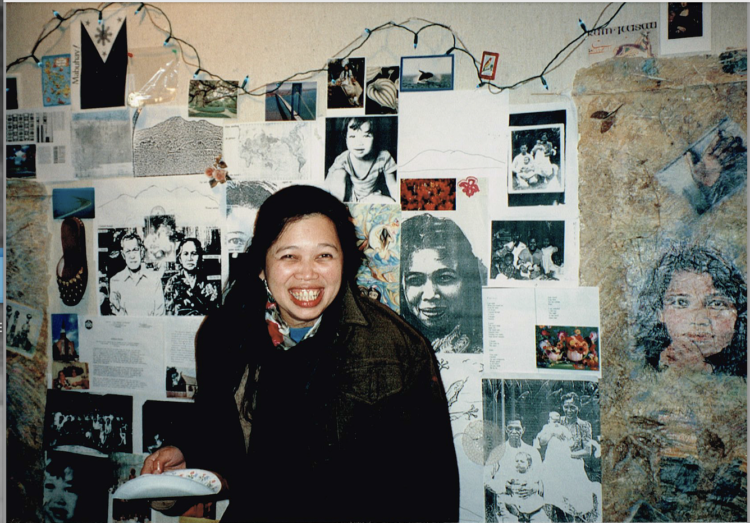
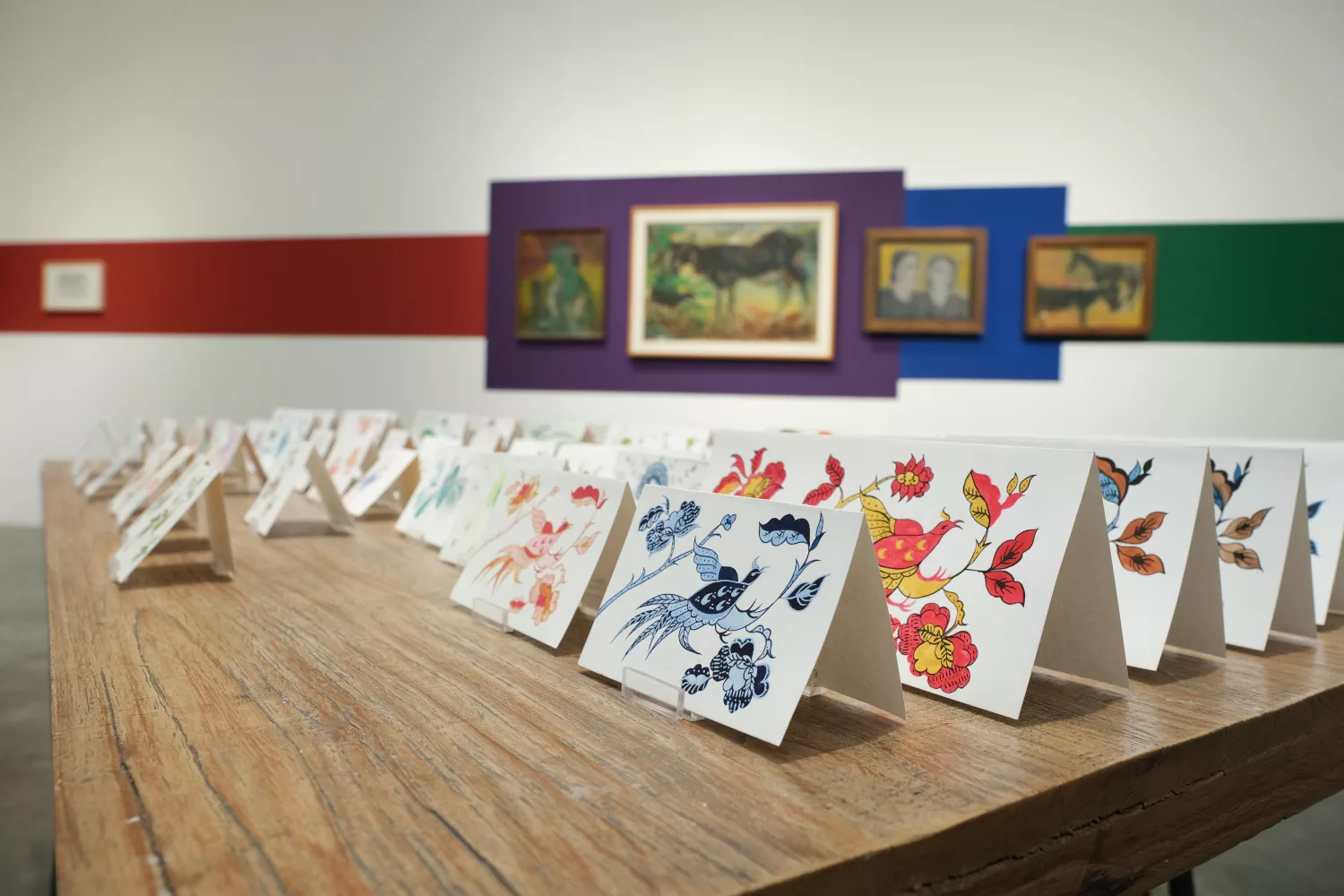
Siti Rulijati, Untitled, undated, hand painted cards exhibited at Kebebasan manusia perasa [Freedom of the sentient beings] at Gajah Gallery, Yogyakarta, 2025, photo by Rendy Erianda, courtesy of Gajah Gallery, Hyphen— and the artist
Two recent exhibitions in Yogyakarta centring women artists born in the early twentieth century offer a reminder of how the categories of art and craft continue to collapse when women’s artistic labour is situated across domestic, economic and cultural domains. As part of the 18th Biennale Jogja, the monographic exhibition of Mia Bustam (1920–2011) presented her paintings and writings alongside a wide selection of her needlework.1 M. Bustam’s embroideries unfold intimate yet politically charged narratives of women’s work, filled with stories of care, survival and endurance shaped by her years as a political prisoner under Suharto’s anti-communist regime.
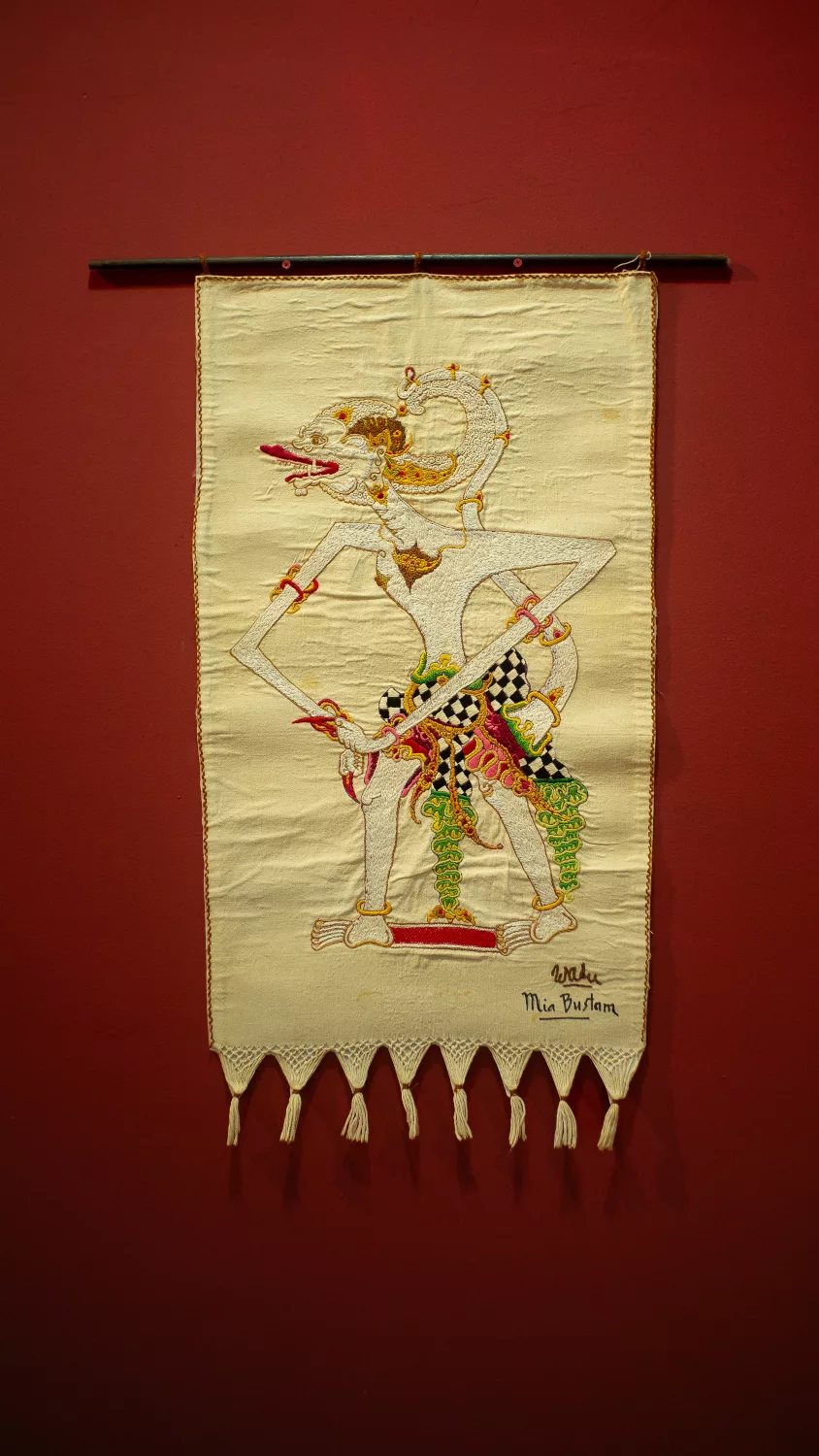
Mia Bustam and Watugunung (her third son), Hanuman, undated, embroidery, sketch design by Watugunung, finished after Mia Bustam was released from prison in 1978, Collection of Sri Nasti Rukmawati. Photo by RaungSingosari (Mia Bustam exhibition team), courtesy of the artist’s family
Kebebasan Manusia Perasa [Freedom of the Sentient Beings], held at the Gajah Gallery, likewise foregrounded the porousness between art and craft in women’s work. Siti Rulijati’s (1930–2023) practice appeared alongside her contemporaries Kustiyah (1935–2012) and Sriyani (1930–2006), whose works, as the curatorial collective Hyphen– notes, “illuminate the delicate threshold between feeling and form, intimacy and distance, life and object”.2 This threshold surfaces vividly in S. Rulijati’s hand-painted greeting cards and stitched animal motifs, which echo the vigorous brushwork and careful detailing of her paintings and drawings. For S. Rulijati, who supported her family through handicraft sales, craftwork functioned as both livelihood and artistic foundation.
By embracing domestic craft – long relegated to the realm of ‘low art’ and coded as feminised labour – both exhibitions challenge modernist assumptions that cast craft as unoriginal and intellectually inferior. Their curatorial choices resonate with feminist interventions since the 1960s which, despite the risk of essentialising feminised labour into an assumed feminine character, have helped reframe the art-craft hierarchy as inseparable from analyses of the devaluation of women’s domestic work within the gendered division of labour.3
These curatorial moves serve as an entry point into a wider history of how women’s art and craft have been framed, celebrated or constrained from turn-of-the-century colonial exhibitions of women’s labour to women-centred initiatives in Indonesia from the 1950s to 1980s. How have exhibitionary frameworks made women’s labour visible or invisible, and what forms of value have been attached to women’s work across time?
Craft, Empire and the Exhibitionary Politics of Women’s Labour
One of Indonesia’s early feminist icons, Kartini (1879–1904), was an advocate for women’s education as well as an avid promoter of local craft in her hometown, Jepara. Yet her position as a regent’s daughter and member of the aristocracy placed her inside a fraught colonial landscape, where gestures of emancipation coexisted uneasily with structures of imperial power. This tension became sharply visible when Kartini and her sisters, Roekmini and Kardinah, were invited to contribute to the National Exhibition of Women’s Labour in The Hague in 1898. Hailed by scholars as a milestone of Dutch first-wave feminism, the event celebrated European women’s expanding roles in the workforce and their pursuit of civil rights. As Berteke Waaldijk and Maria Grever note, the exhibition showcased a wide range of Dutch women’s work, from live demonstrations by factory girls to typing skills, paintings and literary achievements.4
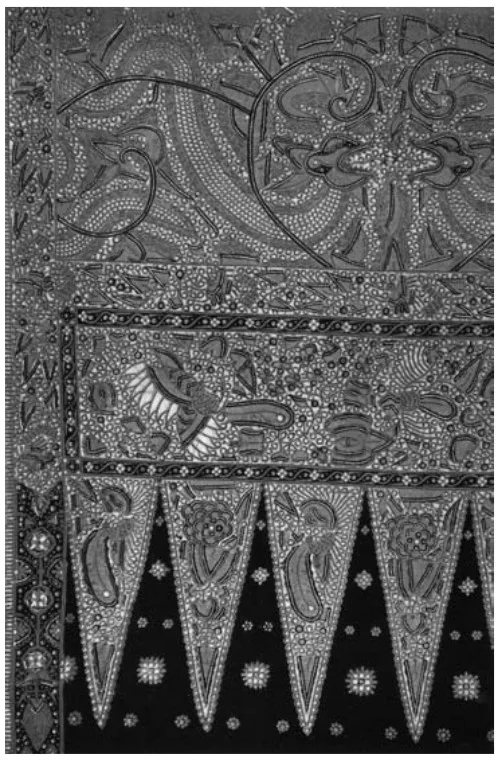
Batik piece from the collection of Bertha Levyssohn Norman-Zoetelief, exhibited at the Dutch National Exhibition of Women’s Labor in 1898. Image from Rouffaer and Juynboll (1900), collection of Utrecht University Library, public domain
Even as the exhibition championed women’s progress, its exhibitionary framework remained tied to the colonial logic of world fairs that reinforced bourgeois imperial authority. This contradiction was palpable in the Dutch East Indies (DEI) Room, where the Jepara sisters assembled a selection of woodcarvings, paintings and batik fabrics from their hometown. Kartini had prepared an article about the art of batik, but it went negligently unpublished and her contribution uncredited in the catalogue. Moreover, the DEI section broke with the exhibition’s principle of displaying only women’s work. There were objects from private collections of people who had lived in the Dutch Indies and even colonial war trophies, such as baskets woven by Acehnese women for soldiers and decorative fans seized from Lombok after the 1894 war.5 All objects were flattened into decorative curiosities, at once exoticised and decontextualised. In this setting, nuances of gendered distinction were reserved only for the Dutch feminist struggle, while colonised women’s knowledge was silenced in a colonial exhibitionary system that neutralised women’s labour even when claiming to honour it.
The focus on craft in the DEI room anticipated the Dutch Ethical Policy (1901–1942) that manifested at the turn of the century. Colonial officials saw the economic potential of what they termed as ‘Native Craft’ to improve the impoverished condition of the colonised population, yet they were also worried that business could harm the authenticity of Native Art’.6 Hence the Dutch determined to draw a clear distinction between art and craft, a hierarchy that can be traced back to Kantian aesthetics, but which was also driven by economic impulses and white preservationist moralism. However, it seems that Kartini did not find the distinction useful. As art critic Sudjoko noted, Kartini referred to every tukang (craftsperson) interchangeably as artisten (artisan) or kunstenaars (artist). Sudjoko saw this ambiguity in Kartini’s politics of language as a challenge to the emerging modern Indonesian hierarchy separating kesenian (art) from kerajinan (craft).7 For him, Kartini’s vocabulary unsettles boundaries that industrial modernity sought to fix, pointing instead to a continuum of creative labour where distinctions between art and craft were neither stable nor necessary.
Women’s Work Within and Against the Hierarchy of Labour
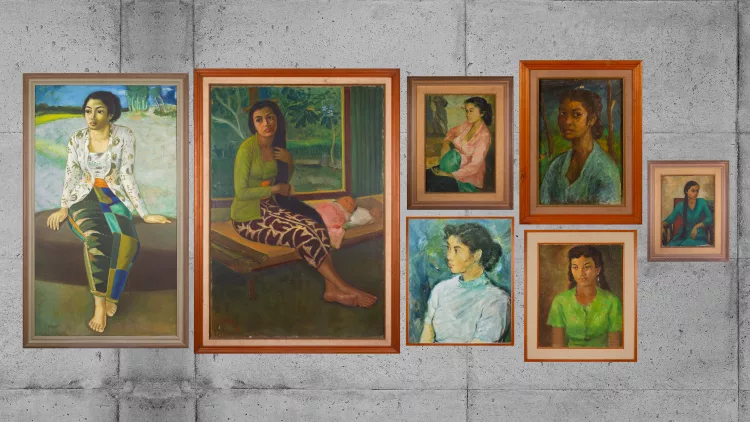
By the mid-twentieth century, Indonesian women had gained greater public visibility, shaped by decades of organising since the early women’s movement of the 1910s and the founding of the Indonesian Women’s Congress in 1928. This expanding assertion of agency formed the backdrop to a 1961 exhibition in Jakarta commemorating the Congress. Bringing together paintings and craftworks by women, the exhibition created an encounter that both echoed and unsettled earlier colonial framings of women’s labour.
Reviewing the event, art critic Oei Sian Yok opened with an observation about the shifting status of women: “without underestimating housework, we are now grateful that women have freedom in all fields, and take part in thinking and acting in our society”.8 Yet she quickly acknowledged the limits of this freedom. Many of the participating artists, she observed, painted only in their “free time”, which, she pointed out – in brackets – was in fact very limited. The aside subtly registered the ongoing weight of domestic labour and the uneven distribution of leisure available to women.
Still, O. Sian Yok refused the narrative that women artists should be defined primarily by constraint. Her position implicitly counters patriarchal criticisms such as that epitomised in Dan Soewarjono’s harsh 1957 review of what was known as the first all-women exhibition in Yogyakarta, where he claimed that women lacked the capacity to “sacrifice” enough to produce serious art because their practice only filled leftover hours.9 While not addressing such bias directly, O. Sian Yok invoked Henri Rousseau (1844–1910), the French post-Impressionist who began as a self-taught amateur “Sunday painter” while employed as a customs officer. For O. Sian Yok, beginning as a hobbyist did not diminish artistic seriousness. By aligning women’s circumstances with H. Rousseau’s, she treated domestic work as work, and insisted that women’s use of their “free time” was no less legitimate as an artistic ground than the economically constrained conditions under which many male artists also laboured.
The exhibition presented what O. Sian Yok termed “free painting” [seni lukis bebas] and “applied art”, categories she approached with equal attentiveness. She praised painted works on canvas as well as on shawls, bags, plates and bamboo fans, recognising in these works “the depth of women’s soul”, and a refusal to be “drowned in the monotony of daily life”. In retrospect, her review unsettles the entrenched divide between intellectual and manual labour, as well as between art and craft, to highlight how such distinctions obscure the complexity of women’s creative work. The 1961 exhibition, and Sian’s careful reading of it, offers a rare glimpse of how women’s artistic labour could be valued without reinscribing inherited hierarchies, and how exhibition-making might illuminate rather than erase the conditions that shaped women’s lived practice.
When a new stream of women-centred exhibitions re-emerged in the 1980s, most prominently through the establishment of Nuansa Indonesia group, “professionalism” became the key term of advocacy. As Yvonne Low argues, this feminist initiative sought to secure women’s participation on an equal footing with their male artist counterparts, despite the risk in serving patriarchal expectations of women’s double burden and reinstating the amateur-professional divide.10 Women’s craft seems to disappear from the conversation, probably because it remained associated with inferior forms of non-work, and was therefore deemed incompatible with the professionalised aspirations of the Nuansa Indonesia circles. This separation between art and craft, hobby and profession, productive and reproductive labour, reflected a fundamentally middle-class feminist’s desire to join the professional ranks of artists, rather than to question how those ranks were historically constructed.
Today, in contemporary art worlds that can draw in any critical discourse and spit it out as a commodified spectacle, the art-craft divide may appear theoretically obsolete. Post-medium specificity practices routinely borrowed from craft techniques, but only in the service of formal experimentation. When craft is contextualised, as Pamela Corey observes, it often positioned as an “index of locality”, shaped simultaneously by global market appeal and by the ambiguous self-Orientalism of artists who have to navigate their place in ideological narratives that profited from the overemphasis of cultural differences.11 Within this dynamic, the uneven distribution of value often continues to operate along gendered, racialised and classed relations.
Bringing craft back into discussions of art history should not become simply a claim that craft should be equally considered “high art”. Attending closely to women’s craftwork shows how feminised labour, though consistently undervalued, becomes a site through which women navigate, endure and subvert patriarchal conditions. Yet this gendered analysis must be held together with a broader critique of labour itself – of capitalist divisions between intellectual and manual skill, productive and reproductive labour. In doing so, it opens a new direction for both feminist art and labour history, one that recognises the full range of women’s work and reconsiders the very divisions of labour that have shaped the material and cultural life of our society.
Brigitta Isabella encounters and mediates people, objects and discourses through various platforms of knowledge production at the intersection between art history, critical theories and activism. She is part of KUNCI Forum and Study Collective in Yogyakarta and the translocal editorial collective Southeast of Now: New Directions in Contemporary and Modern Art journal. She teaches at the Faculty of Visual Arts and Design, Institut Seni Indonesia (ISI) Yogyakarta.