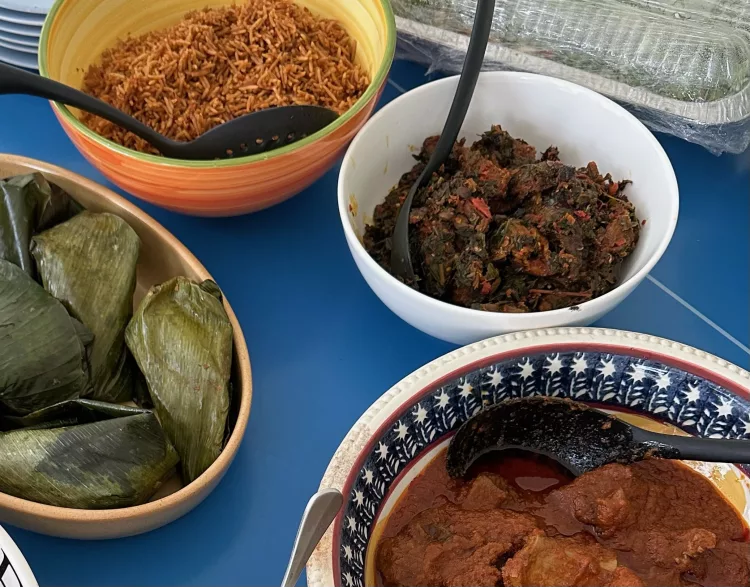
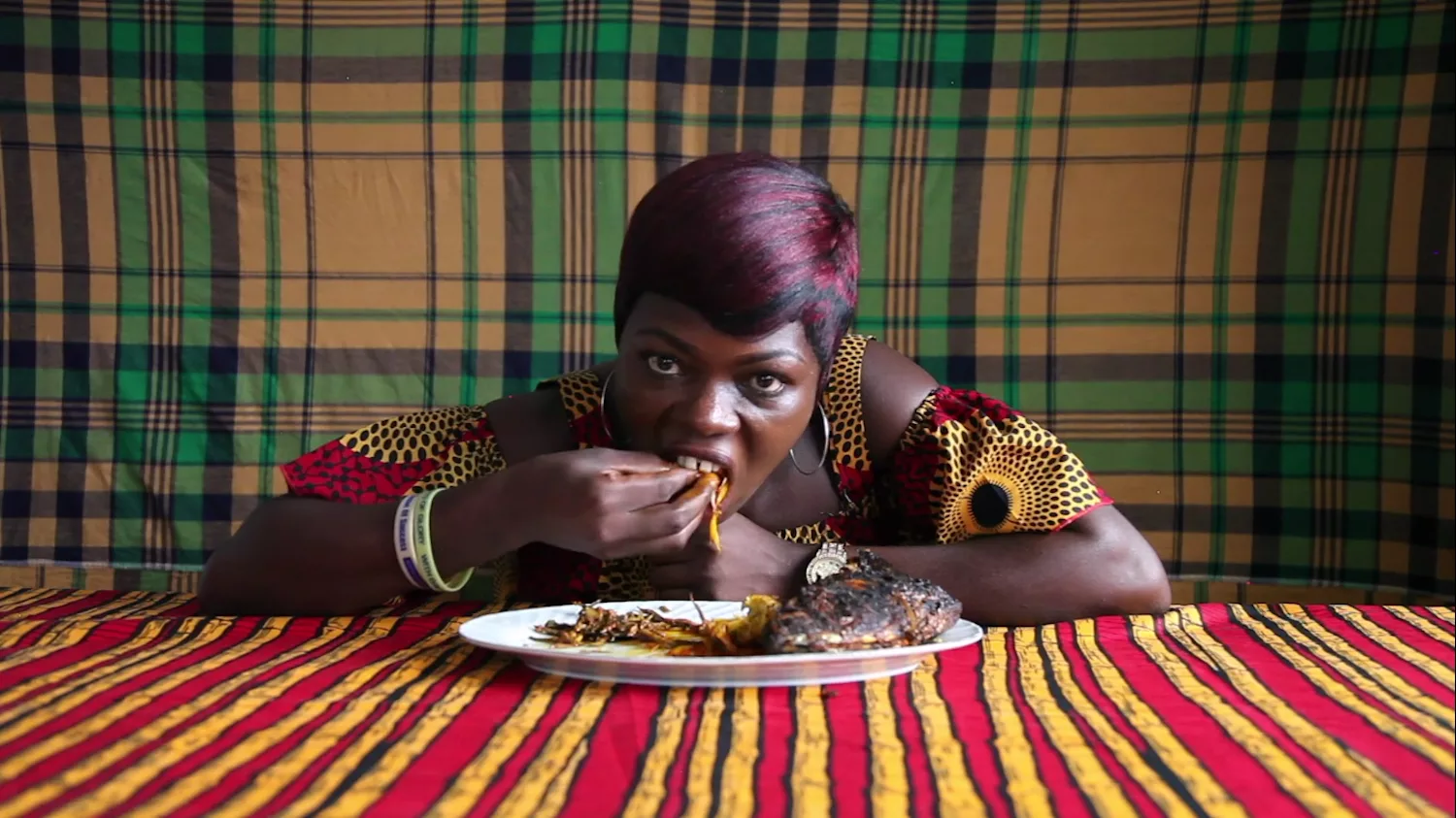
Zina Saro-Wiwa, Table Manners Season 2: Precious Eats Boli and Fish and Oil Bean, 2019, video still
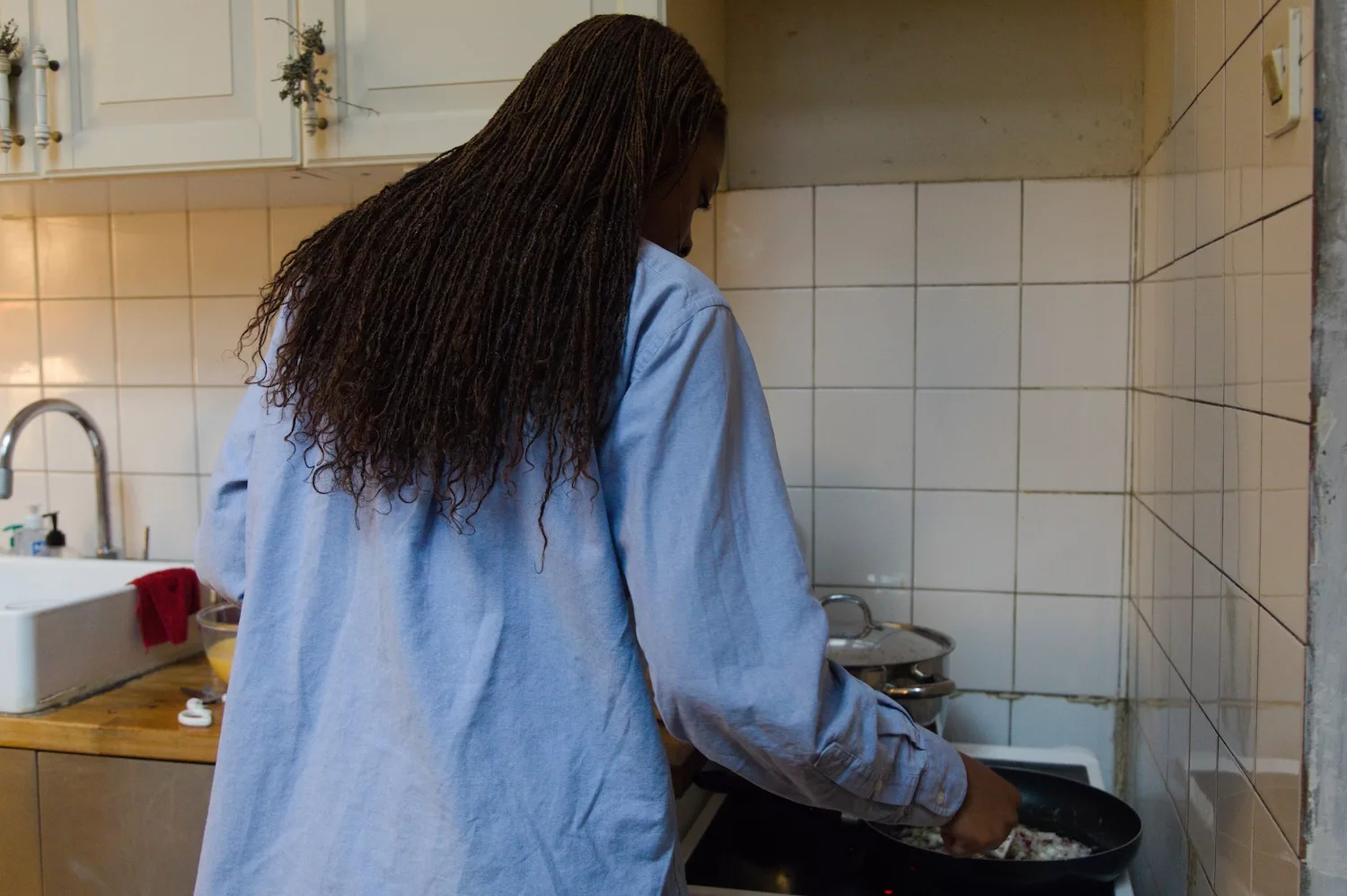
Oluwatobiloba Ajayi preparing Nigerian chicken stew at L’AIR Arts, March 13, 2026, © Photo: Lorena Almario Rojas, © AWARE: Archives of Women Artists, Research and Exhibitions
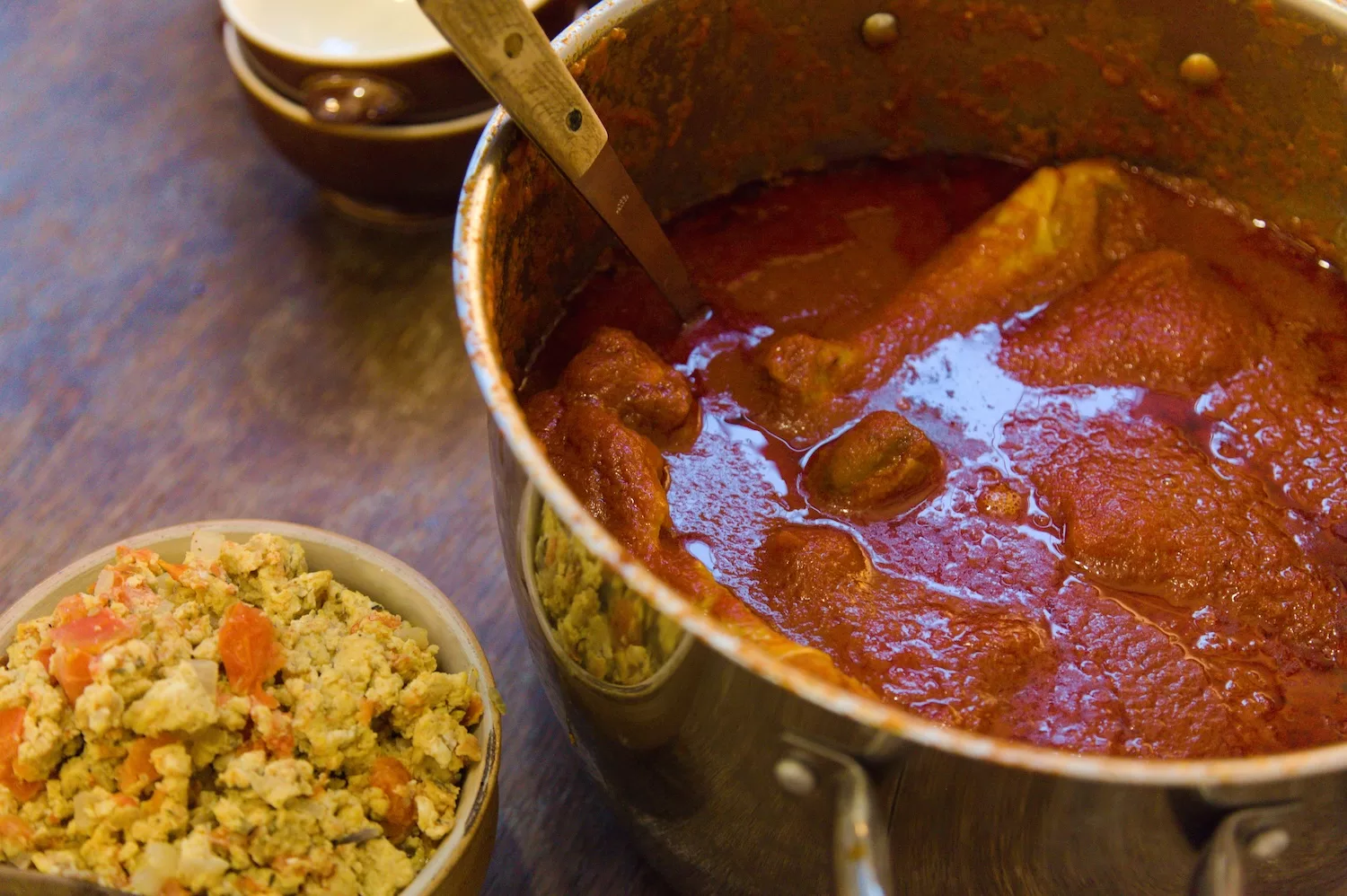
Nigerian chicken stew and egg sauce prepared by Oluwatobiloba Ajayi at L’AIR Arts, March 13, 2026, © Photo: Lorena Almario Rojas, © AWARE: Archives of Women Artists, Research and Exhibitions
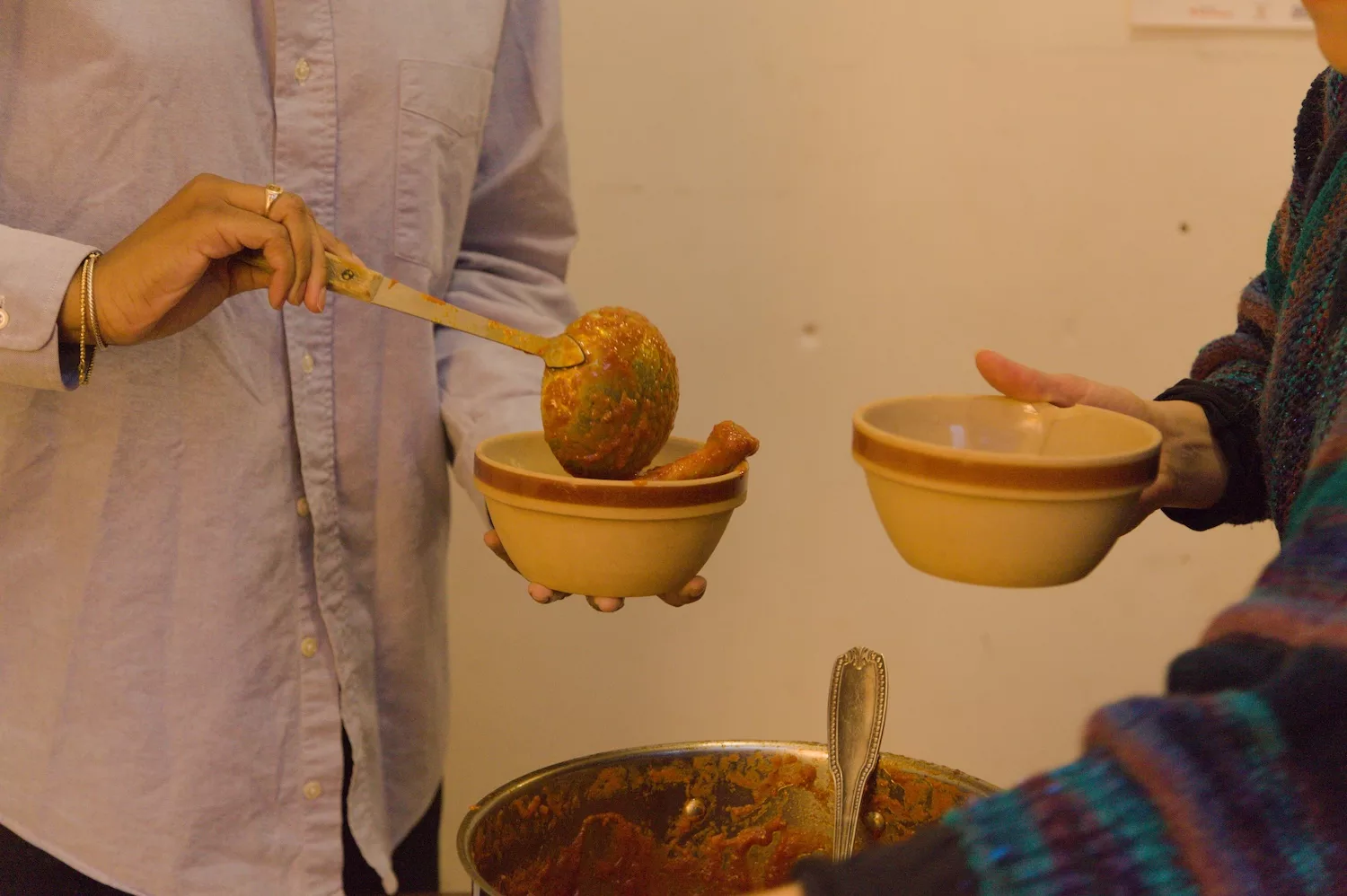
Oluwatobiloba Ajayi serving Nigerian chicken stew to attendees at L’AIR Arts, March 13, 2026, © Photo: Lorena Almario Rojas, © AWARE: Archives of Women Artists, Research and Exhibitions
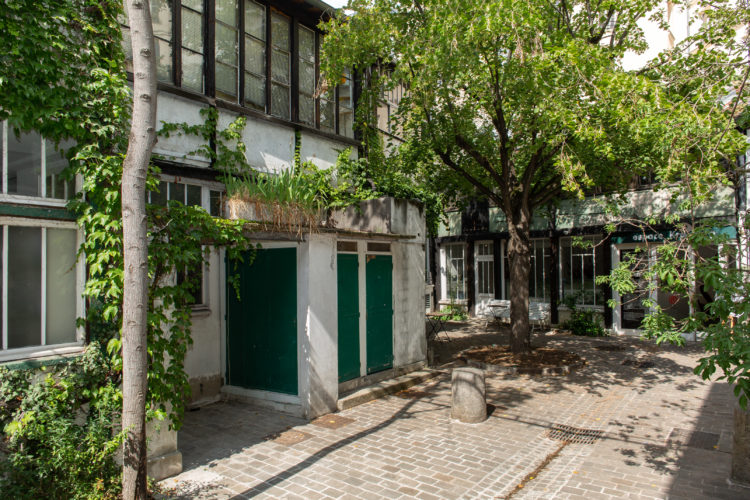
Under the roof of L’AiR Arts’ Atelier 11 in Montparnasse (Paris), which once housed artists such as Modigliani, Soutine and Brancusi, a group of artists, curators and writers gather and eat Nigerian chicken stew, egg sauce and sweetened focaccia. I had spent the whole day cooking the stew to serve at the event that would close out my residency, while my collaborator, food-practitioner Marie Doumerc, baked the bread that would accompany it. I first came to Paris not to cook, but to write about representations of landscape in the photography and film of a number of women artists across the Black Atlantic. I was following author Dionne Brand’s expressed disillusionment with the landscape, her “giving up on land to light on”, hoping to trace this assertion in the works of Carrie Mae Weems (1953–), Dionne Lee (1988–) and Zina Saro-Wiwa (1976–).1 As it tends to do, my hunger narrowed my focus.

Zina Saro-Wiwa, Table Manners Season 2: Jonah Eats Bread and Stew with Coca-Cola, 2019, video still

Zina Saro-Wiwa, Table Manners Season 2: Jonah Eats Bread and Stew with Coca-Cola, 2019, video still
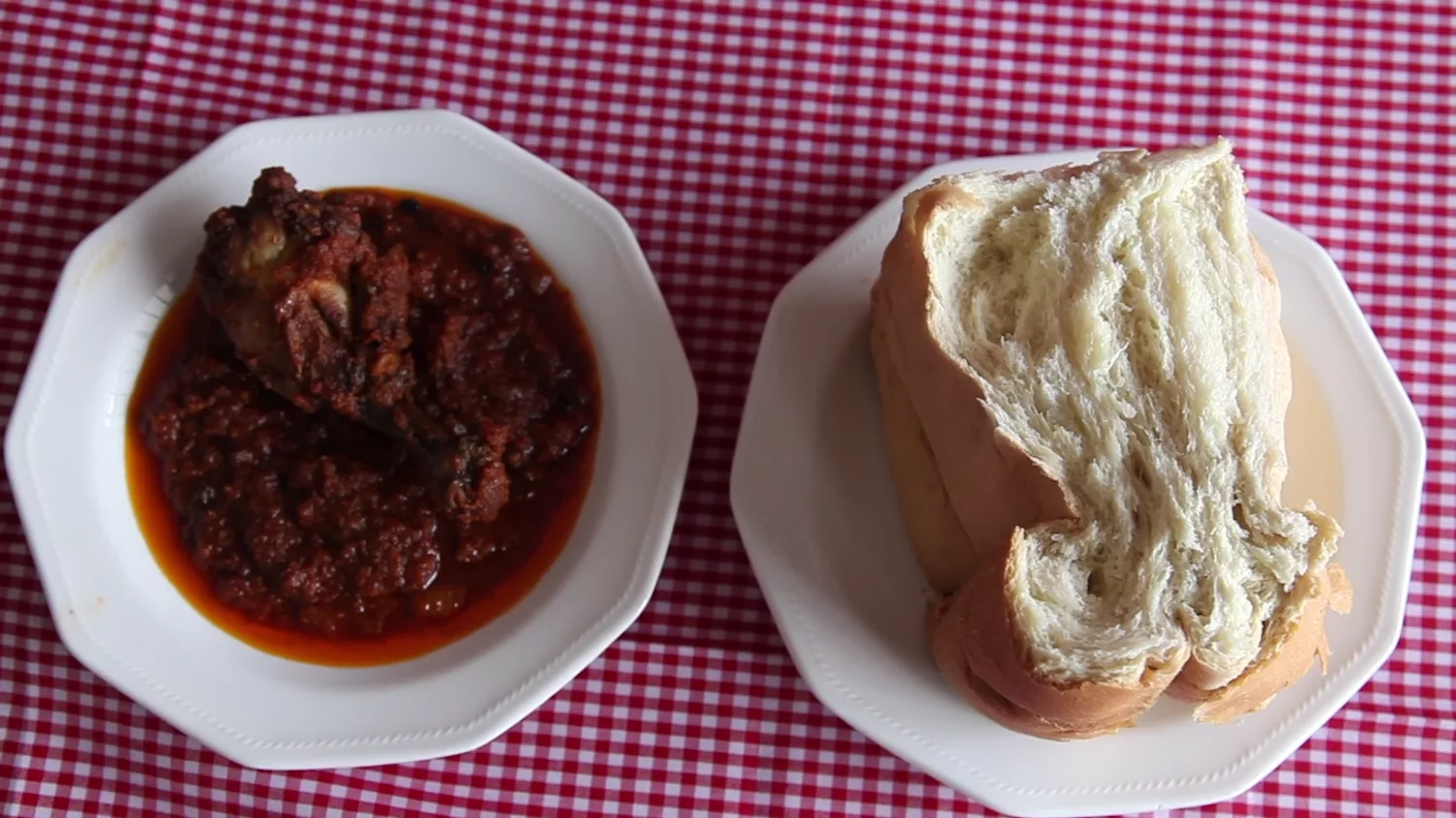
Zina Saro-Wiwa, Table Manners Season 2: Jonah Eats Bread and Stew with Coca-Cola, 2019, video still
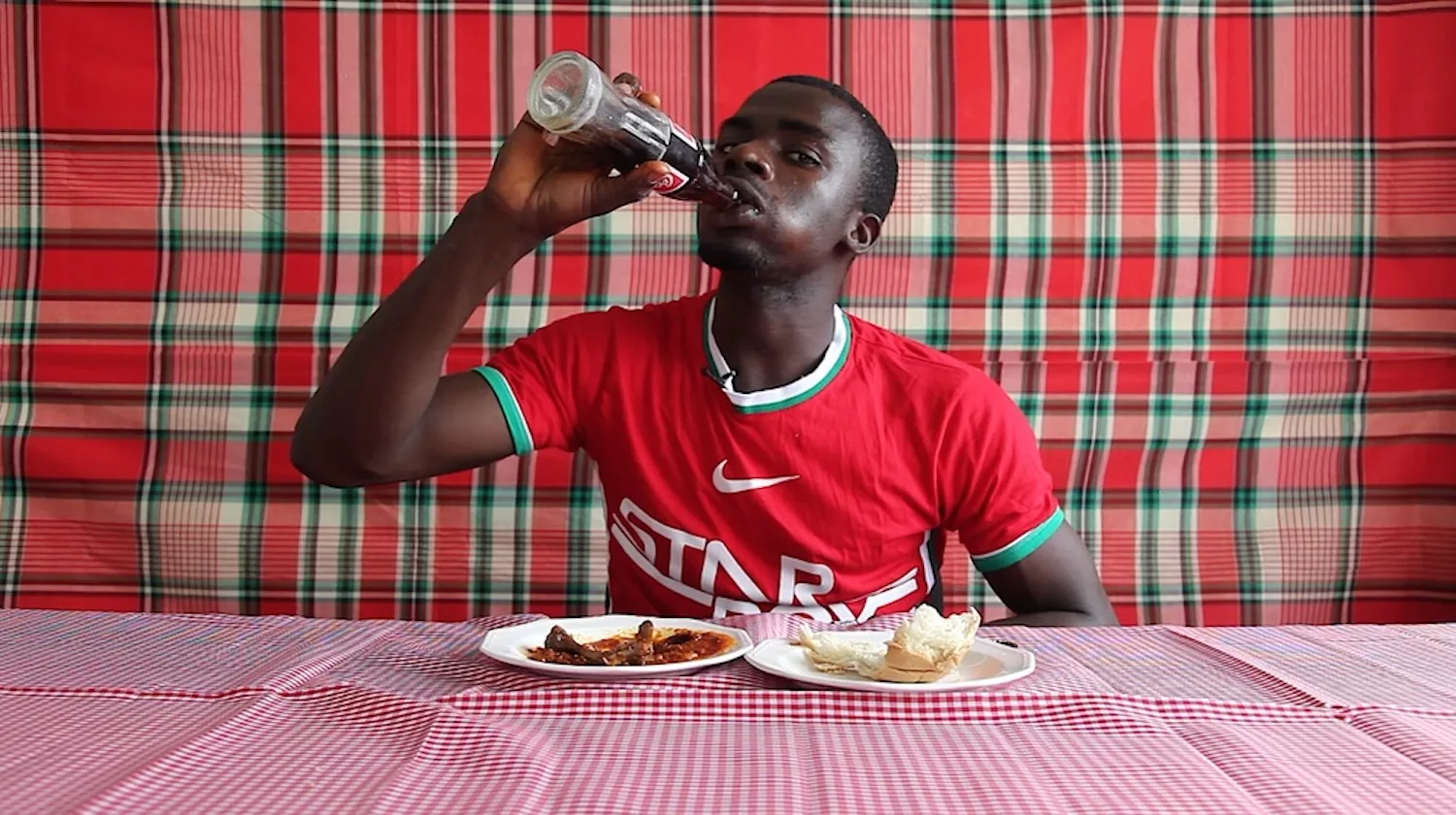
Zina Saro-Wiwa, Table Manners Season 2: Jonah Eats Bread and Stew with Coca-Cola, 2019, video still
In Season 2 of Z. Saro-Wiwa’s video series Table Manners (2014–2019), Jonah is filmed eating my favourite meal: agege bread (sweet yeasted white bread) and stew.2 The stew, a rich tomato-based sauce, has one chicken leg nestled tantalisingly within it and is drowned in oil – just how I like it. A Coke accompanies Jonah’s meal, and he opens the glass bottle with his teeth, as I often do and am scolded for. I’m told it is not something to do in polite company, that it is demonstrative of bad etiquette, of indecent table manners. Jonah tears into the soft bread and dips it into the stew. He picks up the chicken leg and rips the flesh open, and I am hungry. As I write, I’m fuelled by a steady diet of chicken soup and tinned fish eaten on crackers. In Paris, I’m in a city with a distinct culinary culture, one often seen as the gold standard against which all others are measured. This strangeness draws me strongly to the familiarity in Table Manners. In watching the videos, my longings are mirrored back to me, and I think of my next trip home.
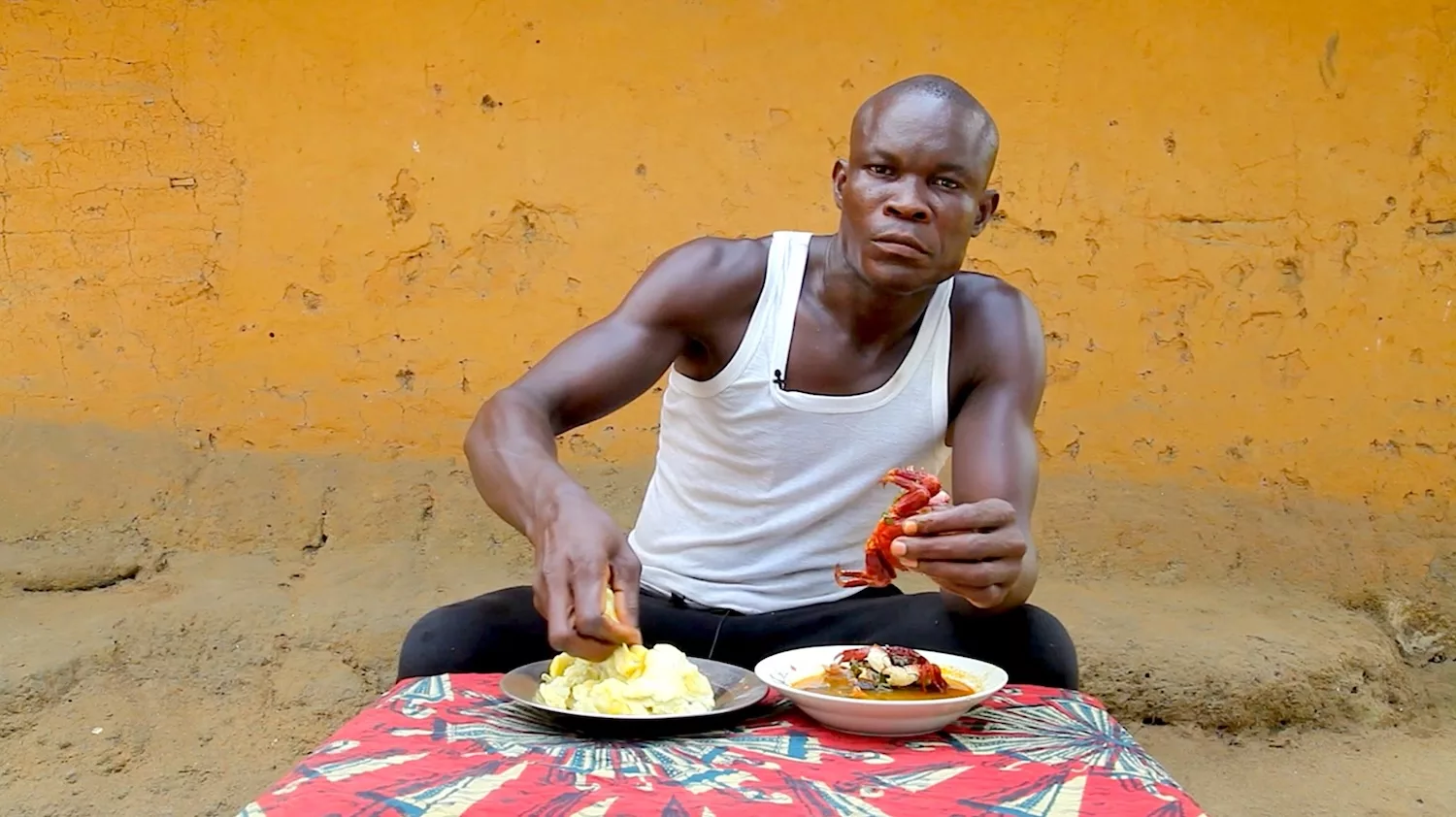
Zina Saro-Wiwa, Table Manners Season 2: Friday Eats Hairy-Leg Crab Pepper Soup with Pounded Yam, 2019, video still
Table Manners, very simply, features people eating. Individuals eat with their hands and hold the viewer’s gaze; their cheeks dance with the motion of chewing. At times, morsels of food catch on their lips and remain there until the next bite. They eat hairy-leg crab, garri (cassava flour), egusi (ground melon seeds’ soup), okro (okra pods’ soup), pumpkin leaf soup and Scotch egg. The eaters work to look at us, but it is clear that their attention is split – caught between a deliberate reciprocal gaze and the natural inclination to look at what it is you are eating.
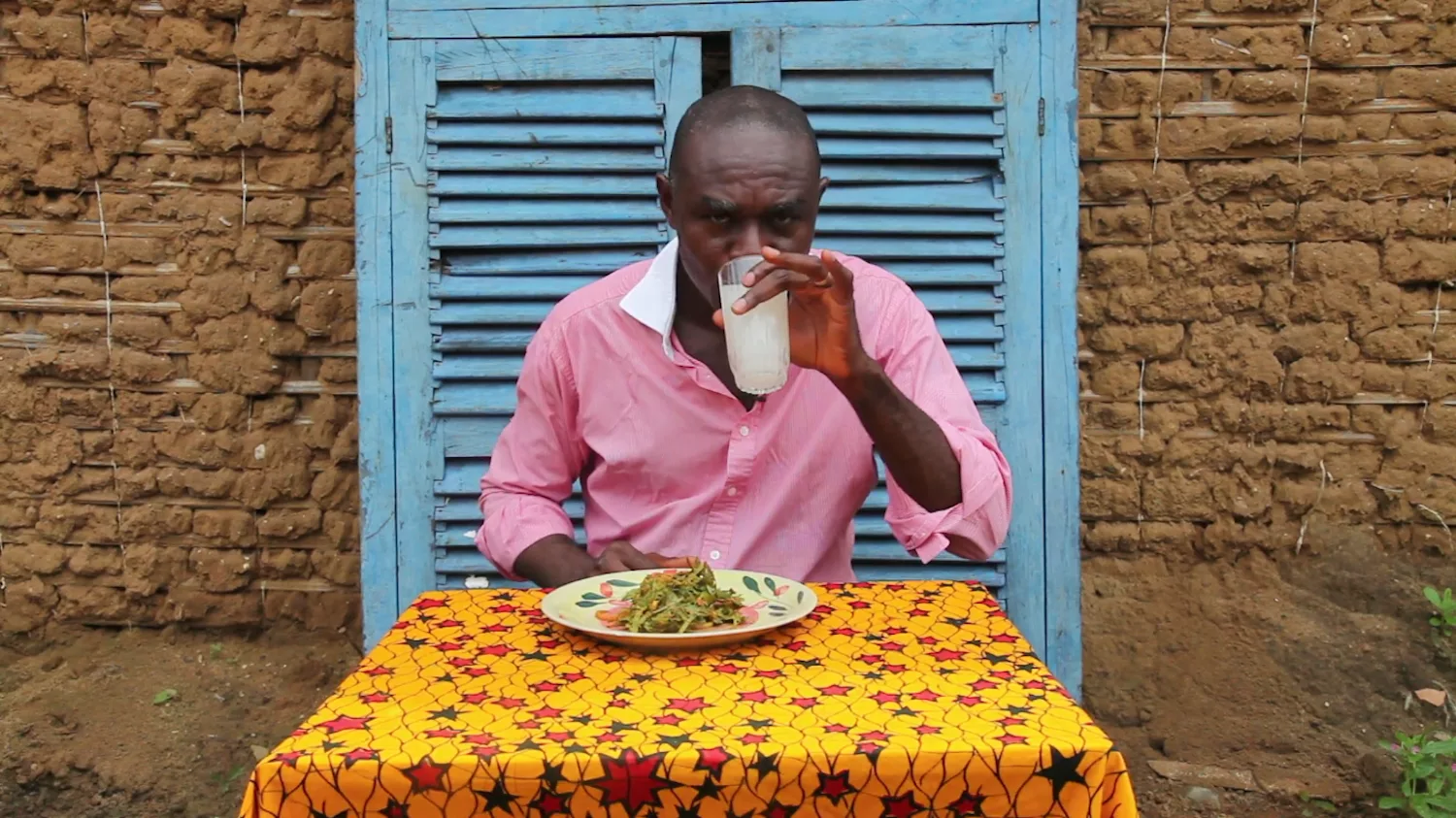
Zina Saro-Wiwa, Table Manners Season 1: Felix Eats Sorgor Salada with Palm Wine, 2014, video still
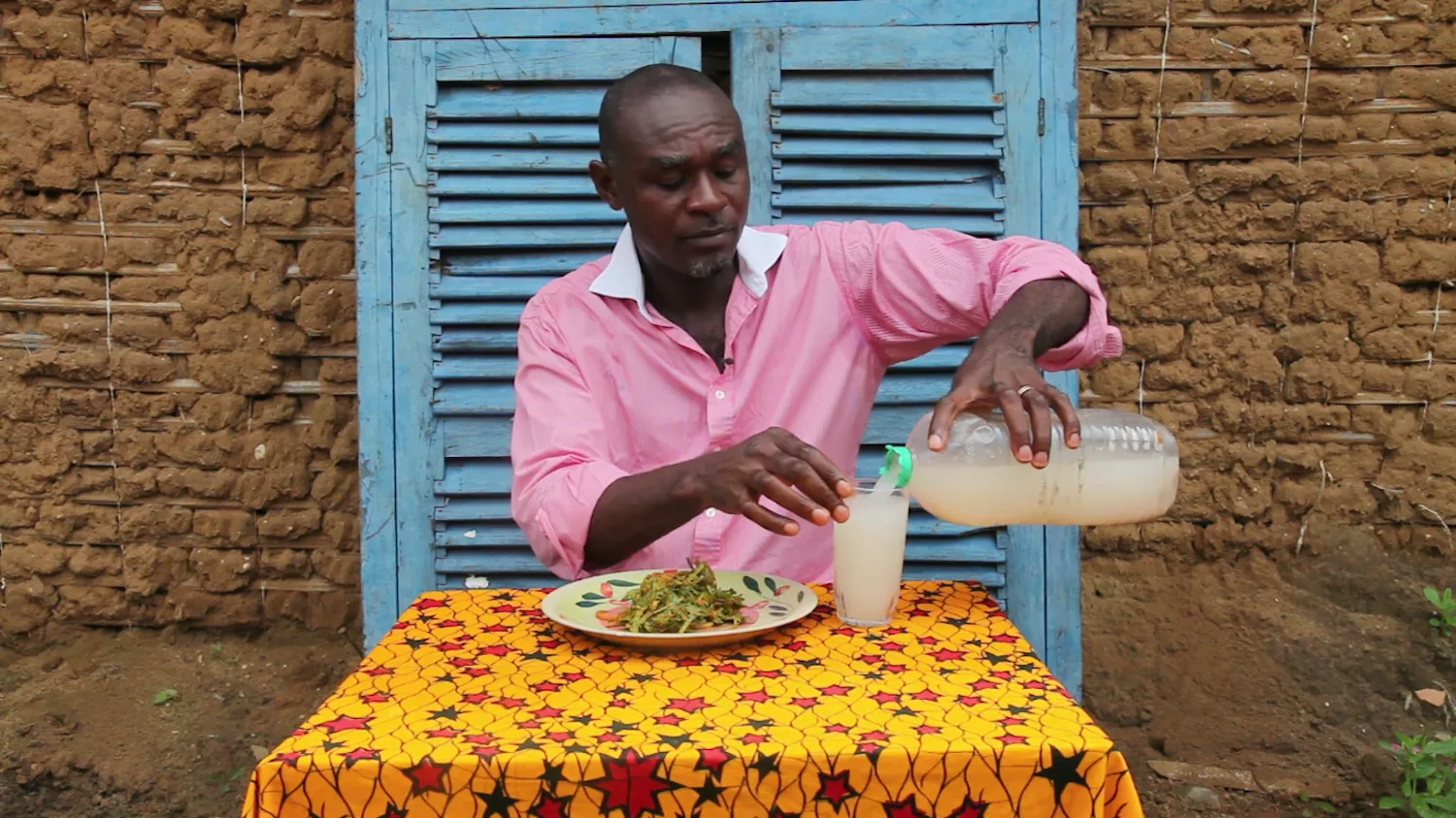
Zina Saro-Wiwa, Table Manners Season 1: Felix Eats Sorgor Salada with Palm Wine, 2014, video still
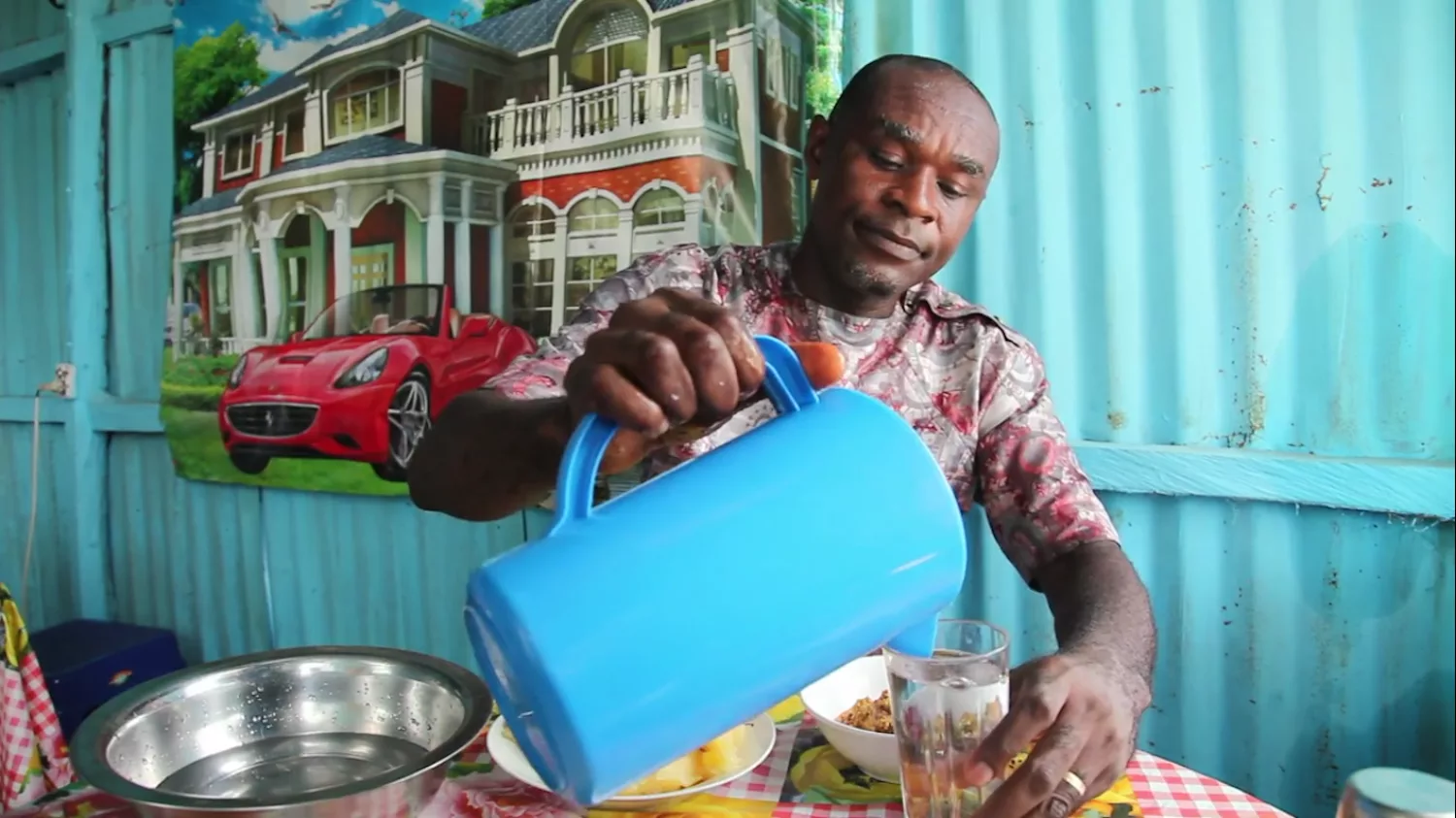
Zina Saro-Wiwa, Table Manners Season 1: Felix Eats Garri & Egusi Soup, 2014, video still
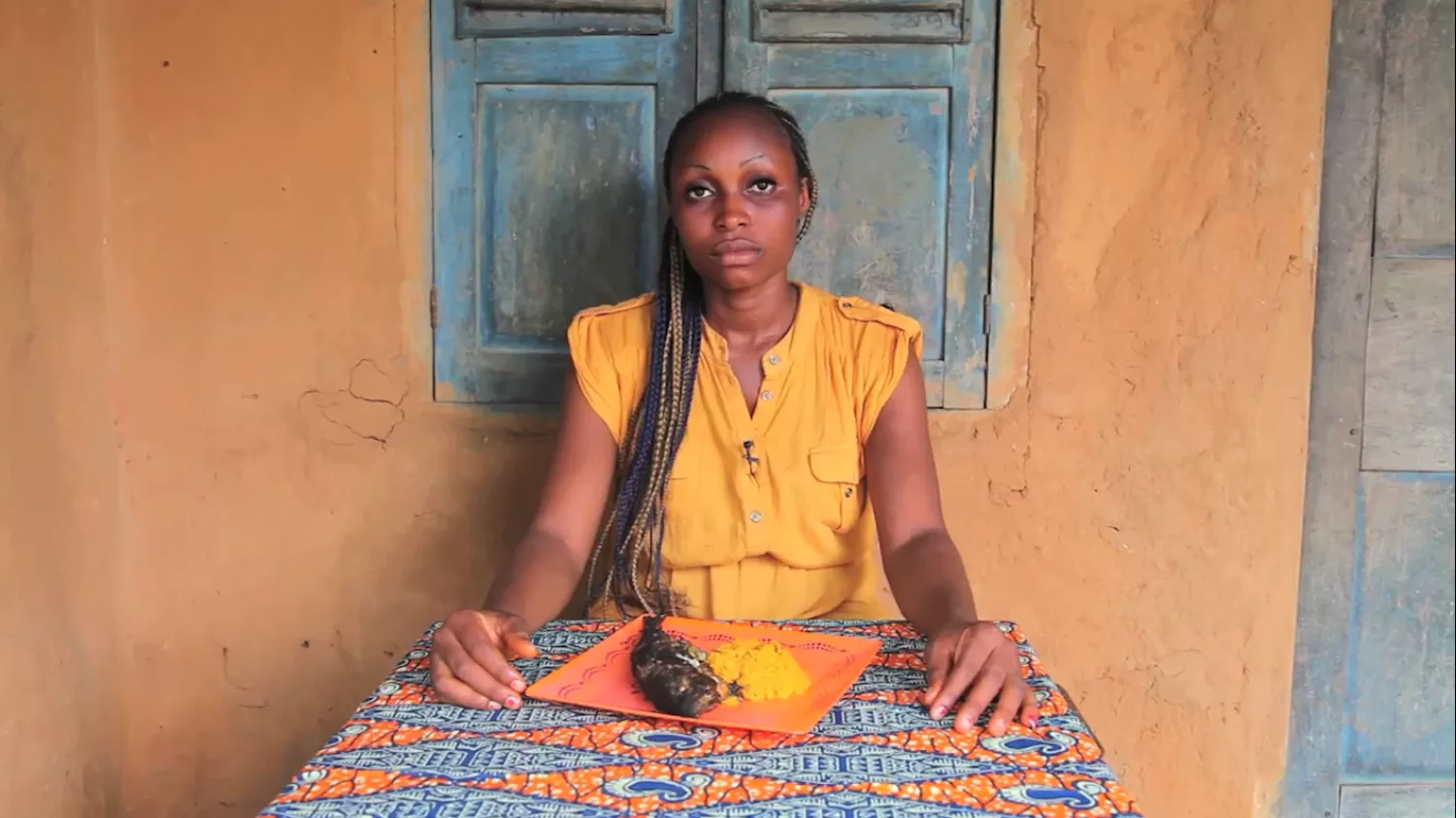
Zina Saro-Wiwa, Table Manners Season 1: Barisuka Eats Roasted Ice Fish and Mu, 2014, video still
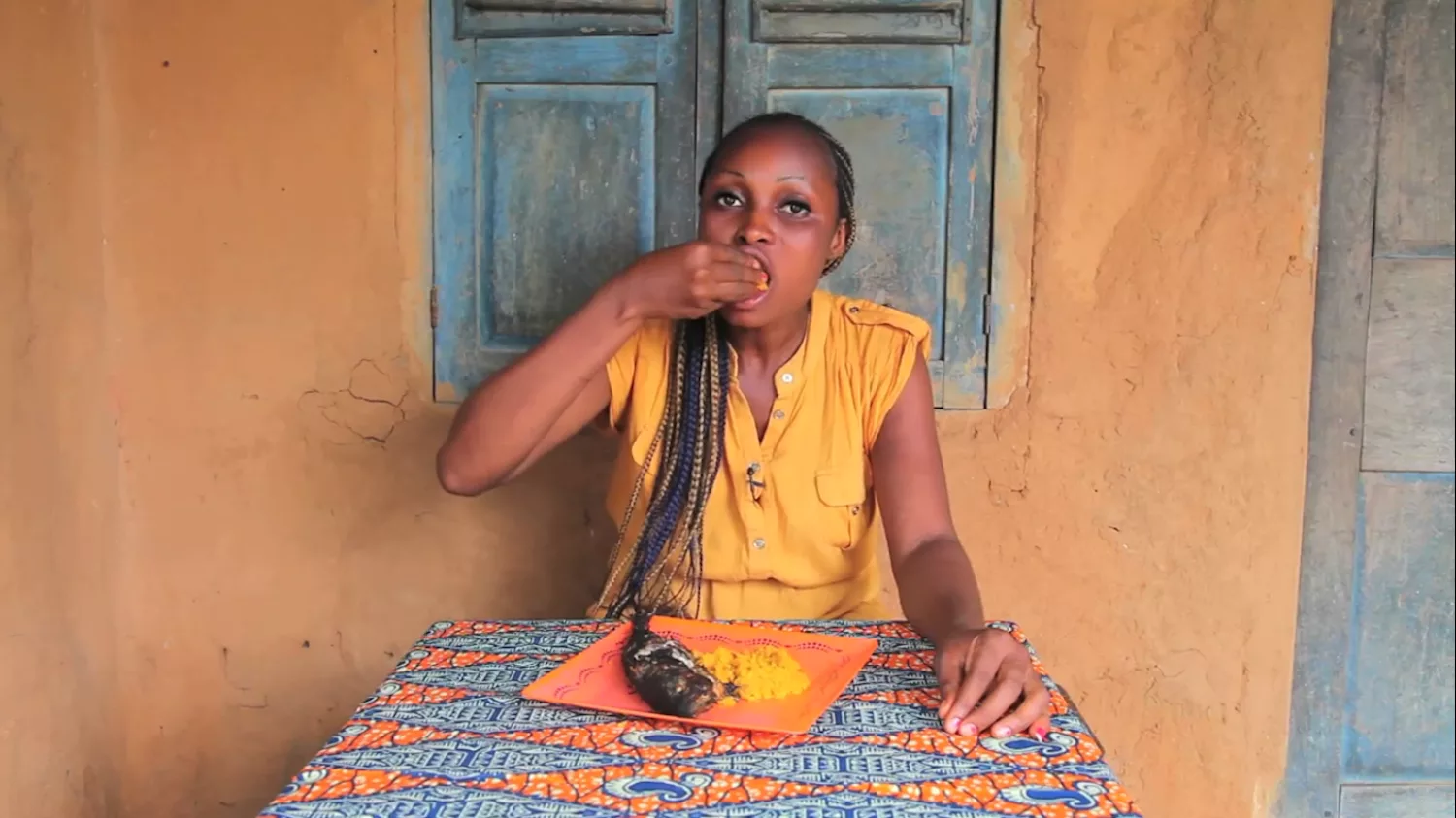
Zina Saro-Wiwa, Table Manners Season 1: Barisuka Eats Roasted Ice Fish and Mu, 2014, video still
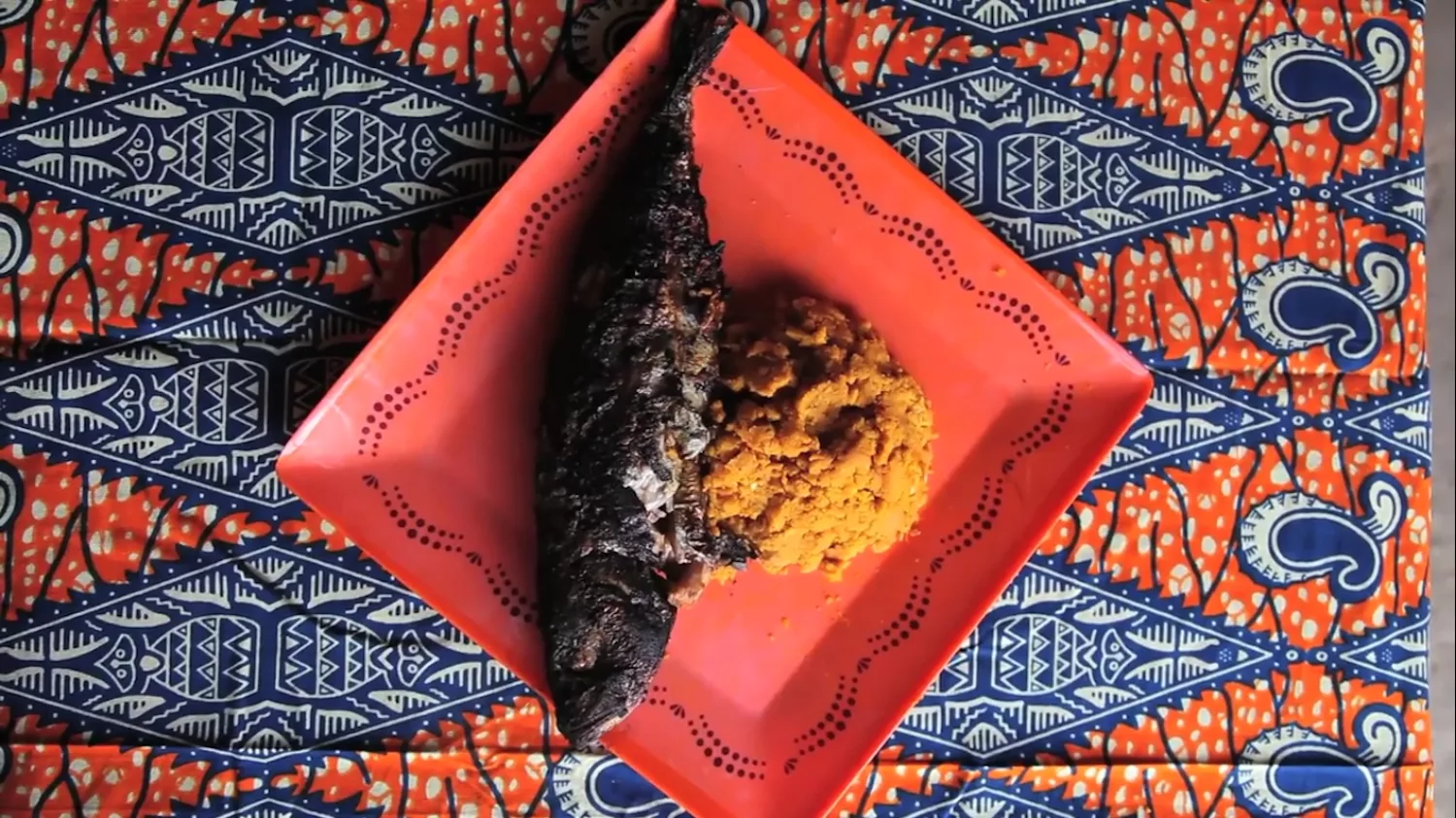
Zina Saro-Wiwa, Table Manners Season 1: Barisuka Eats Roasted Ice Fish and Mu, 2014, video still
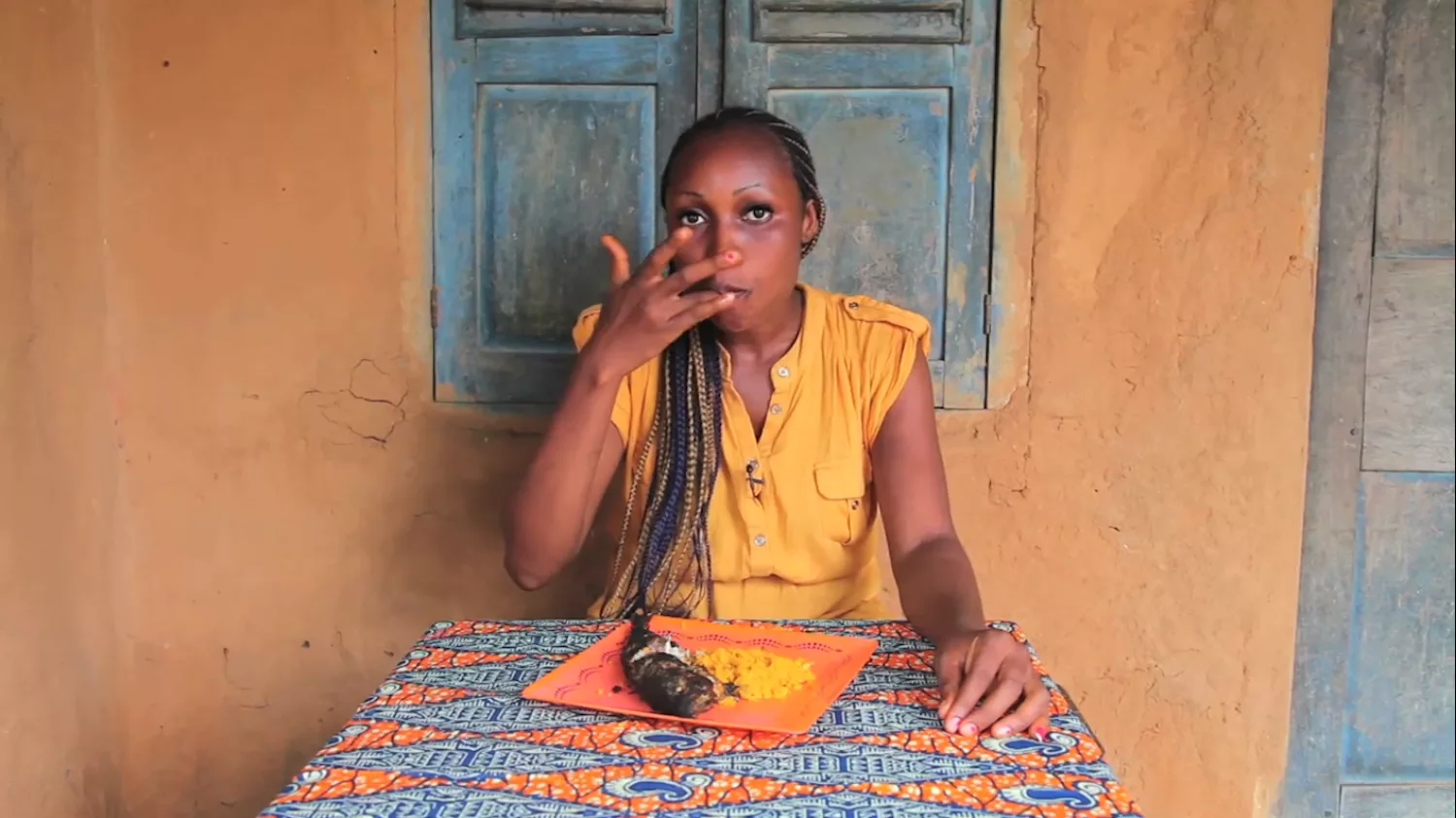
Zina Saro-Wiwa, Table Manners Season 1: Barisuka Eats Roasted Ice Fish and Mu, 2014, video still
We are invited into the ritual of eating not just with our eyes, but also with our ears. In the first video of the series, Felix gulps down palm wine, and we hear it run down his throat, along with the satisfied release of breath once the milky, yeasty liquid is swallowed.3 Barisuka licks her fingers clean mid-meal.4 She snaps her lips across three fingers emphatically before going in for another bite of mu (pounded unripe plantain), and my stomach grumbles. We hear her chew, the lick of her lips and her fingers, and the food as it gushes around in her mouth. Watching Z. Saro-Wiwa’s eaters activates our sight and hearing but not taste, smell or touch, creating the necessary chasm for hunger to rush in.
The appetite that haunts my viewings of Table Manners reveals not just my desires for food, but for home, for Nigeria and its environment. To eat is to draw the land into the body, and my longing for food is a longing for the soil itself. At the end of each video, the location of each meal is revealed. Z. Saro-Wiwa makes sure to name the place that cultivates the food used in the meals. They are filmed across Ogoniland and Port Harcourt in the Niger Delta of southern Nigeria. In this distinctive geography, the action of eating takes on greater significance, beyond its somatic necessity and the pleasure it provides.
The Niger Delta region, of which Ogoniland and Port Harcourt are part and from where the artist comes, is one of the world’s largest oil-producing regions and also one of the most polluted. Since oil extraction began in the 1950s, multinational companies have depleted and contaminated the earth, causing oil spills with devastating environmental and human health effects. Water, air and crops are poisoned with carcinogens, and life expectancy in the region is ten years less than the national average.5 Following an oilfield explosion, a witness describes “crude oil moving swiftly like a great river in flood, swallowing up anything that comes its way. Cassava farms, yams, palms, streams and animals… Men and women forced by hunger have to dive deep in oil to uproot already rotten yams and cassava.”6 In a brutal inversion, nourishment in Ogoniland is coupled with death. Though this is also true for all of us, this truth is corrupted in an environment where the poisons of oil plundering leak into the land, the waters, and, therefore, the bodies of its people. The danger of contamination introduces a quiet alarm – a ‘slow violence’7 – into the scenes of eating in Table Manners.
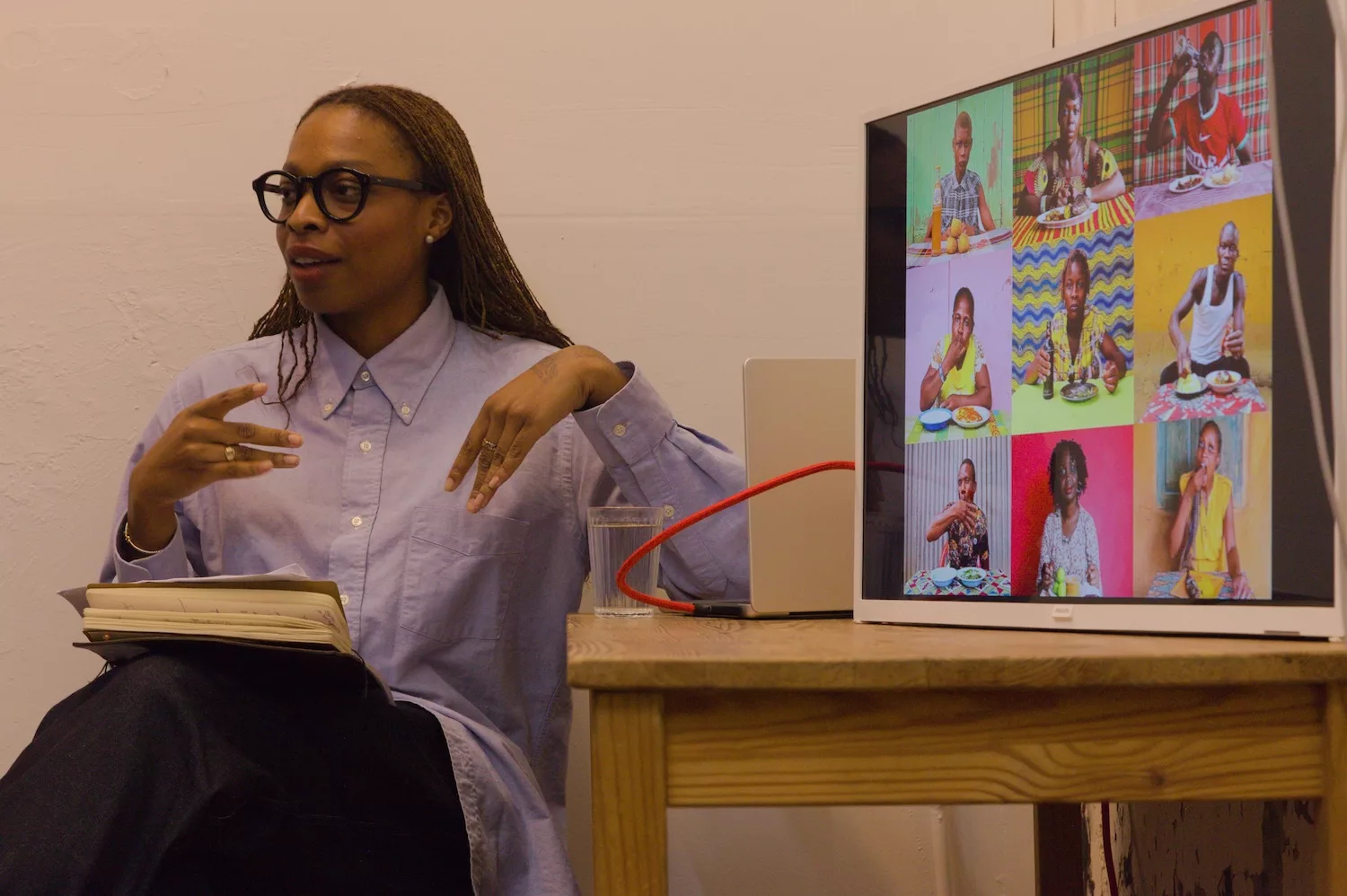
Oluwatobiloba Ajayi presenting Table Manners by Zina Saro-Wiwa at L’AIR Arts, March 13, 2026, © Photo: Lorena Almario Rojas, © AWARE: Archives of Women Artists, Research and Exhibitions
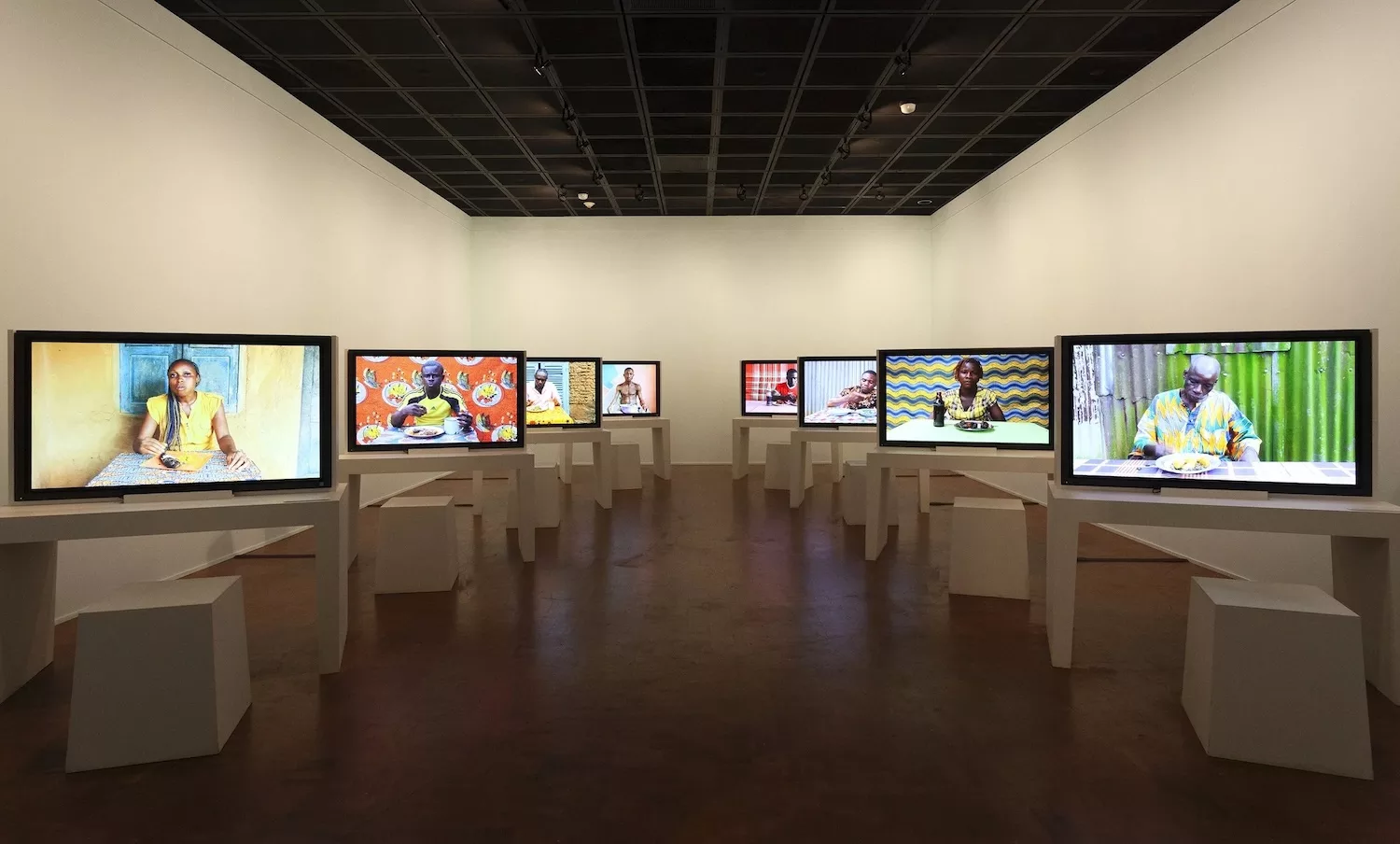
Installation view of Zina Saro-Wiwa’s Table Manners series (2014–2019), in Inheritance: Recent Video Art from Africa, Fowler Museum at UCLA, 2019, © Photo: Dan Cole, © Zina Saro-Wiwa / Fowler Museum
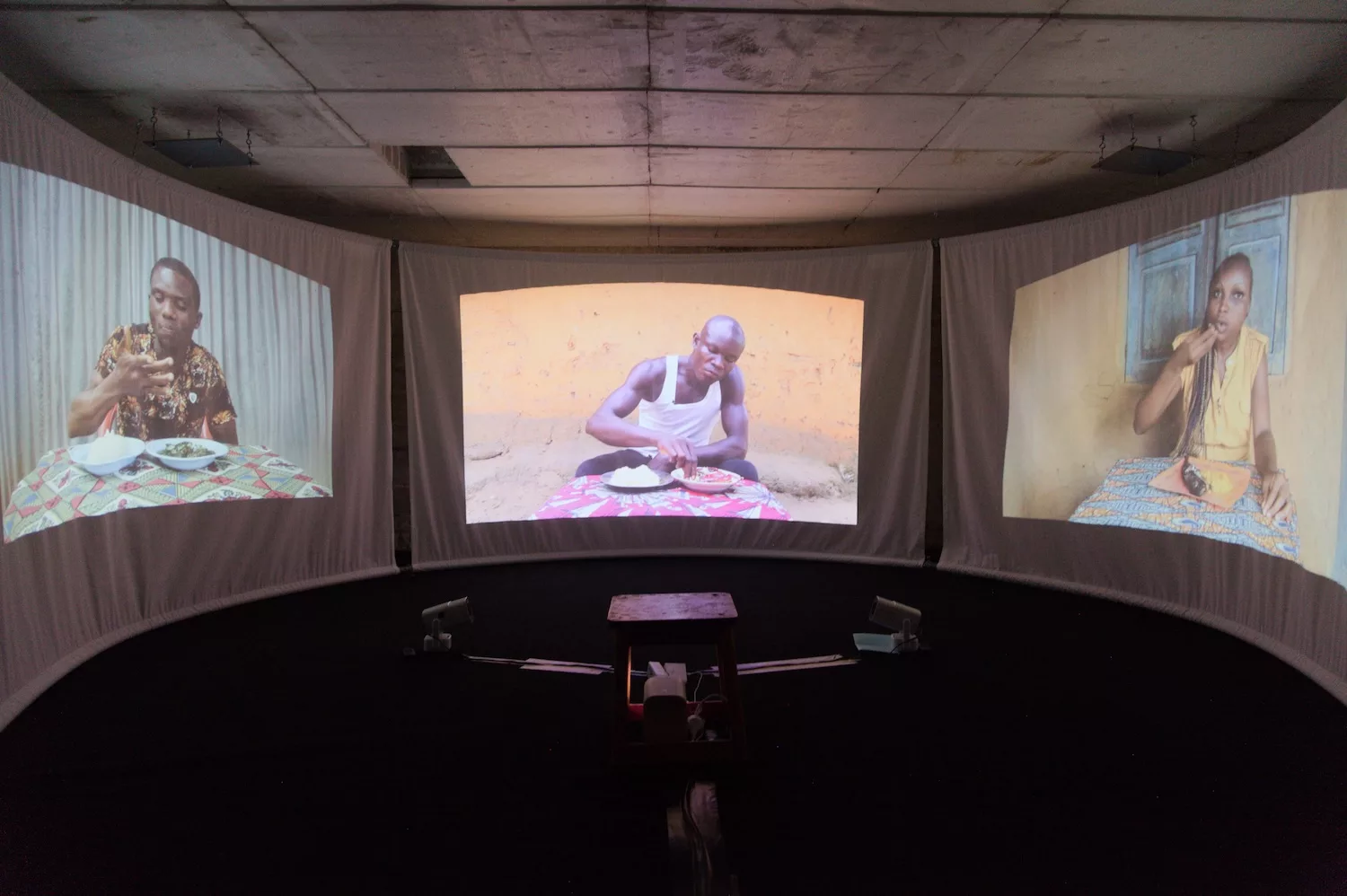
Table Manners by Zina Saro-Wiwa, projected at L’AIR Arts, March 13, 2026, © Photo: Lorena Almario Rojas, © AWARE: Archives of Women Artists, Research and Exhibitions
The effects of oil extraction in Nigeria are not felt equally. The Ogoni people, who are most affected, are a small minority within Nigeria, totalling about 0.5% of the country’s population. Under the 1914 Mineral Ordinance, the British Colonial administration was granted exclusive ownership of all mineral resources in Nigeria, a monopoly over Nigerian oil that Western oil companies retained after independence, with successive Nigerian governments acting as complicit enforcers. Against this backdrop, the artist’s father, Ken Saro-Wiwa, founded the Movement for the Survival of the Ogoni People (MOSOP), a non-governmental organisation undertaking a non-violent campaign for the environmental rights of the Ogoni people. On 10 November 1995, K. Saro-Wiwa and eight other activists were executed, hanged by Sani Abacha’s government on false accusations of murder, after requests from Shell to silence the protests that were hampering their ability to secure their operations.8 That foreign petroleum companies have been able to benefit from Ogoniland’s crude oil without accountability is part of an enduring colonial apparatus. Profits are externalised while costs are localised. The Ogoni people are left to state their case within a national container that can’t fully recognise their distinct concerns, while petroleum multinationals plunder and profit scot-free.
There is an ironic, ouroboric quality to the layered struggles of tribalism, colonialism and nationalism. K. Saro-Wiwa writes of his cynicism of country in his poem ‘Victory Song’: “You have raped my land/Black brother, silenced my song.9 ” These “black brothers” he addresses are the state officials who aid in the destruction of Ogoniland – a critique that would prove tragically prescient with the execution of the Ogoni Nine, an act that sparked international outrage and Nigeria’s suspension from the Commonwealth of Nations. Here, Abacha’s government acted in support of an international company’s business interests – a company first permitted to pillage the environment under a colonial administration – and was in turn punished by its imperial master. A bitter and familiar taste lingers in one’s mouth under the vestiges of empire. They will poison your food and still tell you how you how to eat it.
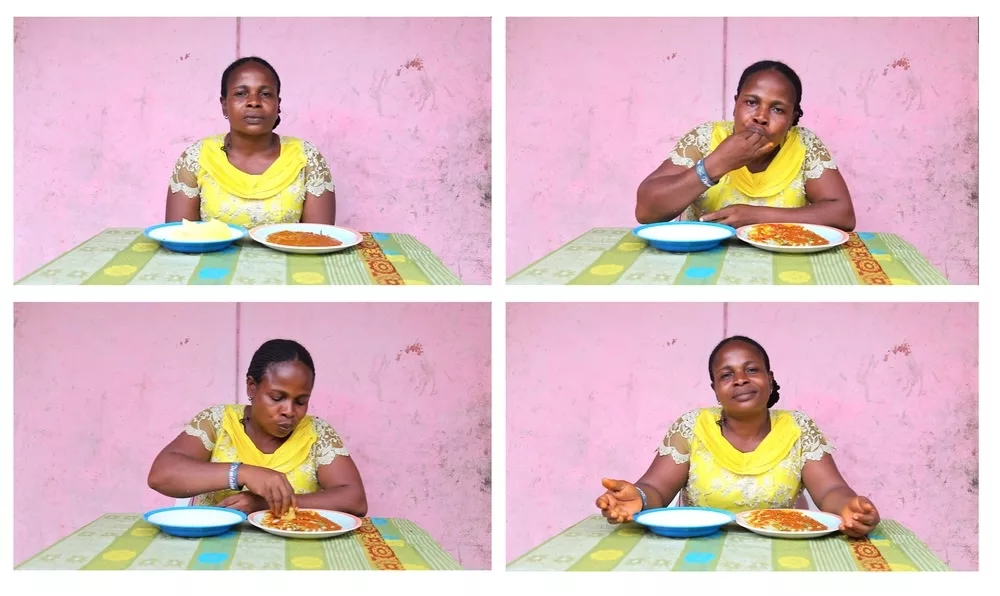
Zina Saro-Wiwa, Table Manners Season 2: Eucharia Eats Three Leaf Yam and Gho, 2019, video stills
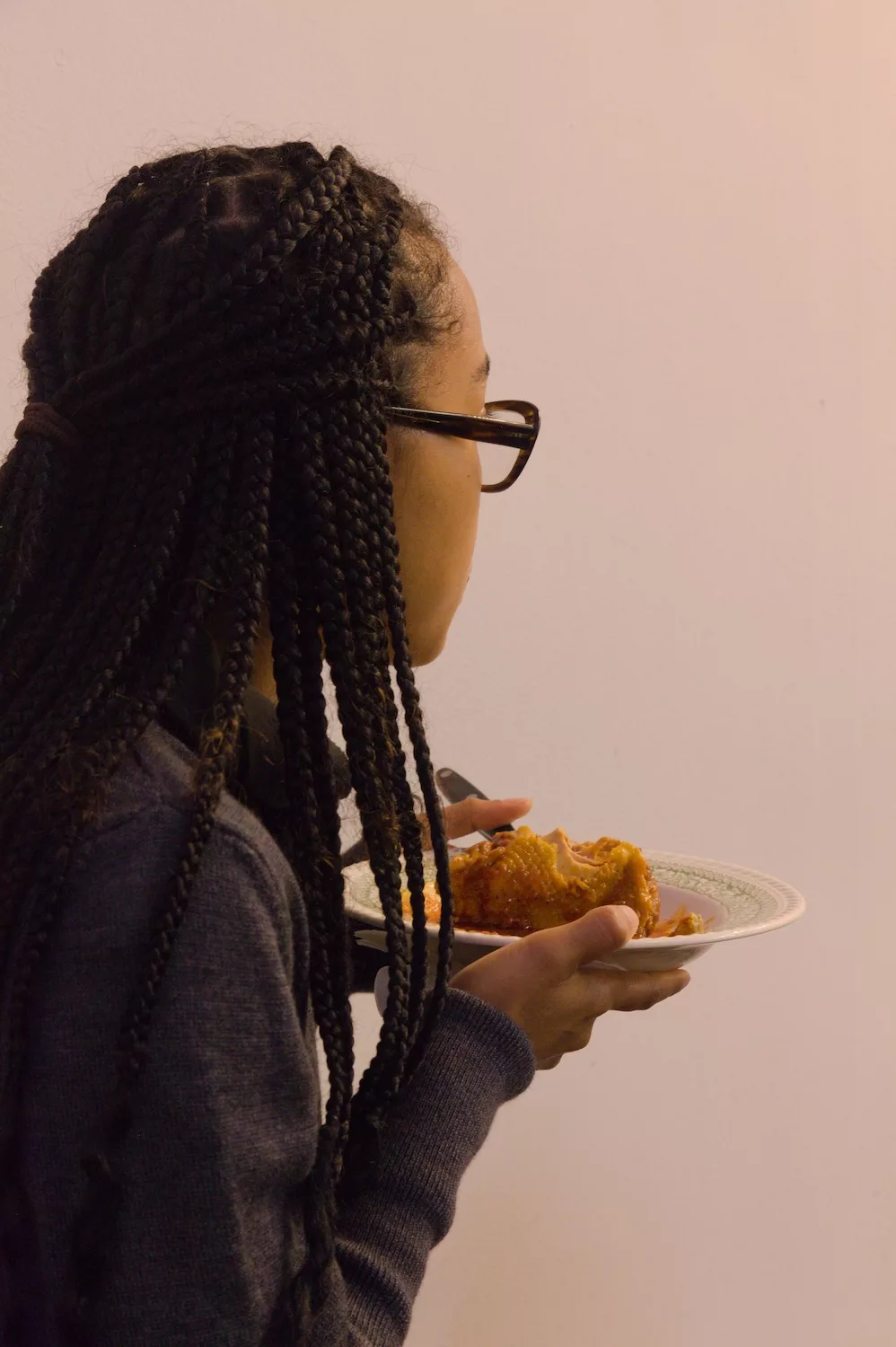
Kwama Frigaux attending the event organised by Oluwatobiloba Ajayi as part of the AWARE: Archives of Women Artists, Research and Exhibitions residency at L’AIR Arts, March 13, 2026, © Photo: Lorena Almario Rojas, © AWARE: Archives of Women Artists, Research and Exhibitions
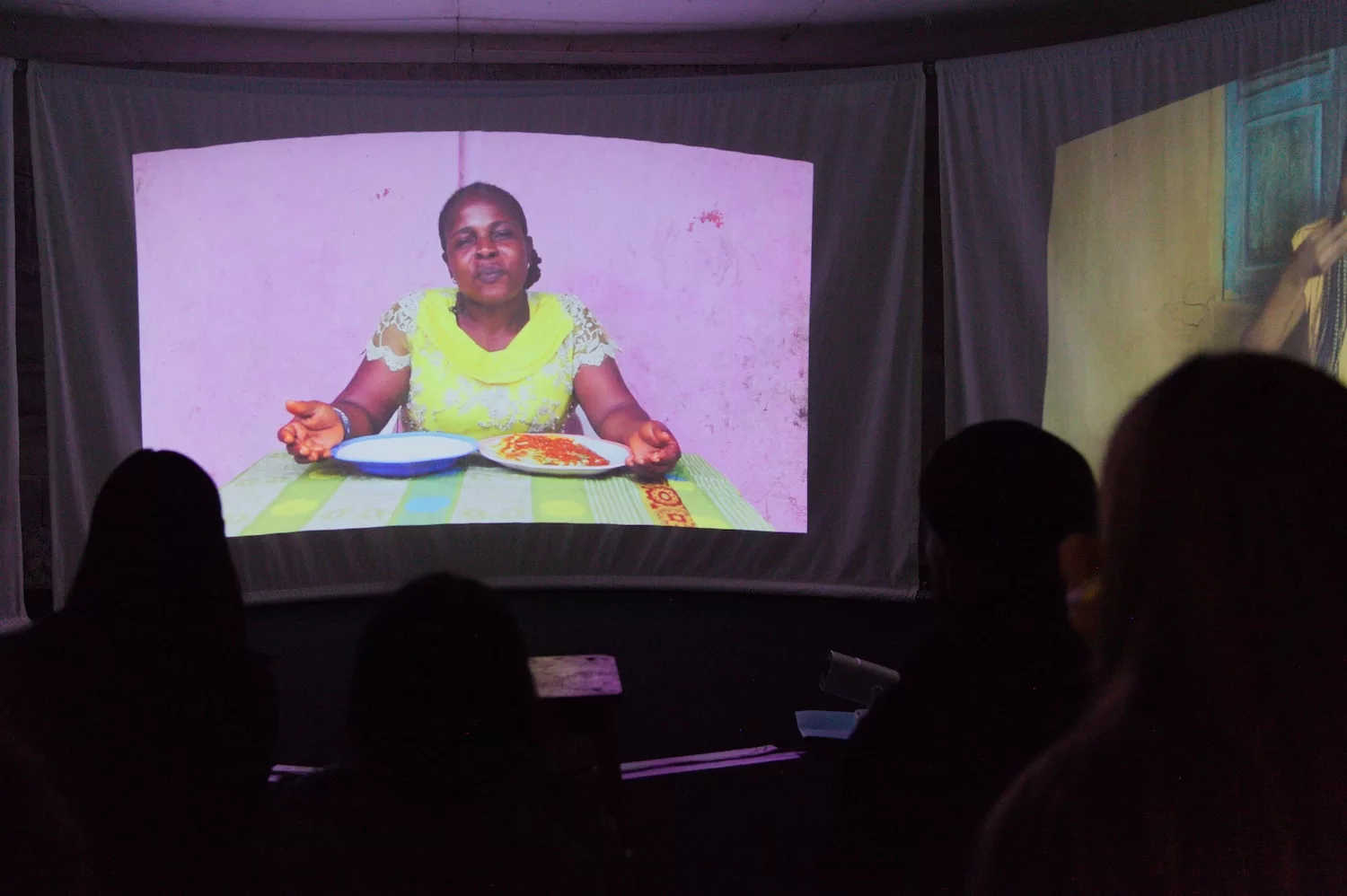
Table Manners by Zina Saro-Wiwa, projected at L’AIR Arts, March 13, 2026, © Photo: Lorena Almario Rojas, © AWARE: Archives of Women Artists, Research and Exhibitions
In Table Manners, the sitters are not simply eating, but eating despite the noxious haunting of their environment by an imperial past and an extractivist present. While Z. Saro-Wiwa’s father’s work was more explicit in advancing an anti-oil trade campaign, the artist instead commits to making alternate images of Ogoniland, detailing how life goes on despite the insecurity that continues to plague the region. She insists that “violent oil extraction is a tragedy but not an identity”, and her focus on the act of eating expands the relationship between the people and their landscape beyond one of devastation.10 While the ground is not directly pictured, the meals in Table Manners are made possible by it. The fact that each eater is satisfied and, without restraint, finishes their food marks not fragility but security. This assurance shapes the sitters’ attitudes. When Dorcas eats her roasted snails and drinks Maltina, I know the snails are spicy and that the super sweet maltiness of the drink makes the pepper sing. Smacking her lips softens the heat and makes the food taste sweeter. Each eater feeds themselves and remains poised in the face of colonial table manners that would deem the rhythm of eating with one’s hands as backwards or impolite. They each maintain the sentiment that we know how best to draw the soil into our bodies.
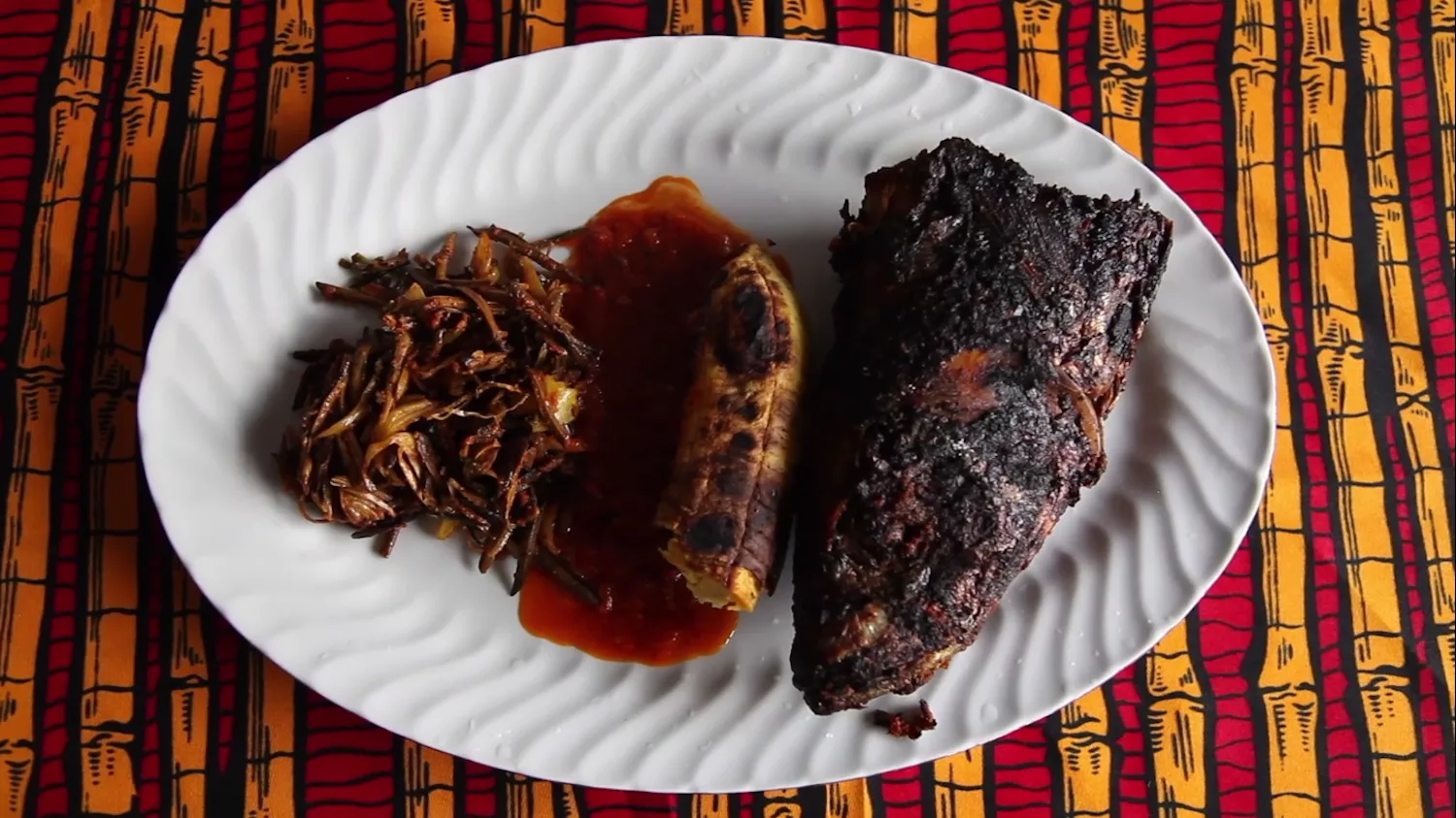
Zina Saro-Wiwa, Table Manners Season 2: Precious Eats Boli and Fish and Oil Bean, 2019, video still
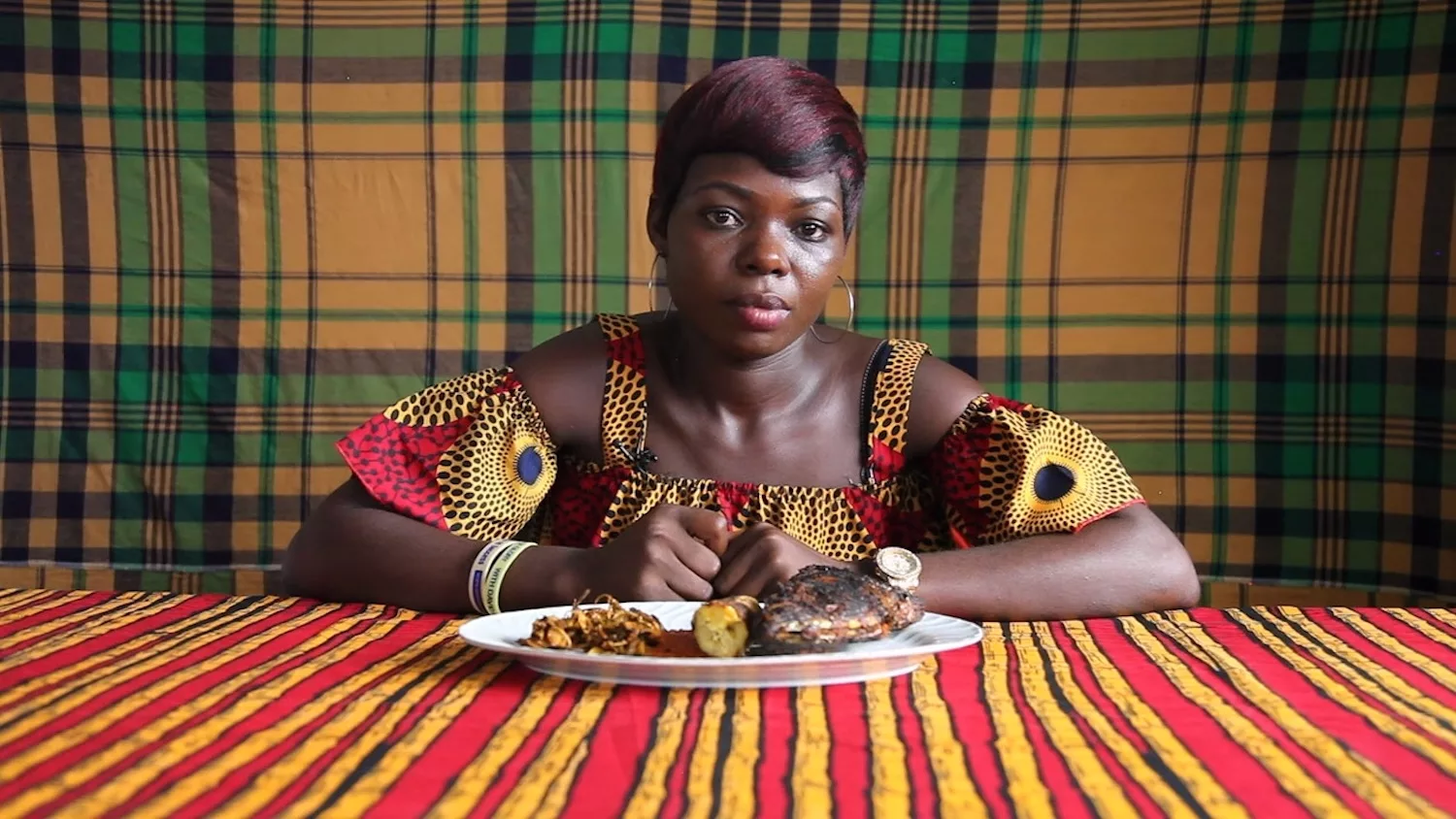
Zina Saro-Wiwa, Table Manners Season 2: Precious Eats Boli and Fish and Oil Bean, 2019, video still
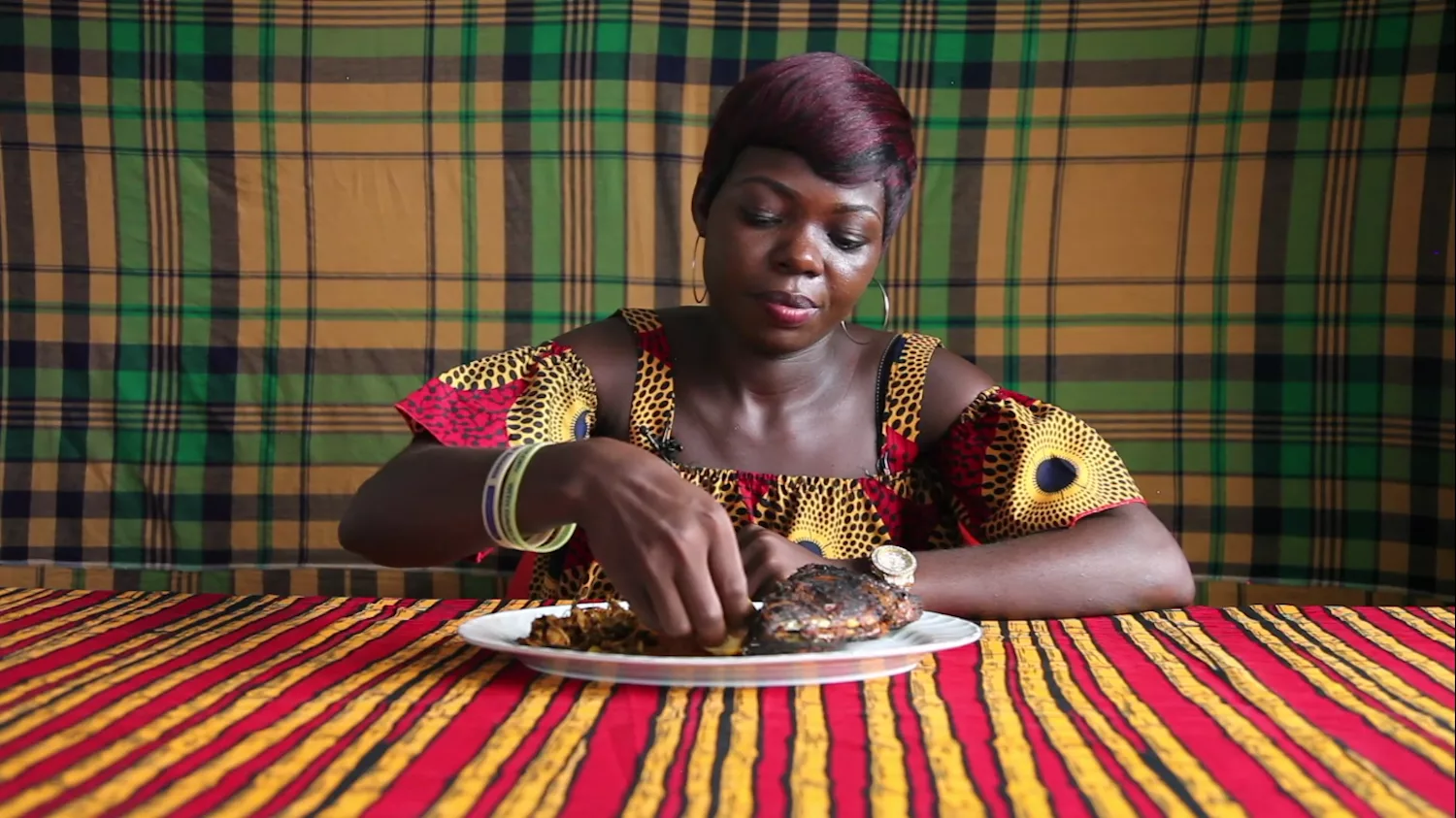
Zina Saro-Wiwa, Table Manners Season 2: Precious Eats Boli and Fish and Oil Bean, 2019, video still
Across Table Manners, the work that goes into making the plates remains absent. In the video where Precious eats, a slight smile creeps onto her face when she receives the off-camera cue to start eating.11 While the labour that went into her plate remains invisible, it is central to her and the other eaters’ energy and implicit joy. In the West African context, food is largely a women’s task. In a country where almost two-thirds of its population works in agriculture, Nigerian women constitute around 75% of the agricultural workforce.12 In rural areas, women are often responsible for growing vital crops such as cassava, yams and maize, which form the basis of local diets. When Gideon, Victor and Felix eat garri, they are eating fermented cassava probably grown by Ogoni women. And where the women don’t plant the food, they often still have to prepare it. The food in Table Manners is a testament to the resilience of the earth and the work of farming and cooking, traditionally left to women in Nigerian households.
Seizing on the relationship between Black womanhood, food and environmental wellbeing, Z. Saro-Wiwa imagines the environment as a female figure in a text introducing her recipes in Did You Know We Taught Them How to Dance for The Mangrove Banquet (2015), a publication made alongside her exhibition of the same name at the Blaffer Art Museum. She writes: “I tell her: I make food to tell stories. I make food so that people receive whatever alchemy or magic happens when eating another culture’s food. To tell them something. Or perhaps it is just my way of telling myself that the land belongs to me too. That it is not worthless. That the labour of so many women is not for nothing… Why are you here, Zina? What is this feast you want to make of me? I tell her that I want her to give me her seeds for a future that she may have given up on.”13
Z. Saro-Wiwa expresses environmental disenchantment whilst offering a potential balm in the imagined wisdom of an embodied female landscape. Food becomes a translational vehicle for spiritual and cultural enrichment rooted in agricultural stewardship. This food is only made possible with the labour of ‘so many women’, and with the earth that begs to return to itself and birth a future beyond its despoliation.
Z. Saro-Wiwa’s likening of the landscape to an African woman’s body is historically anchored. Just as colonial architecture saw territory as an entity to be conquered and made property, so too were Black women’s bodies. Unpaid labour was needed to develop the agricultural slave economy that drove the empire, and the fertility of Black women was central to this labour force. Today, agricultural practice in Nigeria, while afflicted by its imperial history, continues to be fortified by women’s contributions. When crops are threatened and yields are reduced by environmental degradation, rural Nigerian women bear the greatest burden, having to ensure they can still feed their families. Black women are uniquely positioned not just to support a deeper engagement with the soil, but also to widen the parameters of our environmental consciousness. Such consciousness is embodied in the practice of eating, where the sitters consistently sup the ground into their bodies, remaking their relationship with the earth in observable time. While the artist is not making the food or demonstrating the gendered labour that goes into its preparation, she creates the context in which the food is served and eaten. From the eaters within the Table Manners videos to us as viewers, we feast on the fruits of the earth and the work of Black women’s hands.
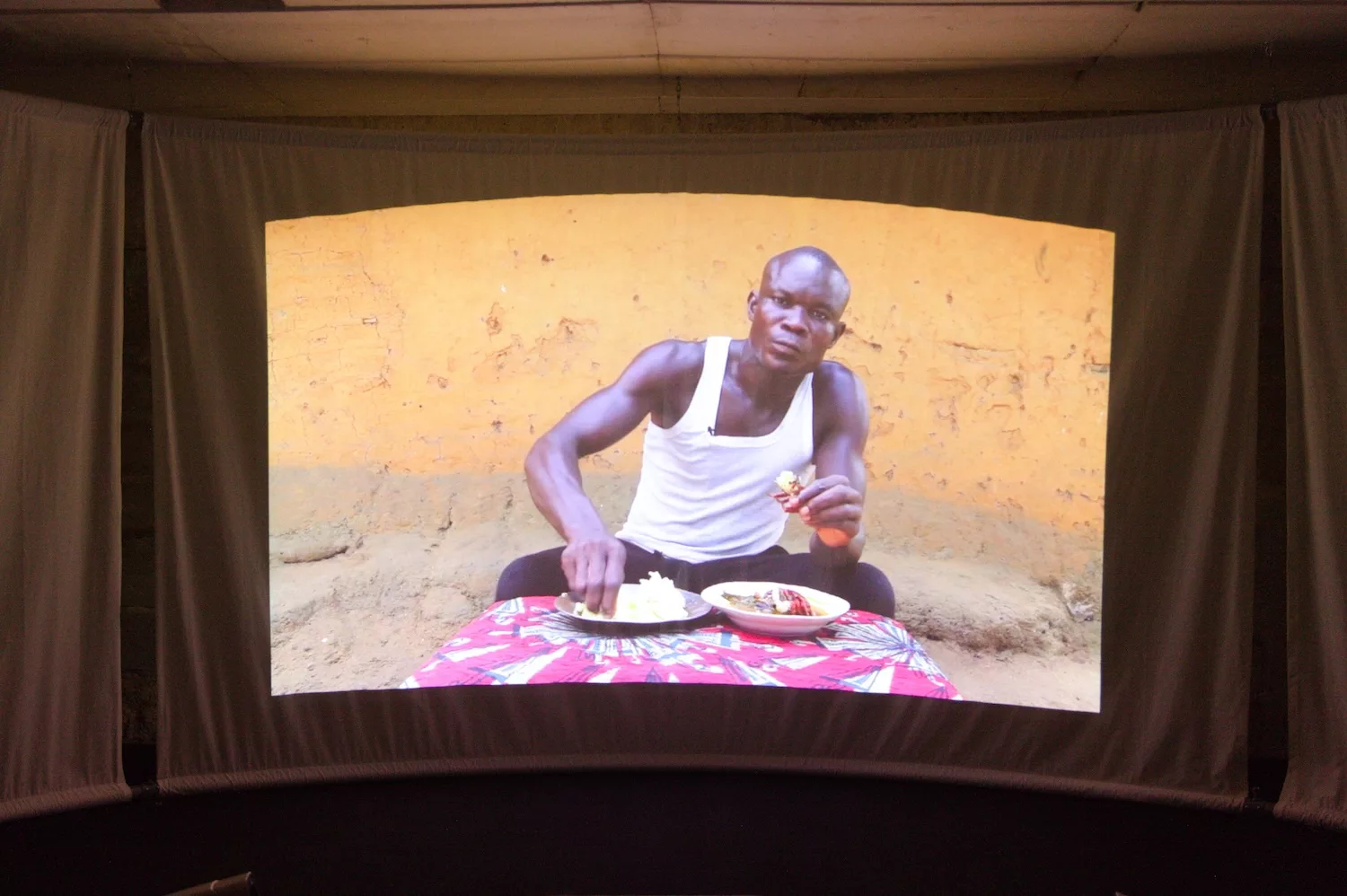
Table Manners by Zina Saro-Wiwa, projected at L’AIR Arts, March 13, 2026, © Photo: Lorena Almario Rojas, © AWARE: Archives of Women Artists, Research and Exhibitions
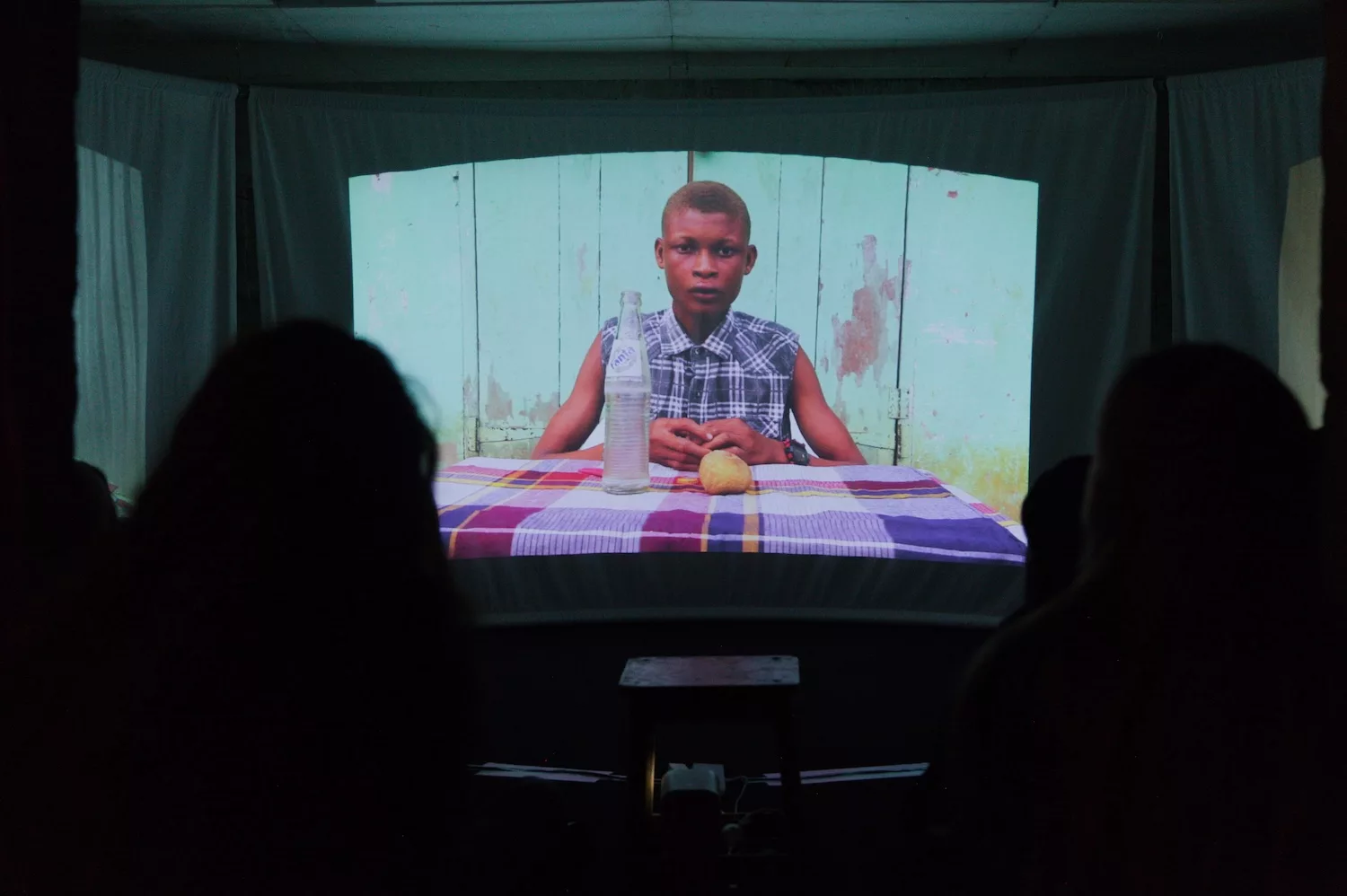
Table Manners by Zina Saro-Wiwa, projected at L’AIR Arts, March 13, 2026, © Photo: Lorena Almario Rojas, © AWARE: Archives of Women Artists, Research and Exhibitions
Z. Saro-Wiwa reconstitutes the concept of an environmental body, of environmental agency, so that the land may speak for herself. Ogoniland is and continues to be fertile ground – producing fresh fish, plantain, garden egg, yam and sorghum. During my closing event, I screened Jonah Eats Bread and Stew, amongst other videos from the series. As we gathered, watched and ate together, our shared meal was a mirror to those Ogoniland makes possible in Table Manners. There, nourishment is reconstituted as autonomy and repair, rooted in the labour and environmental literacy of Black women.
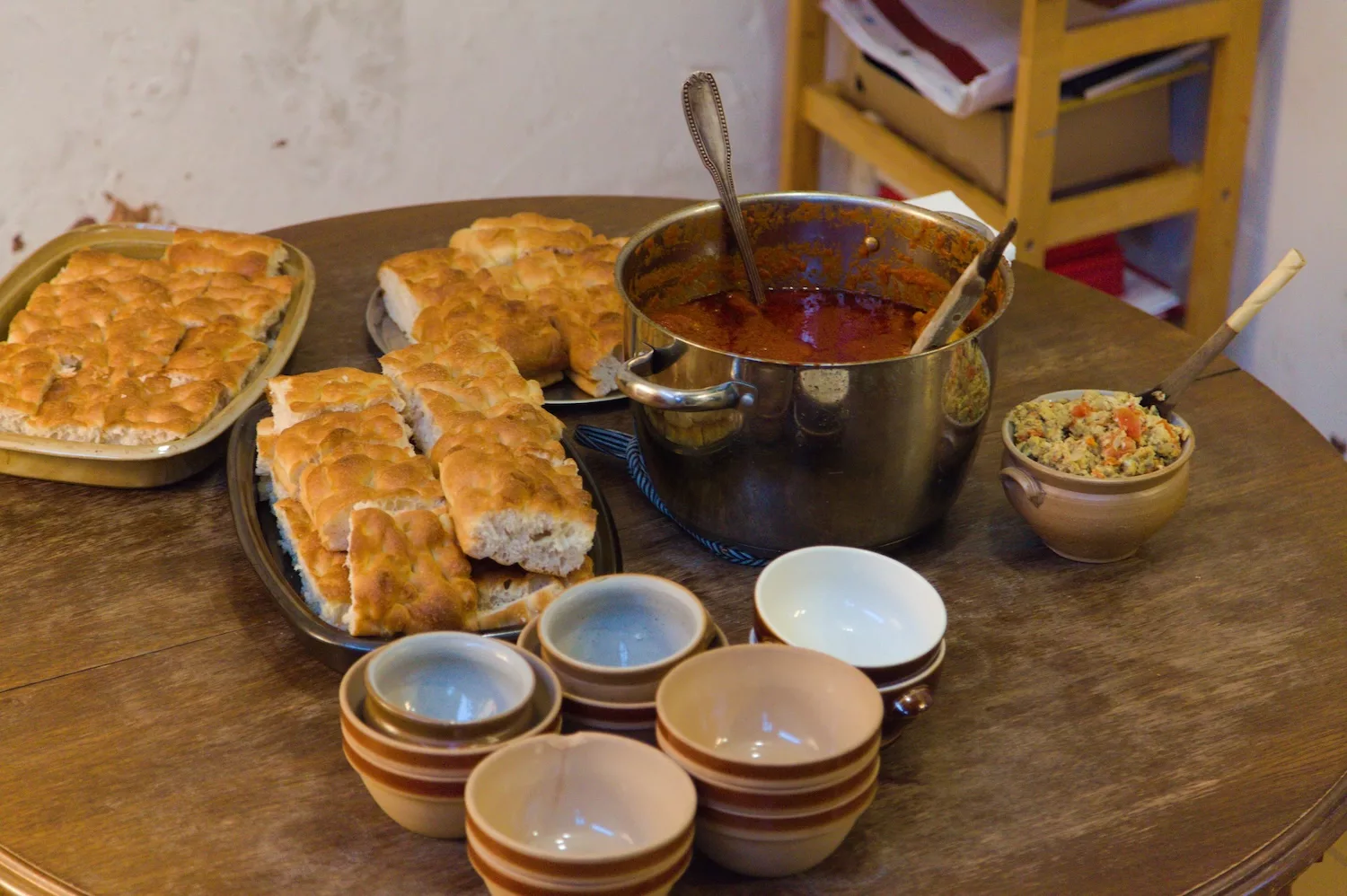
Nigerian chicken stew, egg sauce, and sweetened focaccia prepared by Oluwatobiloba Ajayi and Marie Doumerc at L’AIR Arts, March 13, 2026, © Photo: Lorena Almario Rojas, © AWARE: Archives of Women Artists, Research and Exhibitions
Throughout my residency, my homesickness manifested in a hunger I could only satiate by bringing the food of home, through Jonah’s meal, to Paris. As I shared my research, the room filled with an improvised score: the faint sounds of full cheeks, grinding teeth and sauce-bedecked fingers tearing soft bread. The gradual gestures of stowing mouthfuls of food into our bodies marked an imperative connection between a people and their place. I was reminded that even in the strangest of environments, shared food has always been my primary source of comfort, belonging and social connection.
Oluwatobiloba Ajayi is a London-based artist and writer. She holds a BA in Architecture (Princeton University) and an MA in History of Art (Courtauld Institute of Art), where she specialised in post-war Black British Art. Informed by anti-, post- and decolonial theory, her research centres on the importance of space within Black feminist creative practices. Her writing has appeared in The Architectural Review, The Brooklyn Rail and Worms, amongst others. Recent group exhibitions include Amphiphrasis (words as objects): Oluwatobiloba Ajayi and Theresa Hak Kyung Cha at the Broodthaers Society of America (2024), and Manifold Lagos at Alára (2024).
Oluwatobiloba Ajayi has been researcher-in-residence at the Villa Vassilieff as part of the AWARE residency programme for research on women and non-binary photographers and video artists, which received the support of Neuflize OBC Foundation.