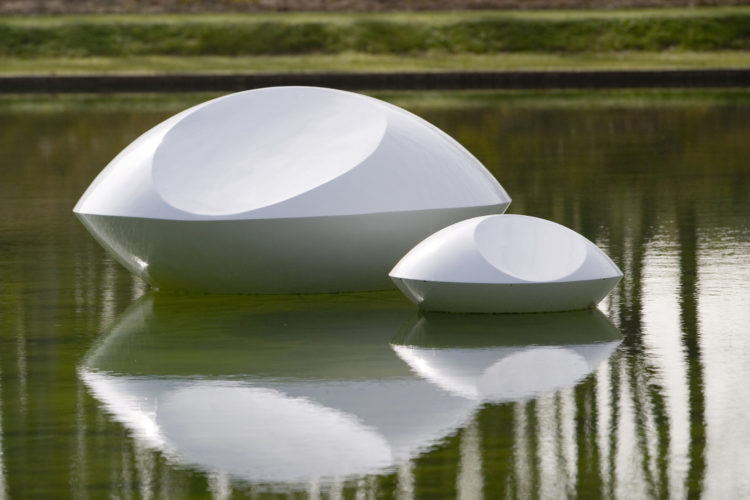
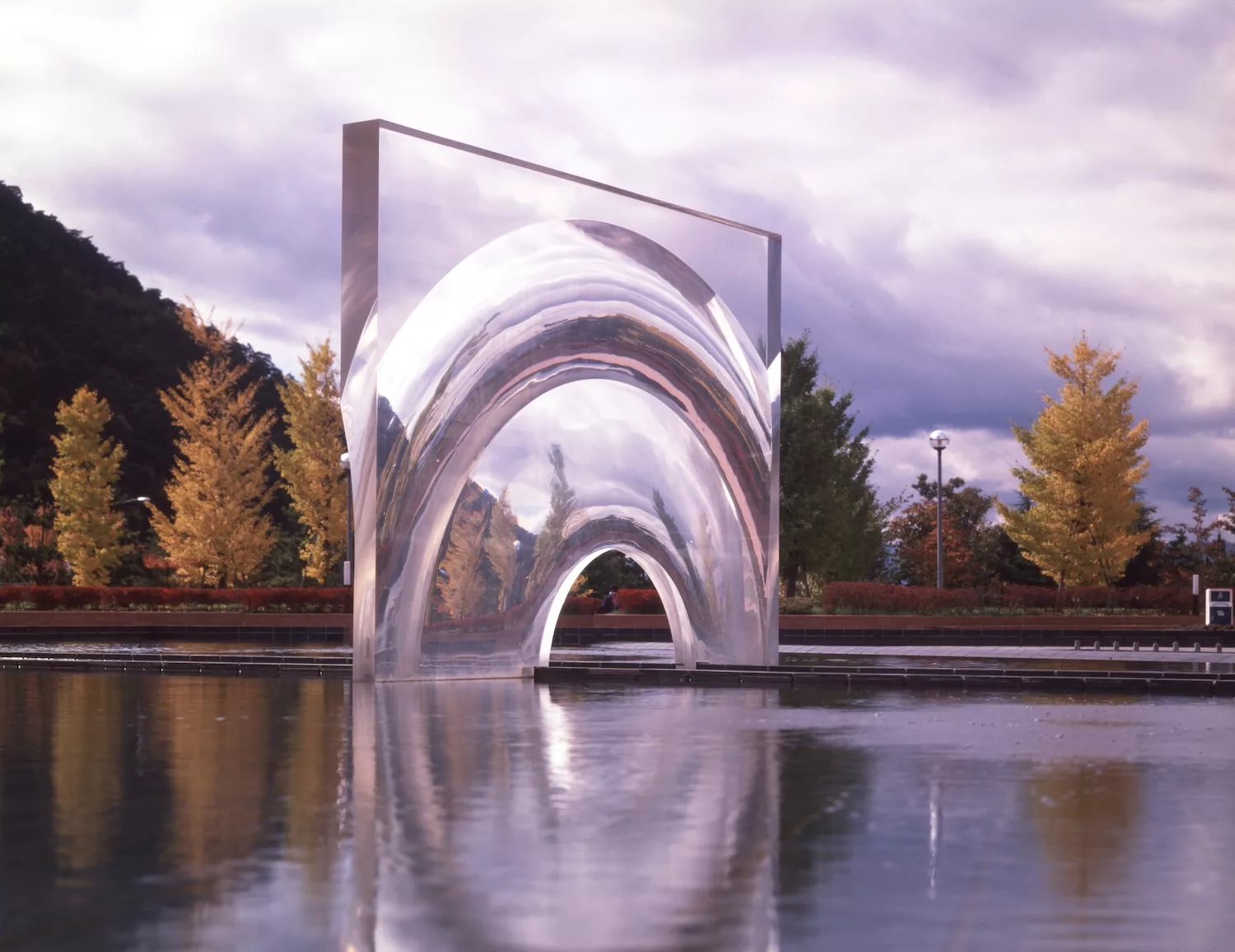
Minami Tada, Pole ’Y, 1978, Acrylic, H.200 x W.260 x D.16 cm, Yamagata Prefectural Government Building © Photo: Kuniharu Sakumoto
This symposium is co-organized by the Museum of Contemporary Art Tokyo (MOT) and AWARE: Archives of Women Artists, Research and Exhibitions, as part of the special programme accompanying the exhibition Tada Minami—Still, shimmering light. Minami Tada was a leading abstract artist in post-war Japan whose practice spanned sculpture, design and architecture. Many of her works, that incorporate industrial materials and fabrication technologies, can still be found in a wide range of urban and natural environments today.
Taking Tada’s practice as a point of departure, the symposium will examine the contributions of women artists to sculpture after World War II, highlighting the cross-disciplinary relationships between art, architecture, and design. Bringing together scholars and curators from Japan and overseas, it will explore post-war spatial practices related to gender issues from a variety of angles, focusing on materiality, abstract sculpture and public space.
Practical information
Saturday, November 7 and Sunday, November 8, 2026
Auditorium, Museum of Contemporary Art Tokyo
The event will take place in Japanese and in English
Free entry
Izumi Nakajima (Associate Professor, Graduate School of Humanities, Osaka University)
Abstract TBA
Izumi Nakajima is Associate Professor at the Graduate School of Humanities, Osaka University. Her research focuses on modern and contemporary art history and gender studies, with a particular interest in the relationship between art institutions, critical discourse, and gender in postwar Japanese art. She is the author of Anti-Action: Postwar Japanese Painting and Women Artists (Brücke, 2019; expanded paperback edition, Chikuma Shobo, 2025), which received the 42nd Suntory Prize for Social Sciences and Humanities.
Charlotte Matter (Art historian, Laurenz Assistant Professor of Contemporary Art at the University of Basel)
This talk will explore the use of industrial materials, and more specifically plastics, by women artists in the 1960s and 1970s, bringing Tada Minami’s practice into conversation with that of artists working in Europe, Argentina, and the United States. It will consider shared affinities as well as differences, focusing on questions such as the interest in light and transparency, the role of collaboration and the world of factories, and the use of industrial materials and processes to conceal traces of the artist’s hand. The talk will also examine the notion of durability in relation to the materiality of plastics. While their degradation poses a challenge for the conservation of artworks, their resilience more generally raises environmental concerns. Tada’s interest in durability, and the care and maintenance involved in preserving her works, will be considered alongside other women artists’ explicit engagements with plastics in relation to fragility, vulnerability, and decay.
Charlotte Matter is Laurenz Assistant Professor of Contemporary Art at the University of Basel, Switzerland, and a member of the governing committee of eikones – Center for the Theory and History of the Image. Her book, Feminist Substances: Plastics in Art of the 1960s and 1970s (Manchester University Press, 2026), examines the use of plastics from a feminist perspective, with case studies on Carla Accardi (Italy), Lea Lublin (Argentina/France) and Alina Szapocznikow (Poland/France). She is a co-editor of Sculpture Journal, and her writings have appeared in ASAP/journal, Critique d’art, kritische berichte, RACAR, Texte zur Kunst, and Third Text.
Annalisa Rimmaudo (Assistant Curator at the Contemporary Collections Department of the Musée national d’art moderne, Centre Georges Pompidou
My contribution will draw parallels between Tada Minami’s work and that of international artists who, faced with the same questions, have pursued their research toward very similar solutions. Her work, at the heart of the concerns of her time, resonates in Asia, Europe, and the United States alike. From her earliest paintings—which evoke Alberto Magnelli’s synthetic explorations of intersecting structures and planes—Tada Minami has employed a repertoire that is both geometric and organic. Beginning in the 1960s, these two worlds found a unique expression in Void and the Frequencies series. Void seems to be the « blossoming » of Lucio Fontana’s Concetti spaziali (1959–1960) and give a fixed form to Saburo Murakami’s Passage (1955). Through this gaping opening, Tada Minami directs the viewer’s gaze beyond two-dimensionality and toward larger dimensions. She also began incorporating new materials in her search for new forms. In the 1960s, much like Marisa Merz, she used raw, pliable aluminium foil to shape organic structures. Her exploration of organic and inorganic forms was intertwined with her experimentation with materials, her desire for transparency, and her creation of outdoor installations. An approach that is, incidentally, similar to that of another female artist, Carla Accardi. While aluminium and Plexiglas have primarily been used in abstract geometric sculpture—from the Bauhaus to Minimalism (from Naum Gabo to Donald Judd)—Tada Minami explores the reflective quality of the former and the transparency of the latter, evoking the futuristic explorations of Heinz Mack as well as the fluid spaces of Dan Graham. Her pursuit of transparency as applied to light installations draws on a section of art history, ranging from Otto Piene, Günther Uecker, Nanda Vigo and Chryssa to contemporary Jorge Pardo installations.
Annalisa Rimmaudo is assistant curator at the Contemporary Collections Department of the Musée national d’art moderne, Centre Georges Pompidou in Paris. In 2003, she earned her PhD in contemporary art history at the Panthéon-Sorbonne University, Paris I. She curated numerous exhibitions at the Centre Pompidou including “Annette Messager Christian Boltanski”, Malaga, 2026; “Enormement bizarre. Jean Chatelus Collection”, Paris, 2025; “Christian Boltanski Faire son temps”, Paris, 2019; Jim Dine at the Centre Pompidou, Paris and Malaga and at MaMM, Moscow, in 2018; “L’œil écoute”, Paris, 2017. She cocurated with Camille Morineau Elles@centrepompidou in 2009 and has collaborated on several exhibitions and catalogues with European institutions. She is also a member of the editorial board of Aware where she has published multiples articles notably « Minimal and Post-Minimal Sculpture Beyond the White Cube », 2024.
Nodoka Odawara (Artist and Critic)
“Publicness and Collaboration in Tada Minami’s Practice: Through Her Early Sculptures and Group Kaku”: This presentation focuses on Tada Minami’s work and activities during the 1960s, when, having received formal training in painting, she shifted the focus of her artistic practice to sculpture. It examines her bronze works Emptiness and Beginning (both 1960), as well as Group Kaku, a collective of women sculptors in which Tada participated. Through sculptor Kumasaka Taiko, a member of the group, Tada met art historian Wakakuwa Midori, who was then lodging at Kumasaka’s home. A conversation between Tada and Wakakuwa was later included in Wakakuwa’s book Josei Gaka Retsuden (Lives of Women Painters). In their conversation, they discussed Tada’s reasons for turning away from painting, the significance of “rejecting handwork that leaves fingerprints,” and the gender bias faced by women artists. How might these issues relate to Tada’s work and activities? Few artists produced as many large-scale sculptures as Tada did. Yet her work has not necessarily received adequate recognition within art history. By comparing Tada’s work with other examples of public and collaborative practices in sculpture from the same period, this presentation reconsiders the position and evaluation of her work within art history.
Nodoka Odawara is an artist and critic. PhD in Art Studies. Publisher and faculty member at Yokohama National University. Born in Miyagi Prefecture in 1985, Odawara lives in Kamakura, Kanagawa. Taking sculpture as a point of departure, her practice encompasses writing, art-making, and social activism. Through both theory and practice, she reexamines art history from the perspectives of gender, anti-imperialism, and the public sphere. Her major solo exhibitions include those at the Aomori Contemporary Art Centre [ACAC] and the Tsunagi Art Museum. Her principal monographs include Sculpting / Overcoming Modernity (Kodansha) and Toward a Theory of Monuments: Sculpture as a Critical Problem (Seidosha). She is a Visiting Researcher at the National Center for Art Research, Japan (NCAR) for FY2026.
Naoyuki Umemura (Curator, Sapporo Art Museum)
From the 1950s onward in Japan, architects increasingly commissioned artists to create works conceived as integral parts of architecture. It was in this context that Minami Tada’s Coal Mine (1957) was installed at the entrance to the building of the Japan Confederation of Coal Mine Workers’ Unions (Tanro Kaikan). Beginning with this work, Tada went on to undertake numerous architectural commissions throughout her career. This presentation will first examine the background to the growing popularity of collaboration between architects and artists, and then explore the distinctive characteristics of Tada’s architectural works through comparisons with works by sculptors active from the 1950s to the 1970s, including Takeo Yamauchi and Ryokichi Mukai.
Naoyuki Umemura, was born in Sapporo in 1987. Umemura graduated from the Hokkaido University and completed a master’s degree at the Hokkaido University before leaving the doctoral program prior to completion. While a graduate student, he studied at the University of Munich in Germany. He joined the Sapporo Art Museum as a curator in 2017 and was seconded to the Japan Foundation for Regional Art-Activities in 2021. In 2023, he became a curator at the Hongo Shin Memorial Museum of Sculpture, Sapporo, and returned to his current position in 2026. Exhibitions he has curated include Sapporo Art Exhibition: Bikky Sunazawa—Wind— (2019) and Takeo Yamauchi: 50 Years after His Death (2025). His major publications include Bikky Sunazawa: The Sculptor Who Carved the Wind, A History of German Castles: Pavilion of Infinity, and Takeo Yamauchi: Resonant Sculpture. His recent research focuses on collaboration between artists and architects from the perspective of artists.
Gabrielle Schaad (Art historian, Lecturer in Fine Arts, Zurich University of the Arts)
“Shifting Shadows, Concrete Interventions: The Architecture of Public Encounter”:
This paper examines how Shizuko Yoshikawa’s engagement with light and color developed through art in architecture. Trained in architecture and product design in Tokyo and visual communication at the Ulm School of Design before settling in Zurich in 1963, she developed site-specific reliefs in the early 1970s and subsequent color-shadow reliefs, whose appearance varies with daylight, chromatic reflection, and viewing position. I trace selected commissions, grounded in geometric abstraction, across settings of worship, education, civic architecture, and care. Concrete reliefs and a water-relief landscape in Zurich anchor this inquiry into use, material change, and preservation. The 1958 Swiss Exhibition for Women’s Work (SAFFA) provides an earlier, if ambivalent, context for considering women’s roles in shaping public space through art, architecture, and graphic design. I conclude with Shinjuku no Me (Eye of Shinjuku, 1969) by Yoshiko Miyashita, who later worked in Paris. Created for the Subaru Building and installed in an underground passage near the West Exit of Tokyo’s Shinjuku Station, the work extends the discussion to urban circulation and assembly. Together, these works show how art embedded in architecture both shapes public encounter and is transformed by the changing uses of its sites.
Gabrielle Schaad is an art and architectural historian and lecturer in Fine Arts at Zurich University of the Arts, where she leads the program Exhibiting and Making Public. Her research examines postwar to contemporary art and feminist spatial practices through materiality, environment, gender, and transnational entanglements. She earned her doctorate at ETH Zurich and was a MEXT Scholarship recipient at Saitama University (2013–2015). Her forthcoming book, Concrete and Code: Material Politics of Art and Environment in Postwar Japan, examines Gutai, Metabolism, and Expo ’70. She serves on the board of the Shizuko Yoshikawa and Josef Müller-Brockmann Foundation, Zurich.