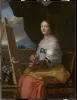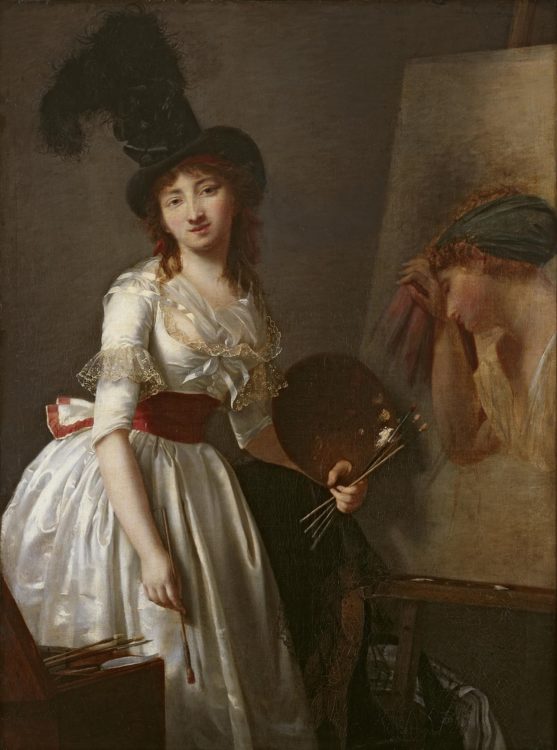
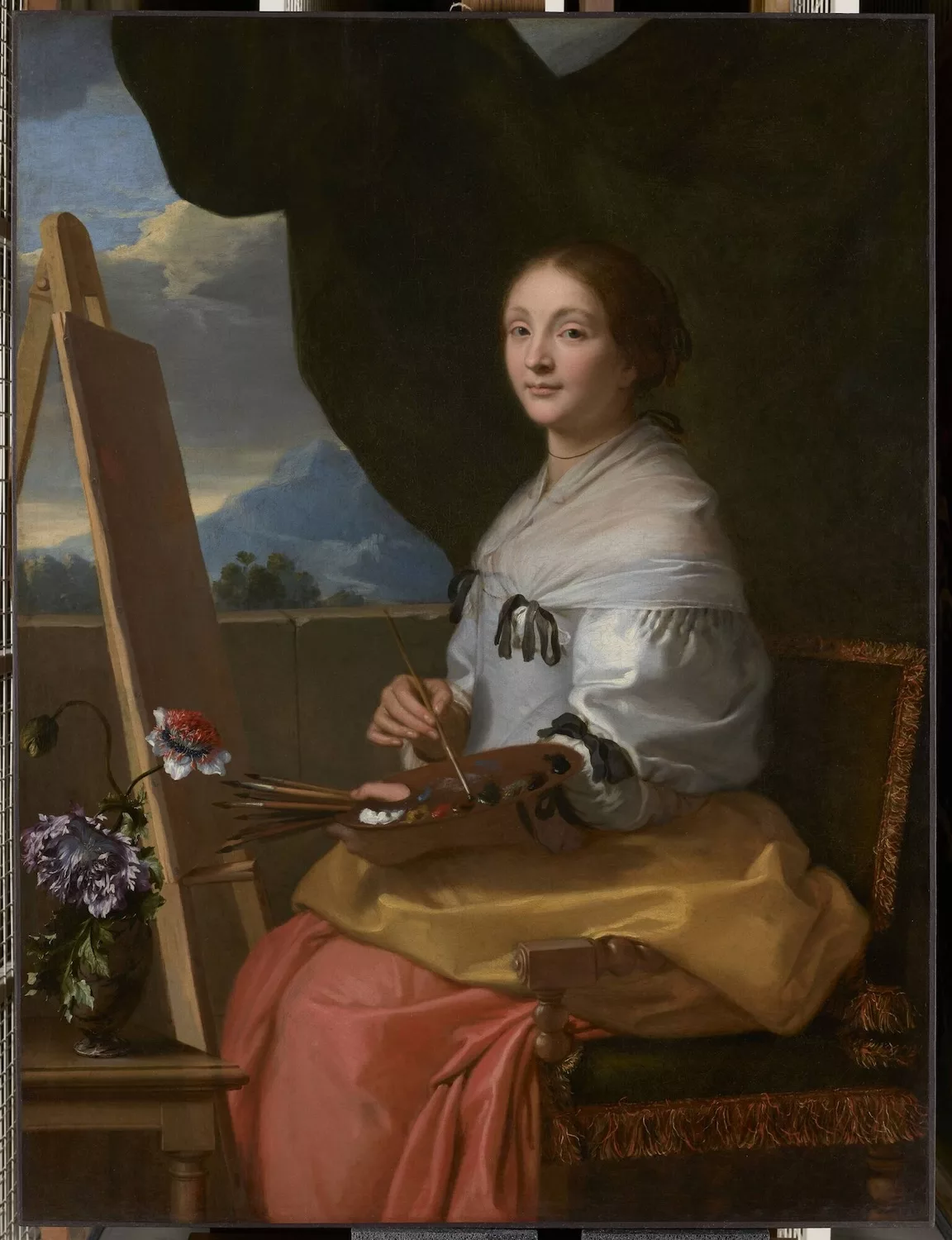
Charles Le Brun, maybe assisted by Catherine Duchemin, Portrait de Catherine Duchemin (1630-1698), peintre de fleurs, à son chevalet, c. 1663, oil on canvas, 130 × 96 cm, Versailles, musée national des châteaux de Versailles et de Trianon, © Château de Versailles, Dist. RMN / © Christophe Fouin
Vaysse, Élodie, « Catherine Duchemin, la première académicienne. Une artiste peintre du Grand Siècle », émission « L’envie de savoir », Canal Académie, 23 juin 2022
→Lely, Sandrine, « Catherine Duchemin », biographie in the Dictionnaire des Femmes de l’ancienne France, SIEFAR (Société Internationale pour l’étude des femmes de l’Ancien Régime), 2004
French painter.
Baptised in Paris on 12 November 1630, Catherine Duchemin was the daughter of well-established decorative painter Jacques Duchemin and his wife, Marie Hubault. Her earliest artistic education was no doubt with her father, after which she may have trained with Nicolas Baudesson (1611–1680), a Troyes-born specialist in the depiction of flowers. During her active years, she herself appears to have painted only floral compositions. As no hierarchy of genres had yet been established in France, still lifes were not regarded with contempt but, on the contrary, collected by particularly discerning connoisseurs. Other women artists, including Louise Moillon (c. 1609–c. 1696), some twenty years her senior, also chose this specialisation.
On 23 October 1657, shortly before her twenty-seventh birthday, C. Duchemin married François Girardon (1628–1715), a young sculptor who had just been accepted at the Académie Royale de Peinture et de Sculpture; she gave birth to four children over the following four years, and then to six more between 1664 and 1673. Between these two periods, on 14 April 1663, she became the first woman to join the Académie. Like the women who came after her, such as Madeleine de Boullogne (1646–1710) and her sister Geneviève de Boullogne (1645–1708) in 1669, and Élisabeth-Sophie Chéron (1648–1711) in 1672, her admission followed a different process from that reserved for men: she was not authorised to present her works in person but was instead enrolled directly, without undergoing the preliminary acceptance phase. Nor did she take part in any of the debates or teaching activities the institution organised. Although under the patronage of Charles Le Brun (1619–1690) – as was her husband – C. Duchemin gave the Académie a large-format painting recorded as depicting “a basket full of flowers on a pedestal”. This work has since been lost.
Likely due to frequent pregnancies and her husband’s successful career, C. Duchemin seems to have gradually slowed, if not halted, her work as a painter. Archives show that her works were kept at her home – six flower paintings were listed amongst her family’s possessions in 1716, including one depicting carnations – or placed with acquaintances; renowned writer Charles Perrault received a canvas in 1672 (all are now lost). No painting can be attributed to her with full certainty today. However, she appears to have painted the flowers in the portrait depicting her at her easel, which the 1716 inventory of family collections lists as the work of C. Le Brun. When the Château de Versailles acquired this painting in 2022, a scientific analysis showed that the flowers, vase and table had been painted after the easel and the figure’s gown, suggesting that another painter may have been involved.
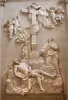
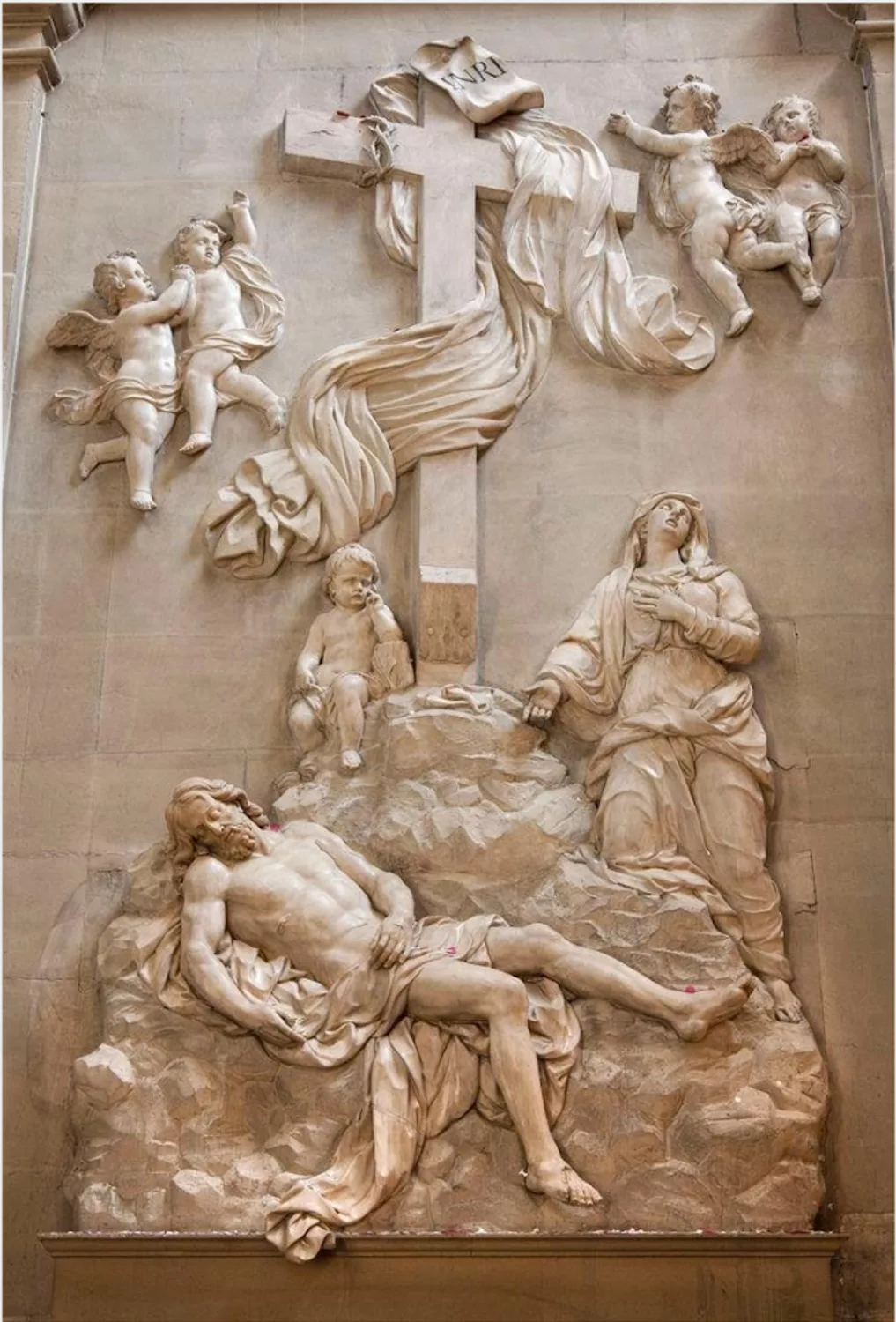
C. Duchemin died on 21 September 1698 in Paris, at the Louvre galleries, where she had settled with her husband twenty-two years earlier. She was laid to rest two days later in the Église Saint-Landry, where F. Girardon had a spectacular monument erected for them both; in 1817 it was moved to the Église Sainte-Marguerite in the city’s 11th arrondissement. In 1700 her first biographer, Florent Le Comte, wrote that she so “excelled at painting flowers” that “except for the sense of smell, [her paintings] deceived all the senses”.
A biography produced in partnership with the Louvre Museum.
© Archives of Women Artists, Research and Exhibitions, 2026