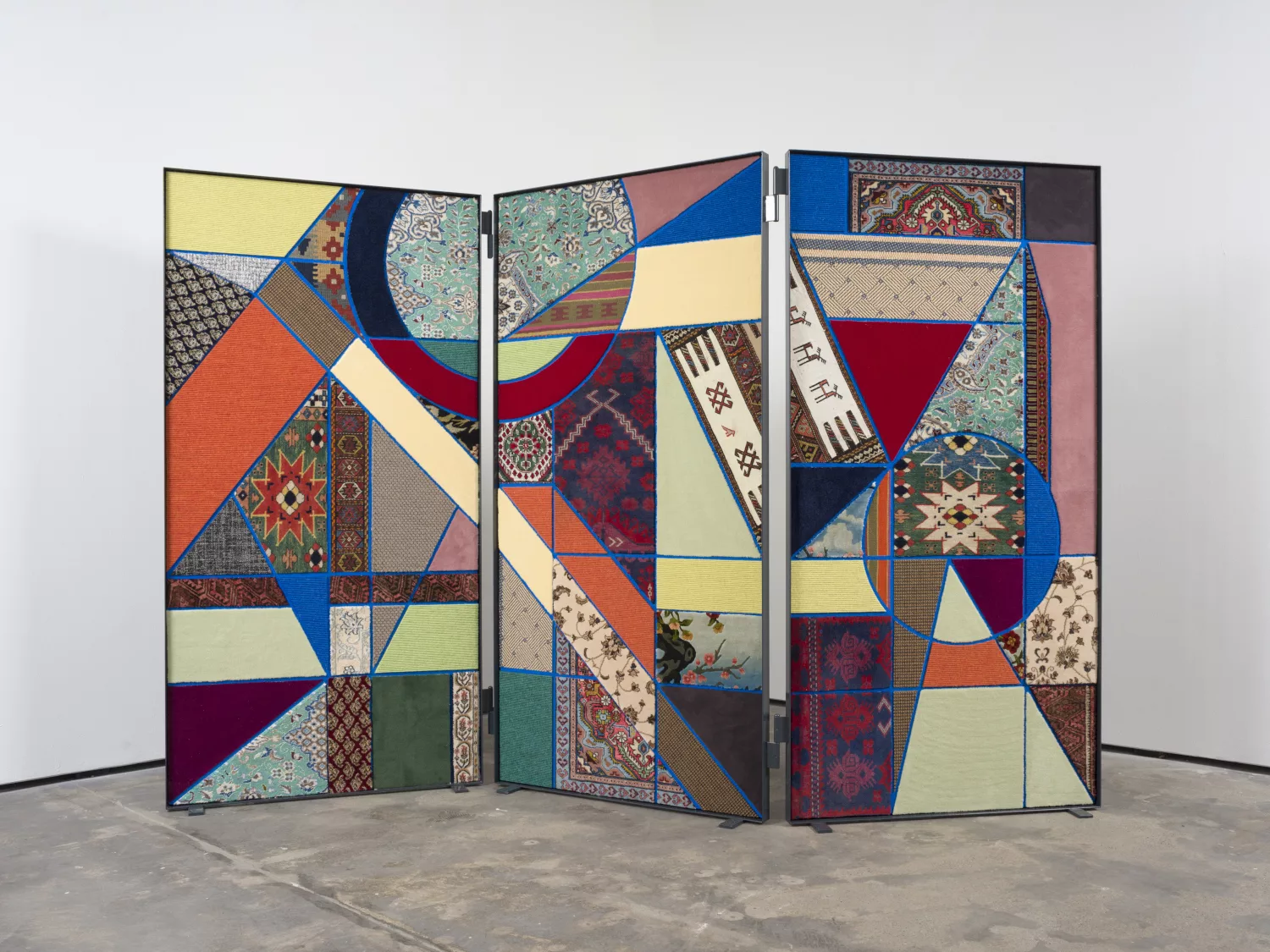
Nevin Aladağ, Paravent, Social Fabric #3, 2013, collage with carpets, 180 x 85 x 4 cm, photo by Trevor Good © Courtesy of Sheikh Zayed Bin Sultan Bin Khalifa Al Nahyan Collection (Abu Dhabi – UAE)
Contemporary art scenes are witnessing a decisive shift as textile objects and practices move from the periphery toward the centre, gaining increasing visibility and recognition. Discourses surrounding these works, however, often fail to encompass their diversity and multilayeredness. Similar to a contemporary perception of craft as “an inherently progressive and democratic political form,”1 textile is also frequently understood as a politically-charged medium, particularly regarding the histories of its gendered marginalisation.2 While this is a relevant and necessary approach, it often overshadows the material and sensorial specificities of the works, as well as the making process itself, which are all sites where aesthetic, political and affective aspects converge. This article examines the use of textiles by contemporary women artists in Turkey, highlighting the diversity of practices and fostering reflection on their integration into contemporary art.
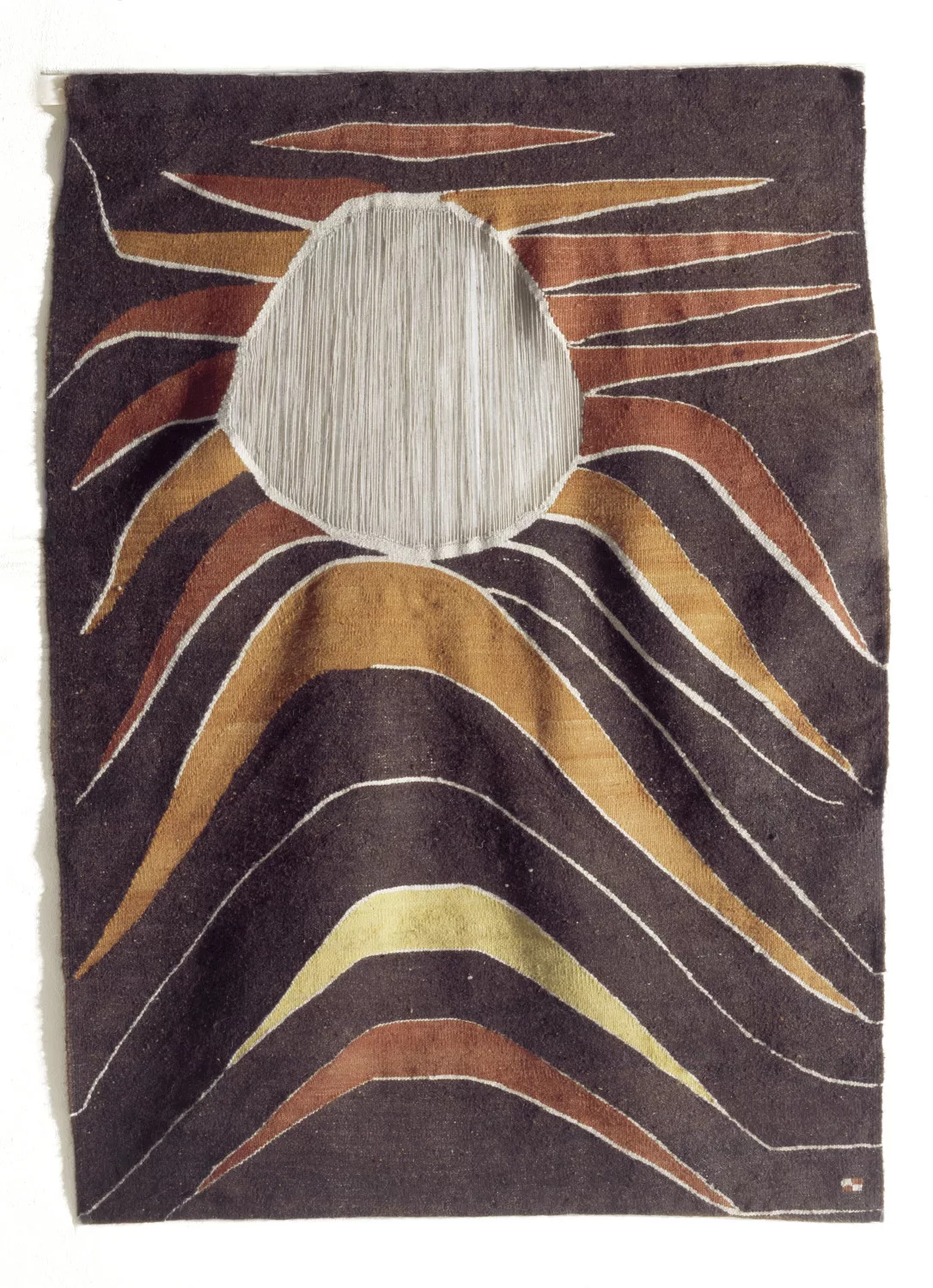
Belkıs Balpınar, Empty Sun, 1990, weaving, 120 x 170 cm © Courtesy of the artist and Anna Laudel Gallery
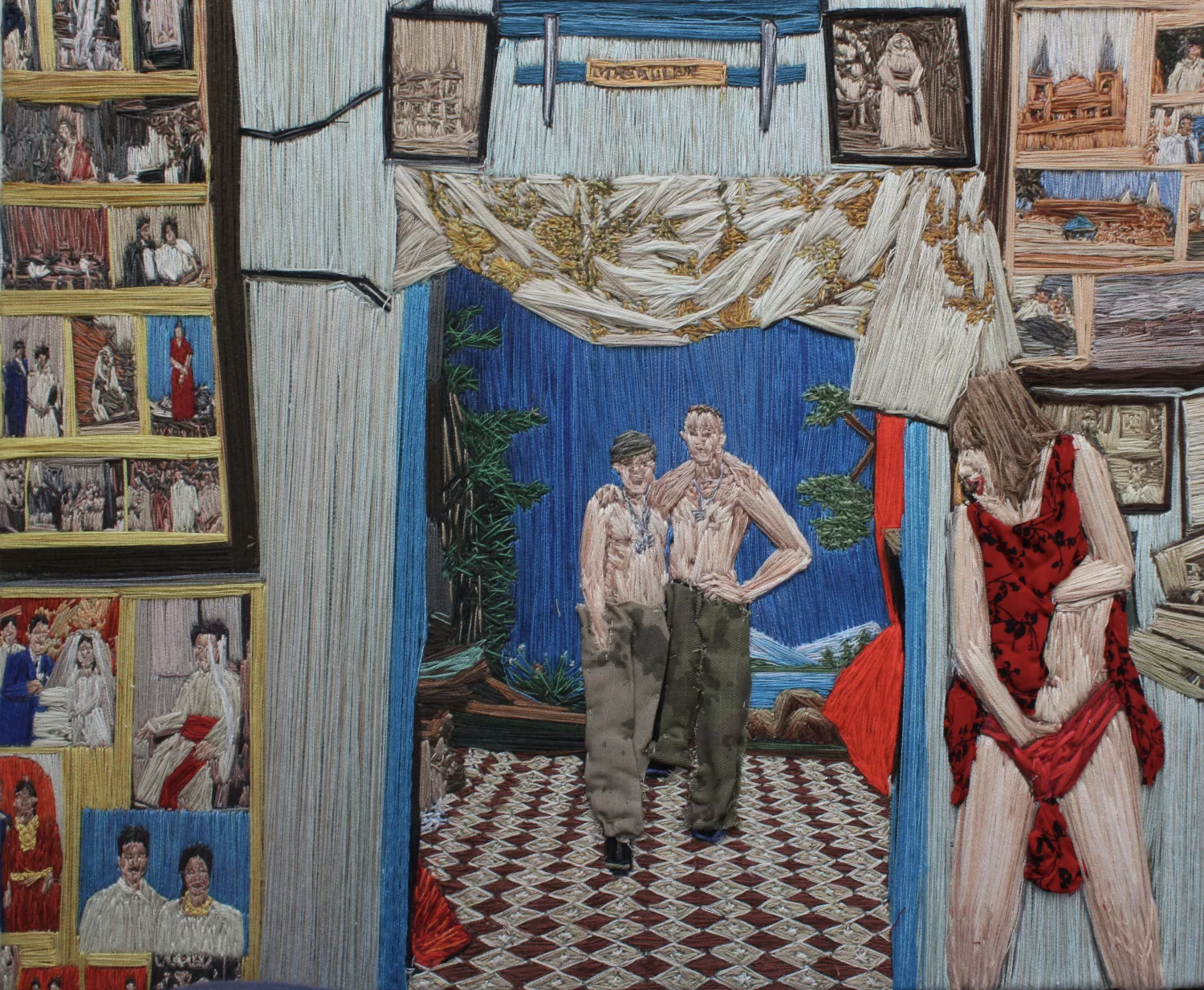
Pelda Aytaş, Invasion and Appetite, 2025, embroidery, 40 x 50 cm © Courtesy Pelda Ayta
In the early examples of contemporary textile art, from the 1980s, the artistic pursuit was not directly centered on textile as a material or technique itself. Rather, it functioned as a utilitarian material alongside other mediums, within broader contemporary artistic explorations seeking new expressions and forms. This primarily conceptually-driven approach has persisted in the context of contemporary textile art in Turkey to this day. From this perspective, textile often becomes part of artistic production not by adhering to traditional textile techniques, but by serving, for example, as a material to realise installations or as a surface upon which the desired visual narrative and forms are constructed. Belkıs Balpınar’s (1941–) practice, extending back to the 1980s and directly focused on weaving with geometric patterns, can be considered one of the rare exceptions to this trend. Pelda Aytaş (1992–), making almost exclusively small-scale figurative embroideries, offers another exceptional case where a traditional textile technique is positioned centrally to the work.
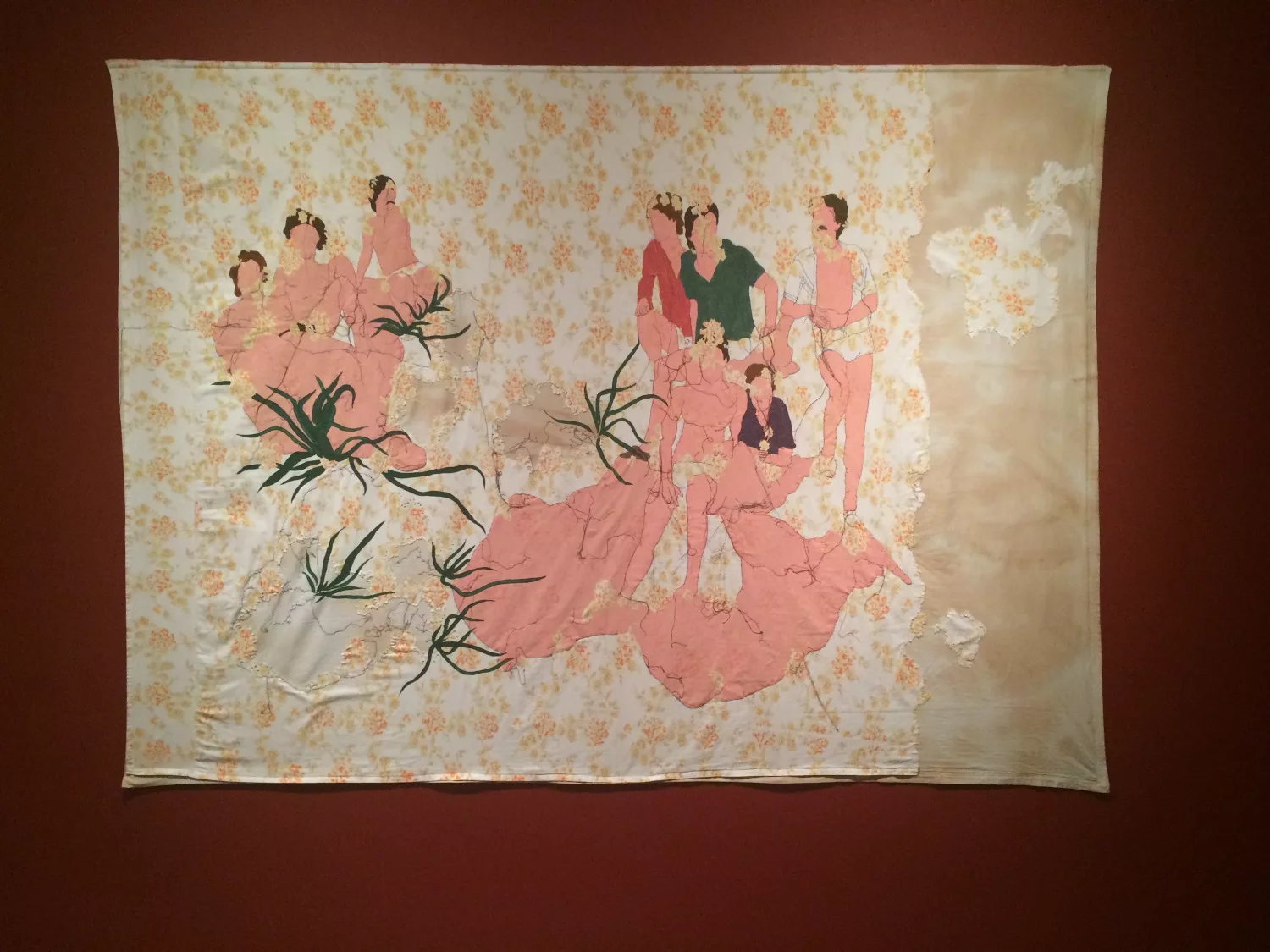
Gözde İlkin, The Sloping Land, from the series Inverted Home, 2017, embroidery and painting on duvet cover, 188 x 249 cm © Courtesy of IKSV, A Good Neighbor, 15th Istanbul Biennial, curated by Elmgreen and Dragset, presented with the support of SAHA – Supporting Contemporary Art from Turkey
The instrumentalisation of textiles to serve the conceptual occasionally derives from the possibilities afforded by material properties, as well as cultural, social and economic associations. Regardless of the specific motivations for choosing fabric, both artists’ explanations of their practices and writers’ interpretations of works tend to foreground the subject matter or conceptual background. Within this discursive framework, materiality and technique are rarely considered. This limits the opportunity to deepen potential discussions on these aspects, including relationships with meaning-making and conceptual elements. This situation is undoubtedly related to a distinctive characteristic that has become established in Turkey’s contemporary art over the last few decades: as sociocultural anthropologist Banu Karaca highlights, “The increasing domestic and international interest in contemporary art from Turkey […] has largely centered on explicitly political works” that are concerned with “the social and political predicaments of Turkey, both past and present”.3
At times, the fabric’s history is integrated into the work as an essential element. This is achieved by incorporating previously used personal or domestic textile objects. This process brings both the material and intangible memory embedded within the fabric into the work’s conceptual world. Gözde İlkin’s (1981–) practice is closely identified with this method. In her works, she intermingles the patterns, stains and textures of fabrics with the images she creates with them using paint and thread. Nancy Atakan (1946–), too, occasionally uses pre-owned or homemade fabrics, exploring the convergence of the visual and the textual.
Nevin Aladağ, Paravent, Social Fabric #3, 2013, collage with carpets, 180 x 85 x 4 cm, photo by Trevor Good © Courtesy of Sheikh Zayed Bin Sultan Bin Khalifa Al Nahyan Collection (Abu Dhabi – UAE)
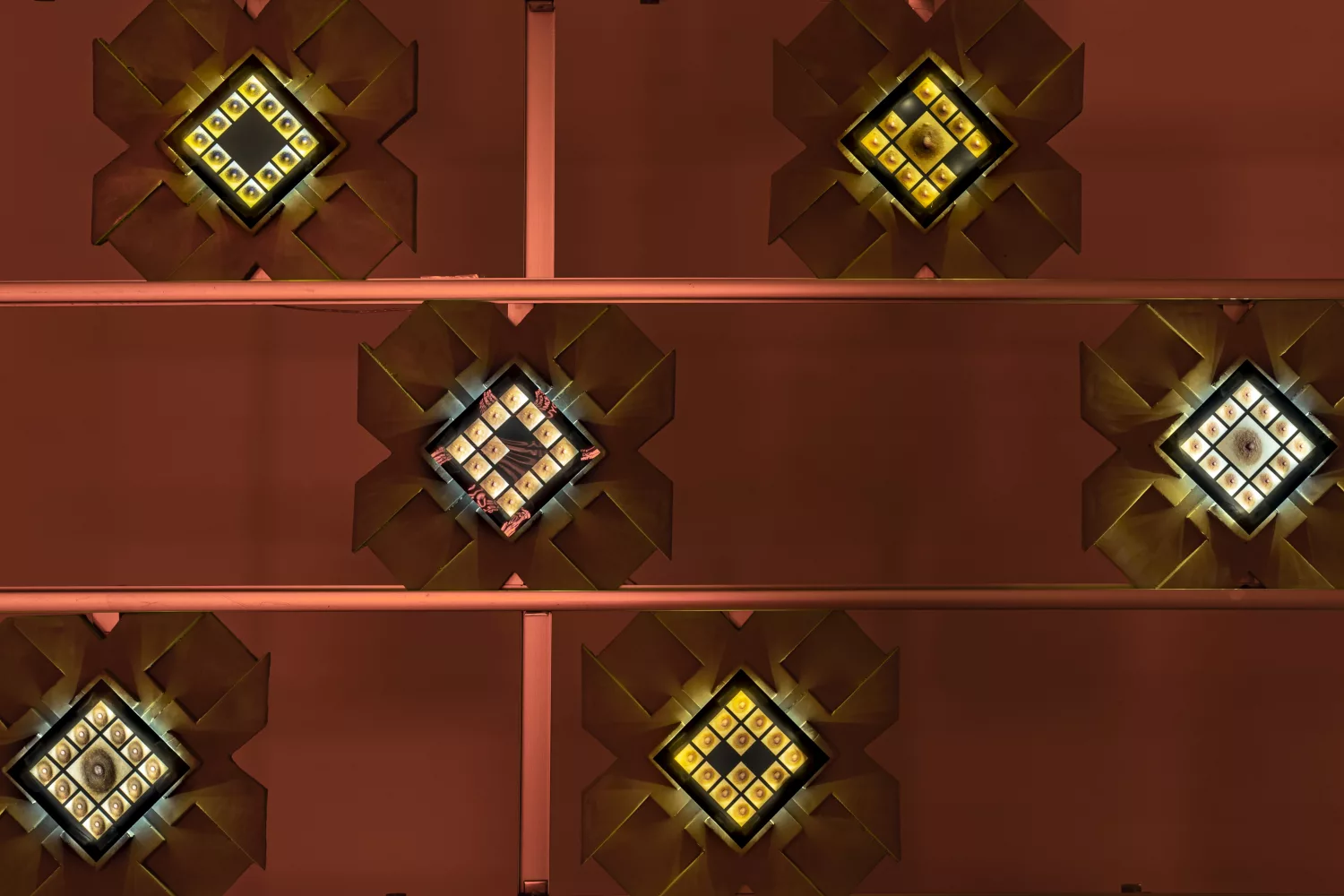
Eda Sütunç, Genderless Nipples, 2020, installation with concrete plaster, aluminium, LED Strip and Duratrans prints, 21 light boxes, 235 x 223 x 2 cm, photo: Zeynep Fırat © Courtesy of the artist and SANATORIUM
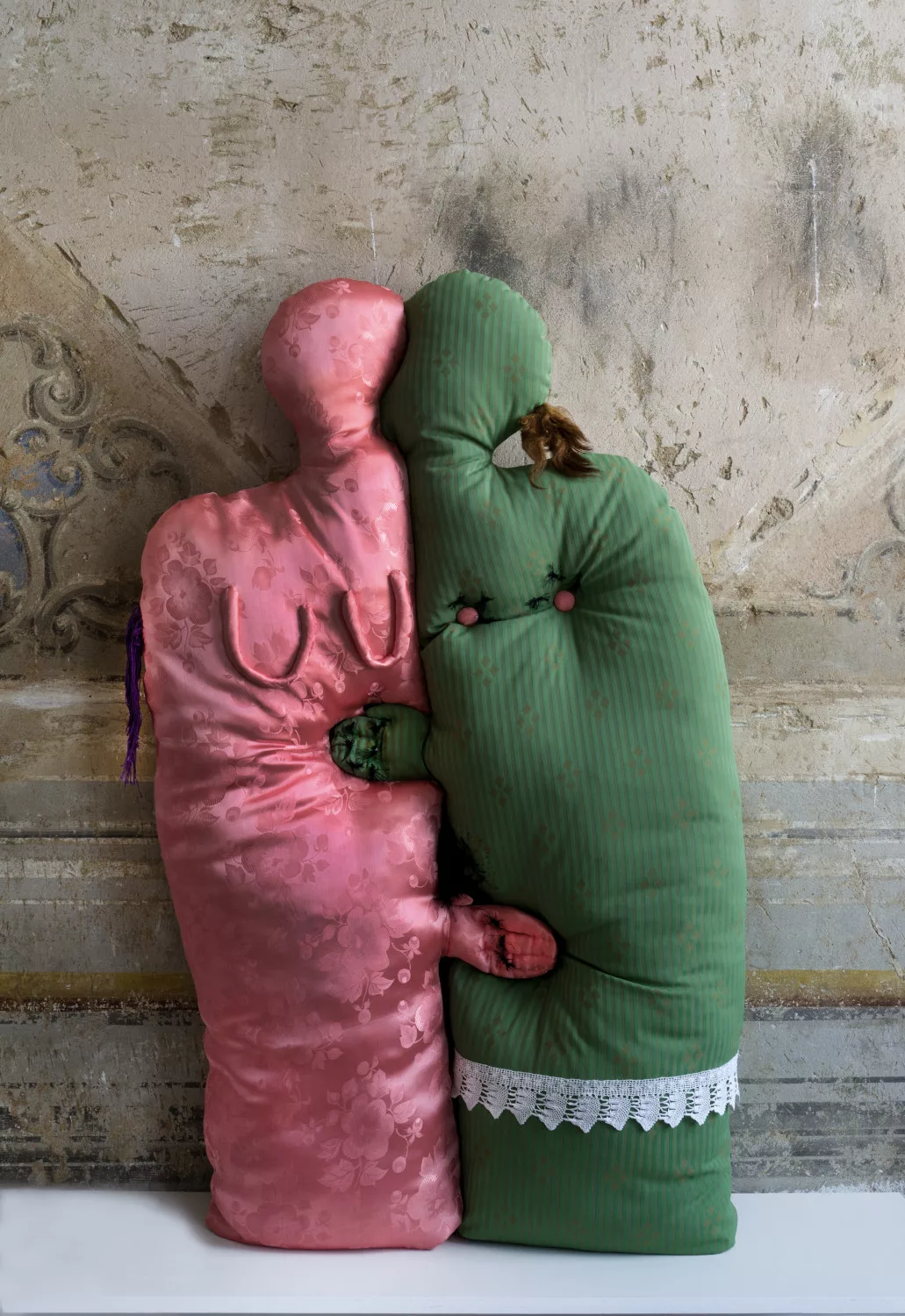
Nilbar Güreş, Underneath, 2019, fabric, 115 x 72 x 18 cm, photo: Reha Arcan © Courtesy of the artist and galerist
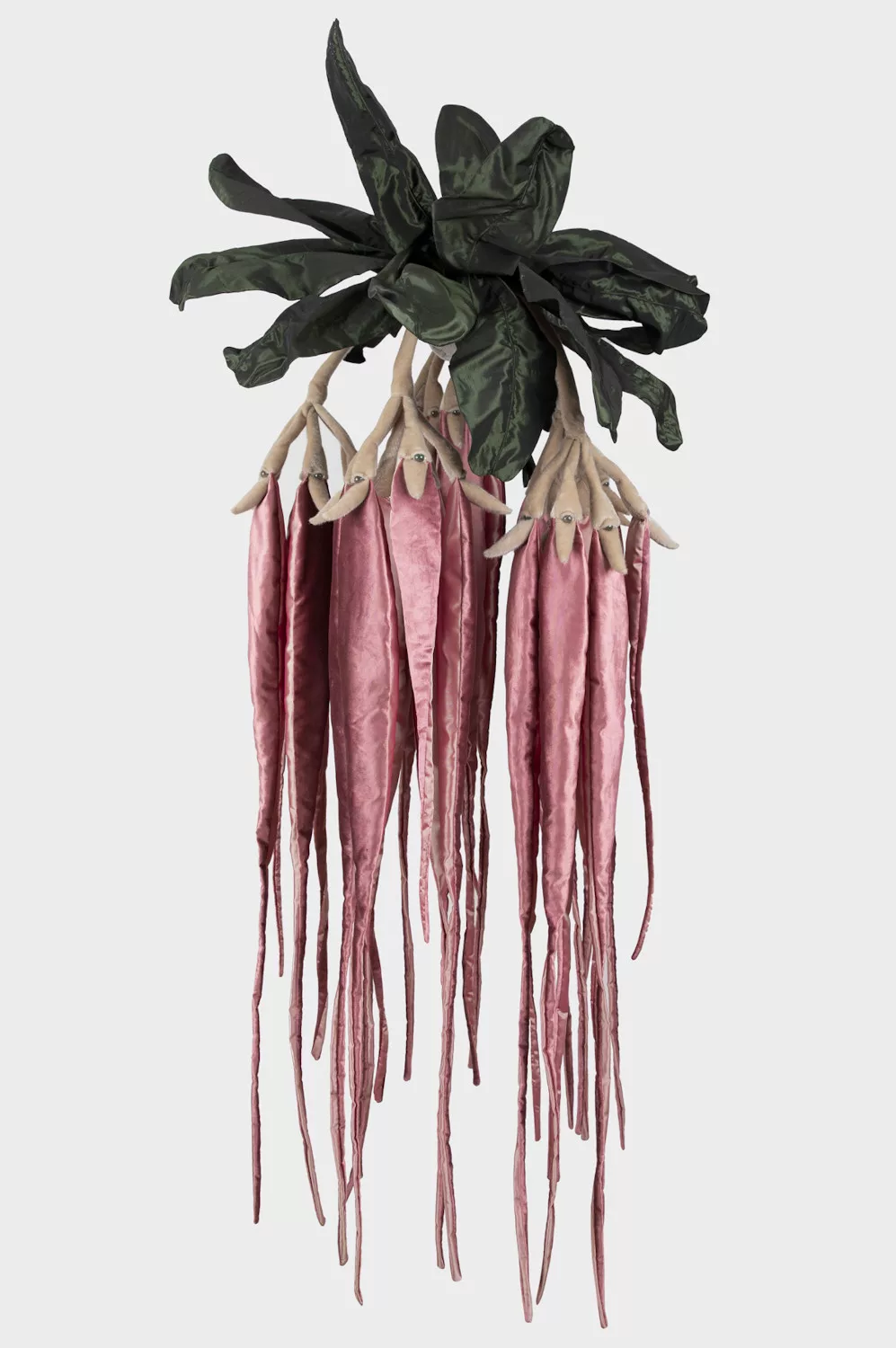
Şafak Şule Kemancı, Untitled, 2021, mixed media, 180 x 90 cm, photo: Nazlı Erdemirel © Courtesy Şafak Şule Kemancı
Sometimes, fabrics are chosen to evoke broader cultural and social associations, rather than singular histories. Neriman Polat (1968–), for example, creates works using materials already in circulation on the market, such as flannel and tulle, or children’s blankets. As part of material culture, these fabrics and objects are widely familiar across Turkey, and carry easily recognisable associations with gender and class. N. Polat’s works, such as Dress (2015) and Flower Wound (2019), or pieces from the 2018 exhibition Merciless4, can be considered within this context. One of her specific methods, which reflects forms of violence, involves deliberate distortion of fabrics through using bleach, cigarette burns, and cutting and scraping. Through these actions, N. Polat transforms textiles, converting the “painful ‘trace[s]’” of violence and “inconceivable” pain into images bearing the power to be inscribed into memory.5
Textiles also serve as defining elements of local cultures, which in turn often function as immediate national or ethnocultural representations. Carpets and rugs bear such symbolic significance for Turkey and the broader region; their traditional motifs circulate in contemporary art in Turkey, recontextualised through diverse themes. For example, such motifs appear in Nevin Aladağ’s (1972–) Paravent, Social Fabric (2012–2013), which collages fragments of carpets and kilims of different origins and production conditions. Gülay Semercioğlu’s (1968–) Kilim series reweaves them with shimmering, colorful wires. Eda Sütunç (b.1992) transfers kilim motifs to completely different mediums by using AI and digital technologies or baklava in her series entitled The Future Looms (2020), exploring themes about new mediums, gender and the human-machine dichotomy.
Specific types of textile-based objects – examples of which include flags, certain kinds of clothing, or curtains – also prove conceptually functional in contemporary art. Clothing, for instance, functions as a tool for addressing frameworks closely related to Turkish modernisation, notably the secular-religious or East-West dichotomies, which are closely linked to gender constructs. Some works use clothing as a core conceptual element, reproducing it in different media ranging from photography and video to painting. Some others make the clothing a central part of the work. Gülsün Karamustafa’s (1946–) Double Reality (1987) incorporates clothing in this way, standing as an early example of transgender imagery in Turkey’s contemporary art. More recent textile-based works by artists including Nilbar Güreş (1977–) and Şafak Şule Kemancı (1975–) connect queer imagery to themes such as sexuality, desire, and ecofeminism.
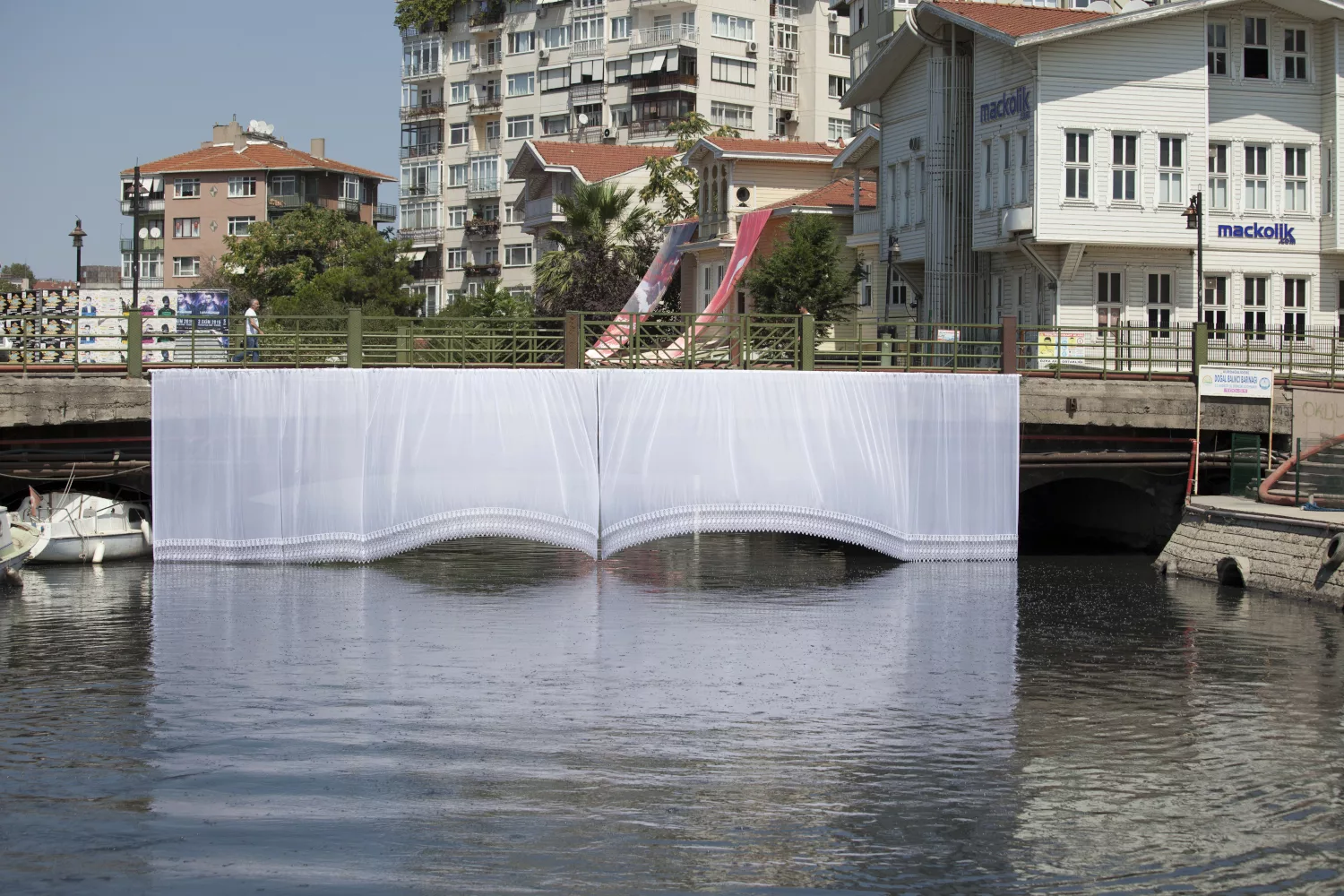
Özgül Arslan, Exposure, 2015, site-specific installation, tulle curtain, 16 m x 3 m, photo: Petek Arici © Courtesy of the artist
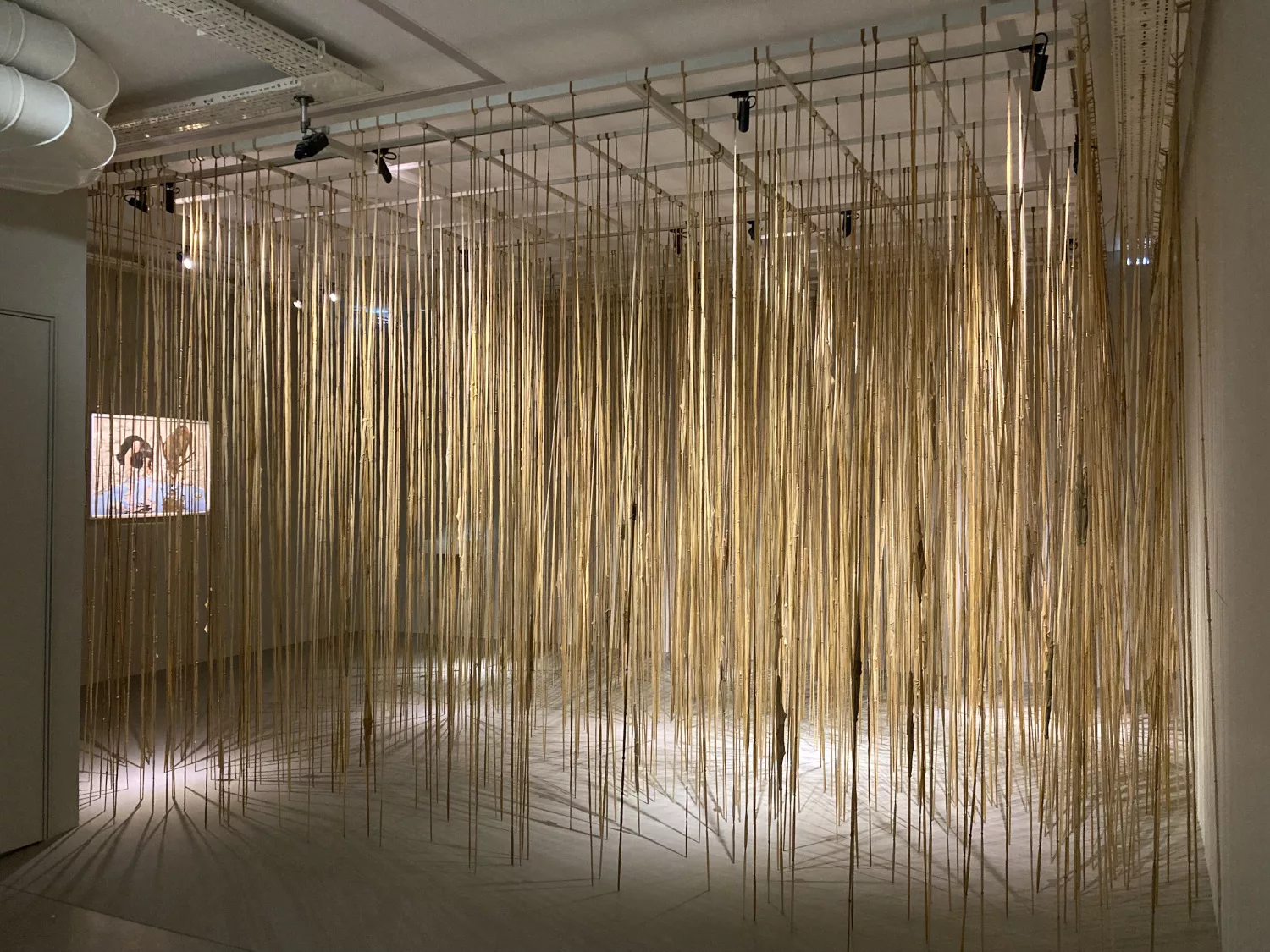
Defne Tesal, Interval, 2022, site-specific installation with tights, 300 x 500 x 600 cm, installation view from I Am Nobody. Are You Nobody Too?, Meşher, Istanbul, 2022, photo: Defne Tesal © Courtesy of the artist and galerist
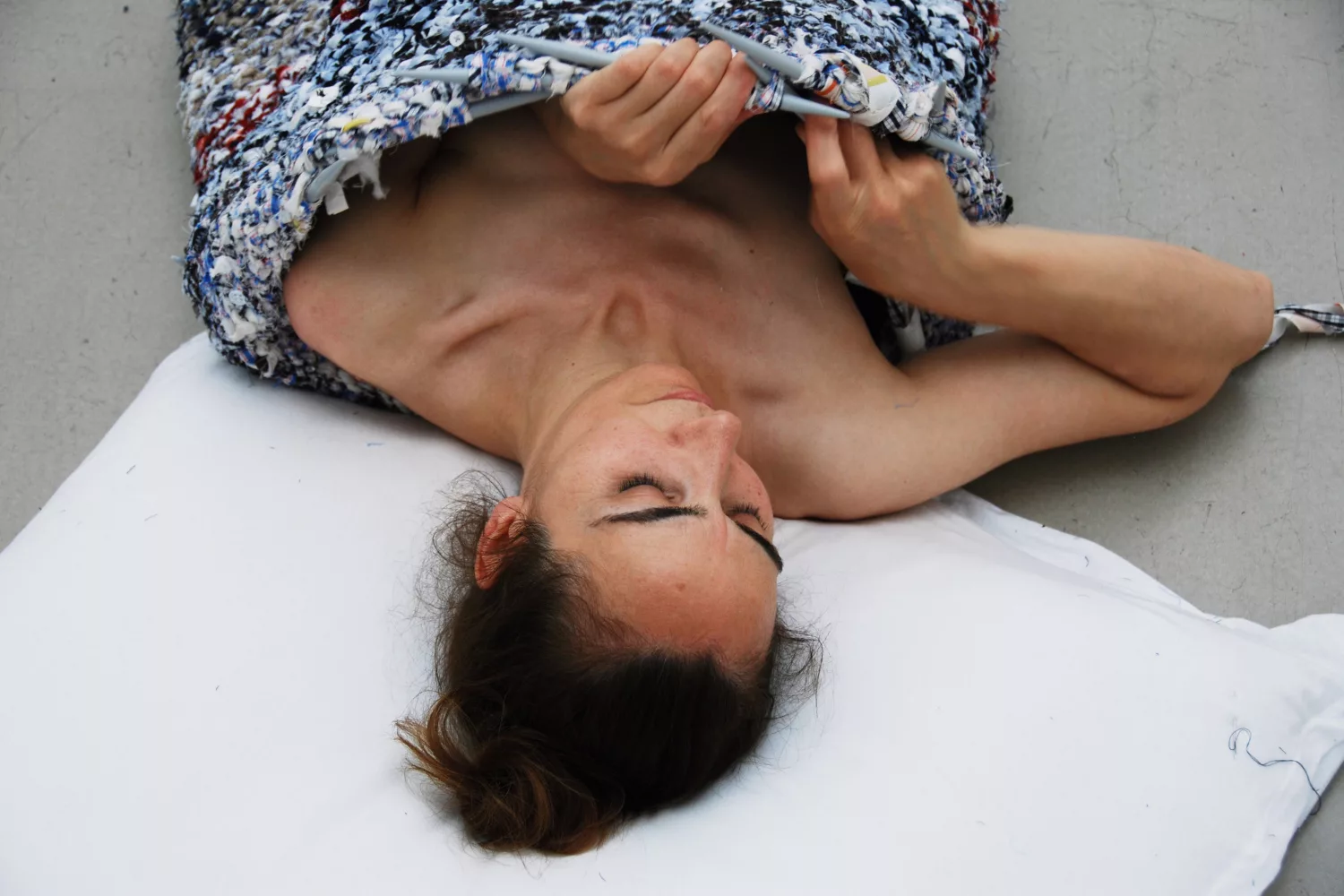
Mehtap Baydu, Cocoon, 2015, photograph from the performance at Documenta Halle, Kassel © Courtesy of Arter
The curtain, as both a kinetic and liminal object, offers a conceptually and formally rich material for a wide array of themes. It appears as a central element, for example, in Özgül Arslan’s (1974–) site-specific installation Exposure (2015), and it is revisited as an image and an object in the works of Gül Ilgaz (1962–). In such works, the textile object becomes part of strategies to foreground the distinctions and continuities between public and private spaces. Because of their association with domestic labour and objects, textiles often form a significant line of inquiry into the public-private divide and, specifically, how this separation is gendered. A feminist campaign mobilised by women artists in 2015 provides a compelling example of this gendered divide alongside the intersection of art and activism. To demand justice for Nevin Yıldırım, a woman on trial for killing the man who had repeatedly raped her,6 a group of artists reproduced N. Yıldırım’s portrait on bedsheets, along with slogans highlighting the hypocrisy of the justice system. They hung these sheets on balconies and windows, and unfurled them in a street protest.
Another critical relationship between textile-based works and spatiality is the use of fabrics’ material properties to create an atmosphere or sense of space within an exhibition venue. One example of this is to employ fabric to play with light and shadow, creating environments where the line between reality and the otherworldly is blurred – an approach evident in Füsun Onur’s (1938–) Elegy for Tekir (2009–2012) and in several works produced by CANAN (1970–) since the late 2010s. Another way to utilise fabrics’ material features in relation to spatiality is found in works that create a sense of space-within-a-space and invite the visitor to ‘enter’ an engagement through tactile contact. F. Onur’s Third Dimension in Painting – Come In (1981) and recent works of Defne Tesal (1985–) exemplify such multisensory spatialities.
Textile-based works are often presented in exhibitions as objects detached from their making process. This separation tends to obscure the links between the bodily act of making and meaning-making. Performances directly incorporating textile techniques, however, have the potential to draw attention to the making and the bodily dimension as key parts. Fatoş Irwen’s (1977–) Şiryan (2012–2015) and Mehtap Baydu’s (1972–) Cocoon (2015) are such works, where the body is involved as a multifaceted element: the body as both subject and actor in social relations, norms and power dynamics, as well as the body in motion – acting and making. Other artists foreground the making process as essential to the work by emphasising collectivity; these include Güneş Terkol (1981–), who conducts workshops to create textile banners with diverse groups of participants,7 and Ebru Kurbak (1977–), who mobilises participatory methods while bringing together technology and traditional textile techniques.
Derya Acuner is a researcher currently based in Italy. Inquiring into intersections of contemporary art, craft, and activism through feminist theories and methodologies, her primary research focus is the contemporary use of textiles and textile-based techniques. She earned her PhD from the IMT School for Advanced Studies Lucca in 2024, with a dissertation examining the politics and aesthetics of fabric-based practices in Turkey and their relationship to memory-making. Her current research and writing centre on themes of making, materialities, and human and non-human collectivities in artistic practices.